When Jackson Harlo dropped to his knees in the mud with a dead calf in his arms, he knew he had reached the kind of moment a man remembers long after the pain itself should have faded.
The calf was light in a way that made him sick. Not because it had always been small, but because death had emptied it so quickly. Its legs hung stiff against his coat. Its jaw had fallen slack. Jackson could still feel a little warmth under the hide, and somehow that made it worse.
Around him, Harlo Ranch looked like a place that had forgotten what life was supposed to feel like.
The Wyoming wind moved over the land in long, dry breaths, carrying dust through the corrals and across the yard. The grass in the western pasture had turned brittle weeks ago. The troughs smelled metallic and stale. Even the barn boards seemed to creak with fatigue. Beyond the fence, a few surviving cattle moved slowly across the field, their bodies narrowed by hunger, their heads low, their shadows thin and uncertain in the autumn light.
Then came his uncle’s voice.
“A man who can’t keep cattle alive doesn’t deserve the family name.”
Jackson did not need to look up to know Elias Harlo was enjoying himself.
Elias had always known how to arrive at the exact moment suffering became public. He stood there in a black coat too fine for ranch work, boots polished, gloves clean, his face arranged into that same expression he wore at funerals and debt collections—something between pity and appetite.
Jackson’s hands tightened around the calf.
He could have shouted. Could have told Elias to leave his land and never return. Could have thrown the dead animal at his feet and asked what sort of man came dressed like a banker to insult blood.
Instead, he kept his silence.
Because silence was the only thing he had left that didn’t look weak.
Old Pete Dunore stood near the split-rail fence, his weathered face hard with disgust. Pete had worked the Harlo land long before Jackson was old enough to ride. He had known Jackson’s father, Amos Harlo, when the ranch was little more than raw timber, stubborn cattle, and a dream built with bleeding hands.
“This isn’t pride, Elias,” Pete said. “Something’s wrong with the land.”
Elias turned on him. “Land doesn’t go bad on its own. A ranch dies when the man running it has no business owning it.”
The two remaining ranch hands, Cody and Frank, lowered their heads. It wasn’t agreement. It was survival. Everybody in Teton County knew Elias had been spending time with men from the bank. Everybody knew he had money tied up in land speculation. If Jackson failed, Elias would not mourn. He would buy what remained.
By evening, the humiliation had settled into the walls of the cabin like smoke.
Pete poured coffee at the kitchen table and watched Jackson stare at the account book, though neither of them needed numbers anymore to understand the truth. The herd was shrinking. Winter was coming. The bank had already sent its warning. And no veterinarian who had come through had given Jackson a reason to believe the next week would be better than the last.
“There’s a settlement near Snake River,” Pete said at last.
Jackson looked up, exhausted. “What kind of settlement?”
“Chinese families. Railroad workers, mostly. Some stayed after the tracks were laid. I’ve heard stories. They preserve food different. Treat animals different. Read things in land and water most men ignore.”
Jackson leaned back, bitter enough to laugh. “So now I’m meant to go begging strangers because every man around here has failed me?”
Pete’s stare sharpened. “You’re meant to save your ranch. However you have to.”
“My father wouldn’t have done this.”
At that, Pete hit the table with his palm.
“Your father would’ve swallowed every ounce of pride in his body if it kept this place standing.”
The words landed harder than Elias’s insults. Because Pete had loved his father. Because Pete would not lie about him. Because deep down Jackson feared the old man was right.
Still, pride did what pride always does. It disguised itself as patience.
Jackson waited.
He buried more cattle. Sold two good saddles he’d hoped to pass on one day. Stretched feed. Delayed wages. Reread the bank’s letter until the paper softened in his hands. Four months before foreclosure, it said. Four months to recover what felt impossible to recover.
Then, just before sunrise one cold morning, he found two dead longhorns by the northern creek.
Their bodies lay half-twisted near the bank, tongues swollen, eyes clouded. One had clawed furrows into the mud before dying. Jackson stood over them in the pale light and understood, with a clarity that felt almost peaceful, that he had run out of pride to spend.
He saddled his horse and rode for Snake River.
The settlement was quieter than he expected. Smoke rose from cook fires. Laundry moved in the breeze between rough-built structures. Men and women looked up when he rode in, measuring him with the caution of people who had spent years being watched without kindness.
He asked for anyone who knew livestock and was led to Wei Chong Fa.
Wei was older than Jackson expected and smaller too, but he carried himself with the stillness of a man who missed very little. Jackson explained the deaths, the drought, the bank, the uncle circling like a hawk. He left out none of it. Not even the humiliation. Especially not the humiliation. He had already learned that desperation, once admitted, often sounded less shameful than pretending.
Wei listened without interruption. When Jackson finished, Wei stood, went to the doorway, and called for his niece.
Min entered the room without lowering her eyes.
That was the first thing Jackson noticed.
The second was that she did not seem impressed by him in the slightest.
Her hair was tied back simply. Her face was calm, but not soft. Her gaze moved across Jackson’s coat, boots, and hands and settled on his expression as if that mattered most.
Wei explained her knowledge plainly. She had learned food preservation, medicinal herb use, and practical livestock care from workers, widows, and older women who had survived too many winters by knowing what not to miss. She had an eye for bad water, mold, and spoiled ground. She had learned English from pages salvaged wherever she could find them.
Jackson looked from uncle to niece—one quiet, one unreadable—and decided there was no point dressing need in polished language.
“I need help,” he said. “I can offer a home, legal protection through marriage, and half of whatever can be rebuilt. I won’t insult you by promising what I don’t feel. I cannot promise love.”
Wei said nothing.
Min did.
“If people on your ranch hate me, will you still listen when I tell you something you do not want to hear?”
Jackson held her gaze. “Yes.”
She studied him for a long moment, as if weighing whether he understood the cost of that answer.
Then she nodded.
“I will come.”
Harlo Ranch changed the moment Min arrived, though not because anything improved right away.
Suspicion got there first.
Cody and Frank became stiff and careful around her. Men in town muttered when they heard Jackson had brought a Chinese woman to live on the ranch. Some called him desperate. Some called him dishonorable. Elias, predictably, called him a fool.
Pete alone seemed openly relieved.
Min ignored all of it.
She unpacked ceramic jars sealed with wax, wrapped bundles of herbs, a ledger, and tools Jackson didn’t recognize. Then she asked to see everything.
Not just the sick cattle.
Everything.
She inspected the feed store, the smokehouse, the troughs, the tools used to clean them, the grazing routes, the creek banks, the fence lines, the patches of soil where grass had failed first. She looked into the mouths of weak animals and pressed their gums. She scraped residue from trough edges. She asked which cattle drank from which water source and whether the worst deaths clustered in any particular pasture.
No veterinarian had worked this way. They had diagnosed from symptoms. Min investigated like a person who assumed the symptom was only the last page of the story.
By sunset she had said very little, which made Jackson increasingly uneasy.
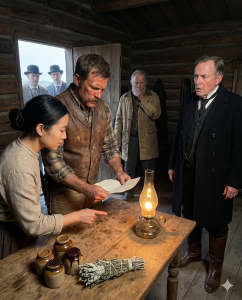
Finally, in the kitchen, with Pete, Cody, and Frank watching from the table, she placed a bit of green-streaked stone on a rag and spoke.
“The northern creek is making your cattle sick.”
Frank laughed uncertainly. “That creek’s been here longer than any of us.”
Min did not react. “So has poison, in many places.”
Jackson leaned forward. “How?”
She pointed to the residue. “Not natural growth. Not ordinary rot. I need more light tomorrow, but I believe something is washing into the water upstream.”
“From where?”
She looked at him steadily. “Who owns the land north of you?”
Jackson felt something cold move through his chest.
“My uncle.”
At that exact moment, the cabin door flew open.
Elias entered with two bank representatives behind him, both dressed in the smug neatness of men who made ruin sound official. Elias’s gaze landed on Min, then on the jars and herbs spread across the table, and his contempt flashed so openly it almost looked careless.
“So this is what we’ve come to,” he said. “You’ll lose the ranch with a foreign woman under your roof and call it management.”
Jackson stood. “Get out.”
Instead, Elias removed folded papers from his coat and tossed them onto the table.
“Sign the transfer now. Spare everyone the drama.”
Pete rose halfway from his chair, but Min had already taken the papers.
Elias’s expression changed the instant she began reading.
It was small. Tight around the mouth. Sharp around the eyes.
Jackson saw it.
Min read in silence long enough to make the room uncomfortable. Then she looked up.
“This does not give you four months,” she said.
Jackson crossed to her side. “What are you talking about?”
She pointed to a clause buried in the legal language. “The debt can be called immediately if asset value was intentionally damaged through negligent stewardship. This filing says the loss of your herd resulted from your own failure.”
Jackson stared. “The letter said four months.”
“It said that,” Min replied. “This says something else.”
Pete swore under his breath.
Min kept reading. Then her finger stopped again.
“There is also a statement attached to the inspection notes. It refers to runoff contamination and assigns responsibility to this property.” She lifted her eyes to Elias. “But the source described here is upstream.”
The room stilled.
Upstream from Harlo Ranch was Elias’s land.
Elias smiled, but it came too fast. “You think because you can sound out legal words, you understand them?”
Min folded the paper with deliberate care. “I understand when a lie is written before the truth is discovered.”
Jackson turned slowly toward his uncle. “What did you do?”
“Watch yourself,” Elias snapped.
But Jackson was already moving. He grabbed a lantern and headed for the door. Pete followed with a shovel. Min came behind them, her face unreadable in the dark.
They reached the northern creek within minutes.
In lantern light, the bank showed more than daylight had. Near a bend in the water, Min knelt and scraped away wet mud with a stick. Beneath it lay a dark, oily substance that gave off a bitter smell. Pete muttered a curse. Then Jackson’s lantern beam caught on broken wood half-hidden in reeds.
He dragged it free.
Part of a barrel.
Burned into the splintered side were two letters.
E.H.
Elias Harlo.
Footsteps sounded behind them.
Elias had followed after all, with the bank men hanging back now like men who suddenly regretted being present.
“You start making wild accusations,” Elias said, “and you’ll bury yourself.”
Jackson rose with mud on his hands and murder in his eyes.
But Min stepped forward first.
“At dawn,” she said to the bank men, not to Elias, “this barrel, this creek, and those papers should be before a judge. Unless the bank wishes to explain why foreclosure language was prepared around contamination before any honest investigation took place.”
One of the bankers went pale. The other opened his mouth and then shut it again.
For the first time that evening, Elias looked less certain than angry.
“You know nothing,” he said.
Min turned to him fully. “I know you did not come tonight to collect debt. You came to make sure he signed before anyone traced the sickness to your land.”
Then a horse came pounding up the road from town, hard and fast.
The rider was Sheriff Nolan Briggs.
He swung down before the horse had fully stopped, breath steaming in the cold.
“Jackson,” he said, looking from the barrel to Elias to the bank men. “You’d better hear this before anybody lies another word.”
No one spoke.
The sheriff held up a folded message. “Telegraph came from Cheyenne. State survey men were already investigating illegal dumping along the creek network after stock losses on two smaller properties south of here. One of the names flagged in the inquiry was Elias Harlo.”
The words hit the night like gunfire.
Elias lunged, snatching for the paper, but Pete stepped in his way. For an old man, Pete moved with impressive speed. Sheriff Briggs caught Elias by the arm and shoved him back.
“This gets better,” the sheriff said grimly. “Bank records came with it. Your debt wasn’t just being monitored, Jackson. Someone petitioned to buy it early through a proxy account tied to Elias.”
The bank men turned on Elias at once, their loyalty evaporating under the weight of official attention.
Jackson felt every bitter week of the past months gather into one scorching truth. The dead cattle. The pressure. The urgent papers. The staged concern. Elias had not merely been waiting for failure.
He had been building it.
“You poisoned my herd,” Jackson said.
Elias’s face twisted. “I preserved this family’s future.”
“You tried to steal it.”
“It was already yours to lose!” Elias shouted. “Your father left this ranch to a sentimental fool. I only did what should’ve been done before you ruined the name.”
That was the confession.
Not neat. Not complete. But enough.
Sheriff Briggs took him then, despite Elias’s struggles and the stream of threats pouring from his mouth. The bank men offered no help. One would later claim he suspected nothing. The other would insist the paperwork had been routine. The judge would not be impressed.
What followed was messy and public, exactly the way family betrayal usually becomes.
State investigators confirmed contamination in the creek from runoff connected to waste improperly buried on Elias’s land. Whether he had intended to sicken the herd or only to cut corners until it caused damage no longer mattered much. He had also pushed the bank with false claims of mismanagement, positioning himself to acquire Harlo Ranch once foreclosure hit. The bank, eager and careless, had cooperated more than prudence should have allowed.
There were hearings. There were statements. There were men in town who suddenly remembered warning signs they had ignored.
Jackson spent those weeks fighting for the ranch in daylight and working to save it before dawn and after dark.
And Min became the center of that survival.
She ordered the northern creek fenced off at once. She had fresh water hauled from a southern spring until they could dig a safer well. She sorted the herd, separating the strongest from the weakest, and mixed careful treatments that settled some stomachs and failed others. She adjusted feed, changed grazing patterns, salvaged what meat they could preserve, and stopped losses from spreading further than they already had.
She was not magical.
That was what impressed Jackson most.
She did not promise miracles. She promised work, attention, and the refusal to miss what other people dismissed.
Slowly, the dying stopped.
Not all at once. Not cleanly. But enough to let hope back onto the property.
Winter arrived, harsh and honest. Harlo Ranch met it wounded but standing.
By spring, Jackson had won more than a legal fight. The court blocked the fraudulent foreclosure effort, froze Elias’s claims, and forced a reckoning with the bank’s conduct. Compensation did not erase the dead animals or the months of fear, but it gave Jackson room to breathe. More importantly, the land itself began to answer.
With safer water and managed grazing, sections of pasture recovered. Calves survived. Buyers returned cautiously, then more confidently when they saw the herd improving.
And Min, who had arrived under whispers and suspicion, became impossible to dismiss.
At first, town opinion shifted only in private. Men who had mocked Jackson now asked careful questions about water storage and spoilage. Ranch wives came to speak to Min about preserving food and treating fever. A blacksmith’s wife brought fabric as thanks after Min helped save a milk cow. Even Cody and Frank, embarrassed by their early doubt, began watching her work with open admiration.
One evening, months after the sheriff’s ride, Jackson found Min near the repaired fence line at sunset.
The light turned the pasture bronze. Wind moved through new grass where the worst patch had once seemed dead beyond saving.
“You were right,” he said.
She didn’t look at him. “About which part?”
“That the truth would frighten the right man.”
That made her glance his way. “And were you one of them?”
He thought about that. “At first.”
She nodded, as if she appreciated honesty more than flattery.
Jackson hesitated, then said what had been growing in him for longer than he wanted to admit. “When I asked for your help, I offered you a home and a bargain. Nothing more.”
“Yes.”
“I was wrong about what I had to offer.”
Min grew very still.
The wind moved between them.
“I do not say things lightly,” Jackson continued. “I don’t know when respect became trust, and when trust became something I waited for each morning. But somewhere in all of this, the ranch stopped being the only thing I was afraid to lose.”
She looked at him for a long time, and this time her calm did not feel like distance. It felt like caution earned honestly.
“At the settlement,” she said, “I thought you were a desperate man asking for rescue.”
“I was.”
“You were also a man willing to be taught in front of people who wanted him humiliated.” Her gaze softened, almost imperceptibly. “That is rarer.”
He let out a breath that might have been the first peaceful one in months. “Is that enough?”
“For today,” she said.
It was not a grand declaration. It was better.
Because it was real.
They married first out of necessity, then stayed for reasons necessity could never have created on its own. In time, affection became companionship, and companionship became the kind of love neither of them had trusted enough to name early.
Years later, people still told the story wrong in town.
Some said Jackson had been saved by luck. Others said Elias had gone mad with greed. A few insisted the ranch would have recovered eventually on its own.
But the people who knew better remembered the truth.
Harlo Ranch survived because one man finally laid down his pride long enough to ask for help, and one woman saw what everyone else had either missed or ignored.
The poison in the creek was real.
So was the poison in a family that thought inheritance mattered more than decency.
And when folks argued afterward about the biggest shock in the whole ugly affair, it was never really the fraud, or the bank papers, or even Elias’s confession.
It was that the person everyone in town had been most ready to dismiss turned out to be the only one who saw the danger clearly from the start.
Maybe that was the part that lingered because it forced people to face more than one question at once.
Who had actually saved the ranch?
Who had nearly destroyed it?
And how many disasters begin not with strangers, but with the people who think your name already belongs to them?