When Elena Morales arrived at the ranch, she was hungry enough to feel embarrassed by it.
Not the kind of hunger that comes and goes between meals, but the heavy, hollow kind that makes every smell feel cruel. Broth. Coffee. Warm tortillas. Even damp earth after sunset. Everything around her seemed rich with life while she stood at the gate clutching two black garbage bags that held the remains of her own.
The ranch sat in the fading light like something out of another lifetime. The adobe walls were whitewashed but weathered, the porch shaded, the bougainvillea thick and bright against the front of the house. There was a chicken coop to the side, a low corral beyond it, and farther back, fields stretching under the orange evening sky. An old cow with a patient face grazed near the fence, lifting her head only once to stare at Elena as if judging whether she belonged there.
On the porch sat Don Aurelio.
He looked like a man carved out of the same land he worked—sun-worn, quiet, unmoving until movement mattered. His hat shaded his face, but not enough to hide the caution in his eyes as Elena approached.
“I’m looking for work,” she said, forcing the words out before shame could swallow them. “I can clean, cook, wash. I can learn whatever I don’t know. I don’t want charity. I just need a chance.”
He studied her for a moment, then turned his head and called toward the house.
“Mercedes.”
A woman emerged almost immediately, wiping her hands on a flour-dusted apron. Doña Mercedes had the steady presence of someone who had spent her life surviving disappointment without allowing it to harden her. She took one look at Elena’s shoes, then at the bags, then at her face.
That was all.
Instead of questioning her, Mercedes said, “Come in before it gets cold.”
Elena almost didn’t move. Kindness had become suspicious to her. But then the smell from inside the house reached her—chicken broth, fresh tortillas, onions softening in oil—and her body made the decision her pride could not.
At the table, she ate too fast at first, then slowed down out of embarrassment. Mercedes pretended not to notice. Aurelio watched quietly. Neither asked her where she came from until she had finished every drop in the bowl.
Only then did Mercedes say, “You can sleep in the back room tonight.”
Elena stared at her. “I can work for it.”
“You will,” Aurelio said. “Tomorrow.”
That was how it began.
Three weeks earlier, Elena had still had a room in Guadalajara. It was small, humid, and barely fit a bed and a plastic chair, but it was hers. She spent her days at a laundry shop ironing men’s shirts until her wrists burned. She left before dawn and returned long after the rush of the city had thickened into grime and fatigue. It was not a life anyone would envy, but it was stable enough to be survived.
Then she got sick.
A fever kept her in bed for days. When she returned to work, her pay was short. She argued once, quietly, and was told to be grateful she still had a job. Rent piled up. She skipped meals. Sold what little she could. Asked for help and got pity from some, irritation from others, and money from no one.
The afternoon she returned to find her belongings thrown onto the sidewalk, she knew before she even reached the door what had happened.
The landlord had changed the lock.
“You owe me two months,” he called from inside without opening.
“Please,” Elena said, pressing both palms to the door. “My papers are still inside.”
Silence.
She knocked until her hands hurt. No one came. At sunset the neighbors stopped pretending not to watch. At dark she gathered what had been left outside—clothes, a photograph of her mother, a cracked brush, two sweaters, a few kitchen things she could no longer use—and walked.
That first night she slept on a bench outside a bus terminal. Every passing footstep jolted her awake. Every engine sounded like danger. She hugged the bags to her chest and kept her eyes open until dawn painted the pavement gray.
At the laundry shop the next morning, she asked her boss for an advance, a loan, even one night sleeping in the storage room.
The woman sighed, looked at Elena’s wrinkled shirt and swollen eyes, and said, “If you can’t show up clean, rested, and on time, maybe this isn’t the job for you.”
Elena stood there for several seconds, waiting for the sentence to change into something human.
It never did.
So she left the city with no plan except motion. One coworker had once mentioned that ranches in Los Altos sometimes gave room and board in exchange for labor. Elena didn’t know whether it was true or just one more story people tell the desperate to make them keep moving. But walking away from Guadalajara felt less frightening than staying still inside it.
At Don Aurelio’s ranch, truth turned out to be simpler than hope had allowed.
He needed help. Mercedes needed help more than she admitted. The work was hard, but real. The first morning Elena rose before dawn and followed Aurelio through the yard as he explained everything in his dry, patient voice. Chickens first. Then the pigs. Then the old cow, La Prieta, who “has better sense than most people, so don’t insult her by shouting.” Elena nodded as though this were perfectly ordinary instruction.
By noon her hands burned from unfamiliar work. By evening her back felt split in two. But that night, lying on a clean cot with a blanket over her, she felt safer than she had in months.
Days settled into rhythm.
She learned the sounds of the ranch: the hens before sunrise, the metal bucket against the well, the scrape of Mercedes’s chair on the kitchen floor, the soft snort La Prieta made before accepting food from anyone she trusted. She learned that Mercedes hummed when she kneaded dough and that Aurelio sometimes stood at the far fence looking out across the road as if waiting for a figure too distant to name.
There was one place, though, that did not fit into the rhythm.
At the far edge of the property stood a small house, set apart from the rest. Even neglected, it was beautiful. The porch railings had been carved with care. The windows were framed by decorative woodwork. A narrow garden border traced the front path, though the flowers were long dead. Boards had been nailed over the windows from the inside. A rusted padlock sealed the door.
No one approached it.
The first week, Elena told herself it was none of her business. The second week, she realized people actively avoided looking at it. The third week, while shelling corn with Mercedes under the shade, she finally asked.
Mercedes didn’t answer immediately. She picked a thread from her apron first, then sighed.
“It was Mateo’s.”
Their only son.
He had left for Monterrey fifteen years earlier. At first it had been temporary, just work, just a chance, just a few months. Then months became years. Calls became fewer. Promises became vaguer. Mateo never said he wasn’t coming back. He just never came back.
“Aurelio locked the house after he left,” Mercedes said. “He swore he wouldn’t move anything until our son walked through that door again.”
She looked toward the little house with a grief so practiced it had almost become invisible.
“But shut-up houses get sick.”
A few days later, Aurelio placed an old key on the kitchen table.
“If you want to clean it, do it,” he said. “Don’t change anything. Don’t throw anything away. Just let it breathe again.”
Elena took the key with both hands.
Inside, the air was stale with old wood, dust, and time. The furniture was covered but intact. A pair of boots sat by the bed as if their owner might return by evening. On a shelf she found books warped by heat. On the wall hung a photograph of a younger Aurelio and Mercedes beside a smiling young man Elena knew must be Mateo.
She cleaned carefully, not like a worker rushing through a task, but like someone handling another family’s heartbeat. She opened windows. Beat dust from curtains. Carried a rug outside. Wiped down a table. Beneath the bed she found a box filled with letters.
The envelopes were stacked with twine, some opened, some not. Elena never unfolded one. She set the box neatly on the table and continued sweeping.
When Aurelio stepped into the cleaned house that evening, he stopped in the doorway. The light came in through the now-open windows and landed across the room in warm bands. Dust no longer floated thickly in the air. The place looked lived in by memory rather than buried by it.
He walked to the table, touched the box of letters, and sat down.
Elena backed away to give him privacy.
That night, for the first time, she heard Don Aurelio cry.
Mercedes sat beside him without speaking. Her hand rested over his wrist as though she had done that many times through many things.
The next morning, trouble arrived wearing expensive boots and impatience.
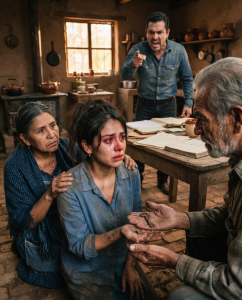
Arturo’s black pickup tore into the yard so fast that gravel spit from the tires. He slammed the door and marched to the house carrying a folder of papers. Elena knew who he was before she was told. The family resemblance to Mercedes was slight, but the entitlement announced him better than blood ever could.
He didn’t greet anyone.
“So it’s true,” he said from the doorway. “You let some stranger into Mateo’s house.”
Aurelio looked up from the table. “Good morning to you too.”
Arturo ignored him. His gaze locked on Elena. “I told you this would happen. People show up here with sad faces and empty hands, and suddenly they’re inside places that aren’t theirs.”
Mercedes stood. “Watch your mouth.”
“I’m saying what no one else will.”
Elena felt herself shrink inward, though she hated that she did. She had done nothing wrong. But accusations have a way of waking old humiliations. She was suddenly back on the sidewalk outside her room, back at the laundry shop, back in every place where poverty had turned her into something people felt entitled to insult.
“When Mateo hears about this,” Arturo said, “he’ll put an end to it.”
Aurelio rose slowly from his chair. “You’ve spoken enough.”
But Arturo had not come to fight about Elena. That much became clear a second later, when his eyes flicked toward the back of the property.
“That house isn’t valuable because it’s pretty,” he said. “It’s valuable because of what’s hidden under it.”
The room fell silent.
Mercedes’s face drained of color.
Aurelio’s expression hardened in a way Elena had not yet seen. Not grief. Not patience. Anger sharpened by recognition.
“What are you talking about?” Elena asked, unable to stop herself.
Arturo gave a humorless laugh. “Ask them.”
No one did.
Instead, Aurelio crossed the room, went to a drawer, pulled out the old rusted key, and placed it in Elena’s hand.
“From now on,” he said, every word deliberate, “you’ll sleep in Mateo’s house.”
Elena stared at him. “No, I—”
“Yes,” Mercedes said softly, though her eyes were fixed on Arturo. “You will.”
Arturo barked out a laugh. “You’re giving her the best house on the property?”
Aurelio stepped closer until the two men were nearly face to face.
“She came asking for work,” he said. “She gave us respect, labor, and honesty. You came counting what you think you’ll inherit.”
Arturo’s mouth tightened. He slapped the folder of papers onto the table.
“You don’t understand what you’re doing.”
But perhaps Aurelio understood perfectly. Perhaps that was what frightened Arturo most.
That evening Elena carried her bags to the little house. Mercedes helped her make the bed with fresh linens. Aurelio checked the locks twice. Neither said much, but both moved with a tension Elena could feel in the air like distant lightning.
Before leaving, Mercedes touched Elena’s cheek.
“If you hear anything, wake us.”
“Anything?”
Mercedes hesitated. “Anything.”
Elena did not sleep well. Every creak sounded like a footstep. Every gust sounded like whispering against the boards. Near midnight she heard movement outside the porch. Then again before dawn. She sat in darkness, gripping the old key so tightly it left a mark in her palm.
At first light she opened the door.
Mud marked the porch. A clay flowerpot by the entrance had been knocked to one side. The garden soil beneath it looked newly disturbed. Elena crouched and stared. The dirt had not been shifted by rain or wind. Someone had dug there with urgency and then stopped.
Heart pounding, she carried the pot aside and scanned the doorway, the wall, the floorboards just inside.
That was when she noticed one plank near the back wall sat slightly higher than the others.
She called for Aurelio.
By the time he and Mercedes arrived, Elena was kneeling on the floor with a kitchen knife, working the blade carefully into the seam. The plank lifted with a dry groan.
Beneath it lay a wrapped bundle.
Inside was a property deed, old but official, bearing stamps and signatures. With it were several letters tied together with string, a faded photograph of Mateo standing beside a young woman holding a small child, and a second key taped beneath the folded deed.
Mercedes sank onto a chair.
Aurelio picked up the photograph with trembling fingers. “He never told us,” he whispered.
“Told you what?” Elena asked.
Before either could answer, the sound of an engine ripped through the morning.
Arturo.
This time he wasn’t alone.
Another truck pulled in behind him, and from it stepped a man in a pressed shirt carrying a leather briefcase, followed by two others Elena didn’t recognize. One wore the expression of someone who preferred not to be involved. The other looked far too interested.
Arturo strode onto the porch with the confidence of a man who believed he had timed his move well.
“You found it,” he said, seeing their faces before he saw the open floor.
Aurelio moved to block the doorway. “Get off my property.”
Arturo’s gaze shifted to the deed in Aurelio’s hand, and satisfaction flashed across his face. “That’s not entirely your property anymore.”
The man with the briefcase stepped forward and cleared his throat. “I’m here regarding transfer documents and a pending claim.”
Mercedes stood so abruptly her chair scraped hard across the floor. “Claim by whom?”
Arturo smiled, and Elena hated the ease of it.
“By Mateo.”
The name landed like a blow.
Aurelio did not move. “Mateo is not here.”
“No,” Arturo said. “Because Mateo is dead.”
Mercedes made a sound Elena would remember long after the words themselves had blurred—a sound too broken to be called a cry.
Aurelio’s hand tightened around the deed. “You lie.”
Arturo’s smile faded. “I’m not lying. He died eight months ago in Monterrey. The notice never reached you because he hadn’t updated his address and the paperwork got stuck. But before he died, he signed documents naming his legal heirs.”
Mercedes shook her head violently. “No.”
Arturo looked toward the photograph on the table, then back at them. “That woman in the picture? Her name was Lucía. They were never married, but the child was his. Mateo had a daughter.”
The room spun around Elena though the news wasn’t hers.
Aurelio stared at the photograph like a man seeing both miracle and cruelty at once. “A daughter?”
Arturo nodded once. “And because Mateo’s house sits over the parcel your brother separated years ago but never properly recorded, the corrected deed changes ownership of that section of land. Which means the house, the well behind it, and the road access now belong to Mateo’s line.”
He paused, letting it settle.
“And since I’m the legal representative sent to manage the transfer until the child’s guardian appears, I came to make sure nothing was tampered with.”
It was such a clean speech that Elena understood instantly he had rehearsed it.
She also understood something else.
“You knew,” she said.
Everyone looked at her.
Arturo’s eyes narrowed. “What?”
“You knew the deed was hidden here. You knew about the letters. You knew Mateo was dead before today. And you waited.”
A flicker crossed his face—small, but there.
Elena stood up slowly. “You didn’t come here because you were protecting the family. You came because you wanted to get to the deed before Don Aurelio did.”
The man with the briefcase shifted uneasily.
Arturo scoffed. “Careful. Poor women with imagination become dangerous.”
But Elena was no longer afraid of him.
She turned to Aurelio and handed him the bundle of letters. “Read them.”
One by one, in a silence so heavy even Arturo didn’t interrupt, Aurelio opened the letters his son had left hidden under the floor.
The first explained why Mateo had stayed away. Shame. Debt. Pride. The kind of mistakes a son keeps from parents until too many years have passed. The second spoke of Lucía. The third spoke of a little girl named Renata who loved drawing cows despite having never seen one in real life.
The last letter was addressed not to his parents, but to anyone who found the deed.
If Arturo is the one who brings these papers, don’t trust him.
Mercedes covered her mouth.
Aurelio kept reading, voice roughening with every line. Mateo wrote that Arturo had offered to “help” him handle legal paperwork after he learned the land parcel beneath the little house had separate value because of a planned road expansion nearby. Mateo said he realized too late that Arturo was trying to pressure him into signing away control for almost nothing. Frightened, sick, and unsure whom to trust, he hid the corrected deed, the birth acknowledgment for Renata, and the second key to a safety box containing official copies in town.
Then he wrote the line that changed everything.
If my parents are alive when this is found, the house and parcel are theirs to use until my daughter is old enough to choose for herself. Arturo is to receive nothing.
Arturo lunged forward. “That proves nothing—”
But the man with the briefcase snatched the letter from Aurelio’s hand and scanned the page. “Actually,” he said quietly, “it proves quite a lot.”
“What?”
“There’s a witness signature here. And if the safety box contains notarized copies, your authority may be very limited.”
Arturo’s face went white, then red.
Aurelio lifted the second key. “Then we’ll open it.”
By noon they were in town.
The safety box held exactly what Mateo had described: certified copies, Renata’s documents, and one more sealed statement detailing Arturo’s attempts to manipulate the transfer. It was enough. Not enough to erase the pain, not enough to return a lost son, but enough to stop the theft hiding behind family language and legal tricks.
Within a week, Lucía arrived at the ranch with Renata.
The little girl was nine years old, solemn at first, clutching a backpack to her chest. She had Mateo’s eyes. Mercedes saw them and began crying before a single word was spoken. Lucía, tired and guarded, admitted she had nearly refused to come. Arturo had contacted her first and made everything sound confusing, hostile, and already decided. Only when a real attorney reached her with copies of Mateo’s letters had she believed she and her daughter were being called, not cornered.
The meeting was awkward, tender, and full of absences no one could repair. Aurelio knelt in front of Renata and asked if she wanted to see the cow her father would have laughed about. Renata nodded once.
La Prieta accepted the child immediately.
It was Mercedes who laughed then, through tears. “Well,” she said, “that settles who belongs here.”
Lucía stayed for several days. Then several more. The little house, once sealed by grief, began filling with life again—shoes by the door, a cup left by the sink, colored pencils on the table. Elena watched it happen with a feeling she didn’t know how to name. Not envy. Not sadness. Something quieter. Relief, perhaps. Proof that locked places could open without breaking.
Arturo did not return to the ranch after the legal notice was served. There were court matters later, signatures, statements, consequences. He fought longer than anyone wanted, then lost more completely than he expected. In the end, the thing that destroyed him wasn’t just greed. It was impatience. He had mistaken a family’s grief for weakness and a poor woman’s silence for blindness.
As for Elena, no one ever again spoke of her as a drifter or a burden.
Aurelio offered to let her stay in Mateo’s house permanently. Lucía, after many late-night conversations over coffee, suggested something better: Elena could manage the property records and household operations with her, because “clearly you notice the things other people miss.”
It made Elena laugh the first time she heard it. Then cry later when she was alone.
Months passed. The garden in front of the little house bloomed again. Renata planted marigolds. Mercedes saved seeds. Aurelio built a new bench facing the road but no longer sat on it waiting for someone who would never come. Instead, he sat there watching someone who had.
And Elena, the woman who had once begged through a locked door just to retrieve her papers, now held keys that no one could take from her.
In the end, what saved that family was not blood alone, nor law, nor luck.
It was the person everyone found easiest to dismiss.
Maybe that was the cruelest truth of all. The one who arrived with the least was the one who saw most clearly who was lying, who was grieving, and who still deserved a place to come home to.
And the question that lingered long after the papers were settled was not whether Arturo had been greedy. Everyone knew he had.
It was whether Mateo would have come back sooner if shame had not kept him away… and how many families lose years they can never recover because the wrong person speaks first, while the right one stays silent too long.