When Nora Fitch drove back into Beaufort after sixteen years away from the Hollis house, she did not come as a guest, a wife, or a woman hoping to be accepted.
She came with a deed in her bag, a ceramic lighthouse wrapped in a scarf, and the kind of calm that only belongs to people who have already survived the worst thing in the room.
The Hollis house on Carteret Street still looked like old money pretending time had no authority over it. White columns. Wide porch. Live oaks bending overhead with Spanish moss hanging in long gray ribbons. But close up, the illusion had started to fray. The paint around the railings had cracked. One shutter leaned a little crooked. The hedges had gone ragged at the edges. It was the sort of decline most people would call charming until they saw the unpaid bills underneath it.
Nora parked, stepped out, and stood for a moment with the winter air on her face.
She had imagined this return in a hundred different ways over the years. In some versions, she arrived angry. In others, triumphant. Once or twice, in the earliest years, she imagined not coming back at all.
But reality had come to her the way most things did: in paperwork first.
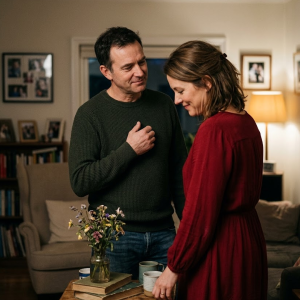
Sixteen years earlier, she had left this house humiliated on Christmas Eve, carrying a casserole dish and a silence she never forgot. She had married Daniel Hollis too quickly, partly out of love and partly because at twenty-nine it still seemed possible that love might be enough to bridge class, family, and old Beaufort prejudice.
Margaret Hollis cured her of that idea in a single sentence.
You are not what this family needs.
Nora still remembered the exact shine of the dining table when Margaret said it. The silver. The candles. Daniel’s face when he chose obedience over loyalty and carried Nora’s casserole dish to the front door instead of defending her. She remembered Britt staring at her plate. She remembered the lighthouses lined across the mantel, hand-painted and neat and smug.
Most of all, she remembered the weight of the one she took.
At the time it had felt less like theft than proof that she had been there at all. That they had not simply erased her the second she crossed the threshold. She kept the figurine for years without understanding why. It sat on windowsills and shelves and desks while she rebuilt herself from scratch.
That rebuilding was not glamorous. Nora divorced Daniel four months later. She worked long hours at a title office in Charleston, first doing clerical work, then research, then full title review. She learned the language of land the way some people learn to fight: because once you understand where power is stored, you stop being easy to corner.
She learned that deeds outlast apologies. Surveys expose lies. Family stories often collapse under a courthouse stamp.
By forty-five, she had her own office and a reputation for noticing what other people missed.
So when the Carteret Street house appeared in a distressed-file chain tied to lender concerns, she noticed.
The Hollises had been bleeding money in quiet, proud ways for years. A refinancing here. A tax issue there. A parcel sold under market. Everyone in Beaufort still talked about them as if wealth were a weather pattern that naturally followed the name, but the records told a different story.
What caught Nora was not the debt. It was the access.
The Hollis house relied on a narrow strip of land along the front edge of the property for legal street access. On the current survey, it was shown as if it had always belonged to the Hollis parcel. But an older plat hinted otherwise. There was a correction in the chain that did too much too cleanly. Then there was an estate inventory from Frank Hollis’s probate file that listed something odd: a custom pair of Beaufort lighthouse ceramics.
Pair.
Nora went home that night and pulled the figurine from her shelf. She turned it over in her hands, studying the glaze, the painted windows, the seam around the base she had somehow never really looked at. When she twisted, the base loosened.
Inside the hollow ceramic body was a narrow roll of paper, brittle with age.
For Rose Fitch, if Margaret ever tries to sell without making it right.
Second light opens the wall.
— F.H.
Nora sat frozen in her office chair.
Rose Fitch was her grandmother.
Rose, who had raised her after her mother died. Rose, who made the corn pudding casserole. Rose, who once muttered after two glasses of tea that the Hollises had built their “front glory on somebody else’s dirt.” At the time Nora had thought it was bitterness talking. Now she heard it as testimony.
She pulled records until dawn.
The strip in front of the Hollis house had indeed once belonged to Rose’s family. Years earlier, after a death, storm damage, and a cluster of hurried legal filings, the strip had been transferred through documents that looked legal if you stayed on the surface and deeply wrong if you did not. A quitclaim. A survey correction. A signature that matched Rose’s name but not her hand.
Then Nora found the dead attorney’s ledger entry: corrective deed prepared, never recorded.
Frank Hollis had discovered the fraud. Rather than expose his wife and her family publicly while he was alive, he had signed a corrective deed restoring the strip to Rose Fitch or her heirs and hidden it inside the house, apparently using the pair of lighthouse figurines as the mechanism to reach it.
That was when Nora understood why Margaret had gone cold the first time she met her.
Not because Nora was poor. Not even because she was ambitious.
Because Margaret had recognized something in her face.
Rose Fitch had been gone for years by then, but family resemblance can rise up like a ghost.
Nora arranged a formal property meeting under the pretense already in motion: title defects had to be resolved for any sale to proceed. The lender wanted clarity. The Hollises, boxed in by debt, had little room to refuse.
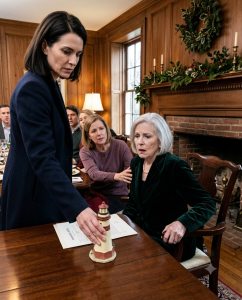
Margaret received her with the same rigid spine, though age had thinned her and sharpened the bones in her face. Britt sat at the dining table too, looking tired in the way people look when they have spent years cleaning up after someone else’s pride. Daniel was absent, living in Atlanta now and apparently on his third reinvention.
Nora did not mind. Some reckonings are cleaner without witnesses who once failed you.
She set her bag down but did not sit immediately.
Instead, she walked to the fireplace. The mantel still carried holiday greenery, though less lavish than before. The lighthouse collection was gone from open display. Only one sat in the old place. The matching one, according to a blurred inventory photograph Nora had found, was usually kept in a side cabinet.
She opened the cabinet.
“There is no reason for you to be in there,” Margaret snapped.
Nora turned with the second figurine in her hand. “Actually,” she said, “there is.”
She knelt by the mantel. Two small brass fittings sat hidden underneath the shelf, painted over but still visible if you knew to look. She set Margaret’s lighthouse into the left fitting.
Then she pulled the stolen lighthouse from her bag and set it into the right.
A click sounded inside the wall.
Britt gave a startled cry. Margaret lurched to her feet.
Nora pressed on the trim and a narrow panel released behind the fireplace surround. Inside was an oilcloth packet tied with twine and sealed with old stubbornness. She laid it carefully on the dining table and unwrapped it in front of all of them.
Inside were three things.
An original survey showing the front strip as Fitch land.
A corrective deed, signed by Frank Hollis and prepared for Rose Fitch or her heirs, restoring the strip.
And a letter.
Margaret saw the paper and sat down hard.
What followed was less dramatic than television and far more final. Nora called counsel from the table. Copies were made. The title defect was undeniable. Without the access strip, the Hollis house could not be financed or sold cleanly and was exposed to creditor pressure that would turn ugly fast. Nora, as Rose’s heir, now controlled the strip that made the property functional.
She could have taken the fight to court. She could have dragged Margaret through public humiliation, made every old Beaufort whisper official, and watched the story spread from church foyers to county offices in one afternoon.
She chose terms instead.
The Hollises, desperate to prevent a larger collapse of their finances, agreed to a settlement transferring the Carteret Street house to Nora outright in exchange for a global resolution that protected Britt from the worst of the fallout and kept several other debts from swallowing the remaining family assets. Daniel signed from Atlanta after a lawyer explained the alternatives in language even he could not romanticize.
By the time Nora returned to the dining room for the final signing, the deed was done.
That was when she set the lighthouse on the table.
Margaret looked at it as if it might explode.
Nora laid Frank’s letter beside it and slid it toward Britt, not Margaret.
Britt read the first line aloud without meaning to. “‘Rose was my wife before God, if not before Beaufort.’”
Her voice broke.
Margaret lunged for the letter, but Nora caught it first. “No,” she said, and there was nothing loud in her tone, which somehow made it stronger. “She gets to know.”
Frank’s letter was not a melodramatic confession. It was worse for Margaret because it was precise.
He wrote that before his marriage to Margaret, he had intended to marry Rose Fitch. Margaret’s father intervened, using money and social pressure to bury the relationship. Later, when the opportunity arose to absorb the access strip from the Fitch family during a vulnerable moment, Margaret helped it happen and then treated the theft as correction rather than theft. Frank discovered the truth years later. He did not leave his marriage, but he documented what had been done and tied the correction to title so that the land itself would one day force the matter into the light.
He also wrote that Margaret would recognize Rose’s bloodline if it ever came back to the door.
That was why she hated Nora on sight.
Not because Nora was beneath them.
Because Nora was evidence.
Britt read in silence, tears sliding down without ceremony. “Dad knew?” she whispered.
“Yes,” Nora said.
“Did Daniel know?”
“He tried to tell him before he died,” Nora said. “There’s a note about that too.”
Margaret’s voice came out low and venomous. “You came here to destroy this family.”
Nora looked around the dining room that had once made her feel small. The chandelier. The mantel. The table where people had watched her humiliation and kept chewing.
“No,” she said. “I came here because your family already did that. I just brought the paper.”
Then she placed one final document on the table: a copy of the forged transfer bearing Margaret’s signature.
Britt stared at it for a long time.
“You signed this?” she asked.
Margaret said nothing.
“Mom.”
Still nothing.
That silence did more damage than any denial.
In the weeks that followed, the practical side of the reckoning moved faster than the emotional side. Nora took title to the house. Britt moved into a smaller place near Lady’s Island and, to Nora’s surprise, wrote her a short note that said only: I am sorry for Christmas. I should have stood up. Nora wrote back: So should I have. We both know better now.
Margaret left Beaufort within two months to live with a cousin in Savannah after discovering that social standing is harder to carry when your own daughter will not return your calls.
Nora kept the house for almost a year. Long enough to strip the dining room wallpaper. Long enough to repaint the front door. Long enough to stand on the porch one humid evening and feel, at last, that memory had stopped owning the place more than she did.
Then she sold it.
Not because she had to, but because possessing the house was never the point. She used part of the money to restore the little marsh cottage her grandmother Rose had once rented and to set up a small scholarship fund in Rose Fitch’s name for students entering paralegal and title work programs in Charleston County.
The two ceramic lighthouses sat together afterward on a shelf in Nora’s office.
Clients sometimes noticed them and said they were pretty.
Nora would smile and say thank you.
She never told the whole story unless she had reason. But every now and then, when a nervous young woman sat across from her desk feeling underestimated and outmatched by somebody with a bigger name, Nora would glance at those lighthouses and remember exactly what paper can do when the truth survives long enough to be read.
The strangest part was not that Margaret lost the house.
It was that the house had never really been the deepest theft.
That had happened years earlier, when people with power decided Rose Fitch could be loved in private, cheated in public, and erased in the record.
They were wrong.
In the end, it was not gossip or revenge that exposed them. It was a dead man’s correction, a granddaughter who learned how to read a title chain, and a Christmas Eve insult that accidentally put the missing key in the right pocket.
Some people would say Nora should have shown mercy sooner. Some would say Margaret got exactly what she deserved. Nora herself was not sure mercy and consequence were always opposites.
She only knew this:
The first time she left the Hollis house, she drove away crying with a casserole dish in her lap.
The second time, she left with the deed.
And depending on who tells it, the bigger victory was not that she finally owned the house.
It was that Margaret, for one terrible honest afternoon, had to watch the truth sit down at her table and refuse to leave.