They said Dottie Crane would never amount to anything after Ray left.
In Heller’s Hollow, Tennessee, that kind of sentence could follow a person for decades. Small towns had long memories, but they didn’t always have fair ones. They remembered who got embarrassed, who got left, who lost money, who cried in public, who moved into a cheap room over a store. They remembered the spectacle. They rarely remembered the rebuilding.
Dottie learned that the hard way.
The night everything came back around began under the chandeliers of Copperleaf Resort, a place so grand it still didn’t look real to most locals. For forty years Heller’s Hollow had been a town people drove through on the way somewhere else. Then came the luxury development: the restored valley, the spa, the cabins on the ridge, the glossy articles praising the untouched beauty of the Tennessee hills as if nobody had been living there all along.
And on that night, the most celebrated room in the most celebrated building in town was full of white orchids, polished silver, and two hundred guests gathered for Ray Crane’s wedding.
Dottie arrived alone.
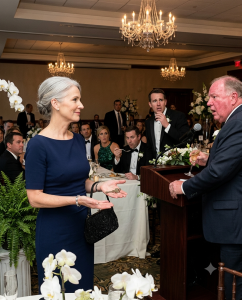
She wore a navy blue dress from the Belk clearance rack and sensible block heels. Her silver hair was pinned neatly at the nape of her neck. Nothing about her appearance begged for attention, and maybe that was why it took people a moment to recognize her. She had the kind of face that had grown quieter over the years, less eager to explain itself. Time had not softened her exactly. It had refined her.
In her beaded clutch she carried a single tarnished house key on a plain ring.
She kept rolling it between her fingers as she crossed the ballroom.
Years later, people would still talk about that key.
At the back of the room, near a potted fern and just far enough from the dance floor to be forgotten, Dottie took her seat and accepted a glass of sparkling water from a passing server. She thanked him with a small smile and sat with the calm of someone who had already decided how the night would end.
No one knew that yet.
Most people in that room only knew the old version of the story. Ray Crane had left Dottie twenty-two years earlier. He’d stood in the gravel driveway of their yellow house on Persimmon Road and announced the marriage was over. By then he had already emptied the business account. Dottie found that out only after trying to pay bills that should have been covered. The house, he implied, would soon be gone too. It needed too much work. There wasn’t enough money. They’d both know when to stop pretending.
Except Dottie had still believed in the house.
That was what people never understood. To them it was a weathered place with a sagging porch, failing gutters, and land too awkwardly shaped to matter. To Dottie it was eleven years of labor. Fresh paint layered over old mistakes. Tomato vines along the fence. A front room she had sanded and refinished herself. Wallpaper stripped one furious inch at a time. A place that had become a home because she had made it one.
When Ray left, she was thirty-four with forty-seven dollars, a box of her mother’s china, and shoes worn through at the toe.
The town watched.
For a while, Dottie became the saddest thing in Heller’s Hollow. Men shook their heads. Women lowered their voices when she passed. Some people offered help. More offered opinions. Several thought she should sell the Persimmon Road property immediately and move somewhere easier, smaller, less humiliating. One of the loudest among them was Gerald Holt, a big man with a booming voice who liked hearing his own advice repeated back to him.
“Best thing that woman could do,” he said more than once, “is let go.”
Dottie never argued.
That was one of the many mistakes people made with her. They thought silence meant weakness. They thought a woman who didn’t announce her plans probably didn’t have any.
What Dottie did instead was survive.
She found work at the county assessor’s office. The pay wasn’t glamorous, but it was steady. More importantly, it opened a door nobody else in town thought to walk through. There, among dusty maps and filing cabinets, Dottie discovered she had a mind for records. She learned how property was described, how lines were drawn, how rights were separated, how mistakes sat unnoticed in old deeds for decades until money came looking for them.
At night she took classes. She learned the language of title searches, easements, surveys, tax histories, parcel consolidations. Before long she knew more about land records than most people who talked confidently about owning land.
She rented a single room above the hardware store on Maple Street and lived there with quiet discipline. In the summer, heat rose through the thin floorboards. In winter, the windows rattled at every strong wind. She mended her clothes. She saved what she could. She did not complain, because complaint had never once changed a fact.
And little by little, she pieced together what Ray had assumed she never would.
The Persimmon Road property had not been as simple as he’d made it sound.
Years before, when an elderly neighbor had settled a boundary issue informally with Dottie’s late father, a narrow access strip had been recorded in a way that looked insignificant to anyone reading quickly. It wasn’t the house lot itself that mattered. It was the adjoining parcel and the access rights tied to it, tucked inside old filings that most people would never bother tracing. During the marriage, Ray had treated the whole place like a burden. After he left, he assumed Dottie would sell under pressure and sign away anything attached.
She did not.
Instead, she studied.
By the time Ray remarried, Dottie knew exactly what she owned.
Copperleaf did not appear overnight. First came rumors of outside investors. Then survey crews. Then whispers about a luxury development stretching through the valley. People got excited. Property values shifted. Men who had ignored those hills for decades started speaking about vision and opportunity. But one problem slowed everything: the development needed a legal access route through a small but critical parcel connected to old Persimmon Road.
Dottie recognized the description the first time she saw it referenced.
She said nothing.
She hired an attorney from two counties over, one with no friends at the Heller’s Hollow diner and no interest in local politics. Together they placed the parcel into a private trust under her direction. When developers came asking questions indirectly, she let them ask. When they circled, she waited. When they finally understood what they needed and who controlled it, negotiations became very different.
Patrick Coe was the first one to treat her like the most informed person in the room.
He came without swagger. He brought maps, engineering plans, and respect. Dottie appreciated all three. They met more than once in a small conference room at the assessor’s annex where she no longer worked but where many still remembered her with admiration. She did not make quick decisions. She had not spent twenty years rebuilding her life just to be hurried by men who had discovered urgency last week.
In the end, the deal made her wealthy by local standards. Wealthy enough to buy peace, security, and choices. Wealthy enough that the room above the hardware store became a memory instead of a necessity. But the money was only part of it.
What mattered more was that she had been right to hold on.
She never flaunted that. She never corrected the old stories. She let people believe what they wanted, because truth had a way of arriving on its own schedule.
And then an invitation appeared.
Ray Crane and his new bride requested the pleasure of her presence at their wedding.
Dottie stared at the card for a long time.
She might have declined. Most people expected her to. But tucked beneath the stiff wording was a handwritten note in Ray’s familiar slanted script: Hope there are no hard feelings after all this time. Would mean a lot to have everyone there.
Everyone.
Dottie almost laughed.
By then she knew something else Ray did not realize she knew. During the title work for the Persimmon Road negotiations, an old sealed envelope had been referenced in a document inventory related to the original house. She eventually located it exactly where an old list said it would be: hidden in a narrow compartment beneath a built-in cabinet Ray had always claimed was empty and useless. The key in her clutch opened that compartment.
Inside were letters, financial notes, and one signed statement that changed her understanding of their marriage.
Not because it proved Ray had left.
She had lived that.
It proved why.
Dottie wore navy blue to the wedding and sat quietly by the fern while the string quartet played and servers drifted by with trays of champagne. Ray looked older, thicker through the middle, but still careful about appearances. His bride was young and lovely in a way that suggested she had grown up in cleaner rooms than Dottie ever had. Gerald Holt moved through the reception with all the confidence of a man whose daughter had married well and whose town had finally become profitable enough to impress strangers.
The outsiders were there too. Developers, investors, consultants. People with polished shoes and polite laughter. Patrick Coe stood among them near the bar.
Dottie kept turning the key in her hand.
She could have confronted Ray privately another day. She could have stayed home and let his wedding pass without a ripple. But after reading what was in that envelope, after years of being spoken about like a cautionary tale instead of a person, she wanted one thing she had denied herself for too long.
The truth in daylight.
She did not expect Gerald Holt to set it in motion.
Halfway through the evening, Gerald drifted over to Patrick Coe and began congratulating him in the loud, proprietary way local men do when they’ve decided success happened partly because they approved of it. He praised Copperleaf, praised growth, praised the town finally “becoming something.” Then he asked, almost jokingly, who exactly had controlled the old Persimmon Road parcel that made the valley acquisition possible.
Patrick’s expression changed just enough for Dottie to notice from across the room.
Then he looked directly at her.
Gerald followed his gaze.
The color left his face with shocking speed.
For a second the reception continued around them, untouched by the realization traveling through one corner of the room. Then conversation thinned. Nearby guests noticed the strange stillness. Ray turned from the head table. His bride frowned. Gerald stood frozen, champagne glass tilted in his grip as if he had forgotten how hands worked.
Patrick did not rescue him.
He didn’t need to. Gerald understood. The woman everyone had pitied, advised, ignored, and quietly condescended to for twenty years had been sitting on the most valuable leverage in the valley. She had held it while men like him spoke as if she should be grateful to be included in other people’s futures.
Instead, they had all built theirs around land she controlled.
Gerald walked to the podium as though the floor were moving beneath him. The microphone was still on from the earlier toasts. He gripped both sides and stared into the room.
“Dottie,” he said, voice cracking in front of everyone, “that’s your name on the deed?”
Silence flooded the ballroom.
Dottie looked up and smiled.
The room changed in that instant. You could feel it. Her name, once attached to embarrassment, was now attached to power. People began searching their memories, reorganizing years of assumptions in real time. Ray had gone pale. His bride was watching him now, not Dottie, because there was something in his face she did not like.
Patrick stepped forward with a folder under his arm.
“For the last six years,” he said, calm and precise, “the Persimmon Road access parcel has been held in a private trust under Ms. Crane’s direction.”
A private trust.
The words spread like sparks in dry grass. Guests exchanged stunned looks. Gerald blinked hard. Several of the investors straightened with fresh respect. Ray stood too quickly, the scrape of his chair loud as a gunshot in the quiet room.
Then Dottie finally spoke.
“I kept the land,” she said softly. “But that wasn’t the hardest thing I kept.”
Ray’s eyes fixed on the key in her hand.
He knew that key.
She saw recognition hit him like cold water. His bride saw it too.
Patrick reached back into the folder and removed a yellowed envelope, still sealed with the date visible in the corner. Dottie had brought it because the truth deserved witnesses, and because too many men had spent too many years depending on her decency to protect them from consequences.
“Before this night goes any further,” Dottie said, her voice steady, “there’s something your guests should know.”
Ray moved as if to stop her. “Dottie, this isn’t the time.”
A faint murmur moved through the crowd. His new wife turned to him sharply. “The time for what?”
Dottie did not answer her. Not yet. She looked only at Ray.
“When you left,” she said, “I thought you were just tired of me. I thought you wanted a different life and I wasn’t enough for it.” She held up the key. “Then I opened the compartment you were always so careful to keep closed.”
Ray’s face collapsed.
Patrick handed her the envelope. Her fingers, though lined with age and work, were perfectly steady as she broke the seal.
Inside was a stack of letters and a notarized statement dated months before Ray left. The statement detailed debts incurred in Ray’s name, loans taken against business assets he had never disclosed, and one final devastating line: he had planned to transfer ownership interests in the Persimmon Road property without Dottie’s informed consent, using forged supporting documents prepared by an associate who later withdrew. When that effort failed, he emptied accounts and left before the fraud could fully surface.
The ballroom seemed to inhale at once.
His bride sat down without meaning to.
Gerald Holt stared at Ray as if he’d never met him.
Dottie read only the necessary parts. She did not dramatize them. The facts were enough. She explained that the papers had been hidden in the house, likely because Ray intended either to destroy them later or believed no one would ever find them. She explained that once she understood what he had tried to do, she stopped seeing herself as the woman he abandoned and started seeing herself as the woman who had narrowly escaped being robbed blind by her own husband.
“I didn’t speak before,” she said, folding the papers carefully, “because I was busy surviving what you left behind.”
Ray opened his mouth, closed it, then tried again. “That was years ago.”
“Yes,” Dottie said. “And somehow it still took less time than it took for the truth to catch up with you.”
Nobody laughed. The moment was too sharp for that.
His bride stood slowly, tears bright with humiliation more than grief. “Is this true?”
Ray looked around the room, maybe searching for an ally, maybe searching for a version of the story he could still control. He found none.
Patrick Coe spoke with brutal politeness. “Our legal review independently uncovered enough inconsistencies that Ms. Crane’s documentation answered several open questions.”
That was as close as a man like Patrick came to calling someone a liar in public.
The bride removed her ring.
It was not theatrical. That made it worse. She simply slid it from her finger, set it on the cake table beside an arrangement of orchids, and stepped back from Ray as if distance itself might restore her dignity.
No one moved to help him.
For all his years of managed impressions, all his practiced charm, Ray Crane looked suddenly ordinary: an aging man in a tuxedo standing in the ruins of his own timing.
Dottie tucked the papers back into the envelope and the key back into her clutch. She had not come to scream, insult, or humiliate. Life had already done its work on her. She had come to stand upright in the truth and let the room adjust.
She turned to leave.
Patrick followed and quietly asked whether she still intended to finalize the final hospitality easement addendum the next week.
Dottie smiled. “On revised terms,” she said.
He almost smiled back. “Of course.”
Outside, the mountain air was cool and smelled faintly of pine and rain. Behind her, the ballroom buzzed back to life in shocked fragments. Tomorrow the town would talk. For once, Dottie didn’t mind.
By the time she reached the parking lot, she no longer felt the old shaking grief she used to carry whenever Ray’s name surfaced. That woman had disappeared years earlier, though she’d only now had proof of it. In her place stood someone steadier. Someone who had learned that survival was not the end of a story. Sometimes it was only the long middle before the truth finally arrived.
Copperleaf glowed behind her, all money and glass and borrowed grandeur. Somewhere inside, people were deciding who they had misjudged most: Ray for what he’d done, Gerald for what he’d assumed, or themselves for mistaking quietness for defeat.
Dottie slipped into her car and rested her hand on the clutch in her lap.
The key was still there, old and worn, belonging to a house everyone once thought had no future. Funny how often the world overlooked the plain things that turned out to hold everything together.
She started the engine and drove down the mountain road toward home, leaving the chandeliers behind.
In Heller’s Hollow, people would remember that night for years. Some would call it justice. Some would call it revenge. Dottie called it something simpler.
The truth, finally said out loud.
And if the town learned anything from it, maybe it was this: the biggest mistake you can make is assuming the quiet woman in the back of the room has no idea how the story really ends.