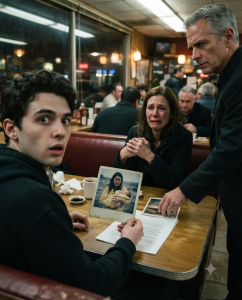
Adrian didn’t sit back down.
For a second, Jenna thought that was the most frightening part of the night—not the old envelope in his hand, not the tremor in his voice, not even the fact that his late wife’s name had just entered a conversation Jenna had spent two decades trying to outrun. It was that he remained standing there beside the diner booth as if sitting would make this too ordinary, too manageable, too easy to survive.
He held the Polaroid for one beat longer, studying it with a look Jenna couldn’t read, then placed it gently on the table between the soy sauce dish and her untouched tea.
The glossy square slid half an inch across the laminate.
Owen looked down at it first. Then at his mother. Then back at the photo.
He went perfectly still.
Jenna’s throat closed.
The courtyard in the photograph belonged to St. Agnes Housing, the emergency residence where she had spent six days at nineteen after leaving the hospital with an empty body, a stitched-up ache she could barely stand upright through, and no clear understanding of what had happened to the baby she had carried. Every adult around her had spoken in polished, patient language that sounded compassionate until she tried to ask direct questions. Then their faces changed. Then the words got softer and more evasive. Then suddenly forms appeared. Signatures mattered. Timing mattered. Procedure mattered.
Her pain did not.
In the picture, she was seated on a chipped concrete bench under a crooked metal awning. Her hair hung limp around her face. Her eyes were swollen nearly shut from crying. The infant in her arms was wrapped in a yellow-striped hospital blanket—the same one she had begged to keep for one more hour before the social worker came back.
She had no memory of anyone taking that photograph.
But she remembered that day.
Remembered clutching the baby so tightly her arms shook.
Remembered saying, “Please, just one more hour.”
Remembered the numb little nod from the woman who brought him back to her as if granting a final visitation.
Remembered believing that if she held him long enough she could somehow stop the next thing from happening.
Only one person had stayed with her the entire afternoon.
Claire.
Adrian’s late wife.
“My wife volunteered there during grad school,” Adrian said quietly. “Years before I met her.”
Jenna looked up at him. Adrian was a hard man to read even on normal days. Tonight he looked carved out of restraint.
“She kept that photo,” he said, touching one corner of the Polaroid with two fingers, “because she said it was the angriest she’d ever been at the way adults talked around a terrified girl like she wasn’t even in the room.”
Jenna dropped her gaze.
Claire.
She remembered her now with painful clarity. A young woman in a secondhand cardigan, hair tied back, no clipboard, no polished phrases. She had been the only person who crouched to eye level instead of standing over her. The only one who said, “This isn’t right,” where others said, “This is complicated.” The only one who asked Jenna what she wanted before telling her what would happen.
Claire had brought her crackers she didn’t eat and tea she let go cold.
Claire had sat beside her in silence when talking became impossible.
Claire had once reached for the stack of forms and said sharply to a social worker, “She needs sleep, not another signature.”
At nineteen, Jenna had clung to that woman with the helpless desperation of a person drowning near one honest face.
“She told me,” Adrian said, “that baby was taken before the paperwork was clean. She also told me the mother swore she’d come back with help.”
Jenna’s hand gripped the booth edge.
“I did come back,” she whispered. “They moved him before I could.”
The word him changed everything.
Adrian’s expression tightened almost imperceptibly. He looked down at Owen, then back at Jenna.
Him.
Not “the baby.”
Not “it.”
Not some abstract grief wrapped in old language.
A son.
Owen’s jaw tensed. He was twenty now, broad-shouldered, restless, too perceptive for comfort. The son Jenna had raised since he was five. The son everyone believed had come into her life through a foster-adopt transition after his grandparents could no longer care for him. The son she had loved without reserve, even while some frightened, irrational corner of her sometimes recoiled from the familiarity in his eyes.
Not because she believed he was hers.
Because she had trained herself never to believe anything that dangerous.
“My wife didn’t just keep the photo,” Adrian said. “She kept a case file.”
The diner seemed to contract around Jenna.
The overhead lights buzzed softly. A spoon clinked against china somewhere behind her. At the counter, someone laughed. It was grotesque, the normalcy of other people’s evenings.
Adrian reached into the worn envelope and removed a folded document. The paper was old, softened at the creases. He set it beside the photograph and turned it so Jenna could read it.
Hospital letterhead.
Court stamp.
A highlighted line.
Temporary kinship placement approved pending maternal reappearance.
Jenna read the sentence once and forgot to breathe.
Pending maternal reappearance.
She read it again. And then again.
No final relinquishment.
No completed adoption.
No permanent order.
For more than twenty years she had lived beneath a version of events that had been handed to her with such certainty she’d eventually stopped testing it. She had been told the transfer was lawful, final, and complete. Told she had missed deadlines she hadn’t known existed. Told she lacked standing. Told the child had already been placed beyond challenge. Told returning to ask questions would only “destabilize” matters.
But this line cut through every one of those lies.
Her hands began to shake.
“Claire spent years trying to track what happened after that order,” Adrian said. “She believed the file was altered later. She believed the baby was placed with relatives connected to the attorney handling the transfer.”
Jenna stared up at him.
“What relatives?” she asked, but her voice sounded strange and distant.
“She never got a final answer,” Adrian said. “But she found names that kept circling back. An attorney. His sister. Her husband. Temporary guardianship filings that disappeared from one office and reappeared in another under different notation. Enough to make Claire think somebody cleaned the trail.”
Owen finally spoke. “Why are you showing us this now?”
The question hung there, sharper than either adult expected.
Adrian looked at him. “Because Claire is gone,” he said. “Because I found her boxes after selling the house. Because I was going to burn half of what was in the attic without opening it. Then I saw this photo, and I recognized Jenna.”
Jenna closed her eyes.
Recognized. Of course. Adrian had met her years after Claire’s death, when he and Jenna’s paths crossed through a tenant advocacy board. They’d never been close, but close enough for him to know her face. Close enough to remember it.
“I thought it was just a terrible coincidence,” Adrian said. “Then I looked deeper.”
Owen leaned back, his face pale. “Deeper into what?”
Adrian pulled another page from the envelope. This one was a typed note in Claire’s handwriting margins—quick, slanted, furious.
Mother returned.
Child already moved.
No clear legal closure.
Something wrong with attorney connection.
Boy may never be told origin.
Jenna’s heart slammed so violently it hurt.
Boy may never be told origin.
Adrian rested that page on top of the first. Then he looked straight at Owen.
It was not a gentle look. Not cruel either. More like the expression of a man who had realized he was holding a live wire and had no idea how to set it down.
“My wife believed that child grew up not knowing where he came from,” he said.
The air changed again.
Jenna felt it.
Owen felt it.
Even Adrian seemed to feel the moment he crossed some invisible point of no return.
Because there were too many things in the room now.
An old photo.
A missing file.
A temporary order.
A son not told the truth.
A timeline that fit too neatly.
A resemblance Jenna had spent years refusing to trust.
Owen looked from the paper to Jenna, and in his face she saw the first fracture of something fundamental.
“Mom,” he said quietly, “what is this?”
The word pierced her.
She had earned that name in sleepless nights and scraped knees and parent-teacher meetings and fevers and slammed doors and every ordinary devotion that makes a family real. But now it trembled on a fault line.
Jenna forced herself to speak. “When I was nineteen, I had a son. I was told he was placed. I was told it was done.”
“A son,” Owen repeated.
She nodded once.
“And you never told me?”
“I didn’t know where he was,” she said, tears burning her eyes. “I didn’t know if I’d ever find him. And then… then life kept happening. And later, when you came to me, when I became your foster parent, then your mother in every way that mattered, I told myself the past was separate. I told myself I couldn’t drag that old wound into your life.”
Owen stood abruptly, his chair scraping backward. “Separate?”
Jenna flinched.
“Do you hear yourself?” he demanded. “You’re telling me at this table that you lost a son, this man shows up with proof it wasn’t legal, and now he’s looking at me like I’m—”
He stopped.
Because he could not say it.
Because saying it would make it real.
Adrian spoke into the silence. “How old was the baby when he was moved?”
“Six days,” Jenna whispered.
“How old were you when you were placed with your grandparents?” Adrian asked Owen.
Owen didn’t answer at first. Then, through clenched teeth: “Infant.”
“Five months,” Jenna said automatically. She knew his file. Knew every dry line in it by heart. “Emergency transfer to maternal grandparents after neglect concerns involving prior guardians.”
Everyone froze.
Jenna looked up slowly.
Prior guardians.
Not parents.
Her stomach dropped.
“Show me that page,” she said.
Owen stared at her, then reached into his backpack with mechanical movements and pulled out the folder he had brought for an unrelated reason—a college housing appeal, of all things. The irony was so brutal Jenna nearly laughed.
His personal documents were inside. She flipped through them with trembling hands until she found the summary page from an old county review.
Initial kin placement with guardians related by legal intermediary.
Legal intermediary.
Not family attorney.
Not named relation.
Legal intermediary.
Adrian took the page from her and read it once. Then again, slower.
“That’s it,” he said.
Owen looked like he might be sick. “What does that mean?”
“It means,” Adrian said carefully, “you may not have been placed with blood relatives at all. It means the people who raised you may have been connected to the lawyer, not to you.”
“No,” Owen said at once. “My grandparents were my family.”
“They may still have loved you,” Adrian said. “That doesn’t answer how you got there.”
Jenna covered her mouth. Memories crashed through her in fragments: the attorney at the hospital with expensive shoes and a gentle smile that never reached his eyes. The way he had insisted he was there to “facilitate options.” The social worker who deferred to him too quickly. The missing forms. The vanished records. The closed office when she returned with borrowed bus money and a church volunteer beside her.
She had thought the system failed her.
Now it looked like someone had used the system to hide what they were doing.
“Claire tried to pursue it,” Adrian said. “She was blocked. She left notes everywhere. She thought if she pushed too hard without standing, the file would disappear completely. Then she got sick. Later, after I married her, she mentioned one lost case she never got over. She said there had been a baby boy and a mother with eyes full of murder and grief, and she was afraid the truth had been buried so deep the boy would grow up inside a lie.”
Jenna began to cry soundlessly.
Owen didn’t move toward her.
Not because he hated her. Adrian could see that. Not yet. This was worse than anger. This was the terrible paralysis of someone whose personal history had cracked open and exposed a second version underneath.
“Did you know?” Owen asked Jenna. “About me. Did you ever suspect?”
Jenna told the truth because there was nothing else left. “Sometimes,” she whispered. “Not in a way I let myself believe. Just little things. The timing. The age. Your file being too vague. The first time I saw your baby picture at your grandparents’ house, I couldn’t explain why it made me shake. But I thought that was my grief looking for patterns. I thought hoping something like that would be cruel to you.”
Owen turned away, pressing a hand to the back of his neck.
Adrian asked the next question no one wanted spoken. “Where are your grandparents now?”
“Gone,” Owen said. “Both dead.”
“And the attorney?”
Owen stared at him. “Alive.”
The answer landed hard.
“Name?” Adrian asked.
Owen hesitated. Then gave it.
Jenna felt the room sway.
It was the same surname on the margin notes in Claire’s file. The same one attached to the attorney who had hovered near her hospital room pretending to represent a process instead of steering it.
Adrian reached into the envelope again and unfolded one final page. It was a photocopy of an old business card clipped to handwritten notes.
Martin Voss, Family Transfer Counsel.
Owen’s face emptied.
“Voss,” he said. “That was my grandparents’ last name.”
Jenna’s breath caught.
No one spoke for several seconds.
The waitress approached with the coffee pot, saw the expressions at the table, and retreated without a word.
“He gave you to them,” Jenna whispered, horrified by the plainness of it. “He gave you to them.”
Owen looked at her then, and Adrian watched something raw and unbearable pass between them. Not certainty. Not reunion. Just a shared terror at how possible it had suddenly become.
“What do we do?” Owen asked, though it sounded less like a practical question than a plea against free fall.
Adrian sat down at last.
“We start with proof,” he said. “DNA. Then records requests in three counties. Claire left enough breadcrumbs that we know where to dig.”
Owen laughed once, a broken sound. “And if it’s true?”
Jenna answered before Adrian could. “Then I tell you everything. Every ugly part. Every year I searched. Every time I failed.”
Owen swallowed hard. “And if it’s not?”
“Then I still should have told you the truth about my past,” she said. “And I’ll live with that.”
The DNA test was done in silence three days later.
The wait nearly destroyed them.
Jenna moved through the week like someone walking under deep water. She barely slept. Every room in her apartment felt haunted by versions of a child she had lost and a son she might have found without permission to hope for either. Owen stayed with a friend and answered only a few texts. Adrian became the grim, practical center of the storm, making calls, opening Claire’s files, tracing signatures, requesting archived dockets.
When the results came, they met not in a diner but in Adrian’s kitchen.
No one sat at first.
Adrian opened the envelope, scanned the first page, and closed his eyes briefly.
Jenna thought she might die before he spoke.
Then he looked at Owen.
“Ninety-nine point nine eight percent probability of maternity,” he said.
Jenna made a sound she had never heard from herself before.
Owen didn’t move.
Then suddenly he did.
He sat hard in the nearest chair and bent forward, both hands over his face. His shoulders shook once, twice, and then he started crying in huge, silent breaths that seemed torn out of him against his will.
Jenna sank to the floor.
For a long time, nobody knew what to do with the truth now that it had arrived.
It didn’t erase twenty years.
It didn’t restore the days stolen from her.
It didn’t simplify the fact that Jenna had already been Owen’s mother in one sense for years without knowing she had first been his mother in another.
It only illuminated the damage.
The legal records took another month to unravel, but the outline was clear. Martin Voss had arranged the baby’s transfer under a temporary kinship order, placing him with his sister and brother-in-law while the birth mother was expected to return with counsel. Before Jenna could do that, supplemental filings were added, dates changed, review notices misdirected, and the temporary placement hardened into apparent fact. By the time Jenna came back, the trail had been deliberately obscured.
The motive was ugly and ordinary: Voss’s sister couldn’t have children. He had access. Jenna had no money, no lawyer, no stable family backing, and no one in the room except a grad student volunteer who was too outraged to stay quiet and too young to stop them.
Claire had been right.
The file had been altered.
The baby had been stolen through paperwork.
And the boy had grown up inside a lie.
When Owen learned the full history, he didn’t explode the way Jenna expected. The anger came colder than that.
He stood in Adrian’s office holding copies of the filings and said, “They tucked me into bed every night. They came to my school plays. They loved me.”
Jenna’s chest tightened.
Adrian nodded. “People can love what they stole.”
Owen closed his eyes.
That was the sentence he carried the hardest.
In the months that followed, there were statements, lawyers, a quiet investigation reopened too late to punish some of the worst actors and just early enough to shame the surviving ones. Martin Voss denied intent, blamed administrative confusion, and then settled civil claims before testimony could drag every detail into court. The county issued a carefully worded apology that named no conspiracy and admitted no criminal coordination. It was not justice.
But it was record.
It was official.
It was true.
It could no longer be buried.
The harder part happened in private.
Jenna and Owen had to learn how to speak to each other again through a reality that made every old memory brighter and stranger. Their first hug after the DNA results felt both natural and impossible. Their first argument after the truth came out was vicious, because grief rarely arrives politely. Owen wanted to know why she had never pushed harder. Jenna wanted him to understand what nineteen looked like when the world had already decided you were disposable. He asked questions she couldn’t answer. She apologized for things that were not fully her fault and still fully her pain.
But little by little, they built something honest.
Not a fairytale reunion.
Something better.
A relationship with all the tenderness and damage still visible.
One afternoon, months later, Owen asked to see the Polaroid again. Adrian handed it over from the acid-free sleeve Claire had stored it in. Owen looked at the image for a long time.
“That was the last time you held me before they took me?” he asked.
Jenna nodded.
He swallowed and said, “She saved proof.”
“Claire did,” Adrian said.
Owen traced the photo edge with his thumb. “Then she gave me back my life.”
Jenna looked at Adrian. For the first time since that night in the diner, the grief in his face softened. “She tried,” he said.
They never stopped missing what had been stolen.
That was the aftershock no court could fix.
Jenna sometimes watched Owen laugh in her kitchen and had to step away because joy still carried grief folded inside it. Owen sometimes spoke of his grandparents with love and fury in the same sentence and hated himself for both. Adrian kept Claire’s notes in a locked drawer but no longer hid them from daylight.
In the end, the truth did not make anyone innocent.
Not the lawyer who orchestrated it.
Not the institutions that let it happen.
Not the relatives who accepted a child they had no right to keep, even if they later loved him well.
Not even Jenna, in her own mind, because trauma has a way of blaming itself long after the facts say otherwise.
What the truth did was simpler and harsher.
It forced all of them to ask which red flag mattered most: the missing paperwork, the too-convenient placement, the adults who kept using gentle words instead of clear ones, or the fact that a frightened young mother kept saying she would come back and no one acted like that promise meant anything.
Some days Jenna believed forgiveness was possible only for the dead woman who had tried to stop it.
Some days Owen thought love could survive almost anything except deception.
And some days Adrian stood in his quiet kitchen, looked at the place where he had opened that DNA envelope, and wondered how many lives are broken not by one monstrous act, but by a room full of adults deciding not to ask one more question.