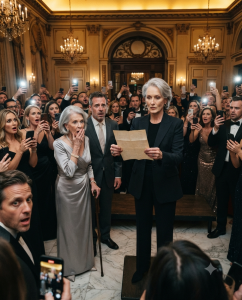
Thomas Bellamy stood before Maren could stop him.
For one fragile second, the Bellamy Grand ballroom stopped being a restored monument to old money and became what it had always really been: a vault with the door finally broken open.
“Maren,” he said, his voice rough with something too late to call courage, “that isn’t all I wrote.”
She turned toward him slowly.
“No,” she said. “It isn’t.”
The mayor, who had arrived expecting ribbon-cutting smiles and donor applause, suddenly looked like he wanted to disappear into the wallpaper. The local press had already stopped pretending this was a routine reopening. Every phone in the front half of the ballroom was raised. Every face had tilted toward the stage. Under the crystal chandeliers and careful restoration lighting, the famous Bellamy name looked less like history and more like evidence.
Maren Vale Bell had built her public reputation on two things: precision and restraint. She was known for buying dying properties no one else could save and returning them to life without sentiment. She did not ramble. She did not improvise. She did not invite ghosts into a room unless she had already measured the exits.
And yet here she was, standing at the microphone in the hotel where she had once been humiliated, holding an audience frozen by a story everyone thought they already knew.
For nearly four decades, the story had been simple. Thomas Bellamy, heir to the Bellamy Grand fortune, had fallen in love with the wrong woman while the family empire was cracking underneath him. Maren, brilliant and ambitious but from the wrong side of old society, had been quietly pushed out. Thomas had married Lydia Mercer instead. The Bellamys survived a little longer. Maren vanished, rebuilt herself, and years later came back wealthier than anyone thought possible. It was the kind of story cities keep alive because everyone enjoys a tidy wound.
But the problem with tidy wounds was that they were usually stitched over rot.
“The second letter,” Maren said, her hand steady on the microphone, “never reached the hotel file.”
Thomas closed his eyes once.
Behind him, Evelyn Bellamy’s cane struck the ballroom floor with a sharp, furious knock.
Maren did not look at her.
“It reached me fourteen years later,” she said. “Forwarded through a law office after your father died.”
A shift moved through the crowd, subtle but immediate. This was no longer a reunion between old lovers. This was an exhumation.
Thomas’s daughter, Claire, stared at him from the second row with her mouth slightly open. Lydia Mercer Bellamy sat near the aisle in a fitted pale suit, every inch the polished widow-in-waiting despite the fact that Thomas was still standing. Only her hands betrayed her, fingers laced so tightly across her lap that the knuckles had gone white.
“In that letter,” Maren continued, “Thomas admitted that the papers his mother showed me in Room 614 were not just my letters. They were copies of his father’s debt agreements. Signed guarantees. Notes tied to this hotel long before the collapse became public.”
The whisper that followed was not gossip. It was recognition.
Maren turned toward Evelyn at last.
“You weren’t protecting your son’s future that night,” she said. “You were trying to secure a marriage that would save your husband’s finances. I was never the embarrassment. I was the obstacle.”
Evelyn Bellamy was in her eighties now, but age had not softened her. She had the bearing of a woman who believed manners were not kindness but weaponry. Her silver hair was perfect. Her gloves were pearl-gray. Her expression held the brittle dignity of someone who had spent her whole life confusing control with virtue.
For the first time all evening, something flickered across her face before she brought it back under command.
Thomas answered without turning to her.
“She told me if I married Lydia Mercer by June, Mercer Capital would cover the bridge loan.”
The words seemed to drain warmth from the room.
Maren’s reply was quiet. “And when you didn’t show up, I understood what mattered more.”
Thomas looked at her then with an expression she had never seen on his face when they were young. Not charm. Not certainty. Ruin.
“I did show up.”
The sentence landed like broken glass.
Maren stared at him.
He swallowed hard. “I got there twenty minutes late. Security wouldn’t let me onto the service elevator. My mother had already ordered the floor cleared. She told me you’d taken the money and left.”
Everything in Maren’s body seemed to lock.
For thirty-eight years she had remembered the details with punishing clarity: the cold edge of the bed in Room 614 against the back of her knees, Evelyn holding an envelope like evidence, the accusation in her voice, the papers spread just enough to imply betrayal and debt and danger. Maren had believed Thomas had chosen family, money, ease. She had believed he had stayed away because staying away cost him less.
It had been a brutal truth.
Now it might not have been truth at all.
Thomas laughed once, without humor. “My father told me the rest when he was dying. He said Evelyn planted those debt papers in the envelope because if you married into the family, you’d learn the hotel was already sinking.”
Evelyn rose with visible effort, both gloved hands wrapped around the silver head of her cane.
“I did what was necessary,” she said.
The whole room heard what was missing.
No apology.
No denial.
No shame.
Only power, still insisting it had been duty all along.
Maren looked past her at the ballroom she now owned outright. The Bellamy Grand had taken her two years to acquire and another three to restore. Investors had called the purchase emotional. Rivals had called it theatrical. She had let them. People always underestimated a woman more effectively when they thought they understood her motives.
“You did,” Maren said softly. “And now so did I.”
She reached into her coat pocket, not for the antique key card she had displayed earlier in the speech, but for a folded deed summary.
“There is one more thing the Bellamy family didn’t know when I bought this hotel,” she said. “Room 614 was never just a room. It sits directly above the original bookkeeping office. During restoration, contractors opened a sealed panel inside the closet wall.”
Thomas went motionless.
Evelyn did not move at all.
“And inside,” Maren said, “we found the ledger your husband spent twenty years pretending had burned in the boiler fire.”
The room erupted into a wave of whispers.
Maren unfolded the paper. “Insurance diversions. Hidden liens. off-book debt extensions. Political contributions routed through vendors that never existed. And one handwritten notation about a payment made to clear a guest floor on the night I was removed from this hotel.”
The mayor’s expression turned to alarm so quickly it would have been funny in another room.
Evelyn’s jaw tightened.
Thomas took a step toward the stage. “Maren…”
But she continued.
“The next morning, Mercer Capital approved a debt extension equal to the amount noted in the ledger,” Maren said. “And beside that entry, in your father’s hand, were seven words: ‘E. handled the girl. T secured by June.’”
Claire Bellamy made a soft sound behind her hand.
Lydia’s face did not break, but it altered. The change was subtle and devastating. A woman who had spent decades carrying herself as chosen suddenly looked as if she had just seen the receipt.
Evelyn’s voice came thin and cold. “You have copies.”
“I have the original.”
That was when the room truly turned.
Because originals survive where explanations do not.
A legal counsel from Maren’s firm stepped forward carrying an archival box. The sight of it transformed the gathering from social disaster into institutional threat. Wealth can endure rumors. It is paperwork that kills it.
“The ledger has already been authenticated,” Maren said. “Copies were delivered this afternoon to the district attorney, the state financial crimes bureau, and the paper your husband spent years threatening into silence.”
Evelyn’s cane slipped against the marble.
Thomas looked at his mother as though he had never seen her clearly before. “You told me she chose money,” he said. “You told me she sold me out.”
Evelyn said nothing.
“You let me believe that for thirty-eight years.”
Her answer came without emotion. “I let you remain useful.”
The cruelty of it stunned even those who had expected cruelty.
Maren felt something settle inside her, a long-unstable weight finally finding ground. Not peace. Not satisfaction. Something harsher and cleaner than either. Confirmation.
The officers who had been stationed discreetly near the ballroom entrance now stood straighter. Reporters pressed in. The mayor glanced toward the side door and seemed to realize that leaving would look worse than staying.
Claire stood up.
She was in her early thirties, elegant in the effortless way her family had trained into her, but there was nothing polished about the anguish in her face now.
“For a loan?” she asked her grandmother. “You destroyed their lives for a loan?”
Evelyn turned to her. “For survival.”
Maren almost laughed.
“That word has always sounded prettier in rich families than it does anywhere else,” she said.
Then she opened the archival box.
The first thing visible was not the ledger.
It was a photograph.
Time-stamped.
Room 614.
The night Maren had been thrown out.
The image had been taken at a slant, likely by a staff photographer or perhaps a private investigator hired for leverage. In it, the bed was half visible, one chair overturned, the envelope lying open, Maren’s coat sleeve caught in the edge of frame.
And in the mirrored closet door, reflected in the background, stood two women.
Evelyn Bellamy.
And beside her, much younger, almost rigid with composure, Lydia Mercer.
The ballroom inhaled all at once.
Thomas looked at the photograph and went white.
Lydia stood slowly. “I was nineteen,” she said.
No one answered.
Her gaze stayed fixed on the picture. “My father brought me there. He said I needed to understand what families like ours required.”
Thomas turned toward her with disbelief so raw it stripped years from his face. “You knew?”
Her head snapped toward him. “I knew your mother wanted her gone. I knew there was debt. I knew our marriage would solve something. I did not know she had shown Maren those letters. I did not know she told you Maren took money and ran.”
“Why didn’t you say anything?” Claire asked, tears bright in her eyes.
Lydia laughed once, but there was no humor in it. “Because by the time I understood the size of it, I was already in the machine.”
That was the closest thing to honesty anyone had heard from her all night.
Maren lifted the photograph and turned it over. Written on the back in fading blue ink were words the restoration team had nearly missed:
Hold until announcement. If Thomas resists, use the second envelope.
Thomas frowned. “Second envelope?”
Maren felt a chill move through her.
She had spent months with the materials recovered from the wall. The ledger had mattered. The debt papers had mattered. The photograph had mattered. But that line had stayed under her skin because it implied contingency. One trap had worked. Another had waited in reserve.
Evelyn’s eyes moved, just once, toward Lydia.
That was enough.
Maren looked from one woman to the other and understood.
“The letters,” she said quietly. “Mine were only the first envelope.”
Thomas stared at her. “What was in the second?”
No one answered.
Lydia’s perfect posture finally fractured. She sat down hard in her chair, looking suddenly far older than she was. “My father kept copies of everything,” she said.
Evelyn’s voice sharpened. “Don’t.”
Lydia ignored her. “He said if Thomas resisted the engagement, there were documents that would finish the choice.”
Thomas took one slow step toward her. “What documents?”
Lydia’s eyes filled, but she did not look away. “Your father’s signature was forged on at least two of the guarantees. Not by him. By someone inside the family office. If those papers surfaced before the refinancing, Mercer Capital would walk away. The bank would call the loan. The hotel would collapse publicly.”
Thomas turned toward Evelyn.
Her silence told him enough.
“You were going to pin it on me,” he said.
“No,” Evelyn replied. “I was going to let your father do what men like him always do. Blame whoever stood closest and preserve the family.”
The room seemed to tilt.
Claire sat back down as if her knees had gone weak.
Thomas gave a low, stunned laugh. “So that was the plan. If I married Lydia, the Mercers covered the bridge loan and everyone pretended dignity. And if I refused?”
Evelyn held his gaze. “Then there would have been a scandal no Bellamy could survive.”
“And Maren?”
Evelyn’s face hardened again, old instincts trying to retake the ground truth had stolen. “She was never built for our world.”
Maren walked down from the stage.
Her heels echoed across the marble, measured and calm, until she stood only a few feet from Evelyn. Up close, the older woman looked smaller than she had in memory. Not less dangerous. Just smaller. Time did that to tyrants eventually. It shrank their bodies before it shrank their appetite.
“No,” Maren said. “I was simply the only person in your world who couldn’t be trained to call this love.”
The silence after that belonged to her.
Then one of the officers approached Maren’s counsel, who handed over a sealed copy of the recovered documents. Across the room, reporters began dictating notes with the frantic focus of people who understood they were witnessing the kind of scandal that redrew local history.
The mayor tried once to step away. A journalist blocked him with a question about shell vendors and campaign donations. He did not get far.
Thomas remained where he was, his eyes on Maren. There were too many years between them now to bridge with one look. Too much harm had calcified. But beneath the wreckage was something more unbearable than anger.
He had loved her.
She had loved him.
And their lives had been arranged around that fact as if it were a weakness others had every right to monetize.
“Maren,” he said quietly.
She turned.
“I would have chosen you.”
She believed he meant it.
That, somehow, was the cruelest part.
Because the truth had arrived after it could save nothing: not youth, not trust, not the decades each had built in the shape of an absence.
She answered him with gentleness neither of them had earned from the other anymore. “I know.”
Tears stood in his eyes.
Lydia looked away.
Evelyn gripped her cane and seemed to understand, perhaps for the first time that night, that all the deals she had once called necessary had failed at their main purpose. Yes, the hotel had survived a little longer. Yes, the name had remained polished on invitations and donor walls and hospital wings.
But the family itself had rotted.
Claire rose again, this time not as granddaughter but as witness. “I’m done,” she said.
Evelyn blinked. “Claire—”
“I’m done defending any of this.” Claire looked at her father. “All those years you said the past was complicated. It wasn’t complicated. It was arranged.”
Thomas lowered his head.
Lydia stood too, steadier now. “Mercer Capital is not what it was,” she said, her voice flat. “My father’s dead. The board won’t protect this. They won’t even try.”
It was not repentance. But it was surrender.
Maren nodded once. “They don’t need to. The records speak for themselves.”
By then the ballroom had divided into visible camps: those still clinging to etiquette, those already calculating headlines, those privately searching old memory for moments that suddenly made sense. A reopened hotel had turned into a public reckoning, and no amount of floral arrangements or string music could disguise it.
An officer stepped toward Evelyn. “Mrs. Bellamy, we need you to come with us for questioning.”
She drew herself up with the last of her aristocratic force. “Do you have any idea who I am?”
Maren answered before the officer could.
“Yes,” she said. “Now we all do.”
Evelyn looked at her then with naked hatred, but there was weakness beneath it. Exposure had done what time could not. It had made her ordinary.
As the officers escorted her away, the room parted.
No one reached to help her.
No one defended her.
The cane struck the floor in a diminishing pattern until the ballroom doors closed behind her.
Only then did the noise return in full. Questions. Calls. Breaking-news alerts. Lawyers whispering into phones. The sound of a city beginning to digest the truth.
Thomas stood in the center of it, shattered and motionless.
Maren glanced at the chandelier light catching on the polished floor, at the walls restored more beautifully than they had ever been when the Bellamys deserved them, at the room where she had once been made to feel disposable.
At last, Thomas came nearer.
Not too near.
“I don’t know what I’m asking for,” he admitted.
She considered him. Once, long ago, she would have answered before he finished speaking. Once, she would have searched his face for permission to hope.
Now she no longer needed permission for anything.
“So don’t ask,” she said.
He almost smiled through the grief of it. “That sounds like you.”
“It took a while.”
He looked around the ballroom. “You rebuilt all of it.”
“Yes.”
“And you kept 614.”
Her gaze lifted toward the unseen upper floors. “I kept it exactly as it was until the wall came open.”
He nodded, swallowing. “Part of me hates that there’s proof.”
“Because now you have to live with certainty?”
“Because doubt let me survive.”
The answer was honest enough that she gave him one in return. “Certainty is heavier,” she said. “But at least it doesn’t lie.”
He closed his eyes briefly.
Below them, reporters still circled. The city would feast on this for months. There would be investigations, depositions, headlines, televised disgrace, board resignations, carefully worded family statements. The Bellamy name would survive in some form because names often did. But it would not survive untouched. Not after tonight.
Maren looked at the photograph one last time before placing it back in the archival sleeve. The young woman in the frame had no idea what was being arranged around her. She looked furious, cornered, proud. She looked like someone who would survive and not yet know the price.
For the first time in years, Maren did not feel sorry for her.
She felt proud of her.
The opening-night orchestra, abandoned in confusion at the far end of the ballroom, had stopped entirely. In the sudden patch of quiet that followed the officers’ departure, the restored Bellamy Grand seemed to exhale.
Not as a monument to the family that built it.
As a place that had finally told the truth.
Thomas glanced toward the doors his mother had been taken through. “Do you think any of this was worth it to her?”
Maren looked at the ballroom, the ledgers, the photograph, the wreckage of all those carefully managed years.
Then she looked back at him.
“She saved the building,” Maren said. “And lost everyone inside it.”
He had no answer to that.
Neither did she.
Because that was the aftershock no indictment would settle: whether survival purchased with betrayal was survival at all, whether love destroyed by fear could still count as love, and whether the biggest red flag had been the lies themselves—
or all the powerful people who heard them and decided they sounded necessary.