The first time Evan Ross got a complaint from the woman next door, it was because Liam dropped a toy truck before sunrise.
The second time, it was because Evan vacuumed.
The third came on a sheet of printer paper shoved under his door, typed in capital letters like a warning from someone who wanted as little humanity attached to it as possible.
PLEASE REMEMBER OTHER PEOPLE LIVE HERE TOO.
Evan had stood in the kitchen reading it while his coffee went cold and his seven-year-old son sat cross-legged on the floor lining up dinosaur stickers on an old cereal box.
Under another set of circumstances, he might have laughed. He might have held it up dramatically and done a cranky-neighbor voice for Liam until the boy giggled. He might have told a friend about the woman in 4D who acted like ordinary apartment sounds were a personal attack.
But grief had stripped the humor out of too many things.
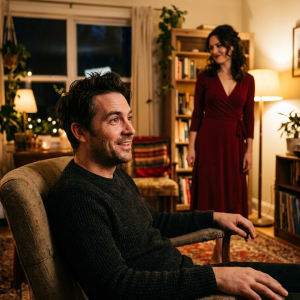
He was thirty-nine years old, sixteen months widowed, and learning that exhaustion could become a permanent feature of a man’s face.
Apartment 4C still looked like a place a family had built together and one person had been abruptly removed from. There were framed photos Evan couldn’t take down. A chipped blue mug Grace used for tea that still sat in the wrong cabinet because she always insisted it belonged there. A cardigan hung over the back of a chair because every time he tried to donate it, Liam cried.
And in the corner of the living room stood the upright piano.
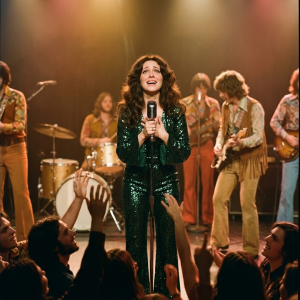
Grace had played almost every night.
Not as a performer. Not with grand ambition. Just because music was how she arranged her own heart. She played while soup simmered, while rain collected on the windows, while Liam lay on the rug with crayons, while Evan answered a late email and pretended he wasn’t listening. There was one piece she returned to more than any other, a strange, simple lullaby made of repeating phrases and a middle section that shifted unexpectedly into something almost aching.
Liam called it “the apartment song.”
Grace had smiled every time he said that.
“Why?” Evan had once asked.
“Because,” Liam had answered solemnly, “when Mom plays it, the walls don’t sound empty.”
Grace died on a Tuesday afternoon in a hospital room so bright and clean it seemed insulting. A sudden stroke. No warning anyone recognized in time. One normal morning, one terrible phone call, one irreversible collapse into before and after.
After that, the piano was silent.
Evan dusted it carefully but never opened it. He couldn’t. The thought of hearing anyone else play the instrument made something in him seize.
Then one Thursday nearly a year later, Liam climbed onto the bench without asking permission and pressed a single note.
Evan had looked up from the sink, ready to stop him, but the child’s face made him stay still. Liam was staring at the keys with fierce concentration, sounding out the beginning of the apartment song one uncertain note at a time.
“I want to keep Mom here,” he said when he got stuck.
Evan had to turn away so his son wouldn’t see him cry.
From then on, Liam practiced every Thursday after school. It wasn’t loud. It was barely music at first, more like memory searching for shape. But week by week the melody grew more recognizable.
Apparently, recognizable enough for the woman next door.
Her name, he would later learn, was Tessa Hale.
Until that evening she was only a hallway figure to him: mid-thirties, tall, dark curls usually tied back too tightly, sharp cheekbones, severe headphones, eyes that looked permanently exhausted by the existence of other people. She never smiled. She never chatted. She had the cold efficiency of someone who’d spent too much of her life managing damage.
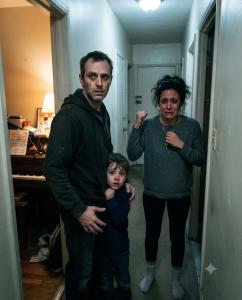
Then Liam was halfway through the apartment song one Thursday evening when three furious bangs shook the shared wall hard enough to rattle a framed photo.
Liam jumped so badly his hands flew off the keys.
Before Evan could move, a woman’s voice cut through the wall.
“Stop playing Grace’s song!”
Every nerve in his body went rigid.
The music had stopped. The apartment had gone completely silent. Yet somehow the room felt louder than ever, as if an alarm had been triggered in a place no one knew existed.
Evan crossed the room, threw open the apartment door, and found the woman from 4D in the hallway with one hand still curled from pounding the wall.
She looked stunned to see him there so quickly.
More stunned when Liam appeared behind him.
“How do you know my wife’s name?” Evan asked.
Tessa’s face changed immediately. The irritation vanished. In its place came something raw and cornered.
“I’m sorry,” she said.
“That’s not an answer.”
Liam peered around Evan’s side. “Who is she?”
Tessa looked at the child and for one impossible second it seemed as if she might cry.
“My name is Tessa,” she said.
It meant nothing to Evan.
He repeated the question. “Why did you say Grace’s name?”
Tessa swallowed. “Because that was her song.”
Liam frowned in confusion. “It’s my mom’s song.”
The woman actually flinched.
“Yes,” she said softly. “I know.”
Then Liam saw the key.
It hung from a thin chain around Tessa’s neck, small and silver and old-fashioned. The moment his eyes landed on it, his expression changed.
“My mom had one like that,” he whispered.
Evan felt cold spread through his chest.
Grace had worn a key sometimes, always under her shirt, always removed before bed. Years ago he’d asked what it opened. She had smiled in that evasive little way he used to find charming and said, “An old mistake.”
He’d laughed.
She hadn’t explained.
Life had moved on.
Now Tessa’s hand flew to the key, too late to hide it.
Liam stepped forward, all fear replaced by wonder. “She said if I ever heard the song through a wall, it meant the key was lonely.”
Tessa stumbled backward as though someone had pushed her.
The hallway seemed to contract around them.
Grace had left a message. Not in a letter. Not in a safe deposit box. Not in anything Evan had ever found.
Inside a song.
Inside a child’s memory.
Inside a sentence so strange it should have meant nothing and somehow meant everything.
That was how Tessa ended up standing in his living room twenty minutes later while Liam sat on the couch clutching a pillow and staring at both adults as if adulthood had turned into a language he didn’t speak.
Evan made tea because he didn’t know what else to do with his hands. No one drank it.
Tessa stood near the piano but would not touch it. Her eyes kept drifting to the keys like they accused her of something.
“Start talking,” Evan said.
She took a slow breath. “I knew Grace before you.”
That much was obvious.
“How?”
Tessa looked at Liam, then back at Evan. “Not all of this is for him.”
“Then choose carefully.”
She accepted that. Maybe she knew she had no right to object.
“We were together,” she said.
The room tilted.
Evan didn’t speak. Didn’t blink.
Tessa continued before he could stop her. “Years ago. Before you. Before Liam. Before the life she built here.” Her mouth tightened. “We were serious. More serious than she let most people know.”
Evan stared at her.
Grace had told him she’d had relationships before him. She’d been vague in the comfortable way married people often are when the past feels irrelevant. A college girlfriend once mentioned in passing, Evan remembered now. It had been folded into a broader conversation about youth and mistakes and self-discovery. He had not asked many questions. He told himself that made him evolved, trusting, mature.
Now it felt more like blindness.
“She was going to leave with me,” Tessa said.
Evan heard Liam shift on the couch. He forced his expression to remain steady.
“What are you talking about?”
“Before your wedding.” Tessa’s voice shook now, not from uncertainty but from memory. “Grace told me she was engaged to a good man and about to choose the safe life everyone expected. But she said she couldn’t breathe inside the decision anymore. She found me again. We started talking. Then meeting. Then pretending we weren’t doing either.”
The words landed one by one, each one sharp.
“It wasn’t a fling,” Tessa said. “It was… unfinished. That’s what she called it. Something she had buried because everyone around her wanted the other version of her life.”
Evan felt his jaw lock.
He wanted to reject all of it on instinct. Wanted to say no, you’ve mistaken grief for access, no, you’ve built a drama around a dead woman who can’t defend herself, no, you’re cruel.
But Liam’s remembered line about the lonely key stood between them like proof.
Tessa went on quietly. “We rented a storage box together for the things she said she couldn’t keep at home. Letters. Photos. A few recordings. One envelope she told me never to open unless the song came back through a wall.”
“The song,” Evan repeated.
She nodded toward the piano. “It was our signal once. A private thing. When we lived in different apartments years ago, she’d play that piece after an argument. If I heard it through the wall, it meant come over, I’m still here, I’m still angry, but don’t let me disappear.”
Evan sat down because suddenly standing felt impossible.
“And the key?”
“We each kept one. Same lock. Same promise.” Tessa gave a humorless smile. “Grace liked symbolism more than practicality.”
That, at least, sounded horribly true.
Liam’s small voice cut in. “Did my mom lie?”
Both adults turned.
Children did not ask questions in soft ways. They laid them on the table like hard objects.
Tessa’s face crumpled. “I think your mom loved very deeply,” she said.
“That’s not what I asked.”
Evan almost broke then, because Liam sounded so much older than seven.
“No,” Evan said quietly. “That’s not what he asked.”
Tessa pressed her lips together. “Yes,” she said at last. “She lied. To me. To your dad. Maybe to herself most of all.”
She explained in fragments, stopping when details strayed too far into territory Liam didn’t need. Grace had reconnected with Tessa months before the wedding. They met in secret. They talked about leaving. Not only Evan, Tessa said, but everything Grace’s family expected from her. The apartment song became their signal again. The storage box became a place to put whatever didn’t fit the life Grace was publicly choosing.
“She disappeared the night before your rehearsal dinner,” Tessa said to Evan. “Do you remember?”
Of course he remembered. Grace had claimed she needed space, had gone off alone for hours, had returned pale and strange and said she’d panicked about the wedding but was fine now.
“I met her that night,” Tessa said. “She was supposed to come with me.”
Evan’s vision blurred at the edges.
“She packed a bag,” Tessa continued. “She had the second key. She cried the entire time. And at the last minute she said she couldn’t do it. Not because she didn’t love me. Because she looked at me and said if she chose me, she’d lose her family, her future, the child she already wanted even though he didn’t exist yet. She said with you she could be loved without burning everything down.”
The sentence struck like a slap.
Evan thought of Grace laughing in the kitchen. Grace asleep on his shoulder. Grace holding newborn Liam and weeping because she had never felt anything so fierce. None of those memories vanished, but they shifted, as if their foundation had cracked.
“Why stay silent after she died?” he asked.
Tessa’s answer came instantly. “Because she made me promise.” She touched the key at her throat. “She said if she ever died before telling the truth herself, I was not allowed to tear apart the family she chose unless she gave me a sign I couldn’t ignore.”
“The song.”
“The song through a wall.” Tessa nodded. “And the message.” Her eyes found Liam. “She told me she might hide a line inside the lullaby for a future child because children remember what adults dismiss.”
Liam looked both proud and uneasy, as if he sensed he’d opened a door too heavy for him.
Evan stood abruptly. “Where is the box?”
Tessa looked toward the piano.
“Grace said if this moment ever came, you’d know where to look.”
He followed her gaze and felt a chill race over his skin.
The piano had never been moved since Grace died. Not once. He had cleaned around it. Avoided its underside. Treated it like a shrine.
With hands that barely felt connected to his body, he and Tessa shifted it away from the wall.
A small metal tin was taped underneath the back corner, hidden in shadow.
Liam gasped.
Evan peeled it down with trembling fingers.
Inside was a folded note, a tiny brass address tag, and a key.
Another key.
He stared at Grace’s handwriting before he could bring himself to unfold the note.
For Evan and whoever has to stand beside him when this opens.
His throat closed.
He read in silence first. Then, because Tessa deserved to hear what Grace had left, he read aloud.
Grace wrote that she had loved them both. That the sentence sounded selfish because it was selfish. She wrote that she had tried to split herself into acceptable pieces and had only succeeded in wounding everyone. She wrote that marrying Evan had not been fake, not convenient, not a cover for emptiness. She loved him. She loved the steadiness he gave her, the gentleness, the home they made.
But she had also loved Tessa before him and never fully stopped.
The storage box, she wrote, contained the part of her life she had not found the courage to integrate with the one she chose. Not because it was shameful, but because she was afraid of what honesty would cost. She called that fear “the oldest mistake of my life.”
Then came the part that made Evan sit down on the floor.
There was one more truth, Grace wrote. The reason she could never fully sever the past. The reason Tessa mattered long after she was supposed to be over.
Liam had been born because Grace had chosen Evan. But Liam had been named because of Tessa.
The lullaby Evan thought belonged only to their family was one Grace and Tessa had written together years earlier after losing a pregnancy no one else knew about.
Tessa broke at that point, one hand flying to her mouth.
“She never told you,” Evan said faintly.
Tessa shook her head through tears. “She only told me she couldn’t survive losing me twice.”
The room seemed to fill with the weight of all the grief Grace had carried without dividing it cleanly enough for anyone to understand.
The address tag led to a storage facility across town.
They did not go that night. Liam was exhausted, frightened, and clinging to Evan’s hand like the floor might split if he let go. So Evan put him to bed first.
At the bedroom door Liam asked, “Did Mom still love us?”
Evan knelt in front of him, feeling the enormity of answering for a dead woman.
“Yes,” he said. “None of this changes that.”
Liam considered it. “Can people love wrong and still love real?”
Evan closed his eyes for half a second. “I think sometimes that’s exactly the problem.”
The next morning, Evan left Liam with his sister and met Tessa at the storage facility.
The box inside was smaller than he expected. A banker’s box. Ordinary. That made it worse somehow.
Inside were photographs of Grace and Tessa in their twenties, laughing with the reckless softness of people who still believed joy could stay uncomplicated. Letters tied with ribbon. A cheap motel keycard. A receipt dated the night before Evan’s wedding. A hospital bracelet from years ago with Grace’s name on it. And beneath everything, a cassette tape labeled in Grace’s handwriting:
If you open this, I’m gone or finally brave.
They found an old player at Tessa’s apartment.
Grace’s voice filled the room, warm and unmistakable. Evan had not heard her speak in a new sentence since she died. It nearly leveled him.
She apologized first. Not elegantly. Not enough. Just honestly.
She said she had lived too long as two separate women and had mistaken compartmentalizing for kindness. She said Evan deserved the truth before marriage and Tessa deserved more than a farewell disguised as sacrifice. She said every time she planned to confess, she imagined the losses lined up behind honesty and chose cowardice instead.
Then she spoke directly to Tessa.
She thanked her for surviving the years after their breakup. For keeping the key. For not exposing the life Grace chose out of anger. She confessed that the pregnancy they lost together had frightened her so deeply that she fled into the version of adulthood that looked safer. She had loved Tessa, she said, but she had been too afraid to build a life that required constant courage.
Finally, she spoke to Evan.
She said their marriage had been real. The happiest parts were not lies. Liam had been the clearest joy of her life. But love was not always neat enough to justify the choices made in its name, and she was sorry for leaving him to discover her fractures after her death.
When the tape ended, no one moved for a long time.
The resolution, when it came, was not cinematic. There was no screaming scene, no dramatic object thrown, no final denunciation that neatly sorted innocence from blame.
There was paperwork. Tears. Three boxes: keep, store, discard.
Evan took the photos of Grace alone and with Liam. Tessa kept the letters addressed to her. The hospital bracelet went back into the box. The motel receipt was thrown away. The tape was copied so neither of them had to beg the other for access to the last truth Grace left behind.
Over the weeks that followed, Tessa stopped wearing headphones to check the mail.
Liam asked once if Tessa could come hear him practice, and Evan almost said no on instinct. Then he said yes.
The first time she sat in their living room while Liam played the apartment song, she cried quietly and did not try to hide it. When he finished, she told him his mother used to rush the middle section too.
Liam smiled for the first time in days.
Evan never became friends with Tessa in any easy sense. Their connection was too jagged for that. But they became something stranger and maybe more honest: two people left behind by the same woman, carrying different versions of her, learning that grief can compete with betrayal and still refuse to cancel it out.
Sometimes Evan listened to the copied tape alone after Liam slept. Not because it made anything simpler. Because it didn’t. Because the voice of the woman he loved now came threaded with truths that bruised him and comforted him at the same time.
Grace had lied.
Grace had loved.
Grace had been brave in moments and cowardly in others.
Grace had built a home while hiding another life inside it.
Grace had hurt people and been tender with them too.
In the end, maybe that was the part that stayed with Evan most.
Not whether she had been good or bad.
Not whether Tessa should have fought harder or disappeared sooner.
Not even whether forgiveness was deserved.
It was the quieter, more terrible question left behind in the empty spaces after the truth had been aired:
How well can you ever know the person you trust most, and if the love was real, does discovering the hidden rooms make the whole house false — or just human?