They said Loretta Phelps didn’t have a fight left in her.
In Granger County, that sentence had been passed around so often it stopped sounding cruel. It became one of those things people said with lowered voices and sympathetic eyes, as though kindness could excuse the damage done underneath it.
Loretta had been Earl Phelps’s wife for thirty-eight years. They had built a life the way most farm families did—one season stacked on top of another, through dry years and wet years, through machinery breakdowns and market swings and the endless math of trying to hold onto what your parents handed down long enough to pass it to your children. They had no flashy kind of marriage. Nothing dramatic. Nothing people in town would gossip over. But everybody knew they were solid.
Then Earl got sick.
It started with the fatigue. Then the appointments in Des Moines. Then the diagnosis that turned every ordinary day afterward into something measured and precious. He lasted eleven months after that. Long enough to put his affairs in order, or so he believed. Long enough to trust the people closest to him. Long enough to think his wife would be protected.
He was wrong about one person.
Diane Phelps had married Earl’s younger brother years before and had spent most of her life studying the county the way a card player studies a table. She knew who liked to feel included, who could be flattered, who repeated everything they heard, who would confuse confidence with competence. After her husband died, Diane became even more polished. More involved at church. More visible at the co-op. More helpful in public and harder to question in private.
By the time Earl’s funeral flowers had wilted, Diane was already inserting herself into the practical matters that follow a death. Meals. Forms. Bank visits. Phone calls. She came by Loretta’s house with files tucked under her arm and that soft, efficient voice that made everything sound reasonable.
“You don’t need to worry about all this right now,” she told Loretta more than once. “I’ll help you sort it.”
At first, Loretta was grateful.
Grief is a strange kind of fog. It makes simple decisions feel punishing. People ask you questions and your mind moves too slowly to catch up. You sign where they point. You nod because resisting takes more energy than you have.
Later—much later—Loretta would go back over those weeks and realize how carefully Diane had worked. Never too forceful. Never impatient in a way anyone else could witness. Just present. Helpful. Necessary. There with a pen. There with explanations. There with one paper after another, framed as temporary arrangements, standard filings, routine updates.
Loretta signed some of them. She knew that much.
What she did not know was that the documents transferring control of a significant portion of the Phelps family grain shares had not been what Diane claimed they were. Nor had all the signatures on file been handled honestly.
By the time Loretta understood the consequences, the changes had already been entered. The grain revenue that had once come through her side of the family line had shifted. Diane was suddenly speaking at meetings as though she had always been the natural steward of that piece of the operation.
When Loretta objected, she was met with pity.
That was Diane’s genius.
She never outright attacked Loretta. Open cruelty can create sympathy for the victim. Instead, Diane built a gentler narrative and repeated it until it hardened into truth.
“Poor Loretta,” she would say at church potlucks, laying a hand over someone’s wrist. “She’s been through so much. After Earl passed, she just wasn’t thinking clearly. But nobody blames her.”
At feed store mornings, she said it with a sigh. At 4-H fundraisers, with concern. At family holidays, with the kind of careful sorrow that makes other people feel slightly ashamed for even wondering whether the story could be false.
“She signed the papers herself. Nobody forced her.”
Each time she said it, she made herself sound compassionate and Loretta sound unstable.
People believed her because Diane looked like the sort of woman communities reward. Organized. Composed. Involved. She chaired committees. She sent flowers. She remembered birthdays. She could ruin you without ever raising her voice.
Loretta watched it happen for two years.
She said little. That, too, was turned against her. Silence made people assume weakness. If she had truly been wronged, surely she would have fought harder. Surely she would have said more.
What they didn’t understand was that Loretta was not silent because she had nothing. She was silent because she was waiting.
The envelope appeared eight months after Earl’s funeral.
Her daughter, Melissa, noticed it first on Thanksgiving Day. They were clearing dishes, and Loretta’s black church purse tipped sideways on the counter. A cream-colored envelope slid into view, hand-addressed in blue ink. No return address. There was a water stain on the bottom left corner, as if someone had once set it down beside a sink or on a wet porch rail.
“What’s that?” Melissa asked.
Loretta looked at it for half a second before tucking it back inside. “Just something I’m holding onto.”
Melissa assumed it was a letter from Earl, or maybe an old insurance paper her mother couldn’t bear to throw away. There was enough pain in the house already. She let it go.
But the envelope kept showing up.
At Christmas, Loretta carried it in her purse the entire day.
At Easter, the family was crowded around the long dining table at Diane’s house when Loretta set the purse down too near the edge. The flap loosened. The envelope slipped halfway out.
Diane saw it immediately.
She reached across the table, smiling. “Oh, let me—”
Loretta’s hand came down over the purse with a crack sharp enough to rattle silverware.
The whole table went quiet.
Loretta smiled then, but it wasn’t apology. “I’ve got it.”
Diane withdrew her hand. “Of course.”
No one said much after that, but Melissa saw the look on Diane’s face. Not anger. Something quicker, thinner. Alarm.
By the Fourth of July cookout, Carol Briggs had noticed the envelope too. Carol had lived next door to the Phelpses for seventeen years and had the practical instincts of a woman who had seen too much to be fooled by polished people. She noticed things others missed. The way Loretta had grown less fragile instead of more. The way she listened now. The way she said almost nothing when Diane’s name came up, as if she were measuring each silence.
At the cookout, the envelope emerged again when Loretta reached for a napkin.
Carol laughed softly. “What on earth is in that thing, Loretta?”
Loretta touched the edge of it with her thumb. The folds were soft from use. “Nothing,” she said. Then her mouth shifted into that tiny private smile Carol had come to recognize. “Just something I’m holding onto.”
Carol let it rest there. But that night, as she washed her dishes, she kept thinking about the envelope and the way Loretta’s fingers had lingered on it—not like someone clinging to the past, but like someone carrying a key.
The truth had arrived in Loretta’s mailbox on a Tuesday in late spring, months earlier.
The letter had not been from Earl directly. It had come from a retired legal secretary named Joanne Mercer, who had once worked for an attorney in Ames handling estate and farm succession matters. Joanne had been sorting through old office storage after her former employer’s death when she found a file box marked with Earl Phelps’s name. Inside was a sealed personal note Earl had left with instructions: If any dispute arose regarding the transfer of his grain shares or if Loretta appeared not to have received the enclosed statement, a copy was to be forwarded to her private address.
Joanne had no idea whether the condition had been met until she overheard, months later at a church event in a neighboring county, someone mention that “the Phelps widow signed everything away after the funeral.” The phrase lodged in her mind. She went home, pulled the file, and mailed the packet.
Loretta opened it alone at her kitchen table.
Inside was a signed letter in Earl’s handwriting, dated six days before his death. Along with it were notarized instructions he had dictated in the hospital, clearly stating that his grain shares were to remain under Loretta’s control until her death, after which they would be divided equally between their daughter and son. There was more. Earl named Diane specifically. He wrote that under no circumstances was his sister-in-law to be granted authority over those holdings because, in his words, “she has pressed this matter more than once while I have been sick, and I do not trust her intentions.”
Loretta read the pages once, then twice, then again until the words blurred.
It was not merely proof that Diane had lied. It was proof Earl had seen the danger before he died.
The first shock gave way to something colder and steadier. Loretta did not rush to confront Diane. She did not march into the co-op. She did not run from neighbor to neighbor with copies in her hand. She understood something about Granger County that Diane also understood: truth spoken too early, by the wrong person, in the wrong room, can be smothered before it catches.
She needed witnesses.
She needed timing.
She needed a moment Diane could not control.
So she carried the envelope.
Everywhere.
She read the letter until she could recite parts of it from memory. She took it to one attorney, then another. The first was too cautious. The second advised discretion but warned her that publicly embarrassing Diane could complicate ongoing legal review. Loretta listened and nodded and kept waiting. At last she met with Martin Heller, the cooperative’s attorney, a gray-suited man with a habit of pausing before he spoke. He examined the documents, requested certified records, compared dates, and found discrepancies large enough to chill even his professional manner.
Some signatures on the transfer paperwork were badly timed. One had been witnessed under circumstances that did not align with hospital visitation records. Another supporting form had language inconsistent with the version Loretta remembered seeing. Martin never accused Diane outright in those early meetings. But he did say, “Mrs. Phelps, if these records are what they appear to be, the cooperative will have no choice but to address this formally.”
Loretta asked him one question.
“Can it be addressed where she can’t talk her way around it?”
Martin had looked at her for a long moment before saying, “Possibly.”
The harvest banquet gave them the opening.
It was the biggest social event of autumn in Granger County. The kind of evening people planned outfits for and discussed for weeks afterward. Attendance was high. Board members came. Donors came. Farmers, spouses, local business owners, clergy, people with long memories and quick tongues—all under one roof.
And Diane, as fate or vanity would have it, put herself at the center of every detail.
She organized the centerpieces. Approved the menu. Coordinated the seating. Selected the music. And, with one of those “small logistical choices” nobody questions until too late, placed Loretta at table eleven, back left, partially hidden behind a pillar.
When Carol found out, she muttered, “That woman ought to be ashamed.”
Loretta only said, “It’s fine.”
It was more than fine. It was useful.
The Farmer of the Year award had been all but announced in advance through whispers and assumption. Diane had done enough public cultivation that the prize seemed inevitable. Which meant the room would be full, attentive, and trained on her when the moment came.
On the evening of the banquet, Carol drove Loretta to the cooperative hall. The sky over the fields had gone violet with early autumn dusk, and the wind carried that crisp, dry smell of cut corn and cooling dirt.
“You sure about tonight?” Carol asked as she parked.
Loretta held her purse in both hands. “I’ve never been more sure of anything.”
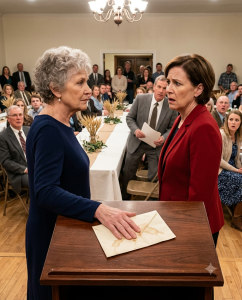
Inside, the room glowed with chandelier light reflecting off white tablecloths and polished cutlery. Diane, in a red blazer, moved through the crowd like someone already accepting her own legend. She greeted Loretta from a distance with the exact right amount of politeness and no warmth at all.
Loretta took her place at table eleven.
She sat through dinner. Through the salad course. Through the prime rib. Through the coffee service. She spoke when spoken to. Smiled when appropriate. All the while, her hand moved occasionally to the clasp of her purse.
Carol noticed. She said nothing.
At table nine, Martin Heller sat unnoticed, program folded beside his plate.
When the speeches began, the room settled.
The cooperative president offered thanks to the sponsors, the volunteers, the season’s hard work. Then he introduced Diane.
The applause rolled out immediate and warm.
Diane rose, touched beneath one eye with theatrical restraint, and approached the podium. She began beautifully. That was the maddening thing. She was good at this. Her voice carried. Her pauses were perfect. She spoke of stewardship, family legacy, honoring the sacrifices of those who came before. She spoke as though she herself were the guardian of every decent value in the county.
Loretta listened until Diane said, “We carry forward what others built—”
Then she stood.
Not abruptly. Not shakily. Simply completely.
People noticed in stages. A few heads turned. Then more. A hush spread down the left side of the room as Loretta stepped into the aisle with her purse over one arm.
Diane kept speaking for several seconds, pretending not to see. The co-op president frowned. Carol set down her fork. Martin Heller rose from table nine.
Loretta reached the podium.
She did not snatch the microphone or touch Diane. She placed the cream-colored envelope on the wood between them. The water stain caught the overhead light. The softened folds were visible even from the front tables.
Then Loretta looked directly at Diane.
The color left Diane’s face so swiftly that several people later swore it happened before Loretta said a word. In that instant, before the explanation, before the reading, before the legal language, everyone saw something no rumor could soften.
Diane recognized the envelope.
Loretta turned slightly toward the room. “Before Diane finishes this speech,” she said calmly, “I think folks ought to hear what Earl put in writing the week before he died.”
No one moved.
From table nine, Martin approached, taking a folded document from his jacket pocket. “Mrs. Phelps,” he said, “are you asking that this be entered into the record of the cooperative this evening?”
“I am,” Loretta replied.
Diane found her voice. “This is inappropriate. Whatever this is, it can be handled privately.”
Loretta looked at her without flinching. “You had two years for private.”
There are moments when a room shifts allegiance so suddenly it feels physical. This was one of them. People who had repeated Diane’s story at church and over coffee now stared as though seeing her in a different light entirely. A few exchanged quick, guilty glances. The president stepped back from the podium. Carol sat rigid, heart hammering.
Martin opened his own papers. “The cooperative was notified this afternoon,” he said, “that there may have been material misrepresentation in the transfer of the Phelps grain shares.”
A murmur swept the hall.
Diane turned on him. “You don’t know what you’re talking about.”
Martin didn’t blink. “Mrs. Phelps, before this proceeds, is there anything you would like to amend regarding your previous statements about those signatures?”
She said nothing.
That silence hurt her more than any denial could have.
Loretta slid the letter from the envelope. Her hands were steady. “Earl left instructions,” she said. “And he left them where they’d be found if the wrong papers ever surfaced.”
Diane leaned forward, all pretense stripped away. “You weren’t supposed to have that,” she hissed.
The room heard enough.
Loretta unfolded the first page and began to read.
Earl’s words were plain, direct, unmistakably his. He stated that Loretta was to retain control of the grain shares. He wrote that any claim otherwise should be treated as fraudulent. He named Diane specifically and warned against pressure from her regarding transfer of authority.
By the second paragraph, someone in the audience whispered, “My God.”
By the third, Diane’s hand was braced against the podium to keep it from shaking.
Martin then read from the corroborating documents: hospital dates, notarization records, procedural inconsistencies. Not all of it amounted to criminal proof on its own, but together it did something just as devastating in that room. It destroyed Diane’s story. Completely. Publicly. In her own moment of glory.
The co-op president, red-faced and stunned, announced the award presentation would be suspended pending review. No one applauded. No one defended Diane. She tried once, weakly, to say there had been misunderstandings. But misunderstandings do not make a widow guard an envelope for a year. Misunderstandings do not make an attorney rise from table nine with documents already prepared.
Diane stepped away from the podium to a silence so merciless it was louder than shouting.
She left the banquet through the side door without her speech, without her award, without a single ally following close behind.
After that, events moved quickly.
The cooperative opened a formal investigation. The transfer was frozen. Additional records were subpoenaed. Within weeks, legal proceedings began to unwind the share change. Diane’s standing in the county collapsed not because of one dramatic accusation but because too many people had now seen the same thing at once: the fear on her face before the first line was read.
That expression became impossible to explain away.
Loretta did not celebrate publicly. She attended the necessary meetings, signed the corrective documents, and answered questions with the same measured calm she had shown at the banquet. When neighbors approached her in grocery aisles or after church, stumbling over apologies for believing the wrong person, she accepted some and simply nodded at others.
“You did what you thought made sense,” she told one woman who nearly cried in the canned goods aisle. “Now you know better.”
Carol remained her fiercest defender. “You don’t owe half this county grace,” she said one afternoon over coffee.
Loretta stirred cream into her cup and looked out the kitchen window toward the fields. “Maybe not,” she said. “But I’m tired of Diane taking more than she already has.”
In the end, the grain shares were restored to Loretta exactly as Earl had intended. Diane avoided jail, though only narrowly and only because parts of the paperwork trail proved murkier than her ambition deserved. But she lost the cooperative appointments, the committee positions, the easy invitations, the confidence of every room she entered. She had spent years building an image that depended on everyone mistaking softness for goodness. Once that cracked, there was not much underneath worth saving.
As for the envelope, Loretta kept it for a while longer.
One evening in early spring, after the last hearing was over and the first fieldwork had begun again, Melissa found her mother on the porch with a small metal box beside her. The envelope was in her lap.
“You still carrying it?” Melissa asked.
Loretta smiled. “Not anymore.”
She placed the letter and the supporting papers into the box with Earl’s watch, a few photographs, and the pearl earrings she only wore on special days. Then she closed the lid.
Melissa sat beside her in the cool dusk. “Dad knew,” she said quietly.
Loretta looked out across the land he had loved. “He did.”
“And you knew what to do.”
Loretta took a slow breath. “Not right away.”
That was the truth of it. Courage had not arrived in a flash. It had come in pieces—through grief, humiliation, patience, paperwork, and the stubborn refusal to let someone else write the ending of her life.
In Granger County, people still talk about the night of the harvest banquet. About the envelope on the podium. About Diane turning white. About the attorney at table nine. Most tell it now as a story of justice, of a widow reclaiming what was hers.
But the part that lingers longest is quieter than that.
It is the image of Loretta standing up from table eleven, half-hidden behind a pillar where someone else had tried to place her, and walking calmly into the center of the room with the truth in her purse.
That is the part people remember because it forces an uncomfortable question: how often do we mistake silence for surrender? How often do we believe the person who speaks smoothly over the person who waits, watches, and carries proof?
Some in Granger County still say Diane was desperate, that grief and money and pride can twist anyone. Others say she knew exactly what she was doing from the start. Maybe both are true. Maybe desperation is only the excuse people use when calculation finally gets caught.
Loretta never argued the point. She got the land shares back. She got Earl’s intentions restored. She got her name untangled from Diane’s version of events.
But what she really took back that night was something larger.
The county had buried her under pity. Diane had counted on that. Counted on people seeing a widow and assuming fragility, confusion, defeat. Counted on Loretta shrinking herself to fit the story someone else told about her.
She didn’t.
And maybe that is the red flag nobody should ignore again: the person most eager to narrate another woman’s weakness is often hiding the reason she needs that woman to stay quiet.