By the time Mariana Beltrán saw the horse at her fence, she already knew something was wrong.
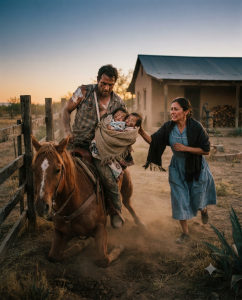
Healthy horses announced themselves. They struck the earth with purpose, tossed their heads, breathed like creatures built to endure another mile. This mare came as though every step was borrowed. Foam hung from her mouth. Her sides fluttered with panic and exhaustion. Her eyes rolled white with the terrible determination of an animal trying to finish one final duty before its body gave out.
Mariana straightened from the washbasin and shielded her eyes from the sinking sun.
A man was draped over the saddle.
At first she thought he was drunk or dying, maybe both. Then she noticed how he was folded protectively around his own chest. Not like a man guarding money. Like someone guarding life.
The mare hit the fence line, stumbled, took three weak steps, and collapsed in a cloud of dust.
The rider pitched forward and landed hard.
Mariana dropped the shirt she had been washing and ran.
For two years she had avoided running toward trouble. Trouble usually came looking for her anyway. Since her husband Esteban had died, the ranch had become a battlefield fought with paperwork, threats, and the smug certainty of men who believed a widow could be pushed off her own land. Esteban’s brothers had tried charm first, then pressure, then insult. Mariana had survived all of it by becoming harder than they expected.
But the sight of a man broken in the dirt stirred something older than caution.
When she reached him, she rolled him onto his back.
His skin was burned deep brown by the sun, except where salt tracks from old sweat had dried pale across his temples. His lips were split. There was dried blood at his shoulder and more fresh blood seeping through a tear in his shirt. He smelled of leather, dust, fever, and horse.
“Sir,” she said, patting his face lightly. “Can you hear me?”
A thin cry answered her.
Mariana froze.
The sound did not come from the man. It came from beneath the serape tied across his chest.
Her fingers moved before her mind did. She tugged at the knots, loosened the rope, and peeled back the blanket.
Two baby girls stared up at her with heat-flushed faces and swollen eyes. They were wedged against the man’s chest, bound there tightly enough to survive a fall. One whimpered weakly. The other let out a furious, exhausted cry that sounded far too strong for a child so close to collapse.
“Holy Mother…”
Mariana gathered them up and hurried inside.
Her small ranch house was clean, sparse, and practical, with whitewashed walls and furniture repaired more than once. She laid the babies in a basket lined with folded sheets, then returned for the man. Dragging him across the threshold was brutal work. He was tall, broad-shouldered, and dead weight with fever. By the time she got him onto a narrow sofa, her arms trembled.
She boiled water, found clean cloths, and cut away the fabric around his shoulder. The wound looked grazed more than pierced, but it had bled plenty and he had kept riding with it long enough to invite infection. When she removed his boots, she grimaced. His feet were blistered and torn. His palms were worse, the skin peeled raw where he had clung to the reins.
The babies cried again.
Mariana abandoned the wound long enough to warm water and mix in evaporated milk. She had no bottles, so she used a spoon and patience. The quieter one swallowed greedily, then settled with wide, solemn eyes. The louder one protested every pause, then finally gave in to sleep.
Near midnight the stranger woke.
He bolted upright with a strangled inhale. “The girls.”
“They’re here,” Mariana said from beside the basket. “Alive.”
He saw them and closed his eyes with such visible relief that she knew instantly this man had ridden farther on fear than on strength.
“What’s your name?” she asked.
“Mateo Urquiza.”
“Who are they?”
He struggled to answer. “I found them near La Tinaja creek. Four days ago.” His voice broke on the memory. “There was a truck burned out. A livestock trailer too. Bodies in the brush. A whole family.”
Mariana sat still.
“The mother hid the girls under some loose boards,” he continued. “She lay over them. Shielded them with her body.”
Mariana looked at the sleeping babies and felt cold creep over her arms despite the heat.
“Who did it?”
“I saw riders nearby. Two horses branded Doble R.”
Rancho Doble R.
The name carried weight all through that stretch of Sonora. Money. Influence. Men willing to settle matters where witnesses were scarce. Mariana had heard enough to know trouble often rode under respected brands.
“I think they came back looking for anyone left alive,” Mateo said. “That’s why I took the hills. I didn’t trust the road.”
“Did you know the family?”
“No. I found a Bible. Larios. Tomás and Julia Larios.”
Mariana looked toward the basket again.
By sunrise, Mateo was deep in fever. Mariana sat up most of the night beside the girls, listening to them breathe and wondering what kind of fate had crossed her threshold. One had a pale crescent mark tucked behind her ear. Luna, she thought. The other watched her with a grave expression no infant should wear. Sol.
Temporary names, she told herself.
At dawn, while washing the bloodied serape, Mariana discovered the hidden pocket sewn inside it. The stitches were rough, hurried, nearly invisible.
Inside was a letter wrapped in oiled cloth.
To whoever finds my daughters, it began.
Mariana should have stopped there and ridden to the authorities. Instead she read.
Julia Larios’s handwriting shook across the page. She wrote that if anyone was reading this, she and Tomás were likely dead. She begged the finder not to trust anyone from Rancho Doble R. Then came the line that made Mariana’s breath catch:
Do not trust Sheriff Becerra.
That was bad enough. But the next lines changed everything.
If the name Beltrán means anything to you, go to the old well behind the north mesquite fence. What was buried there in 1978 is why they are killing us now.
Mariana read it again. Beltrán. Her married name. Her ranch. The old well near the north mesquite fence had been forbidden ground for as long as she had known the family. Her father-in-law had always claimed the stone ring was unstable. After his death, Esteban’s older brothers had repeated the warning too eagerly.
One of the girls cried inside.
Mariana folded the letter and tucked it into her apron pocket just as Mateo appeared in the doorway, unsteady and pale.
“You opened it,” he said.
“You knew there was a letter?”
“I guessed. A mother hiding children usually leaves more than prayers.”
Mariana held his gaze. “How did she know my name?”
Mateo looked past her toward the north edge of the property. “I don’t think Julia was fleeing them at random,” he said quietly. “I think she was trying to get here.”
Before Mariana could ask another question, the dogs started barking.
Dust rose beyond the gate.
Riders.
There were five of them, and at the front was Roque Beltrán, her dead husband’s older brother.
He reined in outside the house as if he owned the land already. Roque was a broad man with polished boots, a neat mustache, and the calm eyes of someone accustomed to being believed. He removed his hat with practiced courtesy.
“Mariana,” he called. “We heard there’s a wounded drifter on your property. Sheriff sent us to help.”
Mateo went rigid.
Mariana stepped onto the porch before Roque could see him clearly. “I didn’t ask for help.”
Roque’s smile never touched his eyes. “That may be. But dangerous men have been moving through the region. We wouldn’t want you alone with strangers.”
His gaze drifted past her shoulder, toward the interior of the house.
Then a baby cried.
Every rider looked up.
Mariana saw the shift instantly. Tiny. Deadly. Roque hadn’t come to help. He had come to confirm.
“There’s no danger here,” Mariana said.
Roque rested a hand on the saddle horn. “Then you won’t mind us stepping inside.”
She heard Mateo moving behind her.
“No,” she said. “I will mind.”
Roque’s pleasant expression thinned. “Careful, Mariana. Pride has cost this family enough already.”
Family.
The word landed like a warning.
Then old Tacho, the ranch hand who had worked for Mariana since before Esteban died, emerged from the barn with a shotgun cradled openly in his arms. He was seventy if he was a day, half blind in one eye, and stubborn as mesquite roots.
“The señora said no,” Tacho growled.
For one suspended moment nobody moved.
Roque tipped his head and smiled again, but this time it was pure threat. “We’ll return with the sheriff.”
“You do that,” Mariana said.
The riders wheeled away. Dust swallowed them.
Inside, Mateo sagged against the wall. “They know.”
“I noticed.”
“Then we don’t have time.”
That afternoon Mariana saddled her mule and rode with Mateo to the north mesquite fence, leaving Tacho with the babies and strict instructions to fire if anyone touched the gate. The old well sat half-hidden by brush, a stone circle choked with weeds. No one had gone near it in years.
Mateo climbed down first and tested the cover—rotted boards and rusted wire. Beneath it, the well was mostly dry, filled in long ago with dirt and rubble.
They dug.
For two hours they found nothing except broken stone, roots, and old cans. Mariana’s back burned. Mateo’s wound seeped through fresh bandages. Then her shovel struck wood.
A box.
They cleared it together and hauled it up with rope.
Inside, wrapped in oilcloth gone stiff with age, were ledgers, maps, and a smaller tin case. The ledgers carried cattle counts and land numbers. The maps showed disputed boundaries between the Beltrán property and Rancho Doble R. The tin case held photographs.
Mariana opened the first one and went cold.
Her father-in-law stood beside the former owner of Rancho Doble R and Sheriff Becerra’s father. Behind them was a group of laborers kneeling in the dirt, wrists bound. On the back someone had written a date: June 1978.
The next photograph was worse.
A young woman with terrified eyes held a baby. Her face was unmistakable even through time.
Julia Larios.
Or rather, Julia as an infant in her mother’s arms, with a note on the back identifying the mother as Elena Ruiz—one of several Indigenous families who had vanished from the region after a land “reorganization” in the late 1970s.
The ledgers explained the rest in brutal fragments. Families had been forced off land at gunpoint. Birth records altered. Bribes paid to officials. Children redistributed through church contacts and false paperwork when their parents resisted or disappeared. The Beltráns and the men behind Doble R had not simply stolen land.
They had stolen identities.
Mateo found the final envelope tucked beneath the maps. Inside was a notarized statement signed by a dying priest who had helped falsify baptisms decades earlier. He named names, detailed payments, and identified one child survivor placed under a new identity.
Julia Larios.
She had discovered the truth about her own origins. That was why she and Tomás had been hunted. And the babies?
Mariana unfolded the attached page with shaking hands.
The girls were heirs—through Julia—to a tract of land and water rights illegally absorbed by the network that still linked the Beltráns, Doble R, and the sheriff’s office. If Julia had gone public, decades of theft could unravel.
No wonder they were dead.
No wonder the babies had been marked for disappearance.
Mariana pressed a hand to her mouth. Her husband Esteban had never spoken of any of this. Either he truly hadn’t known, or his silence had been another inheritance.
“We have to get this somewhere safe,” Mateo said.
Mariana nodded. “Not to Becerra.”
“There’s a federal prosecutor in Hermosillo,” Mateo said. “My cousin hauled freight for him once. Honest man, supposedly.”
Supposedly wasn’t much. But it was more than they had locally.
They barely made it back to the house before Roque returned—this time with Sheriff Becerra and six more armed men.
Becerra dismounted heavily, all official concern. “Señora Beltrán, we received reports you’re harboring stolen children and a suspect wanted for questioning.”
Mateo muttered, “There it is.”
Roque’s eyes slid to Mariana. “Hand over the babies. Let the law handle the matter.”
Mariana could feel the documents hidden beneath the false bottom of a grain chest just inside the kitchen. Tacho stood near the barn again, jaw clenched. The babies were asleep in the back room.
She stepped forward.
“The law?” she said. “You mean the same law named in a dead woman’s letter?”
Something flickered in Becerra’s face.
Too much.
That was all Mariana needed.
She raised her voice so every ranch hand within hearing could catch the words. “Sheriff Becerra, are you denying you knew Julia Larios? Are you denying your office buried land records from 1978? Are you denying these men came for those children before sunrise?”
Roque lunged from the saddle. Mateo grabbed Mariana’s arm. Tacho fired a warning blast into the dirt.
Everything exploded after that.
Horses reared. Men shouted. Becerra yelled for everyone to stand down. In the chaos, Mariana ran for the grain chest, pulled the documents free, and thrust them into Mateo’s hands.
“Ride,” she said.
“What about you?”
“Ride!”
Mateo hesitated only a second, then snatched up one of the babies. Mariana grabbed the other and bolted for the mule tied behind the shed. Tacho, magnificent old fool, swung the shotgun like a club at the first man through the gate.
Roque caught Mariana by the arm before she could mount.
“You have no idea what you’re doing,” he hissed.
She looked him straight in the eye. “I know exactly what your family did.”
His grip tightened. “Esteban knew enough to keep quiet.”
The words hit harder than the bruise forming under his fingers.
Her husband had known.
Maybe not everything. But enough.
Mariana’s grief shattered and reformed into something cleaner than sorrow. Rage. The kind that leaves no room for doubt.
She drove her knee into Roque’s thigh and twisted free. Mateo fired Roque’s own dropped pistol into the air. The horses panicked again. Dust, shouting, screaming babies, men stumbling over one another—the yard became a storm.
Mariana mounted with Sol clutched to her chest. Mateo swung up behind the mare with Luna and the packet of evidence. Tacho shouted for them to go.
They rode.
Not toward town, where Becerra could intercept them, but south through arroyos and scrub until dark, then west to a freight road where Mateo knew a driver willing to ask no questions for cash. By dawn they were in Hermosillo, filthy, exhausted, and desperate enough to force their way into a federal building before anyone could stop them.
It turned out Mateo’s “supposedly honest” contact was real.
The prosecutor listened.
More importantly, he read.
Within days the photographs, ledgers, the priest’s confession, and Julia’s letter triggered an investigation too large for local men to bury. Federal officers sealed records, questioned church archives, froze transfers tied to Doble R, and detained Sheriff Becerra before he could vanish. Roque fled for less than a week before being caught at a private crossing near the border.
The investigation dragged old bones into daylight.
Mass displacement. Falsified land claims. Missing families relabeled as runaways. Children separated and reassigned under false records. The region had been living on a polished lie, and the babies Julia died protecting had become the proof nobody could dismiss.
Mariana testified.
So did Mateo.
The hardest moment came when Mariana admitted under oath that Roque had told her Esteban knew. She had spent years defending the memory of her husband against the greed of his brothers. Learning that he had carried some part of the truth in silence felt like losing him a second time, only this time the grief came with betrayal.
Still, she told the truth.
Because silence was how all of it had survived.
The girls remained in protective custody only briefly. Julia’s letter had named Mariana specifically if anything happened to her. Combined with the danger, the evidence, and Mariana’s role in saving them, it carried weight. So did the testimony of the prosecutor, who said plainly that no local placement would be safe.
By the end of the year, Luna and Sol were still in Mariana’s house.
Their legal names were restored through the investigation, but at home the nicknames stayed. Luna still had the pale crescent behind her ear. Sol still watched rooms as though measuring everyone in them. They grew out of fear slowly, like children learning that the world could hold gentleness after all.
Mateo healed too, though the scar in his shoulder pulled when storms came. He never spoke dramatically about staying, but somehow one repair led to another, one season to the next, until he was simply there—mending gates, hauling feed, teaching the girls how to sit a horse long before they were truly old enough.
People in town talked, as towns do.
Mariana ignored them.
She had spent enough years letting other people define what a widow should do, what a ranch should be, what loyalty required. She no longer had patience for rules built by cowards.
The legal fights over the land lasted a long time. Some parcels were restored. Some compensation was paid. Some truths remained incomplete, because the dead do not answer every question and records can only confess what men once bothered to write down. But the central lie was broken, and that mattered.
Years later, when the girls were old enough to ask about the letter, Mariana showed it to them at the kitchen table.
She told them about Julia’s courage.
About Tomás.
About the mare who had carried hope to her fence and died there.
About Mateo refusing to abandon them.
About the cost of truth and the greater cost of burying it.
Luna cried first. Sol did not. She simply held the page with steady hands and said, very quietly, “She knew someone would choose us.”
Mariana had no answer for that. Not a good one.
Because the truth was, she almost hadn’t. She had almost handed the letter over unread. Almost trusted the wrong men. Almost listened to all the old training that told women not to interfere in the machinery of power.
Instead she opened a page and stepped into a war she never asked for.
That was the aftershock of the whole story, the part that lingered longer than the arrests or the headlines or the land disputes: evil had needed many people to cooperate, but it had only taken one tired widow on a hot morning to interrupt the ending.
Whether forgiveness belonged to Esteban was a question Mariana never fully settled.
Whether Roque and the others deserved mercy was easier.
They had built their lives on the idea that the truth could be buried deep enough to disappear.
They were wrong.
And two little girls lived because their mother, with death closing in, believed that somewhere ahead there might still be one person brave enough to read a letter—and act.