Jacinto Salazar had faced drought, disease, debt, and death without blinking in front of other men.
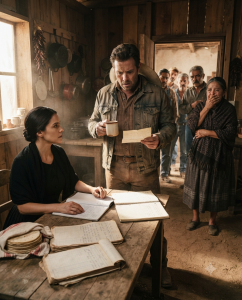
But the morning his brother’s widow told him his ranch had been bleeding money for eight years, he nearly dropped his coffee in front of twelve ranch hands and his own mother.
That was the kind of humiliation he never forgot.
The kitchen of Rancho La Esperanza had always been the center of everything important—contracts signed over black coffee, arguments settled over beans and tortillas, births announced, funerals discussed, droughts counted, and alliances built with men who judged each other by eye contact and silence. It was where Jacinto’s father had once sat at the head of the table like a king of dust and cattle. It was where Daniel, the younger son, used to read while everybody else talked over him. It was where their mother, Doña Amparo, had learned to survive by turning tenderness into steel.
And now it was where Mariana Rivas, Daniel’s widow from Monterrey, was calmly dismantling the myth that held the whole place together.
“La Esperanza has been losing money for eight years,” she said, one hand resting on a ledger thick with old entries and newer lies.
Nobody moved.
The ranch hands lowered their eyes. Evaristo, the foreman who had worked for the Salazars since before Jacinto could ride, stared at the floor. Doña Amparo stood in the doorway with her shawl wrapped tight around her shoulders, as if the woman at the table had dragged cold air into the house.
Jacinto laughed once, sharp and humorless.
“You came here to sell your share,” he said. “Not to judge a ranch you don’t understand.”
Mariana looked up at him. She had tired eyes but a steady voice.
“I came here to settle Daniel’s estate. But Daniel left me twenty-five percent of this ranch, and I’m not signing anything blind.”
That word—blind—hit harder than she probably intended.
Because blindness was exactly how La Esperanza had survived for years. Selective blindness. Inherited blindness. The kind families called loyalty when they were too afraid to call it denial.
Jacinto had not expected her to stay more than two days. He thought she would arrive dressed in city black, grieve politely, ask practical questions, and then leave with a check. Instead, on her very first night, she found the account books in an old wooden drawer and sat up reading them until dawn.
By the time Jacinto returned from checking the lower pasture, she had pages of notes and a look on her face he already hated.
He hated it because it wasn’t arrogance.
It was certainty.
That certainty followed them all day as they rode the land. Mariana asked about infrastructure costs, feed ratios, damaged fencing, water access, supplier patterns, herd performance, and maintenance on parcels that should have been cut loose years earlier. Jacinto knew the terrain with his eyes closed, but her questions exposed a weakness he had spent his whole life covering with labor.
He knew the land.
He did not know the numbers.
That difference had never mattered while his father was alive. Don Salazar had ruled by instinct, force, memory, and fear. If he wanted a fence repaired, it was repaired. If he wanted more cattle bought, money appeared from somewhere. If the books looked ugly, he blamed weather, government, labor, or bad luck. Nobody challenged him. Least of all Jacinto, who had been raised to believe obedience was masculinity and doubt was betrayal.
Daniel had been the only one who ever questioned things out loud.
And because of that, Daniel had always been treated as both son and stranger.
He was the boy who preferred ledgers to lariats, the young man who left to study administration, the brother who came back with sharp observations nobody wanted, then left again before conflict could root itself. Jacinto loved him, but he also resented the ease with which Daniel could stand apart from the mud and exhaustion of ranch life while still claiming to understand it.
That resentment had outlived him.
Maybe that was why Mariana unsettled Jacinto so quickly. She carried Daniel’s habits into rooms that had never forgiven him for having them.
That evening, when she laid out the numbers in front of everyone, the first real crack opened.
“Of the 1,600 hectares,” she said, “1,100 are costing more to maintain than they produce. The profitable 500 are subsidizing the rest. Feed losses are rising. Fence repairs are inflated. Water expenses make no sense in three separate zones. If this continues, the ranch won’t collapse all at once. It’ll be hollowed out slowly until there’s nothing left to save.”
Doña Amparo’s mouth tightened.
“My son died, and now his widow comes to tell us his home is worthless?”
Mariana turned toward her. “That’s not what I said.”
“It’s what you mean.”
Jacinto slapped his hand on the table.
“This ranch is not for sale.”
Mariana didn’t flinch. “Then stop treating reality like an insult.”
Before he could answer, one of the younger ranch hands came running in with news that the fence at the dry paddock had failed and forty head of cattle were out. The wire, he said, had been bought just six months earlier.
Mariana checked the invoice already in front of her.
“That wire was billed as new,” she said. “And overpriced.”
She laid out more invoices after that. Fence wire. Feed. pump repairs. Gate hinges. Labor. Receipts with repeated amounts and suspicious timing. Charges for work that had supposedly been done in areas left untouched for months.
Every paper pointed in the same direction.
Tomás Ledezma.
Supplier. Friend of the family. Trusted presence at every major purchase for years.
Jacinto felt something sink in his stomach.
He had trusted Tomás because his father had trusted Tomás. In places like La Esperanza, that was often enough to turn a man into truth itself.
“Maybe the records are mistaken,” Jacinto said, though he no longer believed it.
Mariana shook her head. “It’s too consistent. This is not sloppiness. It’s extraction.”
The room went still.
Then she added, “And someone inside this house helped make it possible.”
Doña Amparo went rigid. “How dare you.”
Mariana reached into her bag and pulled out an envelope.
“I didn’t come here planning to accuse anyone,” she said quietly. “Daniel gave me this before he got sick. He told me not to open it unless something felt wrong.”
Jacinto saw his brother’s handwriting instantly.
Everything in him tightened.
He took the letter, but before he opened it, he looked at his mother. Her face had changed. Not outrage this time. Fear.
That frightened him more than anything Mariana had said.
He unfolded the paper.
The first lines were unmistakably Daniel—precise, measured, trying to be fair even while preparing a wound.
If you are reading this, Mariana stayed. If Mariana stayed, then the ranch was in worse shape than I thought. That means I was right not to ignore what I found.
Jacinto kept reading.
Daniel had begun reviewing the ranch’s finances years earlier, first out of concern, then suspicion. He noticed the same distortions Mariana had found: inflated invoices, repeated repairs, maintenance on parcels that should have been abandoned, and supplier charges disconnected from reality. He initially suspected Tomás Ledezma alone.
But then came the authorizations.
Not public ones. Not formal signatures in the main books.
Side approvals. Quiet instructions. Handwritten notes carried through workers who didn’t ask questions. Requests that certain costs be delayed, shifted, concealed, or covered from emergency reserves.
Daniel wrote that one name kept appearing around those decisions—not on official ledgers, but in the spaces around them.
Their mother.
Jacinto looked up so suddenly his chair almost tipped.
Doña Amparo was gripping the back of another chair with both hands, as if she needed wood to stay upright.
“No,” he said automatically.
But Daniel had anticipated that too.
I know what you will think, he wrote. That she could never do such a thing. That grief, age, or confusion explain what I saw. I hoped the same. So I confronted her privately.
Jacinto read the next lines twice before the meaning settled.
Their mother had admitted to authorizing Tomás to move money off the books over the years. She did not call it theft. She called it survival.
After Don Salazar’s death, debts Jacinto never fully knew about had started surfacing—private loans, interest-heavy arrangements, obligations tied to land expansion, machinery, and old political favors. Don Salazar had maintained the appearance of strength by hiding weakness wherever he could. He had died before the accounts came due.
Doña Amparo had panicked.
If the truth came out, the ranch would shrink. Land might need to be sold. Their father’s legacy would look like a performance built on borrowed money. Jacinto, proud and stubborn, would never accept it calmly. Daniel, practical and educated, would insist on restructuring. That would mean exposing their father’s mistakes.
So she made a choice.
Tomás would inflate supplier invoices.
Extra money would be siphoned quietly to cover old debts, private obligations, and one secret payment Daniel clearly struggled to name in writing.
He described it only as money tied to a woman his father had supported for years in another town.
Another family, Jacinto thought immediately.
His hands went cold.
The room was silent except for the scrape of the wind outside.
Daniel had begged their mother to stop. He told her the hidden drain was damaging the ranch faster than the truth ever would. He told her that protecting the image of Don Salazar was destroying the actual future of La Esperanza.
According to the letter, Doña Amparo had cried, denied, justified, and finally said something Daniel never forgot:
Better they hate me after I’m dead than watch your father’s name dragged through the dirt.
Jacinto lowered the paper slowly.
His mother wasn’t looking at him. She was looking somewhere past him, somewhere years behind them all.
“Is it true?” he asked.
She closed her eyes.
For a long time, she said nothing.
Then she nodded once.
That single movement changed the room more than any shouting could have.
Jacinto felt fury rise first. Hot, immediate, easy. Fury at Tomás. Fury at the lies. Fury at the years of hidden rot. Fury at being made a fool in front of workers, neighbors, and himself.
But beneath that was something worse.
Shame.
Because his mother had not acted alone in creating the conditions for the lie. She had counted on his worship of the ranch, his refusal to question his father, his hunger to preserve size over sense. She had counted on him choosing pride over scrutiny.
And she had been right.
“You let me break my back for this place,” he said hoarsely, “without telling me what it really was.”
Doña Amparo finally looked at him. Her face had collapsed into age in a way he had never seen before.
“I was trying to save your father.”
“No,” Mariana said from the edge of the room. “You were trying to save a story.”
Doña Amparo flinched because it was true.
The rest came out in fragments, then in floods. Tomás had started as a willing helper, then realized the arrangement could enrich him. What began as hidden transfers to pay off Don Salazar’s old obligations gradually became broader theft. Once nobody stopped him, he inflated more, delayed more, pocketed more. Evaristo had suspected problems but never the full scale. Workers noticed missing materials and poor repairs, but on a ranch built on hierarchy, most men learned early that seeing was not the same as speaking.
Jacinto wanted to ride straight into town and kill Tomás with his bare hands.
Instead, Mariana stopped him.
“You do that,” she said, “and you turn him into the victim you need him not to be.”
The sentence landed because it was practical, not dramatic. It was the kind of sentence Daniel would have said.
For the first time since her arrival, Jacinto truly heard his brother in her.
So instead of riding out alone, they called a lawyer in the county seat. Then an accountant. Then a police contact Mariana knew through Daniel’s old business circle. By nightfall they had copies of the invoices, photographs of the ledgers, recordings of Doña Amparo’s admission made with her permission once the shock passed, and written statements from Evaristo and two workers who had delivered materials that did not match the billing.
Tomás Ledezma did not expect them the next morning.
He was in his warehouse when Jacinto arrived with Mariana, the lawyer, and two officers. At first he smiled. Then he saw the papers. Then he saw Doña Amparo step out of the truck behind them, face uncovered, grief and guilt visible to everyone.
That was the moment he understood he had lost his shield.
Tomás denied everything for exactly four minutes.
After that, he turned ugly.
He blamed Don Salazar. He blamed Amparo. He blamed the economy. He blamed Daniel for digging where he shouldn’t. He even blamed Jacinto for being too proud to notice the theft happening in front of him. In the end, his own anger did what evidence had already begun—he admitted enough to destroy himself.
There had been fake pricing, padded contracts, duplicate invoices, and kickbacks over several years. Some money had gone to debt payments, just as Amparo said. Much more had gone to Tomás.
And yes, there had been another household Don Salazar supported in secret for years.
That revelation spread through the family like poison.
The woman lived in Parral. She had a grown son. The ages lined up in a way nobody wanted to calculate out loud. Whether the man was truly Don Salazar’s child would remain uncertain for a while, but the possibility alone tore open every old wound in the house. Doña Amparo stopped defending her husband after that. Whatever illusion she had tried to protect died in her face before anyone said another word.
The legal process took months. Assets were frozen. Tomás lost contracts, standing, and eventually his freedom. Some of the money was recovered. Not all of it. Enough to matter, not enough to erase what had happened.
The harder part was saving La Esperanza.
That required something Jacinto had never once considered an act of courage.
Shrinking it.
They sold the weakest parcels first—the land that had been consuming money for years just to preserve a number men in neighboring ranches respected. They renegotiated supplier contracts, modernized water use, cut dead costs, and rebuilt the accounting system from the ground up. Jacinto hated every meeting, every signature, every acre released.
But he hated the old lie more.
For the first time in his life, he let numbers speak louder than pride.
Mariana stayed through all of it.
Not because she wanted the ranch for herself, and not because forgiveness came easily. She stayed because Daniel had asked, because the truth had already cost too much to abandon halfway, and because somewhere between conflict and collapse, she and Jacinto began to understand each other through the grief they had once weaponized.
He learned she had never pulled Daniel away from his family. Daniel had chosen distance when the ranch stopped being a home and became a monument no one was allowed to question. She learned Jacinto’s hardness had always been less cruelty than inheritance—an armor built by a father he could never satisfy and a mother who mistook silence for strength.
Doña Amparo changed the slowest.
Confession did not make her gentle. It made her tired. Truly tired. Some evenings she sat in the kitchen and stared at the empty chair where her husband used to sit, as if finally seeing the man instead of the legend. She apologized to Mariana one evening without witnesses. It was not graceful and it was not complete, but it was real.
“I blamed you,” she said. “Because blaming you hurt less than admitting what he was. Or what I became trying to defend him.”
Mariana accepted the words without pretending they repaired everything.
By the following year, La Esperanza was smaller, leaner, and profitable for the first time in nearly a decade.
Neighbors talked, of course. They said Jacinto had surrendered land. They said the Salazars were not what they used to be. They said a widow from Monterrey had come in and broken the family apart.
They were wrong in the most important way.
The family had already been broken.
She had only forced the fracture into the light.
One late afternoon, long after the courts and sales and accusations had settled into history, Jacinto found Daniel’s letter again in the office drawer where he now kept current ledgers instead of old ghosts. He read the final paragraph a second time, slower than before.
If the truth reaches the house after I’m gone, don’t waste your strength deciding who looked weaker. Ask who was willing to keep lying and who was willing to lose something to stop it.
He folded the paper carefully.
Outside, the ranch was quieter than it had been in years. Smaller too. Fewer fences. Fewer cattle. Less spectacle.
More future.
From the doorway he could see Mariana crossing the yard with a folder in one arm, the wind catching loose strands of her hair. His mother sat on the porch, watching her, no longer with hatred, but with the painful caution of someone who understood too late that the person she had called an enemy had been the only one loyal enough to tell the truth.
Maybe that was the real wound at the center of everything.
Not the money. Not the land. Not even the betrayal.
It was how easy it had been for all of them to confuse love with protection, pride with honor, silence with loyalty, and memory with truth.
And once a family starts worshiping what should have been questioned, the most dangerous person in the room is often the one brave enough to open a drawer, add the numbers, and refuse to look away.