The worst humiliation the Salazar family ever suffered happened in front of the entire town, but by the time the shouting started in the cantina, the real damage had already been done.
It began three days earlier on Daniel Salazar’s ranch, under a burning Chihuahua sky.
The evening had turned the plains red. Dust hovered over the dry grass and drifted in long ribbons along the fence posts. The wind smelled like hot earth and burnt mesquite, and Daniel was finishing a repair on an old saddle when his horse gave a low, uneasy snort and turned its head toward the far edge of the property.
Daniel looked up and saw movement.
Something small.
Unsteady.
At first, he thought a calf had broken through from another ranch and wandered too far in the heat. But the shape moved wrong for an animal. It paused, swayed, then kept going as though each step was a fight.
He set down the saddle and started walking.
The closer he got, the more his chest tightened.
It was a little girl.
She looked no older than nine. Her dress was torn and caked with dust. One side of the hem had been ripped nearly to the knee. Her feet were bare, scratched raw, and packed with dirt and thorns. A loosened braid hung over one shoulder, and her lips were cracked from thirst. But none of that hit him as hard as her expression.
She looked at him like she expected cruelty as naturally as weather.
Daniel stopped several paces away. He knew enough about frightened animals—and frightened people—to understand that sudden kindness could be just as alarming as violence. He slowly raised both hands.
“I won’t hurt you.”
She didn’t understand him. He could see that. But she heard the quiet in his voice.
Still, she tried to step back.
Her knees buckled.
Daniel moved on instinct, then forced himself to stop before touching her. Instead, he pulled off his canteen, bent down, and set it in the dirt between them. Then he backed away.
The girl stared at the canteen. Her eyes flicked from the water to his face and back again. Finally she dropped into a crouch, grabbed it with both hands, and drank so fast water ran down her chin.
Daniel looked away for a second.
There was something unbearable about the sight of a child drinking like that.
His ranch stood far from the nearest town: a low adobe house, a weathered stable, a broad corral, and land that rolled out in dry stubborn stretches toward the sierra. The Salazars had owned it for generations, though “owned” was a word Daniel had come to dislike. People bled for land. Lied for it. Buried their better selves in it.
His father had ruled the place with silence and hard work. His mother ruled through family pride. And his older brother, Esteban, ruled through appetite.
Since their father’s death, Esteban had become obsessed with selling part of the ranch to a mining company from Sonora. He spoke of progress, opportunity, investment, modernity. Daniel heard greed dressed in clean clothes. Too many armed strangers had been seen in the hills lately, asking local ranchers and Indigenous families about hidden water sources, old footpaths, and who still knew the mountain well enough to move through it unseen.
Daniel had no intention of helping any of them.
He guided the girl toward the house slowly, careful not to crowd her. When she hesitated at the doorway, he entered first, lit the stove, and gave her time to decide whether to follow.
Eventually she did.
He heated beans, tortillas, and broth. When he placed the food in front of her, she stared at it with such suspicion that he felt anger at whoever had taught her food could come with danger attached.
“Eat,” he said gently, pointing.
She sat still another moment, then reached forward.
At first she ate in tiny bites.
Then hunger won.
Daniel moved across the room and picked up a broken length of rein, pretending to mend leather so she wouldn’t think he was studying her. Once the bowl was empty, she held it like she expected someone to snatch it away.
He made up a place for her near the hearth and left a folded blanket there. He slept in a chair by the door. In the middle of the night, he woke to the sound of her whimpering in her sleep. The words were unfamiliar, but the pain in them didn’t need translating.
The next morning she watched him as if she still hadn’t decided whether this was rescue or delay.
He pointed to himself. “Daniel.”
She blinked.
Then, very faintly, she touched her own chest and said something that sounded like “Aiyana.”
He repeated it carefully. “Aiyana.”
She said nothing more, but she did not correct him.
Over the next few days, their silence softened. Daniel taught her words by pointing to objects and repeating them. Water. Bread. Horse. Fire. House. Morning. Night.
When he said, “Safe,” and tapped his own chest before gesturing around the room, she hesitated for a long time before repeating the word.
It was the pause that stayed with him.
As if safety was not a place she knew could be real.
Little by little she relaxed. She fed corn to the chickens. Helped sweep the porch. Sat on the front step at dusk and watched the sky turn violet over the mountains. Sometimes Daniel caught her studying him as he worked with the horses, her expression alert and searching, like she was trying to solve the mystery of him.
Why had he taken her in?
Why had he asked for nothing?
The truth was simple. Daniel knew what it was to grow up under someone else’s power and spend years learning to hide pieces of yourself just to survive. He recognized that look in her.
On the fourth morning, peace ended.
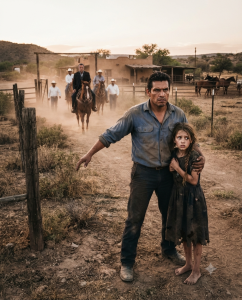
Esteban arrived just after sunrise with two men in white hats and polished boots. The kind of men who looked ridiculous on a ranch until one noticed how comfortably their hands hovered near their belts.
Esteban remained on horseback and surveyed the yard with open contempt.
“So it’s true,” he said. “You really brought her here.”
Daniel stepped out of the stable, already irritated. “Why are you here?”
Esteban’s gaze slid toward Aiyana, who had appeared in the doorway and immediately frozen.
“Well now,” Esteban said. “An Apache girl. You always did have a weakness for trouble.”
Aiyana retreated behind Daniel so quickly she brushed his arm.
“She’s a child,” Daniel said.
“She’s a missing child,” Esteban replied. “There’s a difference.”
Daniel’s eyes narrowed.
Esteban enjoyed the silence too much before continuing.
“The mining men have been asking around. Seems a girl disappeared near the old pass. Seems her family knows something valuable. A spring, maybe. A route. Something worth paying for.”
Daniel felt his body go cold, then hot.
“She stays here.”
Esteban laughed softly. “You don’t understand. Men are looking for her.”
“Then they can keep looking.”
One of the white-hatted men smirked at that, but Esteban’s face hardened.
“Mother won’t forgive this,” he said. “Do you really think the Salazar name should be dragged through the dirt for a stranger?”
The word stranger had barely left his mouth when Aiyana made a frightened sound and clutched at the neckline of her dress.
Then she pulled something out from beneath it.
A medallion.
Small. Silver. Tarnished nearly black with age.
Daniel stared so hard his vision seemed to narrow around it.
The symbol engraved on the metal was a split sun pierced by an arrow.
He had seen that symbol every day of his childhood.
His father had worn the same medallion on a leather cord beneath his shirt. He used to touch it absentmindedly when he was thinking. Daniel remembered being a boy and asking where it had come from. His father had only said, “From a debt I never finished paying.”
Nothing more.
Now the exact same symbol hung in a child’s shaking hand.
“Where did you get that?” Daniel asked.
Aiyana looked from him to the mountains, terror spreading across her face. Her lips moved.
“Mamá.”
Daniel heard it clearly.
Then came the thunder of horses.
Dust rose beyond the gate. Several riders. Fast.
The two men beside Esteban looked toward the road, but not with surprise. With expectation.
Daniel turned slowly.
“You brought them.”
Esteban did not answer.
He didn’t need to.
The riders came in hard, their horses blowing and stamping as they reached the yard. They wore dust-colored jackets and the expression of men too used to getting what they wanted. The one in front swung down from his saddle and nodded at Esteban as though they had an understanding.
That was enough.
Daniel stepped forward, putting himself fully between the men and the child.
“You’re not taking her anywhere.”
The lead rider looked amused. “That’s not your decision.”
Aiyana grabbed Daniel’s sleeve with both hands and tried to pull him backward. She was whispering frantically now, pointing first to the rider, then to the medallion, then to Daniel. Her breathing had turned ragged.
Daniel’s eyes dropped to the rider’s saddle.
Something metallic dangled near the horn.
Another medallion.
The same split sun. The same arrow.
The rider saw him notice and smiled.
In that moment Daniel understood three things at once.
First, his father’s secret had not died with him.
Second, Esteban knew more than he had admitted.
Third, this girl had not stumbled onto the ranch by accident. She had come carrying the key to something men were willing to hunt a child for.
“Who are you?” Daniel asked.
The rider’s smile faded. “Ask your brother.”
Daniel did.
Esteban slid off his horse at last, dusted his hands, and avoided his eyes.
That cowardice told Daniel even more than the answer itself.
“My father knew her people, didn’t he?” Daniel said.
Esteban muttered, “He made arrangements years ago.”
“With children?” Daniel snapped.
“With protection,” Esteban shot back. “You think the world was kind out here? He hid things. Water locations. old routes. names. He traded silence for peace.”
The lead rider interrupted. “Peace is over.”
Aiyana made a small sound that pulled Daniel’s attention back to her. She was crying now, not loudly, but with desperate restraint. She touched the medallion and then pointed toward the sierra. Then she pressed her palm against her chest.
“My mother,” Daniel said carefully. “Your mother had one too?”
Aiyana nodded hard.
The rider took a step forward. “That belongs to us.”
Her reaction was immediate. She recoiled like he had struck her.
Daniel drew a breath. “No. It belongs to her.”
The man’s face changed.
So did the air in the yard.
One of the other riders shifted, hand lowering toward his belt. Daniel noticed. So did Esteban.
“Don’t,” Esteban warned, suddenly nervous.
Daniel almost laughed at that. Now he was nervous?
What happened next moved too quickly for thought. Aiyana tugged Daniel toward the house, then toward the back, then toward the hills beyond the stable. She wanted out. Away from the men. Away now.
The lead rider saw it and lunged.
Daniel hit him before the man touched her.
The yard exploded into shouting. Horses reared. One of the white-hatted men grabbed Esteban and cursed at him for letting this get out of control. Daniel drove his shoulder into the rider’s chest and sent him stumbling into the dust. Aiyana ran for the side of the house.
“Stop her!” someone shouted.
Daniel turned like lightning and caught the second rider by the arm before he could reach her. The man swung at him. Daniel took the blow, answered with one of his own, and heard Esteban yelling his name from somewhere behind him.
Then a voice cut through everything.
An older woman’s voice.
Sharp. Furious. Familiar.
“Enough!”
Daniel’s mother had arrived in a wagon from town, drawn by the commotion. She climbed down with the fury of a queen stepping onto a battlefield and demanded to know what disgrace was unfolding on Salazar land.
The answer came all at once.
Neighbors had followed her. Then workers from the road. Then curious men from nearby ranches. Word spread faster than fire in dry grass. By nightfall, the argument had moved to the cantina in town, because that was where every scandal in Chihuahua eventually ended up—under lamplight, with witnesses.
The lead rider, now sporting a split lip, wanted public pressure. Esteban wanted support. Daniel wanted truth.
And truth finally came from the one person no one expected.
Daniel’s mother.
At first she tried to command silence, but when the medallion was laid on the table and the rider produced another one, her face drained of color.
“What is it?” Daniel demanded.
She looked at Esteban.
He looked away.
Then she looked at Daniel, and for the first time in years, he saw shame break through her pride.
“Your father made an oath,” she said quietly.
The cantina went still.
She explained that during a drought nearly twenty years earlier, when cattle were dying and the Salazar wells were turning to mud, an Indigenous family from the mountains had guided Daniel’s father to a hidden spring that saved the ranch. In return, he swore the land near that spring would never be sold, mapped, or handed to outsiders. He sealed the promise with matching medallions—one for himself, one for their family. A sign of debt and protection.
But after his death, Esteban learned the mining company had discovered rumors of water beneath the hills. A hidden spring would multiply the land’s value. He had spent months trying to find its exact location.
“When he couldn’t get it from me,” Daniel’s mother said, voice breaking, “he started asking others. Dangerous men.”
The lead rider sneered. “Business men.”
She ignored him.
“Aiyana’s mother was the keeper of the route,” she said. “When they pressured her, she fled. She sent the child with the medallion to find the one Salazar she believed might still honor his father’s word.”
Daniel felt the room tilt.
Aiyana had not chosen the ranch at random.
She had been sent to him.
All around the cantina, murmurs spread like a wave.
Daniel turned to Esteban slowly. “You hunted a child for water.”
Esteban’s face hardened under the weight of every eye in the room. “For survival. For the future. For this family.”
“No,” Daniel said. “For money.”
The lead rider stepped in, trying to regain control. “This is sentimental nonsense. That land can be purchased, documented, developed—”
He never finished.
Because Esteban, desperate and cornered, made the mistake that destroyed him.
He pointed at Aiyana, who stood beside Daniel wrapped in a shawl, and spat, “She’s a wild little thief who wandered onto land that isn’t hers.”
The whole cantina heard it.
Every laborer. Every rancher. Every old woman at the back. Every man who had ever known hunger or shame.
Daniel crossed the room and grabbed his brother by the collar so hard a chair crashed backward.
“You apologize,” he said.
Esteban sneered. “To her?”
Daniel dragged him to the door.
The cantina exploded in noise as Esteban stumbled, cursed, and tried to wrench free. Daniel didn’t stop. He hauled him out through the entrance and threw him into the dirt in front of half the town.
“Get out,” Daniel said.
Esteban looked up in disbelief, dust on his face, pride shattered under the lanterns.
Daniel’s voice carried across the street.
“You are no brother of mine if this is what you’ve become.”
No one moved.
No one defended Esteban.
That was the humiliation people would remember.
Not just that Daniel had thrown him out.
But that the town silently agreed he deserved it.
The riders left before dawn, realizing they had lost the cover of secrecy. Too many people now knew about the spring, the oath, and the child they had chased. Daniel’s mother, stripped of her excuses, confessed everything she had hidden to preserve family reputation. The medallions were handed to the local priest for safekeeping until proper witnesses could mark the protected land in writing.
Aiyana stayed.
Two days later, just after sunrise, a woman emerged from the foothills with three others behind her. Thin, exhausted, and guarded, but alive.
The moment Aiyana saw her, she ran.
Her mother dropped to her knees in the dirt and caught her so tightly it looked like she was trying to make up for every lost hour in a single embrace. Neither of them spoke at first. They only held on.
Daniel stood a few steps away, hat in hand, giving them privacy he knew they deserved.
When the woman finally looked up at him, her eyes were wet but steady. She touched the medallion at Aiyana’s throat, then pressed her hand over her heart and bowed her head.
He understood.
No translation was needed.
In the weeks that followed, papers were drawn. Boundaries were marked. The spring and its route were legally protected from sale. Daniel refused the mining company’s final offers, no matter how high they climbed. Esteban disappeared from town not long after, unable to bear the way people looked at him now.
As for Daniel, he returned to the same work he had always done—mending tack, breaking colts, fixing fences under the Chihuahua sun. But the ranch no longer felt like a place inherited through blood and bitterness alone. It had become something else. A promise kept.
Sometimes, at sunset, Aiyana sat again on the front step and watched the mountains turn purple. Sometimes her mother sat beside her. Sometimes Daniel joined them in silence.
The medallion still caught the last light.
And anyone who heard the story had to decide for themselves what mattered more in the end: the land, the money, the family name, or the moment one man chose to shame his own blood rather than betray a frightened child who had arrived at his door carrying the truth.