“I’ve been waiting for someone to call about that quilt for a very long time.”
The words hit Darlene so hard that for a moment she forgot why she had called at all.
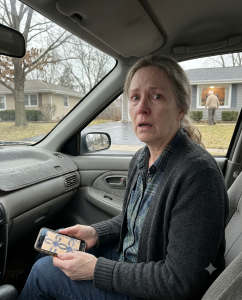
She was sitting in her car in the driveway of the small ranch house she had shared with Gary for twenty-eight years, phone pressed to her ear, keys still in the ignition though the engine was off. Through the windshield, the maple tree in the front yard stood bare and gray against an overcast Indiana sky. Somewhere inside the house, Gary was making lunch, moving around the kitchen with the easy unhurried rhythm of a man who believed Thursday would be exactly like every other Thursday.
But out in the driveway, Darlene’s whole life had just tilted.
She swallowed hard. “I’m sorry,” she said, her voice unsteady. “What do you mean by that?”
The woman on the other end of the line did not sound surprised. If anything, she sounded relieved.
“My name is Patricia,” she said. “And I need you to know I didn’t list that quilt online because I wanted to sell it.”
Darlene looked again at the screenshot on her phone. Vintage handmade quilt, estimated 1980s, passed down through our family. My grandmother received this as a gift and treasured it her whole life.
A gift.
That word had bothered Darlene the moment she read it. It bothered her even more now.
“I listed it,” Patricia continued, “because my grandmother told me something before she died. She said if anyone ever contacted me about that quilt and seemed to know too much about it, I should listen carefully.”
Darlene’s fingers trembled. She lowered the phone for half a second, stared at it, then brought it back to her ear.
“I made that quilt,” she whispered.
Silence filled the line. Not confusion. Not disbelief. Recognition.
Then Patricia spoke, very softly. “My grandmother thought you might still be alive.”
Darlene closed her eyes.
Forty-two years collapsed inward.
She was nineteen again in Muncie, Indiana, sitting at her mother’s kitchen table while the coffee cooled in its cup and the future was decided for her in a voice so calm it still haunted her. There are families who can give this child what we cannot. Her mother had not raised her voice. She had not needed to. In that house, in that time, authority rarely sounded angry. It sounded certain.
Darlene had been too young, too ashamed, and too alone to fight the machinery already moving around her. Relatives stopped asking questions. Church ladies spoke to her more gently than usual, which somehow made it worse. Her mother handled the phone calls. Her aunt handled the arrangements. Somebody found a doctor in Indianapolis. Somebody knew a lawyer. Somebody always knew what should happen next.
No one asked what Darlene wanted.
Or if they did, it was only to check whether she had finally accepted what they had already chosen.
She had accepted it the way people accept being outnumbered.
But before the baby came, before the papers were signed, before the drive to Indianapolis where she wrote her name on a line that felt like a blade across bone, Darlene did one thing that belonged only to her.
She made a quilt.
She made it slowly, stubbornly, almost secretly, on her grandmother’s old wooden quilting frame in the spare bedroom. Cream and cornflower blue. Double-ring pattern. Hand-stitched. She chose every piece of fabric herself from what she could gather quietly without inviting questions. Some squares came from an old dress. Some from feed-sack cotton saved in her mother’s sewing basket. Some from remnants bought with money she should have been using for something sensible.
The quilt took three months.
Every stitch was a way to stay connected to the life inside her.
Every hour bent over the frame was an hour she got to feel like a mother instead of a problem being managed.
On the last night, while the house slept and a single lamp glowed over the frame, she threaded a needle with pale yellow thread and stitched her name into the border seam.
Not where anyone would notice.
Not on the front.
Not where it could be clipped away by someone trying to erase her.
She folded the letters into the binding itself, one by one.
D-A-R-L-E-N-E.
The thread was so close to the cream border it nearly vanished. You could only see it if the light hit the seam the right way. It was the kind of hidden thing that looked like nothing until someone cared enough to search.
She sent the quilt with the baby.
She told herself it was just a blanket.
She knew it was the only proof she was leaving behind.
Now, four decades later, someone in Ohio was telling her that proof had been found.
“My grandmother wasn’t the baby’s mother,” Patricia said.
Darlene opened her eyes. “What?”
“She was the baby’s aunt.”
The words landed with a strange double force. They answered something and broke something open at the same time.
Patricia spoke carefully, as if navigating an old family story filled with rotten floorboards. “My grandmother told me that a baby came into the family through a private adoption in the mid-1980s. She said a young woman in Indiana had given birth, and the baby arrived with a handmade quilt. For years the family story was that the quilt was a gift. But my grandmother stopped believing that.”
Darlene stared through the windshield without seeing the tree anymore. “Why?”
“Because the story never sat right with her,” Patricia said. “She said the quilt was too personal. Too carefully made. Too precious. She used to hold it at the window and study the binding.”
Darlene’s breath caught.
“She found the stitching years later,” Patricia said. “Pale yellow thread inside the seam. A name.”
Darlene already knew. Still, hearing it made her chest ache.
“She told me the name was Darlene.”
A tear slid down Darlene’s cheek.
She had lived a full life since then, at least from the outside. She had married Gary, who was kind in the quiet dependable way that did not ask for performance. They had two sons, both grown now, both decent men with lives of their own. She taught second grade for thirty-one years in a brick elementary school where children lost mittens and forgot lunch boxes and drew pictures with crooked suns in the corners. She made Christmas cookies. Paid off a mortgage. Learned how to laugh again in small everyday ways.
She even kept quilting.
But she never made another cornflower blue double-ring.
And she never stopped wondering whether the child who went away with that quilt had ever known warmth from it, had ever curled under it, had ever dragged little fingers across the stitched rings and felt, without understanding why, that someone had loved her before memory began.
“If your grandmother found the name,” Darlene asked, wiping at her face, “why didn’t she contact me?”
Patricia hesitated. “She didn’t know your last name. She didn’t know if Darlene was your first name or middle name. She didn’t know whether looking for you would destroy a life you had worked to rebuild. And later…” She stopped.
“Later what?”
“Later she became convinced the child herself had never been told the truth.”
Darlene straightened. “What truth?”
Patricia exhaled. “That’s where it gets tangled.”
What followed came in pieces. Her grandmother had always mistrusted the official family version of events. Dates did not line up. Stories shifted depending on who was telling them. A woman who was supposedly a cousin seemed to have been treated too centrally, too protectively, too nervously. There were whispers after funerals. Tense silences when old records were mentioned. One aunt who never spoke about 1984 at all.
Then, shortly before she died, Patricia’s grandmother had taken Patricia’s hand and told her there were lies inside the family that had lasted too long. She said the quilt might be the only honest thing left from the beginning.
“And before she died,” Patricia said, “she told me that if anyone ever called and claimed the quilt, I was supposed to ask one question.”
Darlene’s mouth had gone dry. “What question?”
“Whether the baby was a girl or a boy.”
Darlene did not answer right away. She couldn’t. That detail had lived behind locked doors in her memory for so long that speaking it felt dangerous.
Not one word in the Etsy listing mentioned the baby’s sex. Neither had Becca’s screenshot. Patricia could not have guessed correctly unless there was something real behind all of this.
Finally Darlene whispered, “A girl.”
And Patricia began to cry.
Not loudly. Not dramatically. More like someone hearing an old suspicion harden into fact.
“My grandmother was right,” she said. “She was right all along.”
Darlene gripped the phone harder. “About what?”
Patricia took a shaky breath. “The person who grew up with that quilt was always presented to me as my cousin. But three months ago, my mother confessed on her deathbed that she wasn’t my cousin at all. She said she was my mother’s sister.”
Darlene felt the world narrow to the shape of the steering wheel.
For a moment she thought she had misunderstood. “Your mother’s sister?”
“Yes.”
“Then…”
Patricia finished the thought for her. “Then the woman who grew up with your quilt was raised under the wrong relationship and the wrong story.”
Darlene’s voice came out almost soundless. “Is she alive?”
“Yes.”
That one word split Darlene open.
Alive.
Not lost in some unreachable past. Not dead. Not a ghost she had been grieving without evidence. Alive meant real. Alive meant somewhere on the same earth, under the same sky, breathing through an ordinary Thursday.
But alive also meant forty years.
Forty years of birthdays not celebrated together. Forty years of scraped knees, report cards, heartbreaks, first jobs, weddings maybe, illnesses maybe, joys and griefs and habits and favorite songs. Forty years of another life moving forward while Darlene remained pinned to one unfinished moment in 1984.
“She doesn’t know?” Darlene asked.
“I don’t think she knows any of it,” Patricia said. “Or if she suspects something, she’s never been told plainly.”
“Does she have the quilt?”
“It stayed with my grandmother for years,” Patricia said. “After she died, it came to me. I think Grandma couldn’t bear for it to disappear. I think she believed it might be the thread that led back to you.”
Outside, a truck rolled past. Gary opened the front door, stepped onto the porch, looked toward the driveway, then went back inside when he saw her still in the car. Darlene wondered what he saw from that distance. Probably nothing unusual. Just his wife on the phone.
Her whole body was humming with shock.
“Why put it on Etsy?” she asked.
Patricia gave a sad little laugh. “Because I didn’t know where else to place it where the world might notice. I photographed it, wrote the family-heirloom description because I didn’t know how to explain the truth I wasn’t sure of, and hoped the right person would see it.”
Darlene let that sink in.
All those years she had imagined doors closing. Instead, somewhere in Ohio, another woman had been trying to crack one open.
“There’s something else,” Patricia said.
Darlene’s hand tightened again. “What?”
“My grandmother left a box with the quilt.”
A prickling sensation moved up Darlene’s arms.
“There’s a sealed letter inside,” Patricia said. “She wrote my name on the envelope and beneath it an instruction: Do not open unless her mother is found.”
Darlene stopped breathing.
“And this morning, before you called, I opened the box,” Patricia said. “I didn’t open the letter, but I took it out. Underneath my name there was another name written in smaller letters.”
Darlene could barely force the words out. “What name?”
Patricia did not answer immediately.
Instead she said, “I think you should hear it in person.”
By the end of the call, they had agreed to meet two days later at Patricia’s house in Ohio. Gary sat across from Darlene at lunch while she picked at a sandwich and tried to figure out how to tell her husband that the deepest wound of her life had suddenly developed a pulse again. When she finally spoke that evening, he listened without interrupting, his face full of a kind of stunned compassion that made her cry harder.
He reached across the table and took her hand. “We’ll go,” he said.
“We?”
He looked almost offended. “Of course we.”
The drive to Ohio felt both endless and impossibly short. Every mile gave Darlene more time to imagine and less time to hide. Gary drove most of the way. Darlene watched fields blur past and tried not to build a face in her mind for the daughter she had not seen since birth.
Patricia’s house was a white two-story on a quiet street with early spring flower beds and a green front door. She met them before they even reached the porch.
She was younger than Darlene expected, maybe mid-forties, with tired eyes and a careful manner. She hugged Darlene almost at once, and the awkwardness of being strangers dissolved in shared grief and adrenaline.
Inside, the quilt was waiting on the dining room table.
Darlene stopped at the doorway.
For a moment she could not move.
The colors had softened with age, the cream gone warmer, the cornflower blue a little faded. But it was hers. She knew every imperfect arc, every place where the tension in the stitching shifted because her hands had cramped that night, every choice she had made when she was young and frightened and determined to leave behind one trace no one had asked permission to erase.
With trembling fingers, she touched the edge.
Patricia brought over a lamp. “Show me.”
Darlene nodded. Together they lifted the quilt, angled the border toward the light, and there it was.
Pale yellow.
Nearly invisible until it wasn’t.
D-A-R-L-E-N-E.
Patricia covered her mouth. Gary turned away for a moment, overcome.
It was proof. Small, delicate, undeniable proof.
Patricia then went to a cabinet and returned with a wooden box. Inside lay the sealed envelope, yellowed at the corners. On the front, in shaky handwriting, was Patricia’s name. Beneath it, smaller:
If her mother is found, tell Elaine first in private.
Darlene stared.
Elaine.
She said the name aloud and felt something inside her respond. It was not certainty exactly. More like recognition rising from a place older than logic.
“That’s her?” Darlene asked.
Patricia nodded. “That’s the woman who grew up with the quilt.”
They sat at the dining room table and opened the letter together.
Patricia’s grandmother had written plainly, perhaps because she knew death was too close for gentleness. She explained that in 1984, a baby girl had entered the family through an arrangement barely spoken of and poorly documented. Officially, the child was described as one relative’s daughter by adoption. Unofficially, the truth shifted depending on who was trying to protect whom.
Years later, the grandmother learned the baby had first been taken in by one woman in the family but, after a scandal involving that woman’s failing marriage and fear of public shame, the child’s identity within the family had been altered. Rather than being raised openly as an adopted child from outside the family, she was folded inward and reintroduced under a different relationship. The adults told themselves it would be simpler. Kinder. Cleaner.
It was none of those things.
The grandmother had discovered the hidden name in the quilt and understood that the child came from somewhere else, from someone else, from a young mother whose existence had been buried to make the family story easier to manage.
She tried, the letter said, several times over the years to push for honesty. Each attempt ended in arguments, tears, or silence. In the end she kept the quilt because she believed it was the only object still tied directly to the truth.
At the bottom of the letter was an address and a note.
Elaine deserves the truth, but do not tell her in front of my sister. She will deny until the end.
Patricia lowered the paper with shaking hands. “My mother,” she said. “She was the one who confessed before she died.”
Within a week, Patricia arranged a private meeting with Elaine.
Darlene almost didn’t go through with it. The fear was too large. What if Elaine wanted nothing to do with her? What if the truth felt like an intrusion? What if a woman who had lived under one identity for forty years heard this story and decided it was too late, too painful, too destructive to touch?
But there was also this: it had already destroyed enough.
The meeting took place in a quiet room at a church Patricia trusted. Neutral ground. Soft chairs. A pot of coffee no one drank. Gary sat beside Darlene until the last moment, then stepped out when Elaine arrived.
Darlene heard her before she saw her.
A measured walk. A purse set carefully on a side table. Patricia’s low voice saying, “Please sit down. I need you to hear all of this.”
Then Elaine turned.
Darlene felt the impact physically.
Not because Elaine looked exactly like her. She didn’t. There was another family’s history written in her face too, decades of nurture and circumstance and choices. But the resemblance was there in flashes so powerful they stole breath: the shape around the eyes, the line of the mouth when uncertain, the way she held tension in her shoulders.
Elaine was fifty-one years old. She had two daughters in college and worked in medical billing. She had believed all her life that she was Patricia’s cousin who had simply become more like a sister because the family was close.
She sat down slowly, looking from Patricia to Darlene to the quilt folded on the table.
“What is this?” she asked.
Patricia did most of the talking at first. The letter. The deathbed confession. The hidden stitching. The contradictions in the family story. Elaine listened without interrupting, one hand pressed flat to her chest as though monitoring whether her heart could be trusted.
Finally Patricia unfolded the quilt and angled the border toward the lamp.
The yellow letters appeared.
Elaine stared.
Then she looked at Darlene.
Darlene had thought for years about what she might say if this impossible moment ever came. Every version vanished.
“I made that for you,” she said.
Elaine blinked twice. “For me?”
“When I was pregnant. In 1984.”
No one moved.
“I was nineteen,” Darlene said. “I was told giving you up was the best thing. I didn’t know where you would go. I didn’t know if anyone would tell you about me. I thought maybe if I put my name in the quilt… maybe someday…”
Her voice broke.
Elaine reached for the quilt with both hands, as if afraid it might disappear if she touched it too lightly. She looked at the stitching, then at Darlene again.
“I used to sleep with this when I was little,” she whispered. “Until it got packed away. My grandmother never let anyone throw it out.” She swallowed hard. “She told me once that some things in a family carry more truth than people do. I didn’t understand what she meant.”
Then came the hardest part: questions.
So many questions.
Why had this been hidden? Who decided? Did anyone fight for the truth? Did Darlene try to find her? Did Elaine’s mother know everything? How many people in the family had known and kept silent?
Some answers existed. Some were buried with the dead. Darlene told Elaine what she could bear to tell: the pressure, the arrangements, the paperwork, the helplessness. She did not make herself noble. She did not claim she had fought harder than she had. She told the truth as cleanly as she could.
“I was young,” she said, tears slipping down again. “And I was scared. I have hated that about myself for forty years.”
Elaine cried then too, quietly at first, then with the grief of a person suddenly understanding that an entire section of her own life had been built on omissions.
“You didn’t leave me because you didn’t care,” she said.
“No,” Darlene whispered. “Never that.”
They did not hug immediately. Real life rarely moves that neatly. There was too much shock in the room, too much rearrangement. But before the meeting ended, Elaine asked if she could see Darlene’s hands.
Darlene held them out.
Elaine studied them with an expression Darlene would never forget, then touched the fingertips that had once pulled pale yellow thread through cream fabric.
A week later, Elaine came to Indiana.
This time she met Gary, walked through Darlene’s house, looked at family photographs on the piano, asked careful questions about the sons who were technically her half-brothers though no one was ready to use that word comfortably yet. They ate soup at the kitchen table and laughed once, unexpectedly, over how both Darlene and Elaine hated celery cooked in anything.
Small things became enormous. Similar gestures. Shared expressions. A mutual habit of smoothing napkins flat before meals.
The family did not heal in a straight line. Patricia had to confront surviving relatives who still wanted the old story preserved. Elaine needed months of space between conversations. Darlene’s sons had to absorb the idea that they had a sister no one knew existed. Some relationships deepened. Some cracked under the weight of truth.
But the silence ended.
That was the change that mattered most.
The quilt eventually came home with Darlene for a while. She washed it by hand, dried it flat, repaired one loosened seam without disturbing the letters hidden inside. Later, she gave it back to Elaine, who said it belonged with both of them now and promised it would never again be mistaken for a decorative heirloom with a tidy story.
It was not tidy.
It was proof of love under pressure. Proof of fear. Proof of how families can twist themselves around shame until they call the shape normal. Proof that the smallest hidden thing can outlast the biggest lie.
Months after their first meeting, Elaine asked Darlene one question over coffee.
“Did you ever stop thinking about me?”
Darlene looked at her daughter—because now, at last, she could think that word without swallowing it—and answered honestly.
“Not for one day.”
Elaine nodded slowly, eyes glossy. “I think part of me knew someone had.”
There was no perfect ending for a story that began with a young woman losing her child in a room where she barely had a voice. There was no way to give back forty years. No letter, no confession, no discovered seam could undo all of that.
But there was this:
A hidden name survived.
A woman who thought she had been erased was found in her own stitching.
And a daughter who grew up under the wrong story finally saw the first true thing her mother had ever managed to send her.
Sometimes that is not enough.
Sometimes it is the only miracle you get.
And if you were sitting at that kitchen table with them, watching the quilt between their hands, you might still wonder who did the deepest wrong—the families who hid the truth, the era that made girls like Darlene feel voiceless, or the people who called silence protection when it was really fear. You might wonder whether forgiveness belongs to those who confess late, or only to those who carried the wound longest.
But nobody in that room doubted the biggest red flag anymore.
It was never the hidden name in the quilt.
It was all the people who saw hints of it for years—and chose not to hold it up to the light.