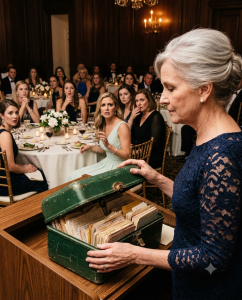
By the time Harriet Caldwell stood behind the podium at the Rhett House gala, most of Beaufort had already decided what kind of story they were living in.
It was the sad kind. The whispered kind. The kind where a talented older woman had finally slipped, and nobody wanted to say it too harshly because good manners mattered even when reputations were being quietly buried.
That was the story people had been telling for nearly a year.
Harriet had heard versions of it in grocery aisles, in church foyers, in the pauses that came after her name. She had seen it in the pitying expression of women who suddenly spoke to her more slowly than before, as if guilt and age must somehow share the same face. She had watched it harden in the Lowcountry Watercolor Society, where she had once been treated like a fixture and then, almost overnight, began to feel like a fragile inconvenience.
The worst part was not the accusation itself.
The worst part was how easy it had been for people to believe it.
Harriet had spent fifty years painting the marshes and gardens and weathered porches of coastal South Carolina. She had taught children how to hold brushes, donated work for hospital fundraisers, and hung paintings in enough local homes that she sometimes joked her landscapes saw more family arguments than she ever would. She had earned her reputation the slow way, the hard way, with years and patience and hands permanently stained with color.
So when Lily Barnett’s painting showed up in a Bay Street gallery under Harriet’s name, there should have been outrage on Harriet’s behalf.
Instead there was hesitation.
Lily was young, soft-spoken, and talented. Harriet liked her immediately when she joined the society, mostly because Lily cared more about light than attention. Her missing painting had been one of her best: magnolias over a ribbon of blue water, with the kind of atmosphere that made viewers stop three steps before they meant to.
Harriet remembered exactly when Lily first realized it was gone. The society had stored accepted paintings for the spring invitational in a side room at the arts center, and Lily had gone pale while checking the inventory list. People searched politely at first, then urgently. Frames were lifted. walls checked. tags examined. Someone suggested a clerical mix-up.
A week later the painting was hanging in a gallery window with Harriet Caldwell on the placard.
The shock of seeing it there had knocked the breath out of Harriet. She still remembered the gallery owner’s startled face when she walked in. He had been embarrassed, then defensive, then confused. The work had been consigned by a woman who signed Harriet’s name and spoke with enough confidence to avoid questions. Payment instructions had been left for later pickup. The owner had not thought to doubt it.
He did, however, have paperwork.
And paperwork, Harriet would learn, could be more honest than people.
At first she thought the nightmare would clear itself. Surely the owner would explain. Surely the society would understand. Surely Lily, at least, would know Harriet would never do something so cheap and ugly.
But rumors had gotten there first.
Renee Caldwell — once Renee Mercer, before the divorce — had inserted herself into the crisis with stunning efficiency. Harriet noticed it too late. By then Renee had already been “helping” people process the scandal. She had cried with Lily. She had called Dottie to say she was deeply worried about Harriet’s recent behavior. She had gently, sorrowfully mentioned that Harriet had become more guarded since Marcus left the marriage. She had seeded the same idea in three directions at once: not criminal, exactly, just confused. Not malicious, perhaps, but unstable. Maybe embarrassed. Maybe declining.
It was such a polished lie that it sounded compassionate.
That was what infuriated Harriet most once she saw it clearly. Renee did not accuse her like an enemy. She mourned her like a witness. It made doubt feel virtuous.
The divorce had been ugly, though Harriet had worked hard to keep herself from becoming its historian. Marcus and Renee had split after years of building separate lives under one roof, and Harriet knew enough to understand both of them had failed each other in different ways. But what Harriet also knew was this: Renee did not forgive the loss of status easily. She did not like doors closing. And she especially did not like doors that stayed open for Harriet after they closed for her.
The grandchildren still adored Harriet. The church women still called her first when they needed centerpieces painted for fundraisers. The society welcomed her before meetings even when Renee was standing in the same room. Harriet had not realized, until much later, how much Renee resented being second in any circle she entered.
The first crack in the lie came from paper.
After Harriet saw the Good Morning Lowcountry segment mention her name, she went home, sat at her kitchen table, and took down her father’s old tackle box. She had used it for years to carry brushes, pencils, clips, and odd scraps of paper. People joked about it because it looked too rough for an artist, too practical for an elegant widow. Harriet liked that. It made people underestimate both the box and the woman holding it.
She opened it and began placing things inside.
At first, only a few.
The gallery intake form, once she got a photocopy. The anonymous letter Dottie finally admitted she had received. A thank-you card Renee had once mailed after a committee luncheon. Then Harriet began adding everything else Renee wrote in public without thinking: recipe cards, auction bids, volunteer sheets, workshop sign-ins, Christmas exchange labels, table assignments, notes left under windshield wipers, anything in Renee’s unmistakable hand.
Harriet did not announce what she was doing.
She simply waited.
The longer she waited, the more Renee relaxed. That was the genius of it, Harriet later admitted to Marcus. Innocent people often fight too early because they are desperate to be believed. Guilty people count on that panic. When it does not come, they get comfortable.
So Harriet let the town believe the worst.
It was humiliating. Some days it felt unbearable. But she understood something about timing that younger people often did not. The truth lands harder when a lie has had time to decorate itself.
Dottie asked her to step back from leadership. Harriet agreed.
She was excluded from the spring invitational. Harriet stayed home and painted.
Renee started running pieces of the Thursday meetings with bright, managerial cheer. Harriet sent a lovely note.
Marcus hated all of it. He offered more than once to confront Renee publicly, and more than once Harriet told him no. “Not yet,” she said. “Anger is loud. Evidence is patient.”
He did not understand at first. Then Harriet showed him the papers in the tackle box.
Marcus sat at her dining table, staring at rows of rounded e’s and slanted y’s and the little hooked capital R that appeared in every sample. He looked sick.
“You’re sure?” he asked.
“I’m sure enough not to waste my first move,” Harriet said.
They took copies to a lawyer in Bluffton, a woman Harriet knew from church who asked sharper questions than anyone else had. The lawyer was the first person besides Marcus to say the obvious thing aloud: if Renee had submitted the painting under Harriet’s name, then this was not gossip. It was fraud. Potential theft. Defamation if intent could be shown. Maybe more if there had been media manipulation.
The lawyer advised Harriet to say almost nothing and gather more.
So she did.
Then came the break she needed.
The Bay Street gallery owner, now sweating over his own role, remembered something odd about the woman who had delivered Lily’s painting. He could not clearly identify her face because of large sunglasses and a scarf, but he remembered her voice. More specifically, he remembered one phrase she had muttered when she noticed a camera above the register.
“Lord, y’all record everything in this town.”
It would not have meant much, except Harriet had heard Renee say almost the exact same line months earlier at a pharmacy self-checkout when a screen flashed video monitoring instructions. Renee had laughed and said, “Lord, y’all record everything in this town.”
The gallery owner also had a partial timestamp from the drop-off. Detectives were willing to look, though not promising much. Still, it was enough. Nearby cameras from the arts center parking lot showed a woman of Renee’s build carrying a flat portfolio case to her car on the afternoon Lily’s painting vanished. The footage was not clean enough for a dramatic television reveal, but paired with the handwriting and the timeline, it built a wall slowly enough that Renee did not realize she was being enclosed.
Harriet learned one more thing before the gala: Renee had called the local morning show producer herself. Not anonymously, as she had implied. She had framed it as a concern about protecting young artists from a respected elder who might be “slipping.” The producer, mortified once the legal implications were explained, cooperated fully.
By then Harriet could have filed quietly and let lawyers do the rest.
But she wanted the truth told in the same room where her humiliation had been celebrated as dignity.
So when the gala invitation arrived, Harriet accepted.
The evening was everything Beaufort pretended not to care about and cared about deeply. White tablecloths, silverware polished to a gleam, candles low enough to flatter everyone, gardenias perfuming the air. Harriet entered with the tackle box in hand and felt eyes follow it. That pleased her more than she admitted.
Renee was impossible to miss in pale green silk, floating from table to table, greeting donors, charming the board, leaning in to hear compliments as if she were already being measured for office. Harriet watched her receive praise with the smooth ease of someone who believed the room belonged to her now.
Then Dottie made her mistake.
She announced a special honor for Harriet, some absurd little tribute to “gracious transition,” as if being falsely shamed out of leadership were a retirement gift. The audience clapped politely.
Harriet rose and walked to the podium.
Everything after that happened with the stillness of a storm eye.
She set down the tackle box. Opened it. Took out the papers. Explained, with calm so complete it felt almost merciless, that she had spent a year collecting examples of handwriting. She laid down the anonymous accusation letter, the gallery form, Renee’s recipe card, Renee’s bid slips, Renee’s notes to Dottie. One by one, similarities became impossible to laugh off.
Renee tried. “That proves nothing,” she snapped.
Harriet said, “The security footage helps.”
That was the moment the room turned.
Renee stood so abruptly her chair struck the table behind her. “This is insane,” she said, but nobody moved to comfort her. Nobody rose. Nobody scolded Harriet for causing a scene. The social tide had shifted too fast.
Harriet then did something even crueler than public exposure.
She invited Lily to the podium.
The young woman approached with trembling hands. Harriet placed Lily’s stolen painting receipt in front of her and said, “I want you to be the first person in this room, besides me, to hear what the detective told us this morning.”
Then she said it clearly enough for everyone to hear.
Renee had been identified by a combination of handwriting comparison, timeline evidence, and corroborating footage. The police had not yet arrested her, but charges were being prepared. The gallery sale had been frozen. Lily’s painting would be returned. And the morning show had agreed to issue a correction and formal apology.
Silence hung for two full seconds.
Then Dottie began to cry.
Not elegant tears. Humiliated ones. She looked at Harriet and whispered, “I am so sorry.”
Others joined in, some out of shame, some from relief, some because they suddenly remembered how much they had loved Harriet before convenience made cowards of them. One woman covered her face entirely. Another muttered that she had always had doubts, which only made her table glare at her harder.
Renee, however, did not cry.
She lunged toward the podium.
It was not a dramatic attack, nothing so theatrical. She simply rushed forward with the desperate energy of someone who believed she might still snatch the papers, deny the copies, recover the room through sheer force of interruption. Marcus, who had been seated near the back at Harriet’s request, stepped into the aisle before she got there.
“Don’t,” he said.
That stopped her more effectively than anything else.
She turned to him, and for one suspended moment the ballroom ceased to be about art or evidence or status. It became about the old wound beneath everything: the marriage, the divorce, the bitterness that had found a new target because the first one was no longer close enough to hurt.
“You let her do this to me?” Renee said.
Marcus looked tired in a way Harriet had not seen since the divorce was final. “You did this to yourself.”
Renee’s face changed then. Not softened. Exposed. The charm fell away so completely that several women later said that was the moment they finally understood how they had been fooled. Without the smile and the sweetness and the deferential “Miss So-and-so,” there was only fury and panic.
She left the ballroom without another word.
No one followed.
The consequences came quickly after that. Charges were filed: theft, fraud-related offenses, and defamation claims through civil action. The morning show aired a correction more serious than the original segment, and the producer issued a direct on-air apology to Harriet Caldwell and Lily Barnett. The gallery owner returned Lily’s painting and cooperated fully. Renee, facing evidence stronger than she expected and allies fewer than she imagined, accepted a plea deal months later that spared jail time but required restitution, community service, and a public statement acknowledging responsibility.
The society never fully recovered from the embarrassment.
Dottie resigned by the end of the summer. Two board members followed her. Lily, at Harriet’s insistence, was given the featured space in the next invitational, where the recovered magnolia painting drew more attention than any work in the show. Harriet was asked to return to leadership. She declined the title, but not the room. She went back to Thursday meetings with her tackle box in hand, set it beside her chair, and painted as if she had never been pushed from the table at all.
That was perhaps the hardest thing for people to understand.
She did not come back vindictive.
She came back exact.
She accepted apologies one by one, though never cheaply. When women cried, she handed them tissues. When they overexplained themselves, she let the silence finish what embarrassment began. When someone said, “I should have known better,” Harriet answered, “Yes, you should have.”
Then she would return to her brush.
Months later, when Marcus asked why she had kept carrying the tackle box even after everything was over, Harriet smiled the same way she always had when people asked what was inside.
“A little of this,” she said. “A little of that.”
But privately she told him the truth.
The box reminded her that evidence matters, yes. But more than that, it reminded her who people become when tested. Some had failed her. Some had betrayed her outright. A few had surprised her with quiet loyalty she would never forget. The box held more than proof against Renee. It held the shape of an entire year, and all the faces that year had revealed.
In Beaufort, the story remained famous for a long time. People still mentioned the gala in lowered voices, usually with admiration for Harriet and disgust for Renee. But Harriet herself never told it that way. She said only that talent can survive slander, but trust, once cracked, dries differently.
And maybe that was the part that stayed with people most.
Not that Renee had forged, stolen, lied, and nearly succeeded.
Not even that Harriet had outwaited her with nothing but paper, patience, and nerve.
It was that an entire ballroom full of civilized people had needed a battered old tackle box to force them into recognizing the truth they should have defended from the beginning.
Even after the apology, even after the painting came home, even after Renee admitted what she had done, one question still lingered in quiet conversations long after the candles from that gala burned out:
What was the bigger offense — the woman who plotted the lie, or all the people who found it so easy to believe it?