Maria had never trusted rich people completely, but she had trusted money.
Not because she was foolish. Because she was tired.
Tired of rent climbing faster than her paycheck. Tired of choosing between replacing worn-out shoes and paying the electricity bill. Tired of pretending that working harder always meant life would eventually get easier. So when she was offered a cleaning position in the most expensive penthouse in the city, with a salary so high it sounded fake, she pushed down every instinct that told her something about it felt off.
The apartment belonged to Lian and Eleanor Wu, a couple who looked as if they had been designed for magazine covers. Lian was controlled, elegant, and quiet in a way that made every room feel smaller when he entered it. Eleanor was all polished charm, the kind of woman who could compliment you and make you feel measured at the same time. They were generous from the beginning. Her wages were paid early. They gave her expensive leftovers to take home. Eleanor once offered her a winter coat she had only worn twice.
That was how the trap worked. Not with force. With comfort.
By the end of the first week, Maria had already told herself she was lucky. The work was easy. The penthouse was huge but immaculate. The couple seemed demanding in the strange, particular way rich people often were, but nothing unbearable.
Then Eleanor showed her the study.
The room was beautiful in a severe, curated way. Dark wood shelves. Floor-to-ceiling windows. Leather chair. Rare art books. A massive Persian rug laid perfectly in the center of the floor, as if the entire room had been built around it.
Eleanor stood at the threshold and spoke lightly, almost casually.
“Everything in this room can be cleaned,” she said. “Except under that rug. Don’t move it. Ever.”
Maria had smiled and nodded.
At first she assumed it was a preservation issue. Then she assumed it was a quirk. But over the next few weeks, it stopped feeling like a preference and started feeling like a warning.
Whenever Maria cleaned the study, one of them appeared. Eleanor would drift past under the excuse of finding a book she wasn’t going to read. Lian would step in as if checking the thermostat. Neither seemed interested in anything except whether the rug had shifted.
One afternoon, Maria accidentally brushed the corner with a vacuum hose. Eleanor appeared almost instantly.
“You didn’t move it, did you?”
Her voice was calm. Her face was not.
After that, Maria became more careful. Careful with her hands, with her questions, with her expression. She needed the paycheck badly enough to convince herself not to be curious.
Curiosity came anyway.
The penthouse had the kind of silence that amplified small things. A pause at the wrong moment. A glance that lingered too long. A conversation that stopped when she entered a room. Maria started noticing details she wished she had missed. Eleanor asked strange personal questions in a sweet tone: whether Maria lived alone, what time she got home, if her neighbors knew her schedule. Lian once “coincidentally” appeared near the small market by Maria’s apartment and acted pleasantly surprised to see her there.
The meeting felt wrong even before he smiled.
Still, Maria stayed.
Then came the Tuesday that changed everything.
She was scrubbing baseboards in the study when she noticed a thin line of dust caught near the edge of the Persian rug. It irritated her instantly. She had cleaned the room carefully, but the dust remained just beyond reach unless she got closer.
She told herself she wasn’t moving the rug. Just cleaning near it.
So she crouched down with a rag and reached toward the floor.
“Are you cleaning around that area again?”
The voice came from directly behind her.
Maria turned so fast she nearly slipped.
Lian stood in the doorway, but that wasn’t what made her heart jump. It was his expression. He looked furious, yes, but beneath that was something colder and more dangerous: panic.
“Sir,” Maria said, trying to keep her voice steady, “it’s my duty to clean where it’s dirty so your wife doesn’t fire me.”
He stared at her hand, then at the rug, then at her face. For a long second he said nothing.
When he finally spoke, his voice was controlled in a way that made it worse.
“Don’t ever clean there again.”
Maria apologized and left with trembling hands. He didn’t stop her. He didn’t need to. She carried the fear with her for the rest of the day.
That night she stayed late in the kitchen, organizing shelves for a gathering Eleanor planned to host the following week. The penthouse was mostly dark. She was lining up spice jars when voices drifted down the hallway.
She lowered herself behind the island and listened.
Eleanor spoke first. “I found Maria cleaning under the rug. Again.”
Then Lian, tense and urgent: “We have to do something before she finds out, otherwise we’re screwed.”
Maria remained crouched there long after the hallway fell silent.
All the doubt she had been feeding herself disappeared. There was something hidden beneath that rug, and whatever it was involved her. By the time she got home, she was shaking.
She barely slept. Her mind replayed every strange moment since she started the job. The personal questions. The surveillance feeling. The overgenerous pay. The way both of them sometimes looked at her not like an employee, but like a clock.
The next morning, Lian and Eleanor announced they were leaving for a weekend trip. They rolled suitcases to the elevator. Eleanor smiled. Lian gave final instructions about the plants. It was all perfect, almost theatrical.
Maria watched them go and knew one of two things was true: either she was about to confirm her worst fear, or she was about to discover she had become dangerously paranoid.
Either way, she could no longer leave without knowing.
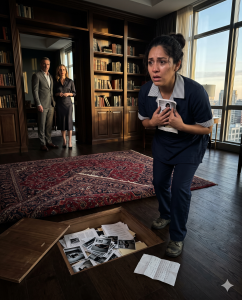
An hour later she stood outside the study, staring at the closed door. Her hand shook on the handle. She stepped inside, crossed the room, and knelt by the rug.
It was heavier than she expected. She had to use both hands to pull it back. The underside scraped softly across the wood.
Then she saw it.
A square outline cut into the floor. A recessed ring handle. A hidden door.
For one irrational moment, relief flooded her. A secret compartment was strange, but it wasn’t automatically about her. Maybe it was money. Maybe jewelry. Maybe some tax fraud nightmare she wanted no part of.
She hooked her fingers into the ring and pulled.
The compartment opened.
It was filled with photographs.
Her photographs.
At first she thought she was imagining it. Then she picked one up and saw herself at the market, turning her head with a bag of oranges in one hand. Another showed her sleeping in her apartment, face half buried in a pillow. Another showed her standing outside a pharmacy at dusk. Another showed her entering her building. Another showed her sitting alone on a bus, exhausted, staring out the window.
The dates on the backs of some photos told the story clearly enough.
They had been following her before she was hired.
Long before.
Maria’s mouth went dry. She searched deeper into the compartment with frantic hands and found a stack of documents beneath the photographs.
The first was a life insurance policy.
Insured: Maria Alvarez.
Policy value: five million dollars.
Primary beneficiaries: Lian Wu and Eleanor Wu.
Her stomach turned.
She read it twice, then a third time, as if repetition might make it less real. It did the opposite. The language was formal and clean. The signatures looked official. There were riders and clauses and stamped pages. It was not fantasy. It was preparation.
Her death had already been organized on paper.
Then she found the folded sheet beneath it.
When she opened it, the room tilted.
A suicide note.
In her handwriting.
Or what looked exactly like her handwriting.
The loops, the slant, the pressure, even the way certain letters leaned when she was anxious. The note described hopelessness, debt, emotional exhaustion. It thanked Lian and Eleanor for their kindness. It apologized for the pain her “decision” would cause.
Maria dropped the paper as if it had burned her.
Everything snapped into focus all at once. The questions. The surveillance. The carefully timed generosity. The absurd salary. They were not paying her to clean.
They were investing in her death.
Then came the sound that froze her in place.
Pip. Pip. Pip.
The electronic lock at the main entrance.
They were back.
She stared at the open compartment, the scattered photographs, the rug shoved aside, the fake suicide note on the floor. Panic finally broke through her paralysis. She shoved the documents back into the compartment, slammed the hidden door closed, and dragged the rug over it in a clumsy rush.
A single photograph remained on the floor.
Before she could grab it, the study door opened.
Eleanor entered first. Lian behind her.
Eleanor’s eyes dropped immediately to the photo.
No surprise. No confusion. Her face simply went still, as if a predicted event had arrived on schedule.
Lian closed the door softly behind him.
“Maria,” Eleanor said, almost gently, “you should have left things alone.”
Maria backed away. “You were following me before you hired me.”
Lian said nothing.
“Why?” Maria demanded. “Why me?”
Lian and Eleanor exchanged a look. Something shifted between them, some private decision made without words. Eleanor took a step closer.
“Because once you know who you really are to this family…”
Lian cut in sharply, stepping in front of her. “Enough.”
From inside his coat he pulled a thick folder.
Maria’s first thought was that he was reaching for a weapon. Instead he opened the folder and held out the top document.
Her mother’s name was printed across it.
Maria stared, uncomprehending.
“What is that?”
Lian looked at her with something complicated in his face now, something beyond fear. “Your mother worked for my father,” he said. “Years ago. Before you were born.”
Maria felt the floor sway under her feet. “I don’t care who she worked for.”
“You should,” Eleanor said. “Because she didn’t just work for him.”
Lian shot her a warning look, but it was too late.
Eleanor’s voice sharpened. “She had an affair with him.”
Maria laughed once, a cracked, breathless sound. “No.”
Lian spoke quietly. “We didn’t know about you until after my father died.”
The folder contained old letters, bank transfers, photographs of a younger version of her mother standing beside a man Maria recognized from framed family portraits in the penthouse hall. Lian’s father. Powerful. Married. Untouchable.
A final document lay beneath the others: an old paternity test request never completed.
Maria’s mind refused to organize the pieces, but one truth was already rising to the surface.
“You think I’m his daughter.”
Eleanor answered first. “We know you are.”
Maria shook her head violently. “Then why do all this? Why follow me? Why insure me? Why fake a suicide note?”
This time Eleanor didn’t hide the contempt in her smile.
“Because if you were acknowledged, the inheritance changed.”
The sentence landed with sickening clarity.
Lian’s father had left behind more than money. He had left behind a legacy, ownership stakes, property rights, family trusts. If Maria was proven to be his daughter, she could claim a portion. Maybe not the entire fortune, but enough to tear open everything Lian believed belonged to him.
Maria looked at Lian. “So you were going to kill me before I found out.”
His silence was answer enough.
Eleanor folded her arms. “We didn’t know how much you knew. Then you got curious.”
Maria moved toward the door, but Lian blocked it.
“We can still solve this,” he said.
Maria stared at him in disbelief. “Solve this?”
“You walk away tonight with money,” he said. “Real money. Enough to disappear. You never come back, never file a claim, never tell anyone about those documents.”
“And the insurance?” Maria asked.
Lian’s jaw tightened. “That was precaution.”
“Precaution,” Maria repeated. “You insured my life and forged my suicide note as a precaution?”
For the first time, he lost control. “Do you have any idea what was at stake?”
“Yes,” Maria said. “My life.”
Eleanor was done pretending. “You don’t belong here. You were an accident from a dead man’s mistake. Don’t act righteous because you found the paperwork before we finished cleaning it up.”
Maria looked from one to the other and realized something important: they were improvising now. The perfect couple, the careful planners, the people who had hidden every move beneath money and charm—they were panicking. Which meant they were vulnerable.
Her phone.
It was in her apron pocket.
She had slipped it there before coming to the study. Without changing her expression, she pressed her hand to the pocket and slid her thumb across the screen. No guarantee. No certainty. But maybe enough.
She had once shown a friend how Eleanor’s instructions could get strange. That friend, Sofia, had told her to share her location whenever something felt wrong. Maria had forgotten that advice until now.
Her thumb found the emergency shortcut.
She pressed.
Then she spoke to buy time.
“My mother never told me any of this.”
Lian’s expression flickered. “Maybe she intended to.”
“Or maybe she knew what kind of people you were,” Maria said.
Eleanor took another step toward her. “Stop provoking us.”
Us.
The word chilled Maria more than anything. There was no good spouse and evil spouse here. No innocent partner trapped by the other. They were together in this, fully and completely.
From outside in the hallway came a faint sound.
A knock.
Three hard strikes on the main door.
Everyone froze.
Lian turned his head first.
Another knock. Louder.
“Security,” a voice called from outside. “We received an emergency alert from this residence.”
For the first time since Maria had opened the hidden compartment, real fear appeared on Eleanor’s face.
Lian moved fast, but Maria moved faster. She shoved the study chair into him and lunged for the door. Eleanor grabbed her sleeve; the fabric tore. Maria stumbled into the hallway and screamed with everything she had.
“Help me! They’re trying to kill me!”
The penthouse exploded into movement. The main door opened as building security pushed inside, and behind them came two police officers.
Lian recovered instantly, launching into a polished explanation about a misunderstanding, a distressed employee, a family matter. But Maria had the torn sleeve, the shaking hands, the photos she had managed to snatch from the floor in the chaos. One of them slipped from her fist and landed at an officer’s feet: Maria asleep in her own bed, photographed through her window.
The room changed.
Police went into the study. The rug was moved. The hidden compartment was found. Then the documents. Then the insurance policy. Then the forged note. Then the folder tying Maria’s mother to Lian’s father.
Lian stopped talking after that.
Eleanor tried once more to recover control, but control was gone. It vanished the second evidence came into daylight.
The investigation that followed moved faster than Maria expected. Too many documents were too complete, too deliberate, too impossible to explain away. Surveillance. fraud. conspiracy. attempted murder. forgery. unlawful insurance procurement. Investigators uncovered private investigators hired months earlier. They found draft versions of the note. Practice sheets mimicking Maria’s handwriting. Financial records showing why Lian was desperate: the family trust had clauses protecting undisclosed heirs, and his father’s death had triggered a review he had been trying to suppress.
Maria was not a random target.
She was a threat that had learned to mop marble floors.
The paternity test was completed this time.
Positive.
Lian and Maria shared a father.
The truth landed strangely. It did not feel like gaining a family. It felt like discovering a wound that had existed before memory. Her mother had died two years earlier without ever telling her. Maybe out of shame. Maybe out of fear. Maybe because she had hoped silence would protect her daughter from exactly the kind of people Maria had just escaped.
In the months that followed, the story spread quietly through legal circles and loudly through gossip channels. People argued over the inheritance, over whether Maria should claim what was legally hers, over whether blood made her entitled or cursed.
She claimed it.
Not because she wanted the Wus’ world. Not because money repaired what had been done. But because refusing it would have felt like helping them erase her all over again.
Lian was indicted. Eleanor too. Their lawyers tried to frame the insurance policy as a financial contingency and the note as “misinterpreted material collected during a family dispute,” but even their own words condemned them. Phone records, drafts, surveillance orders, payment trails—every layer they had hidden under elegance came back up in uglier form.
Maria left the city for a while after the hearings began. She rented a small house near the coast where nobody knew her name. For the first time in years, she slept with the windows closed and the lights on.
Some nights she still woke up convinced someone had been watching her. Some mornings she stared at her own handwriting on a grocery list and felt sick.
But survival is a stubborn thing.
She kept going.
Months later, when the first ruling went in her favor, Sofia hugged her and asked the question everyone else had been too careful to say aloud.
“Do you ever wish you’d never looked under that rug?”
Maria thought about the hidden door. The photographs. The forged goodbye. The life someone had planned to end while smiling at her across a breakfast counter.
Then she thought about what would have happened if she had stayed obedient.
If she had kept cleaning around the edges.
If she had told herself not to be difficult, not to be suspicious, not to ask why.
“No,” she said at last.
Because the ugliest truth was still better than the prettiest lie.
And if there was one thing she would never forget, it was this: the biggest red flag was never the forbidden rug itself.
It was how much they needed her not to question it.