When the family divided Uncle Robert’s belongings, they gave Hannah the broken birdcage.
Nobody fought over it. Nobody even pretended to want it.
The silver watch was gone first. Jason, the oldest cousin and loudest voice in the room, picked it up with the quick confidence of someone who had already decided sentiment should look expensive. The hunting cabin keys disappeared into Laura’s purse. Mark claimed the coin collection after a brief discussion about “who would appreciate it most,” which really meant who had spotted it earliest. The truck started its own miniature war in the driveway before the lawyer reminded everyone that Uncle Robert had, in fact, left instructions.
Hannah stood near the doorway and watched it all happen with the strange numbness that comes after a funeral, when people begin attaching themselves to objects because it is easier than touching grief.
By the time the voices settled, the only thing left leaning beside the kitchen wall was the birdcage.
It looked exactly as she remembered it. Rusted. Slightly crooked. Empty.
For as long as Hannah could remember, it had hung beside Robert’s kitchen window, moving softly whenever the summer breeze pushed through the screen. It had never held a bird in her lifetime. She used to ask him why he kept it.
He always answered the same way.
“Because broken things still deserve a place in the sun.”
Jason snorted when he saw her pick it up.
“You always liked strays,” he said. “Makes sense.”
A few cousins smiled. Hannah didn’t.
She lifted the cage by the handle, thanked the lawyer for his time, and walked it to her car. She did not look back.
Robert had never been the favorite in the family. He was the uncle people called eccentric when they wanted to avoid saying kind. He lived in the old house at the edge of town with a creaking porch, a vegetable garden no one appreciated, and shelves full of books nobody borrowed. He remembered birthdays without help. He sent cards that contained actual sentences instead of signatures. He noticed when someone looked too tired, too thin, too quiet.
That last quality had mattered to Hannah more than anyone knew.
When she was ten, her parents’ marriage had become something sharp and dangerous. They were not violent in the way movies showed violence. There were no broken plates thrown across rooms. No police. No bruises.
There was something harder to explain.
There were doors slammed at midnight. Long silences at breakfast. Sudden fights that seemed to erupt from nowhere and end with her mother crying in the bathroom. Her father sleeping on the couch. Voices hissing through walls with just enough restraint to make every word sound worse. Hannah began sleeping with her shoes on because some frightened animal part of her believed she might have to leave quickly.
Robert noticed before anyone else did.
One Saturday he called and asked if Hannah wanted to spend part of the summer at his place “to help with the tomatoes.” Her parents agreed too quickly. Hannah packed in twenty minutes.
At Robert’s house, nobody asked her to explain why she flinched at raised voices. Nobody told her children shouldn’t worry about adult things. He made blueberry pancakes shaped like stars. He showed her how to fix a screen door that wouldn’t close right. He kept the kitchen light on late at night and pretended he had simply lost track of time reading.
He gave her peace without forcing her to name the reason she needed it.
That summer became the measure by which she judged kindness for the rest of her life.
So when the family reduced his life to valuables and leftovers, Hannah did not care that they handed her a broken cage. She took it home as if it were the most obvious thing in the world.
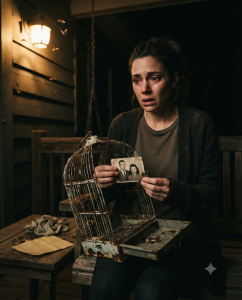
That night, she set it on her porch with an old towel beneath it and began cleaning.
The August air was warm and damp. Moths battered themselves against the porch light. Hannah worked slowly, wiping rust from each bar, feeling absurdly protective of the object everyone else had dismissed. The metal left orange streaks on the cloth. Dust clung to her fingers.
Then she noticed the weight.
The base felt wrong. Heavier than it should.
She turned the cage in her hands, examined the underside, and found a nearly invisible seam in one corner. Her heartbeat quickened. She pressed her thumb against the warped metal and heard a soft click.
The bottom shifted.
Using a butter knife, she pried it loose. A shallow compartment opened beneath the tray.
Inside lay three things: a faded photograph, a small safe deposit key, and a folded strip of paper.
Hannah set the cage down carefully.
The photograph came first. It showed Robert decades younger, standing on the porch of his house beside a woman in her twenties with dark hair pinned back and a guarded expression. They were squinting into the sun. Robert looked relaxed. The woman looked as if she had already learned not to trust easy things.
There was something about her face that made Hannah go still.
Not familiarity exactly.
Recognition.
She turned the photo over and saw a pressed indentation in the paper, like writing from another page had transferred onto it over time.
Eleanor.
The name hit her like cold water.
Eleanor was not a family secret in the dramatic, openly acknowledged sense. She was something stranger: an absence so carefully maintained it had shaped the family from the edges. Hannah had heard the name twice in her life. Once as a child, when adults stopped talking the moment she entered the room. Once when her mother, white-faced and furious, told her father never to bring Eleanor into this again.
Nobody explained. Hannah eventually learned not to ask.
Now the name sat in her hand, dragged out of silence by rust and a hidden compartment.
She opened the folded strip of paper.
Ask about Eleanor.
That was all.
No signature. No date. Just Robert’s handwriting, clean and unmistakable.
Hannah slept badly. Every time she closed her eyes she saw the woman in the photograph and felt the same disorienting pull. By dawn she had made up her mind.
The bank confirmed that the key matched a safe deposit box in Robert’s name, with instructions authorizing Hannah to access it after his death.
A woman in a navy blazer led her to a private room and brought in a long narrow box. It was old, its corners rubbed pale with age. Hannah sat down, suddenly afraid that opening it would rearrange her life in ways she could not undo.
It did.
On top were legal documents bearing her name.
Adoption papers.
A trust account statement opened when she was eight.
Copies of school and medical records she had never authorized Robert to possess.
Then there were letters tied in a faded blue ribbon and a sealed envelope labeled, in Robert’s familiar hand, For Hannah. Only when you’re ready.
Her fingers shook as she opened it.
The letter inside was dated twelve years earlier.
If your mother and father never told you, it is because fear makes cowards out of decent people and liars out of frightened ones. I have waited as long as I can.
Hannah read on, heart hammering.
Eleanor, the woman in the photograph, had been Robert’s younger sister. At nineteen, she became pregnant. The father vanished before Hannah was born. Their parents, rigid and obsessed with appearances, treated the pregnancy as a disgrace. Eleanor gave birth to a little girl and struggled almost immediately. She loved the baby, Robert wrote, but she was overwhelmed, isolated, and drowning in pressures no one acknowledged. When Hannah was three, Eleanor died in a car accident on a rain-slick road outside town.
After that, the family made a decision.
Not a legal one at first. A private one.
Robert’s older sister Lydia—Hannah’s “mother”—and her husband Daniel took the child in. Publicly, they presented Hannah as their own late surprise, a fiction made easier by a move, changed records, and a family willing to protect itself with silence. Robert fought them. He wanted the truth preserved. He wanted Eleanor spoken of openly. But Lydia was terrified that scandal, grief, and gossip would stain the child’s life. Daniel agreed. Their parents backed them. Robert lost.
He did not lose completely.
As soon as Hannah was old enough to understand that something in her house was wrong, Robert began creating another path. At eight, after a particularly ugly period in Lydia and Daniel’s marriage, he met with a lawyer. The adoption documents in the box were not proof that he had taken Hannah; they were proof that he had tried to. He had petitioned for guardianship and prepared to adopt her if the home became unsafe enough to force intervention. Lydia found out, panicked, and begged him not to file. She promised things would improve. She made him promise not to tell Hannah anything until she was grown.
He did not trust promises alone.
That was why the trust existed. Why copies of records had been preserved. Why Eleanor’s letters had been hidden where no greedy hand would think to look.
By the time Hannah reached the last page of Robert’s letter, tears were falling onto the paper.
I could not be your father, he had written. I could not be the man the law named. But if choosing means showing up, preparing a place, and refusing to let you be erased, then I chose you every year I had left.
Beneath Robert’s letter were three written by Eleanor.
The first was from a maternity ward, its handwriting uneven and exhausted. She wrote about Hannah’s tiny fingers, about being terrified of failing her, about Robert bringing soup because nobody else knew what to say. The second was months later, darker, more fragile, full of apologies to Robert for “not doing motherhood the way people expected.” The third was the one Hannah read twice.
If anything ever happens to me, tell her I did love her. Tell her I looked at her and wanted to become someone better than I was. Tell her that if Lydia raises her, it is because Lydia has always known how to look strong when the rest of us cannot.
There was no bitterness in the letter. Only shame, love, and fear.
Hannah sat with the papers spread around her, stunned by the realization that her life had not been exactly a lie, but neither had it been the truth. Lydia was not a random imposter. She was Eleanor’s older sister. She had raised Hannah from the age of three. Daniel had become the only father Hannah remembered. They had loved her in ways that were real.
But they had also buried her mother so deeply in silence that even her name had become forbidden.
At the bottom of the box Hannah found one last note from Robert.
Do not ask them all at once. Ask the one who still flinches when Eleanor is named. Watch the eyes before you trust the words.
Hannah knew who he meant.
That evening she drove to her parents’ house.
Her mother opened the door and immediately understood from Hannah’s face that something had happened. “What is it?” Lydia asked, already pale.
Hannah held up the photograph from the birdcage.
“Who is Eleanor?”
Lydia’s hand went to the doorframe. For one second she looked exactly like the woman in Eleanor’s last letter: someone trying very hard to appear strong while something underneath gave way.
Daniel rose from the living room, saw the photograph, and stopped moving.
“No more lies,” Hannah said. Her voice surprised her with its steadiness. “Please. Not one more.”
Lydia sat down at the kitchen table as if her knees had abandoned her. Daniel remained standing behind her chair, one hand on its back.
For a while neither spoke.
Then Lydia whispered, “She was my sister.”
Hannah waited.
Lydia lifted wet eyes to her daughter—niece—child. “And she was your mother.”
The words did not shatter Hannah the way she might once have imagined. Robert’s letters had already done the shattering. This was the ache afterward, the confirmation of broken edges.
“Why didn’t you tell me?”
Lydia’s mouth trembled. “At first because you were too little and we thought we were protecting you. Then because every year it got harder. We didn’t know how to undo it. We didn’t know how to tell you we had let the lie grow roots.”
Daniel finally spoke. “Your grandparents insisted. They said a dead young mother, an absent father, Eleanor’s… struggles… people would talk. Lydia had just lost her sister. We convinced ourselves we were giving you stability.”
“You erased her,” Hannah said.
Lydia flinched like a struck thing. “I know.”
The conversation lasted hours.
Lydia told Hannah about Eleanor as a girl—reckless, artistic, funny, impossible to direct. About how bright she had been before depression hollowed out her confidence. About the night of the accident, the phone call, the rain. Daniel admitted he had gone along with the secret because he loved Lydia and believed love could justify almost anything if the intention sounded noble enough.
It did not excuse them. But it made them human in a way Hannah had not been ready to allow when she first walked in.
Then she asked the question that mattered most.
“Did she want me given away?”
Lydia shook her head hard, tears spilling. “No. Never. She adored you. She was scared. She was ashamed of not coping. But she loved you. Robert fought for that truth every time we tried to make the story simpler.”
Hannah closed her eyes.
For years she had carried a shapeless loneliness she could never name. Now it had a history. Not a cure, but a shape.
In the weeks that followed, more truths surfaced.
The trust Robert created had grown large enough to matter. There were instructions allowing Hannah full access and naming the money for education, housing, or “any future that makes you feel more free than trapped.” There was also a small package the bank had overlooked the first day: Eleanor’s charm bracelet, wrapped in tissue paper, and a cassette tape with Robert’s note: Ask Mark to digitize this. He still remembers how.
The tape held Eleanor’s voice.
Hannah listened to it alone first.
Her mother’s sister had laughed in exactly the same sudden bright way Hannah sometimes did without thinking. She sang half a lullaby, forgot the words, and laughed again. Then she spoke softly to the baby in her arms.
“Hi, Hannah. You are asleep through all of this, which is probably wise. Your Uncle Robert says one day you’ll roll your eyes at me for talking too much. I hope so. I hope you get to be exactly the kind of girl who rolls her eyes at everyone and still gets loved for it.”
Hannah pressed both hands over her mouth and cried until her chest hurt.
Later she let Lydia listen too.
Her mother wept openly, the kind of weeping that comes when punishment and relief arrive together.
“You sound like her,” Lydia said afterward.
“I don’t even know what that means,” Hannah replied.
“It means,” Lydia said, “that I should have given you this years ago.”
Healing was not quick. Hannah did not forgive in a neat cinematic moment. Some days she was grateful to Lydia and Daniel for raising her. Some days she could barely look at them without thinking of all the birthdays, school projects, illnesses, and ordinary family dinners that had taken place under a lie. Both things were true, and living with both took time.
She visited Robert’s grave with the birdcage tucked under one arm and Eleanor’s photograph in her pocket.
The cemetery was quiet except for the wind moving through dry grass. She sat on the ground beside his headstone and told him everything: that she knew, that she was furious, that she was heartbroken, that she had listened to Eleanor’s voice three times already, that Lydia was finally saying her sister’s name out loud.
Then she laughed through tears and said, “You really hid my life story in a broken birdcage.”
The wind stirred the grass harder, and for a moment she could almost hear his answer.
Broken things still deserve a place in the sun.
So Hannah took the birdcage home and restored it carefully. She did not strip away all the rust. She left some of it, because repair was not the same as pretending damage had never happened. She lined the hidden compartment with felt and placed Eleanor’s photograph inside along with copies of the letters. The cage went beside her own kitchen window, where morning light could reach it.
When people asked about it, she did not say it was worthless.
She said it was family.
Months later, at a dinner that would once have been impossible, Lydia passed Hannah a plate and said, “Your mother used to burn toast exactly like that.”
The room went still for half a second.
Then Hannah asked, “Which mother?”
Lydia’s eyes filled, but this time she smiled.
“Both of us, unfortunately.”
They laughed. It was small and painful and real.
The truth had not undone the years of silence. It had not made every choice forgivable. Robert was still gone. Eleanor was still gone. The lost years could not be returned.
But the name nobody said was being said now.
The woman in the photograph was no longer trapped inside a hidden compartment.
And Hannah, who had been handed the broken thing because everyone assumed it mattered least, finally understood what Robert had known all along: the real inheritance in a family is rarely the object everyone fights over. It is the truth someone loved you enough to protect until you were strong enough to carry it.
Even now, she sometimes wondered who had done more damage—the people who hid the truth, or the ones who told themselves hiding it was love.
She never found an easy answer.
Maybe that was the aftershock Robert intended her to live with.
Not just who Eleanor had been, or who Lydia had tried to become, but what forgiveness costs when the lie was built out of grief, fear, and a desperate kind of devotion.
Some days Hannah thought the biggest red flag had been the silence.
Other days she thought it had been how normal the silence was.
Either way, the broken birdcage still caught the morning light.
And every time it did, she remembered that being chosen does not always arrive wrapped in something valuable-looking.
Sometimes it comes disguised as the one thing everyone else was foolish enough to leave behind.