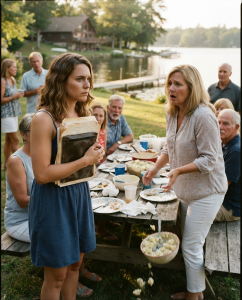
At the family reunion, Olivia’s aunt announced that Olivia’s mother had died owing everyone money.
She said it casually, over paper plates and potato salad, like she was commenting on the weather instead of dragging a dead woman through the dirt. Her voice carried across the long folding table in the backyard, loud enough for every cousin, spouse, and in-law to hear.
“That woman was always irresponsible,” Aunt Margaret said with a weary sigh, scooping more potato salad onto someone’s plate. “Good thing we kept the lake house from falling into her hands.”
A few people laughed.
Not because it was funny. Because families like Olivia’s had an instinct for survival. When the wrong person spoke, everyone learned to smile just enough to stay safe.
Olivia stood still with a paper plate in her hand and felt the heat rise behind her ribs.
The reunion was being held, as it always was, on the property everyone simply called the lake house. A weathered blue-gray place with white trim, a long dock, and a boathouse crouched near the shoreline like it had been listening to family secrets for generations. The backyard was crowded with cheap lawn chairs and children in damp swimsuits. A speaker played old songs no one really listened to. Someone had burned the hot dog buns. Someone else had made a pitcher of sweet tea. The whole scene looked harmless from a distance.
But Olivia had learned long ago that her family’s most vicious moments often happened in broad daylight, while everyone was pretending to be relaxed.
She had almost not come.
At twenty-eight, she had built a life far enough away to avoid this kind of humiliation most of the time. She had a decent apartment, a job she liked, friends who didn’t weaponize old stories, and a habit of keeping her childhood tucked into sealed corners of her mind. But her grandmother had called twice to ask whether she would be there. One cousin had texted that people were asking about her. And some tired, stubborn part of Olivia had decided she wouldn’t let them turn her absence into another family legend.
So she came.
And within twenty minutes, her mother was being insulted over side dishes.
Margaret finally looked directly at Olivia, then lifted one shoulder in a performance of sad honesty. “I’m just saying what everyone knows.”
Everyone knows.
That phrase had shaped Olivia’s life.
She was sixteen when her mother died. Old enough to remember her laugh, her perfume, the way she sang while washing dishes, and the way she stood at the end of the dock on summer evenings with her face turned toward the wind like she was listening for something. But she was also too young to understand what happened after the funeral, when grief became paperwork and adults began speaking in careful, polished lies.
For years, Olivia had been told the same story.
There was no inheritance.
No house.
No savings.
Only debt.
Her mother had borrowed money from relatives. Her mother had been careless. Her mother had nearly ruined the family property. Aunt Margaret had stepped in and handled the mess. The lake house had been preserved only because responsible people had acted in time.
Back then, Olivia had no idea what questions to ask. She didn’t know how trusts worked, how estates were processed, how records were filed, how easily a teenager could be confused by sympathetic adults speaking in legal tones. She was grieving, disoriented, and desperate to believe that the people around her weren’t taking advantage of her.
By the time she got older and started asking for details, the answers changed shape.
The papers were complicated.
The records were somewhere else.
The lawyer had retired.
The debt had been embarrassing.
The past should be left alone.
She had tried to press harder at twenty-three and been told that obsession was unhealthy. At twenty-five, Margaret had suggested therapy in that smooth tone that meant, You’re making people uncomfortable again. After that, Olivia stopped asking aloud.
But she never stopped wondering.
Because memory wouldn’t let her.
Her mother had not been perfect. Olivia knew that. She had struggled after Olivia’s father left. She worked too hard, trusted the wrong people, and could be impulsive in ways that frightened more cautious relatives. But irresponsible? Reckless with everything? Olivia couldn’t make that fit the woman she remembered hiding birthday money in bookshelves, labeling every folder in the kitchen drawer, or staying up late to compare bills at the table.
And there was something else that never sat right: the way Margaret talked about the lake house.
Not like someone who inherited it.
Like someone who had outmaneuvered another person to keep it.
Olivia had noticed the little inconsistencies over the years. Dates that didn’t line up. Stories that shifted depending on who was telling them. Family members who got quiet when certain details came up. But suspicion is a lonely thing when everyone around you treats it like disrespect.
Now, standing in the yard with relatives balancing baked beans and deviled eggs, Olivia heard Margaret raise her plastic cup and say, “To family. To protecting what matters.”
Several people echoed the toast.
Olivia felt something inside her go cold.
Then a small hand tugged at her sleeve.
She looked down and saw Ethan, her youngest cousin, all wet hair and serious eyes, his nose pink from too much sun.
“I found something in the boathouse,” he whispered.
Olivia blinked. “What kind of something?”
He glanced around. “A secret thing.”
Under other circumstances, she might have smiled. But he looked spooked, not playful.
“Can you show me?”
He nodded at once and started toward the path that led down to the water. Olivia set her untouched plate on the edge of a table and followed him away from the laughter and the music and her aunt’s voice.
The air changed as they neared the lake. Cooler. Damp. The smell of grass gave way to old wood and algae and the faint metallic scent of dock hardware baked in the sun. The boathouse sat half in shadow, its boards weathered silver with age.
Ethan led her inside.
“I was looking for the red bobbers,” he said, pointing toward a rack of fishing poles, “and the wall moved.”
He crouched near the back corner and pressed on a loose panel beside a stack of old life jackets. The board shifted with a dry scrape, revealing a narrow compartment hidden between the studs.
Olivia felt her pulse jump.
Inside was a cloudy waterproof pouch.
Not new. Not accidental. Deliberately placed.
For one strange second, she couldn’t bring herself to touch it. Her mind filled with a dozen impossible thoughts at once. Old bills. A will. Nothing important. Something planted. Something real.
Her fingers trembled as she pulled it out.
The seal resisted, then opened.
Inside were folded letters, bank statements in plastic sleeves, and several legal documents clipped together. On top lay a photograph.
The breath left Olivia’s lungs.
It was her mother, standing on the dock in bright sunlight, smiling with a kind of relieved joy Olivia had not seen in years. Next to her stood a man in a navy suit holding a folder. They were both touching the same page, as if marking an official signing. The lake glittered behind them.
There was a date in the corner.
Three months before her mother died.
Olivia stared at the image until Ethan whispered, “Do you know them?”
“I know one of them,” she said.
She set the photo aside and unfolded the top legal page.
The heading was clear.
Trust Agreement.
Halfway down the first page, she saw her own full name.
Beneficiary: Olivia Rose Bennett.
She read on, heart hammering.
The lake house had been placed in trust for Olivia before she turned five. The property was to remain protected for her benefit, with financial provisions for maintenance, taxes, and upkeep. A temporary trustee had authority to manage but not claim ownership, not transfer title, not sell, and not repurpose the property for personal gain.
Olivia flipped to the signature page.
Her mother’s name was there.
The attorney’s name was there.
A witness signature.
Not Margaret.
Not once.
Beneath the trust papers were account statements showing funds designated for the property. Not debt. Not desperation. Organized amounts set aside year after year. There were also letters.
One from the attorney confirming the trust had been finalized.
One from Olivia’s mother referencing concern that “some family members may challenge my intentions if I am not here to explain them.”
One sealed envelope with Olivia’s name on the front.
For a moment, the room seemed to tilt.
Twelve years.
For twelve years, Olivia had been told she inherited nothing because there was nothing to inherit. For twelve years, relatives had sat on the deck, grilled food in the yard, rented boats to friends, argued over holiday weekends, and spoken as though the property had been rescued from her mother’s recklessness. For twelve years, they had let Olivia believe that her mother died leaving shame behind.
And all along, there had been a trust.
A real one. Signed, witnessed, funded, and hidden.
“Is it bad?” Ethan asked quietly.
Olivia looked at him. Poor kid. He had no idea he had just kicked a rotten wall wide open.
“No,” she said, though her voice sounded strange to her own ears. “I think it’s important.”
She gathered the papers carefully, slid them back into the pouch, and stood.
“What are you going to do?”
Olivia looked toward the bright rectangle of sunlight outside the boathouse door. Beyond it, she could hear the faint sound of family laughter drifting down from the yard.
“I’m going back.”
The walk up the path felt unreal. She noticed everything too sharply: the crunch of gravel beneath her sandals, dragonflies skimming over the weeds, the taste of salt where sweat touched her lip. Her mind was racing, but another part of her had gone perfectly still.
Truth had a strange effect.
It can make fear disappear because the worst thing has already happened. The lie has already cost you years. Once you know that, confrontation stops feeling dangerous and starts feeling overdue.
When Olivia stepped back into the yard, a few people turned.
Then more.
Conversation began to falter in pockets.
Margaret was still near the buffet table, telling another story—something about “all the things the family had to clean up” after Olivia’s mother died. Her voice trailed off when she saw the waterproof pouch.
Olivia kept walking until she reached the center of the long table.
She placed the photograph down first.
Then the trust agreement.
Then the financial statements.
The reaction rippled outward before anyone said a word.
One cousin stopped chewing.
An uncle’s drink slipped in his hand and splashed onto the grass.
Someone near the grill muttered, “What is that?”
Margaret’s face lost color so fast it looked like a light switching off behind her skin.
“That,” Olivia said, and her voice came out steadier than she felt, “is what you said never existed.”
Margaret recovered just enough to force a laugh. “I have no idea where you found those, but they don’t mean what you think.”
No one answered her.
Because the pages were visible. The heading. The dates. The signatures. Her mother’s name. Olivia’s.
Margaret reached toward the stack.
Olivia covered the papers with one hand and looked at her. “Don’t.”
The single word landed harder than shouting would have.
“What nonsense is this?” Margaret snapped, but there was a shrillness in it now, not authority.
Olivia lifted the top page and read aloud the line naming herself as beneficiary of the trust established for the lake house. Then she held up one of the statements showing maintenance funds attached to the property.
“You told me she left debt,” Olivia said. “You told me there was nothing. You told me this house had to be saved from her.”
Margaret folded her arms. “Your mother was unstable at the end. She signed all kinds of things.”
Again, the wrong lie.
Because Olivia had already seen the attorney’s confirmation letter, dated after the trust was reviewed and finalized. She held that up next.
Silence spread wider across the yard.
Aunt Denise looked from the letter to Margaret and then quickly away. Uncle Ron put his cup down so carefully it almost seemed deliberate, as though sudden movements might make the truth louder. One of the older cousins stepped backward until the edge of the deck hit the back of his legs.
Olivia had expected denial.
She had not expected recognition.
That was the first moment she realized this might be bigger than Margaret alone.
Then came the voice no one expected.
“You said those papers were destroyed.”
Olivia turned.
Her grandmother was sitting in a lawn chair near the shade, one hand clenched around the armrest. Her voice had been quiet, but every person there heard it.
Margaret looked at her mother with open alarm. “Mom—”
“You said they were destroyed,” Grandma repeated, louder now.
The air changed.
Not because of what was said, but because of what was revealed: there had been papers, and Margaret had known exactly what they were.
Olivia felt a cold, clean fury rise through her.
“You knew,” she said.
Margaret’s mouth hardened. “I did what had to be done.”
“For who?”
No answer.
The children had gone still. The cousins were staring openly now. Some looked horrified. Some looked guilty. Some looked as if they were watching a house fire and only just realizing they had helped stack the wood.
Olivia picked up the sealed envelope from the pouch.
Her name was written across the front in her mother’s handwriting.
A sound escaped Margaret then, small but unmistakable. Fear.
“Don’t read that here,” she said.
Olivia looked up sharply.
Why not here?
What was in that letter that frightened her more than the trust itself?
With slow, deliberate care, Olivia slid her finger beneath the flap and opened it.
Inside was a handwritten note on cream stationery, folded twice.
She unfolded it.
The first line hit her so hard she nearly lost her breath.
Olivia, if you are reading this and Margaret is still in that house, then she did exactly what I was afraid she would do.
A murmur moved through the yard.
Olivia kept reading, eyes burning.
The letter was not rambling. It was not confused. It was clear, direct, and devastating. Her mother wrote that she had created the trust because she did not trust certain relatives to respect her wishes if anything happened to her. She named Margaret specifically. She wrote that there had already been fights over the property, pressure to sell it, pressure to sign over control, and repeated comments suggesting Olivia was “too young to remember” what belonged to her.
Olivia’s mother had anticipated everything.
She had hidden copies in the boathouse after the attorney warned that the originals could go missing if family tensions escalated. She instructed Olivia to contact the law office whose number was written at the bottom of the page. She stated plainly that anyone occupying or profiting from the lake house outside the trust terms was doing so against her legal intent.
And then came the line that cracked the yard open entirely.
If they told you I left debt, ask to see proof. The money they wanted was never borrowed by me.
Olivia looked up slowly.
Margaret wasn’t even trying to look offended anymore. She looked cornered.
“What does that mean?” one cousin asked.
No one answered.
Olivia flipped through the remaining statements with shaking hands. There, buried among maintenance records and trust paperwork, was another file she had nearly overlooked earlier: loan documents. Not in her mother’s name. In Margaret’s.
Dated six months before the death.
Secured against a business venture that had failed.
And in the margins of one photocopied page, a note from the attorney about concerns over “improper attempts to leverage family property not held by borrower.”
The room seemed to contract around Margaret.
“You told everyone she owed you,” Olivia said.
Margaret’s lips parted.
“You told me she left a mess,” Olivia said, louder now. “But you were the one in debt.”
A gasp came from somewhere near the grill.
Uncle Ron scrubbed a hand over his face. Denise sat down abruptly in a chair like her knees had given out.
“It wasn’t like that,” Margaret said.
But now nobody was protecting her.
Olivia took one step forward. “Then tell them how it was.”
Margaret looked around the yard as if searching for one loyal face. She found only avoidance.
Finally she snapped. “I was trying to keep this family from losing everything!”
“By stealing from a sixteen-year-old?” Olivia shot back.
That landed.
Even the people who had been half-defending themselves in their own minds flinched at the plainness of it. When you strip family betrayal down to one sentence, it becomes much harder to decorate.
Margaret started talking fast after that. About obligations. About sacrifices. About how much she had spent “keeping the place afloat.” About how Olivia’s mother had overreacted. About how someone had to take charge. It wasn’t a confession, not exactly. It was what guilty people do when the lie dies before the excuse does. She spoke in circles, each sentence accidentally revealing more than she meant to.
Yes, she had known about the trust.
Yes, she had believed Olivia would never find the papers.
Yes, she had used the house.
Yes, she had told people a version of events that made her sound necessary.
By the time she stopped, the family looked at her as if they were seeing her without makeup for the first time.
Olivia stood there holding the letter her mother had written years before, and grief hit her in a new form. Not the old grief of death. This one was sharper. The grief of realizing her mother had known exactly who she was surrounded by. The grief of understanding how hard she had tried to protect her child and how completely that protection had been undermined anyway.
Grandma began to cry.
Not loudly. Just one hand over her mouth, shoulders shaking, the kind of crying that comes when regret arrives too late to be useful.
“I should have checked,” she whispered. “I should have checked.”
Maybe she should have. Maybe all of them should have. But Olivia was too tired to sort degrees of guilt in that moment.
She turned to Ethan instead.
“You did good,” she told him.
He looked relieved and terrified at the same time.
In the days that followed, the attorney listed in the letter proved very much alive, very much retired, and very interested in what Olivia had found. The trust was legitimate. The property had never belonged to Margaret. Records were recovered. Occupancy and financial use of the lake house were reviewed. Some relatives tried to act shocked, others claimed they had only heard one side, and a few admitted they had suspected something was wrong but hadn’t wanted conflict.
That part, strangely, hurt almost as much as the theft.
Not just that one person lied.
That so many people found it easier to live beside the lie than challenge it.
Legal consequences came next. Olivia did not enjoy them, but she did not stop them either. Years of unauthorized use and financial misrepresentation had a way of unraveling when actual documents entered the room. Margaret lost more than face. She lost the certainty that family would cushion every wrongdoing if she acted offended enough.
As for the lake house, Olivia kept it.
Not because the property itself mattered more than anything else, but because letting it go after all that would have felt like agreeing her mother had failed.
She spent the first weekend there alone.
The house needed work. The porch steps sagged. Several window latches were broken. The boathouse smelled even worse in the morning sun. But the place was beautiful in the honest way old things can be when no one is pretending they’re perfect.
Olivia took her mother’s photograph down to the dock and sat with it until dusk.
For the first time in years, she let herself remember without arguing with anyone else’s version. Her mother laughing. Her mother worried. Her mother trying. Her mother planning. Her mother seeing danger clearly enough to leave warnings behind.
When the wind came off the lake, Olivia unfolded the letter again and read the final lines.
I hope they never make you doubt who I was. If they do, trust what you remember of being loved.
That was the part that stayed with her longest.
Not the trust. Not the betrayal. Not even the confrontation in the yard.
The reminder that lies can steal property, time, and peace, but they struggle to erase the shape of real love once someone decides to believe it again.
Some relatives apologized. Some disappeared. A few tried to reconnect once the story spread and silence was no longer an option. Olivia learned that exposure doesn’t always create justice as neatly as people imagine. Sometimes it just redraws the map. You stop calling certain places home. You stop calling certain people safe.
Still, on quiet evenings at the lake, when the light turned gold over the water and the dock creaked under her steps, Olivia knew one thing with complete certainty:
Her mother had not abandoned her with debt and disgrace.
She had left her the truth.
And in the end, that turned out to be the one inheritance no lie could hold forever.
Even now, anyone hearing the story could argue over the details that came after. Whether Margaret believed she was desperate or entitled. Whether the rest of the family were cowards or accomplices. Whether forgiveness should ever be offered when someone steals not just property, but memory.
But the hardest question lingered in a quieter place.
What was the bigger betrayal: the aunt who hid the papers, or the relatives who found it easier to believe the worst about a dead woman than to ask what really happened?