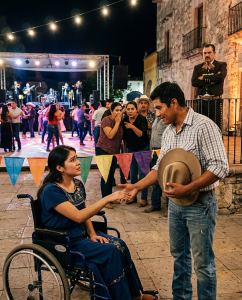
No one wanted to dance with the hacienda owner’s daughter.
In San Jacinto, that sentence traveled through the plaza without anyone needing to say it out loud. It moved in glances, in swallowed invitations, in mothers changing their minds, in young men pretending not to notice the girl in the blue dress near the dance floor.
The town festival had drawn nearly everyone out that night. Strings of colored flags stretched from rooftop to rooftop, lanterns swayed over the square, and the orchestra played with enough energy to make even the oldest men tap their boots against the stones. Women wore bright embroidered dresses. Men arrived in pressed shirts and polished hats. The scent of roasted corn, spiced meat, sugar, and dust warmed by the day still lingered in the air.
It should have been a beautiful night.
For Alejandra, it was a carefully arranged humiliation.
She sat in her wheelchair near the front row of tables, close enough to see every smile, every turn, every hand offered across the dance floor. Her dress was dark blue silk, a little too elegant for the simplicity of the plaza, chosen by her father to remind everyone who she was. Her hair had been pinned up with a silver comb that had belonged to her mother. Her posture was perfect. Her face was calm.
Only her hands betrayed her, clasped too tightly in her lap.
Three years earlier, Alejandra had been the most sought-after young woman in San Jacinto. She rode horses faster than most men. She laughed loudly. She danced every song until her shoes were dusty and her cheeks burned. Then came the accident on the north road after a frightened horse overturned the carriage in a storm. Alejandra survived, but her legs did not recover.
The town had pitied her at first.
Then it had adjusted to her condition in the cruelest way possible: by deciding that whatever future she had once been promised was over.
No one said such things directly in front of Don Mariano. He was too powerful, too rich, too proud. But whispers lived in corners where power could not fully reach. People said Alejandra had become a sorrow no man wanted to marry. They said her father’s land could buy respect but not desire. They said beauty mattered less once a woman needed help entering a room.
Alejandra heard more than people thought.
That was one reason she had almost refused to attend the festival. But Don Mariano had insisted.
“You will be seen,” he told her. “People must never think you are hiding.”
At the time, she thought he meant it as encouragement. By the middle of the evening, she began to understand he meant something else. He wanted her present, displayed, elegant, and silent. He wanted the town to see that his daughter still sat beneath the protection of his name.
He did not want them to see what that protection cost her.
Across the square, Don Mariano played the gracious host with perfect skill. He greeted officials, laughed with businessmen, offered drinks, praised the orchestra, and accepted compliments on the festival arrangements as though the entire night were a reflection of his generosity. He never raised his voice. He never looked troubled. If anyone had watched only him, they would have thought the evening was flawless.
But Alejandra watched the boys.
One was pushed toward her by his mother and retreated the moment he saw the chair. Another drifted near with a flower, then turned and presented it to another girl. A third caught her eye from across the square, held it for a heartbeat, then deliberately looked away.
Each time, Alejandra felt the same small drop inside her chest.
She kept smiling anyway.
Then came the whispers.
“Poor thing.”
“She still came expecting to dance?”
“With all that money, you’d think someone could at least pretend.”
Alejandra stared at the dance floor until the lights blurred.
That was when Don Mariano leaned toward one of the workers and ordered the front row of bulbs dimmed.
The change was subtle enough that some guests barely noticed. But Alejandra noticed at once. The edge of the dance floor remained warm and bright, while her corner slipped into shadow.
She felt the truth before she let herself think it: her father was not shielding her pain. He was hiding the sight of it.
Behind the food stalls, Manuel heard the order and looked up.
He had worked at the hacienda since he was twelve, first beside his father in the fields, then wherever strong hands were needed—repairing fences, loading grain, tending animals, carrying supplies. His life had taught him to keep his head down around men like Don Mariano. Speak only when spoken to. Never mistake usefulness for belonging.
But Manuel had also spent years noticing things that powerful people assumed no laborer would understand.
He noticed when wages were delayed but new chandeliers arrived for the main house. He noticed when a family was evicted after disagreeing with the overseer. He noticed when girls from poor homes were warned not to become “too familiar” with the household. And he noticed the strange pattern surrounding Alejandra: invitations that disappeared, visitors who suddenly stopped calling, young men who became polite but distant after private conversations with Don Mariano.
At first he thought it was ordinary fear. No one wanted to offend the hacienda owner by pursuing his daughter without permission.
But over time, the pattern looked less like caution and more like design.
That night, when the lights were lowered around her chair, Manuel stopped pretending he did not understand.
He set his crate down and walked across the plaza.
He heard the comments as he passed.
“That’s Mariano’s peón.”
“What is he doing?”
“Has he lost his mind?”
Maybe he had. Or maybe he was simply tired of watching cruelty parade as propriety.
He stopped before Alejandra and removed his hat.
“Good evening, miss. Would you allow me to accompany you for the next dance?”
He had expected surprise. He had not expected the hurt in her eyes when she asked, “You want to dance with me?”
Not suspicion. Not vanity. Hurt. As though the question itself had become dangerous to hope for.
“Yes,” he said. “If you want to dance with me.”
When she placed her hand in his, the plaza seemed to inhale.
Manuel did not know much about dancing formally. He knew ranch parties, harvest celebrations, weddings where everyone moved until midnight with more spirit than precision. But he knew enough to follow the rhythm and enough to see what mattered most: Alejandra did not need a performance. She needed dignity.
So he gave her that.
He guided her chair onto the floor with calm, steady motions. He moved around her naturally, as if a dance between them required no explanation to anyone. When the music turned, he turned with it. When the melody lifted, he smiled. He did not overcompensate. He did not act heroic. He simply danced.
Alejandra’s body remained tense for the first few moments, shoulders tight, chin raised against the weight of everyone watching. Then Manuel leaned closer and said, “Then it would’ve been a shame to miss this one.”
She laughed despite herself.
And once she laughed, everything changed.
Her face softened. Her eyes brightened. The stiffness in her hands eased. She tilted her head back slightly as the breeze moved across the plaza and, for a moment, she was not the rich man’s daughter in a wheelchair. She was a young woman at a festival, dancing.
The crowd shifted uneasily. Shame is contagious when someone finally behaves with decency.
A few people began to clap. The musicians, sensing the emotion passing through the square, played louder. A woman at one of the back tables wiped her eyes. A pair of boys who had mocked Alejandra earlier suddenly found the ground very interesting.
When the song ended, Manuel brought her back to her place.
Alejandra looked transformed—not because her life had changed in a single dance, but because someone had reminded her, in full view of everyone, that she was still worthy of being chosen.
Don Mariano rose immediately.
He did not shout. Men like him rarely needed to.
He placed one hand on Manuel’s shoulder and said, “Come with me.”
Behind the orchestra platform, away from the crowd, his expression hardened.
“You’ve made your little scene,” he said. “Stay away from my daughter.”
“It wasn’t a scene,” Manuel answered. “It was a dance.”
“For you, perhaps. For me, it was disrespect. Alejandra is not some girl for any farmhand to approach out of pity in front of the whole town.”
“I did not pity her.”
Don Mariano’s eyes narrowed. “Tomorrow you will understand what happens when a man forgets his place.”
The words were not an empty threat. Manuel knew that. A man in Don Mariano’s world did not need to strike you himself to ruin your life. A word to an overseer, a dismissal, a debt called in, a family forced off the land—punishment could be arranged in many forms.
Still, what troubled Manuel most was not the threat.
It was the phrasing.
Stay away from my daughter.
Forgets his place.
As if this had less to do with protecting Alejandra than controlling access to her.
When Manuel returned to the edge of the plaza, Alejandra was watching him closely. She had seen enough to know the conversation had not gone well.
Before Don Mariano could draw near again, she wheeled herself toward the side of the stage where Manuel stood.
“You shouldn’t be speaking to me,” he said quietly.
“My whole life has been people deciding what I shouldn’t do,” she replied.
He almost smiled at that.
“What did he say?”
“That he wants me far from you.”
Alejandra looked down, not surprised. “He says that about everyone.”
Manuel went still. “Everyone?”
She looked up again, startled by his tone.
He lowered his voice. “Miss… has it ever occurred to you that your father may be doing more than warning people away?”
At first the suggestion seemed impossible. Don Mariano was severe, proud, overprotective, obsessed with appearances—but cruel in that way? Deliberate?
Then her memory opened.
A young teacher from a nearby town who had once visited twice and then never returned. A rancher’s son who had sent her a note asking to call on her, then later avoided her entirely. Invitations that vanished. Friendships that cooled overnight. Servants dismissed after showing her too much affection, as though even kindness had to be supervised.
Alejandra felt a hollow chill spread through her chest.
“My father says people are uncomfortable around me now,” she whispered.
“Some are,” Manuel said. “But that kind of pattern doesn’t happen by accident.”
Before she could answer, Don Mariano approached.
He wore a smile.
That was what frightened her most. Not anger. Not open disapproval. A smile so polished it looked rehearsed.
“Alejandra,” he said, “your aunt has been asking for you.”
“I’m speaking with Manuel.”
“You’ve spoken enough.”
The old obedience rose in her out of habit. For years she had mistaken her father’s control for care because the alternative was too ugly to accept. But the dance had altered something inside her. So had Manuel’s question.
“No,” she said.
Don Mariano blinked once. “What did you say?”
“I said no.”
Nearby conversations faltered. The orchestra stumbled and recovered. Manuel took one careful step back, knowing danger when he felt it.
Alejandra kept her gaze fixed on her father. “Did you tell people to avoid me?”
Don Mariano laughed softly. “What nonsense.”
“Did you?”
“You are upset. This is not the place.”
“Then answer me.”
For one instant, his face slipped. The genial host vanished and the man beneath appeared: hard, furious, trapped by being challenged where others could see.
“I did what was necessary,” he said through a smile that no longer fooled anyone close enough to see it. “After your accident, people talk. People pity. People take advantage. I protected you.”
Alejandra stared at him.
By now, others had stopped pretending not to listen.
“You threatened them,” she said.
“I guided them.”
“You isolated me.”
“I preserved your dignity.”
Manuel’s hands clenched at his sides.
Alejandra’s voice trembled, but it did not break. “You let me believe no one wanted me near them.”
Don Mariano leaned closer. “Better that than watching some ambitious fool court you for my land.”
The words struck like a slap.
Not grief. Not concern. Not fear of heartbreak.
Property.
Control.
Inheritance.
The truth rearranged years of her life in a heartbeat. He had not hidden her because her loneliness pained him. He had hidden her because her loneliness was useful. A daughter who believed herself unwanted was a daughter who stayed obedient. A daughter who doubted her worth did not make demands. Did not choose for herself. Did not challenge the man who managed her world.
Alejandra’s breathing turned shallow.
“My mother knew?” she asked.
At that, Don Mariano hesitated. A tiny pause. Enough.
The answer devastated her even before he spoke.
“Your mother worried,” he said. “But she understood reality.”
Alejandra closed her eyes.
Her mother had died a year after the accident. In that year, she had become quieter, more fragile, less willing to oppose her husband in public. Had she tried? Had she failed? Had she seen what was happening and been too worn down to stop it?
When Alejandra opened her eyes, the tears there did not soften her. They sharpened her.
“Reality?” she said. “No. Your pride.”
Don Mariano’s smile vanished completely. “Enough. You are coming home.”
“No.”
The word rang louder than anything else that night.
Guests openly stared now. The town that had spent years whispering was finally being forced to listen.
Don Mariano reached for the handles of her wheelchair.
Before his hand touched them, Manuel stepped in front of him.
It was a small movement. Quiet. Absolute.
The plaza froze.
A farmhand did not block a man like Don Mariano. Not publicly. Not without consequences.
Don Mariano’s voice dropped. “Move.”
Manuel held his ground. “Not unless she asks me to.”
It was Alejandra who answered.
“Take your hand off my chair,” she said to her father.
He looked at her as if he no longer recognized the daughter he had so carefully controlled.
The next seconds changed everything.
From the back of the square, an older woman’s voice cut through the silence.
“Let the girl speak.”
It was Doña Mercedes, widow of the former schoolmaster, a woman nearly as feared as she was respected. Beside her stood the town doctor. Then the priest’s sister. Then one of the merchants’ wives. Faces Alejandra knew. Faces that had watched in silence for too long.
The doctor cleared his throat. “For what it is worth, Don Mariano, I was once advised by your steward that frequent visits might give your daughter false hopes.”
Doña Mercedes lifted her chin. “My nephew received a similar warning.”
Another voice called from the crowd, then another. Not confessions of innocence—too much damage had been done for that—but acknowledgments of what many had accepted because it was easier than resisting a powerful man.
Alejandra listened as the truth spread outward in broken pieces.
Warnings had been given.
Visits discouraged.
Suitors assessed and dismissed before they could even speak to her.
Servants instructed not to foster “sentimental ideas.”
Each revelation deepened the flush in Don Mariano’s face.
He could command fear. He could not command what happens when fear cracks in public.
“You all misunderstand,” he began.
But his authority had already shifted. Not gone—men like him did not lose power in a single night—but exposed.
Alejandra turned to Manuel. “Take me home.”
Don Mariano laughed sharply. “To my house?”
Alejandra met his eyes. “No. To my mother’s old casita by the east orchard.”
It had stood empty for years, used only for storage and occasionally for visiting relatives. Legally it had belonged to her mother’s family before marriage. Don Mariano had never bothered claiming it because it seemed insignificant.
Now it was the first thing that had felt like hers in a very long time.
“You will not leave this plaza with him,” Don Mariano said.
“I will leave,” Alejandra answered, “with the only person here who treated me like a human being before the whole town forced itself awake.”
No one applauded this time. The moment was too raw for that.
Manuel moved behind her chair, waiting for her signal, not taking it upon himself.
Alejandra nodded.
As he guided her across the square, the crowd parted.
Some faces held shame. Some admiration. Some curiosity. A few still held contempt. But none of them looked away.
Behind her, Don Mariano did not call out again.
Whether because he understood he had already lost the room, or because he finally saw that every command from this point forward would reveal even more of him, Alejandra never knew.
The casita smelled of dust and lavender when Manuel pushed the door open. Moonlight fell across old furniture draped in sheets. A cracked ceramic basin still sat where her mother had once left it. Nothing about the place was grand. That was why Alejandra loved it instantly.
Once inside, she finally let herself shake.
Manuel knelt in front of her, not touching, just close enough for her to feel she was not alone.
“I’m sorry,” he said.
She gave a broken laugh. “You danced with me. That may be the one thing tonight I’m not sorry for.”
The next weeks were not easy. Power rarely surrenders with dignity.
Don Mariano sent messages demanding she return. He threatened to cut her off financially. He dismissed workers suspected of sympathizing with Manuel. He spread his own version of events, calling Alejandra confused, emotional, manipulated by a farmhand seeking advancement.
But the town had seen too much.
And once people begin speaking openly, stories powerful men buried start rising fast.
A former maid admitted she had been ordered to intercept letters. A steward confessed that visitors were screened and discouraged. An aunt from Guadalajara arrived with documents showing Alejandra’s mother had set aside money in her daughter’s name—money Don Mariano had quietly controlled but could not legally keep from her forever.
For the first time since her accident, Alejandra had choices.
She used them.
With her mother’s inheritance and the help of that aunt, she restored the casita and later opened part of it as a sewing and bookkeeping workshop for women who needed their own income. She hired people her father considered invisible. Widows. Girls from laboring families. A young man with a damaged hand who had been told he was no longer useful. She insisted on ramps, wider doorways, practical tables, and work organized around people rather than pride.
San Jacinto talked, of course. Towns always do.
Some said she was rebellious. Some said she had embarrassed her father. Some said Manuel had turned her against her family.
They were wrong in the way gossip often is: confident, shallow, blind to the real story.
Manuel had not turned Alejandra against anyone. He had simply been the first person in years to place dignity above social rank and fear. He had asked her for a dance when everyone else chose safety.
That mattered.
He continued helping her, though never in a way that claimed ownership over her life. He repaired the orchard fence, hauled lumber, read contracts with suspiciously careful attention for a man others insisted was “just a laborer.” In time, Alejandra learned that Manuel had taught himself to read from old newspapers and discarded schoolbooks. In time, Manuel learned that Alejandra’s sharpness had survived every attempt to smother it.
Affection grew between them slowly, then unmistakably.
Not from rescue. Not from gratitude.
From respect first.
Then trust.
Then the dangerous, beautiful realization that neither one of them needed permission.
Months later, at another town celebration, Alejandra returned to the plaza.
This time the lights stayed on.
No one dared dim them.
She wore a simpler dress. Manuel wore the same kind of clean shirt and worn hat he had always worn. But when he crossed the square toward her, no one laughed. No one whispered that he had no place near her.
He removed his hat and asked, with a smile that made her remember the first night all over again, “Would you allow me this dance?”
Alejandra smiled back. “I thought you’d never ask.”
And under the open lights of San Jacinto, with the whole town watching and no one able to hide her anymore, they danced.
Later, people argued for months over what mattered most that night at the festival when everything changed. Some said it was the courage of a poor man standing up to wealth. Some said it was the fall of Don Mariano’s carefully polished image. Some said it was the town’s guilt finally surfacing in public.
But those who understood the story best knew the truth was simpler and harder than all of that.
The biggest red flag had never been the town’s cruelty alone.
It had been the kind of love that calls itself protection while quietly teaching someone they should expect less from life, less from others, less from themselves.
And once Alejandra saw that clearly, no amount of money, fear, or family pride could put her back in the dark.