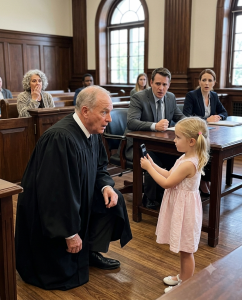
“Call whoever you want,” the judge said with a laugh.
It was the kind of line powerful people used when they believed they were fully in control of the room.
A minute later, Judge Henry Miller would hear a voice he hadn’t heard in over two years, and the foundation of his public life would begin to split open in front of attorneys, clerks, officers, and strangers seated quietly on polished wooden benches.
The custody hearing had already been ugly before the child ever touched the phone.
Savannah’s family courthouse had seen plenty of bitterness, but that morning carried a special kind of cruelty. Robert Hayes had filed for full custody of his five-year-old daughter, Mia, arguing that his ex-wife Isabella was mentally unstable, physically unreliable, and too inconsistent to provide proper care. On paper, it sounded almost reasonable. He had records of missed pickups. Screenshots of unanswered messages. Notes on late arrivals. Two neighbors willing to describe Isabella as pale, distracted, and forgetful in recent months.
He had built a careful case.
That was what frightened Isabella’s mother, Elizabeth, most.
Not the anger. Not the accusations. The preparation.
Because she knew what was missing from every document Robert had filed. She knew that Isabella had not been forgetful because she didn’t care. She had been forgetful because chemotherapy had turned her body into a battlefield. She hadn’t missed calls because she was reckless. She had missed them because some afternoons she could barely hold herself upright long enough to get from the bathroom to the couch.
And yet the hearing had moved forward like none of that mattered.
Judge Henry Miller sat high above the room in his black robe, silver hair neat, glasses low on his nose, his face composed in the stern, detached expression that had intimidated lawyers for decades. At sixty-one, Henry was respected, feared, and endlessly quoted in local legal circles. He believed in procedure, order, and a clean separation between emotion and law.
That belief had cost him his daughter.
Isabella Miller Hayes had once adored her father. As a child, she would sit at the kitchen table doing homework while he reviewed legal opinions with a fountain pen in his hand. He had seemed larger than life then—serious, brilliant, untouchable. The man who could fix anything with the force of a well-chosen sentence.
But adulthood had slowly shown her another version of him. A man who defended distance as discipline. A man who could recite fairness while overlooking suffering up close. A man who prized the appearance of integrity so fiercely that he often failed to do the deeply human thing standing right in front of him.
Two years earlier, when Isabella had called him sobbing and tried to explain that Robert’s behavior was becoming manipulative, Henry had listened in silence and then told her she needed to “document concerns and follow proper legal channels.”
She had hung up and not called again.
Now she wasn’t even in the room for her own custody hearing.
Robert’s attorney, Claude Foster, wore an expensive navy suit and the expression of a man who expected to win. Claude had made a career out of sounding measured while dismantling people’s lives. He never shouted. Never pounded the table. He simply arranged facts in a way that made sympathy look naïve and legal aggression look responsible.
Robert sat beside him with a straight back and a carefully pained expression. He had practiced it. The worried father. The burdened parent. The one trying to rescue his child from the chaos caused by someone else.
In the second row sat Elizabeth, her handbag in her lap, one hand gripping the strap so tightly her knuckles had gone pale. Beside her, half turned and half fidgeting, was Mia.
Mia had not wanted to stay seated.
She was too young to follow the legal arguments, but not too young to sense that the adults were lying with polished voices. She understood only a few things with total certainty: her mother was sick, her father was angry, Grandma Elizabeth was scared, and no one in that room was saying the one thing that mattered most.
Mommy didn’t leave me. Mommy is trying not to die.
At some point while Claude organized documents and Henry reviewed the docket, Mia noticed the black cell phone sticking halfway from Claude Foster’s suit pocket. She had seen adults distracted before. Adults were always easier to outsmart when they thought children were decoration.
Elizabeth shifted in her seat to whisper something to the woman next to her. Claude leaned toward Robert. The bailiff, Benjamin, glanced toward the side door.
Mia slipped from the bench.
She crossed the aisle quietly. One small hand lifted. Two fingers pinched the phone. She pulled it free, turned, and walked toward the front of the courtroom as if she belonged there more than anyone else.
Nobody noticed until she was nearly at the bench.
Henry looked up first.
“What are you doing there, little one?”
Mia held the phone to her ear. “Calling.”
The room rustled with restrained amusement.
“Calling who?” Henry asked.
She looked straight at him. “Whoever I want.”
That should have been the end of it. Any competent judge would have stopped the scene, returned the child to her seat, and restored order. But the hearing had been tense, and Henry, for one reckless instant, treated the moment like comic relief.
He laughed.
Not kindly. Not gently. He laughed at her.
“Let her,” he said when Claude moved to retrieve his phone. “Let her call whoever she wants.”
Several people smiled with relieved discomfort. Even Benjamin looked away to hide his reaction. The moment felt absurd, harmless, even funny.
Then the call connected.
“Mia? Baby? Is that you?”
The voice sliced through the room.
Henry went still.
He knew that voice immediately. Isabella.
His daughter’s voice had changed since the last time he’d heard it. It held a tremor now, and fatigue pressed underneath every syllable. But there was no mistaking it. He gripped the edge of the bench as if to steady himself.
Mia’s face lit with relief. “Mommy, I’m in a big room. There’s a man in a black robe. He was laughing.”
No one moved.
“Is your grandmother there?” Isabella asked, breathless.
“Yes. And he’s here too.”
Mia looked up at the judge. “Are you Grandpa Henry?”
Every lawyer in the room seemed to forget how to breathe.
For a long second Henry could not answer. The title Your Honor had protected him for so long that he had nearly convinced himself it was enough. But here was a child who shared his blood and did not know him. To her, he was not a respected jurist. Not a powerful county judge. Just the unnamed man her mother had never been able to bring herself to explain.
“Yes,” he finally said, and the word emerged broken. “I’m Grandpa Henry.”
Mia held out the phone. “Mommy wants to talk to you.”
Robert stood up at once. “Objection. This is ridiculous. That’s my attorney’s phone.”
Henry turned his head and stared at him with a new kind of attention.
“Sit down, sir.”
Something in his tone made Robert obey.
Then Henry descended from the bench.
Years later, several people would remember that detail more vividly than anything else. The judge did not summon the child forward. He did not command order from above. He came down.
He knelt in front of Mia, bringing himself level with her, and accepted the phone with both hands as though it were something breakable.
“Isabella,” he said.
There was a pause.
“Dad.”
So much history lived inside that one word that even the people who didn’t know the family could hear the damage. The silence between them had not been a simple estrangement. It had been layer upon layer of disappointment, stubbornness, pride, and preventable grief.
“Why is Mia there?” Henry asked. “What is going on?”
Isabella inhaled shakily. “Because Robert is trying to take my daughter before I finish treatment.”
Henry frowned. “What treatment?”
And then Isabella answered with two words that emptied the room of every last trace of mockery.
“Stage two.”
Henry stared straight ahead. He didn’t understand for one half second. Then he did.
“Cancer,” Isabella said. “I’ve been in chemotherapy for four months.”
Elizabeth began to cry quietly into her hand. Benjamin took a step backward. Claude Foster slowly turned toward his client. Robert remained seated, but the muscles in his jaw moved violently.
“Four months?” Henry asked.
“Yes.”
“Has this court been informed?”
Silence.
Henry rose to his feet, still holding the phone. The authority in his posture returned, but it no longer looked smooth. It looked furious. Not merely at the deception in front of him, but at the memory of every warning he had minimized.
Isabella continued, perhaps because she finally had no reason left to protect anyone.
“He used my chemo schedule against me,” she said. “On treatment days, I was weak. Sometimes I was late. Sometimes I threw up before pickup. Sometimes I couldn’t drive right away. He documented everything. He saved messages. He made me sound unstable for being sick.”
Robert stood. “That is not a fair characterization—”
“It’s the truth,” Isabella shot back, her voice shaking. “Tell him about the days you refused to switch weekends when I was too sick to stand. Tell him about threatening to ‘go for everything’ if I didn’t stop talking about your girlfriend spending nights with Mia there. Tell him about saying no judge would trust a woman who looked like she was falling apart.”
The courtroom had become a place where no one blinked.
Henry looked toward Claude. “Counselor, were you aware of a cancer diagnosis?”
Claude’s polished calm began to crack. “My client informed me there were health-related concerns, but the extent and relevance of the matter were not fully disclosed to me.”
Robert turned to him, stunned by the betrayal in the wording. “Claude—”
But Claude had already shifted. He was no longer shielding Robert. He was protecting himself.
Mia, who had followed almost none of the legal language, tugged softly at Henry’s sleeve. He looked down.
“Mommy cries when she thinks I’m asleep,” she whispered. “But she still makes my sandwiches funny.”
It was such a child-sized sentence. So innocent, so strange, so devastatingly specific. Not Mommy is good. Not Mommy loves me. Mommy still makes my sandwiches funny.
Even now. Even sick. Even frightened. Even alone.
Henry’s throat tightened. His daughter had been sick enough for a five-year-old to notice secret crying, and he had known nothing.
Or worse—he had known enough to ask harder questions and chose not to.
He turned back toward the tables. “We are taking a recess of ten minutes,” he said. “No one leaves this floor. Mr. Foster, Mr. Hayes, remain available. Bailiff, secure all submitted materials and communications connected to today’s filing.”
Robert’s composure slipped. “You can’t just—”
“I can,” Henry said sharply. “And I just did.”
The gavel struck once.
In chambers, Henry closed the door and stood alone for several seconds before bringing the phone back to his ear.
“Isabella,” he said quietly, “why didn’t you tell me?”
A bitter laugh escaped her. “I did, Dad. Maybe not the cancer part. I found out later. But I told you enough. I told you Robert was punishing me through Mia. I told you he was keeping score of every hard day. I told you I needed help. You told me to follow channels.”
He sat down heavily behind the desk. “I thought stepping in would look improper.”
“That mattered more than I did?”
He had no answer.
Outside the chamber door, Benjamin began gathering the file materials. What he found within minutes would change the case even further. Several exhibits submitted to demonstrate Isabella’s “instability” had been cropped. Time stamps were missing. A printed chain of text messages began after one of Isabella’s most frantic replies but excluded the earlier messages in which she had explained she was hooked to an IV and begging for one more hour before pickup. There was also a typed summary of incidents that mentioned missed transitions but omitted all references to oncology appointments.
Benjamin carried the stack to chambers.
“You need to see this,” he said.
Henry reviewed the pages in silence, his expression hardening line by line.
One item stopped him cold.
A note referencing a missing medication pouch.
He looked up. “What is this?”
Elizabeth, brought in a moment later, recognized it immediately. “That was in Mia’s overnight backpack. Isabella packed anti-nausea medicine, emergency contacts, treatment times, everything. It vanished weeks ago.”
Henry returned to the phone. “Isabella, tell me about the bag.”
Her breathing changed. “It disappeared right before Robert started writing that I was ‘confused.’ It had my oncologist’s information. The anti-nausea medications. Written instructions in case I became faint during transitions. After it went missing, he began saying I couldn’t keep track of important items.”
There it was.
Not mere opportunism.
Construction.
A case built through concealment.
When Robert and Claude were brought back in, the room felt smaller.
Henry remained seated this time, the file open in front of him. Claude no longer looked confident. Robert looked cornered.
“Mr. Hayes,” Henry said evenly, “did you disclose the mother’s active cancer treatment in your petition?”
Robert shifted. “I disclosed that she was having ongoing health issues.”
“That is not an answer.”
“I disclosed what was necessary.”
Henry’s eyes sharpened. “Did you or did you not know the mother was undergoing chemotherapy?”
Robert stayed silent for one beat too long. “Yes.”
Elizabeth shut her eyes.
“Did you remove or retain any item from the child’s belongings containing treatment information or emergency instructions?”
Claude turned to Robert so quickly his chair scraped the floor. “Robert.”
“I didn’t remove anything,” Robert said. “I may have set something aside because I didn’t want Mia burdened with adult medical—”
Henry slapped the file shut. The sound cracked through the room.
“You do not get to reframe this as protection.”
Robert’s voice rose. “I am her father!”
“And you had rights,” Henry said. “What I am trying to determine is what you chose to do with them.”
Claude cleared his throat. “Your Honor, I would request an opportunity to confer privately with my client.”
“You’ll have one,” Henry said. “After the court addresses whether it has been misled.”
Then he ordered the electronic records from both sides reviewed on an emergency basis and appointed a guardian ad litem to evaluate the child’s immediate interests. He also suspended any temporary transfer of custody until the new evidence was fully examined.
For Robert, that was the first collapse.
The second came three days later.
Phone metadata recovered from Claude’s device and Robert’s messages showed that several exhibits had indeed been selectively presented. More damaging still, one string of text messages revealed Robert complaining to a friend that Isabella’s diagnosis had “finally made things easier” because “judges love the stable parent.”
Another message was worse.
She’s too weak to fight this now.
By the emergency hearing later that week, the courtroom was full.
This time Isabella appeared by video from a treatment center consultation room, a scarf covering her hair, her face thin but steady. She looked exhausted, but not broken. Henry did not preside. He had recused himself after disclosing the family connection and the events of the previous hearing, and an outside judge had been assigned to review the matter.
That decision cost Henry public comfort, but it was the first unquestionably right thing he had done.
Under questioning, Robert tried to insist his actions had always been about Mia’s stability. But the story would not hold. The missing medication bag, the concealed diagnosis, the manipulated exhibits, and his own messages told a different story. He had not simply worried about his daughter’s routine. He had recognized Isabella’s medical crisis as leverage.
Claude, now visibly angry at his client, confirmed that critical facts had been withheld from him. The judge did not hide her disgust.
“You attempted,” she said, “to convert a mother’s cancer treatment into legal evidence of parental unfitness.”
The ruling came that afternoon.
Robert’s petition for full custody was denied. His parenting time was temporarily restricted pending further review. Isabella retained primary custody, with immediate support provisions added for transportation, medical accommodation, and supervised exchange protocols to prevent further harassment. The court also referred the conduct surrounding the filings for possible sanctions and further inquiry.
When the hearing ended, Isabella covered her face and cried.
Not because everything was fixed. It wasn’t. She was still sick. Her body was still carrying poison to save her life. She still had appointments, weakness, fear, and a long uncertain road ahead. But for the first time in months, she was no longer fighting two battles with both hands tied.
Later, when the room had mostly cleared, Henry approached the video screen where Isabella still sat, calmer now, Mia on Elizabeth’s lap nearby.
He looked older than he had a week earlier.
“I was wrong,” he said.
It was a plain sentence, but it cost him more than all his polished courtroom language ever had.
Isabella watched him quietly.
“I hid behind procedure,” he continued. “I told myself I was being principled when really I was being cowardly. You asked me for help, and I chose distance because it protected the version of myself I preferred.”
Her eyes filled, though she did not look away.
“I don’t expect forgiveness because I can finally say the right words,” he said. “I just needed to say them while they still mattered.”
Mia leaned toward the screen. “Mommy, is Grandpa sad?”
A weak smile touched Isabella’s mouth. “Yes, baby. I think he is.”
Mia considered that in silence, then said with the blunt mercy only children possess, “Maybe he shouldn’t laugh at people.”
Henry let out a breath that was almost a laugh and almost a sob. “No,” he said. “He shouldn’t.”
Recovery, it turned out, came in uneven pieces.
Isabella continued treatment. Some weeks were brutal, some less so. Elizabeth helped more. The court’s structure reduced Robert’s ability to ambush her. Friends from the hospital organized meal trains and school pickups. Mia adjusted in the strange resilient way children do, asking practical questions one minute and drawing rainbows for infusion nurses the next.
Henry did not force his way back in.
He sent one letter, handwritten. No legal phrasing. No self-defense. Only an apology and an offer: whatever practical help Isabella would accept, he would provide. Transportation. Childcare. Bills. Silence. Presence. He left the choice to her.
For a month, she did not answer.
Then one afternoon, after a hard round of treatment, she texted three words.
Can Mia visit?
That was how it started.
Not with a reunion speech. Not with a dramatic embrace. With a child at a kitchen table asking her grandfather why judges wore robes and whether he had always been that grumpy.
Henry learned quickly that children make you earn your place without ever formally announcing the test. Mia wanted stories, juice, puzzles, and absolute honesty about whether adults were mad at each other. She also wanted to know whether he had seen her mother cry and why grown-ups always said they were fine when they clearly were not.
He answered as honestly as he could.
Months passed.
Isabella’s treatment worked. Not all at once, and not without setbacks, but well enough for cautious hope to replace daily terror. Her strength slowly returned. Color came back to her face. She began to laugh more. The first time Henry heard that sound again—real laughter from his daughter, not the exhausted courtesy she had learned to wear—he had to step out onto the porch and compose himself.
Robert’s case never fully recovered. The sanctions inquiry did not end in spectacle, but the judge’s findings were enough to damage his credibility badly. He remained Mia’s father, but the image he had tried to build of himself as the only stable parent was gone. Too many people had seen the truth beneath it.
And the courthouse remembered.
People still talked about the morning a five-year-old girl borrowed a lawyer’s phone and changed the direction of a custody battle with one call. But those who had been in the room remembered something deeper too. They remembered how fast a polished story could collapse once the missing human truth entered it.
Years later, when Mia was old enough to understand the outlines of what had happened, she asked her mother whether Grandpa Henry had been a bad man.
Isabella took a long time answering.
“No,” she finally said. “He was a proud man. Sometimes that can do almost as much damage.”
It was not a neat answer. But life rarely offered neat answers.
Robert had loved control more than compassion.
Henry had loved image more than courage.
Isabella had paid for both.
And yet somehow, the smallest person in the room had been the one who saw most clearly. A little girl with pink hair ties, soft shoes, and enough certainty to call the person everyone else had chosen not to hear.
Sometimes the biggest red flag is not open cruelty. It is the calm voice that turns someone’s suffering into a useful detail. Sometimes the worst failure is not hatred. It is distance dressed up as fairness. And sometimes the person who tells the truth first is the one everyone assumed was too small to understand anything at all.