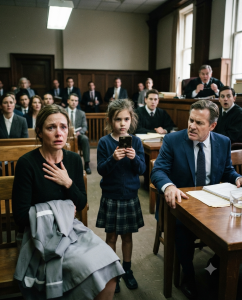
“You can call whoever you want,” the judge said with a smile.
It was the kind of smile people wore when they believed the ending had already been written.
No one in the courtroom imagined that a few seconds later, that same smile would disappear. No one imagined that the man who had walked in radiating control would go pale in front of everyone. And no one imagined that the person about to crack the entire case open would be an eight-year-old girl holding an old phone inside a pink backpack.
Mariana had spent twelve years inside the Almeida mansion without ever once believing she belonged there.
She arrived every morning before sunrise and left long after dinner had been cleared. She polished marble floors she would never own, dusted paintings she was never allowed to ask about, and washed glasses that had held champagne worth more than her monthly salary. She learned how silence worked in rich homes. You kept your head down. You noticed everything. You mentioned nothing.
That silence had fed her and her daughter for years.
But on that morning in court, silence was turning into the thing that might destroy her.
She stood near the defense table in a faded blouse, her work uniform folded tightly over her arm. She had not meant to bring it. In the rush, she had simply grabbed what was on the chair by the door. Now it made her look even smaller in that room full of polished wood, polished shoes, and polished lies.
The accusation against her was simple enough for the public to understand and dramatic enough for everyone to enjoy.
The Almeida diamond had vanished.
The stone was famous in ways that ordinary people’s suffering never was. It had appeared in photographs for years, hanging from Helena Almeida’s neck at galas, charity auctions, and private dinners. Magazines described it as legendary. Commentators called it priceless. Social pages treated it as an extension of the family itself.
And now it was gone.
According to Ricardo Almeida, only one person could have taken it.
Mariana.
Ricardo sat straight-backed across from her, his expression calm, almost bored. He had practiced that expression over a lifetime. It made other people nervous. It suggested certainty without effort. It said: I am not afraid because I do not need to be.
When the prosecutor asked him to describe the timeline, Ricardo did so with smooth precision.
“Helena left the dressing room at 9:10,” he said. “Mariana entered to clean at 9:14. At 9:19, Helena returned and discovered the diamond was missing.”
“And no one else entered?”
“No one.”
It sounded airtight.
Security logs placed Mariana near the room. Camera footage showed her in the hallway. Household staff confirmed she had been assigned to that section of the house. To outsiders, it looked obvious.
Only Mariana knew how carefully obvious had been constructed.
She had worked for Helena Almeida directly more than for anyone else in the house. Helena was not kind, exactly, but she was less cruel than the rest. She spoke to Mariana by name. Some days, she even asked about Sofia. That mattered in places where servants often became part of the furniture.
But during Helena’s last year alive, something had changed inside the mansion.
Doors started closing more quickly when Mariana approached. Arguments stopped the moment she entered a room. Ricardo and Helena were speaking in low, urgent tones almost every week. Sometimes Mariana caught fragments.
“You can’t keep burying this.”
“You’re being emotional.”
“If she ever talks—”
“She won’t.”
Then Helena died.
Officially, it was a tragic accident after a late-night drive on a wet road.
The family buried her fast.
The house became quieter, colder, sharper around the edges.
And Ricardo took over everything.
Mariana might have buried her suspicions too if not for what happened one week before the diamond disappeared.
She had gone into one of the upstairs sitting rooms to collect laundry and found Helena’s old jewelry case open on the table. Inside was the famous diamond necklace, but it was not the necklace that startled her. It was Ricardo, standing over it with a small velvet pouch in one hand and a look on his face that vanished the second he saw her.
“Sorry, sir,” Mariana had said immediately, backing toward the door.
Ricardo smiled.
Too quickly.
“Leave the laundry,” he told her. “I’ll have someone bring it.”
It was the only time in twelve years he had ever offered to do part of a servant’s work himself.
That night Mariana could not shake the image of the pouch. Or the fact that Helena was dead, yet her jewelry was still being moved around in private.
Two days later, she found something else.
A single diamond clasp on the floor near Helena’s old dressing room.
Not the central stone. Just a clasp.
She picked it up, meaning to hand it in, but Sofia had a fever that evening, and the clasp ended up forgotten inside Mariana’s apron pocket. The next morning, before she could return it, the house exploded with shouting.
The diamond was gone.
By afternoon, security had reviewed footage. By evening, Mariana was accused. By the next morning, Ricardo’s lawyers had the kind of neat, devastating narrative poor people almost never survive.
In court, Mariana tried to speak, but truth sounded weak beside wealth.
“I didn’t take it,” she said. “I swear.”
Ricardo’s lawyer adjusted his cufflinks. “Then perhaps you can explain why you were the last person recorded outside the room?”
Mariana had no explanation anyone there wanted to hear.
She could say she had been cleaning. She could say she had found a clasp days earlier. She could say the whole house had changed after Helena died. But suspicion did not need detail. It only needed someone easy to place beneath it.
At the back of the courtroom, Sofia watched all of this with the painful stillness children develop when they know adults are falling apart.
She was eight, but she had already learned the sounds of stress. She knew her mother’s breathing when bills were due. She knew her smile when it was real and when it had been sewn onto exhaustion. She knew Mariana’s hands shook only when fear became too big to hide.
That morning, they had taken the bus together in silence.
Before leaving home, Mariana had knelt in front of her and straightened the collar of her shirt.
“No matter what happens,” she said, “you stay quiet and close.”
Sofia nodded.
But inside the closet at home, she had remembered the old phone.
Years earlier, during a blackout, Mariana had shown it to her like it was some strange emergency tool from another life. The phone belonged to Sofia’s father, Daniel, who had once worked as a driver for the Almeida family before dying of a sudden illness. He had left almost nothing behind except a few photographs, a watch that no longer worked, and that phone with one contact saved under a single letter: C.
“What does it stand for?” Sofia had asked.
Mariana looked at the screen for a long time before answering.
“For someone who owes the truth a voice.”
Sofia did not understand then.
She understood now.
In the courtroom, after Ricardo’s lawyer requested preventive detention, something shifted in her. The adults had all chosen their side already. The judge’s face said he was tired of listening. Ricardo looked relieved. Even the audience seemed hungry for the ending they expected.
Mariana closed her eyes.
That was the moment Sofia knew the truth was about to lose.
So she stood.
Her voice came out small at first, but it carried. “I have something.”
The judge looked irritated. Ricardo looked amused. Mariana looked terrified.
Still, Sofia kept walking until she reached the center aisle.
“My mom didn’t steal that diamond.”
The judge sighed. “This is not a game.”
“I’m going to call someone who knows the truth.”
Ricardo laughed then. A short, contemptuous sound.
“And who would that be?”
The judge leaned back, smiling. “You can call whoever you want.”
Sofia took out the phone.
It felt heavier than it should have. She pressed the button with her thumb and prayed the battery would hold. The line rang once. Twice. Three times.
Then a woman answered.
“Who is this?”
Sofia swallowed. “My name is Sofia. I’m Mariana’s daughter.”
There was silence on the other end.
Then the woman said, “So the day finally came. The day Helena decided to stay silent.”
Ricardo’s face changed.
It was subtle at first. His shoulders stiffened. His jaw locked. But Mariana saw it immediately because innocent men got offended. Guilty ones got afraid.
The judge frowned. “Who is speaking?”
The woman ignored him. “Put me on speaker.”
Sofia looked at Mariana. Mariana gave the smallest nod.
When the voice filled the courtroom, it seemed to change the air itself.
“Ricardo,” the woman said, “are you still lying with the same ease, or has old age made you sloppy?”
Ricardo shot to his feet. “Your Honor, this is outrageous—”
“Sit down,” the judge snapped, sensing something he had not sensed before: danger.
The woman continued.
“You told them Mariana was the only person in that hallway. Tell them about the side entrance. Tell them about the jeweler you brought in after Helena confronted you. Tell them what happened the night before she died.”
Mariana’s hand flew to her mouth.
The name arrived seconds later.
“I’m Camila Duarte,” the woman said. “Helena Almeida’s sister.”
The courtroom erupted in whispers.
Camila had vanished after Helena’s death. Society pages called it grief. Others called it family conflict. Within months, her absence became one more polished mystery the Almeidas never addressed.
Now here she was, alive and furious on speakerphone.
“What are you claiming?” the judge demanded.
“I’m claiming Ricardo tried to replace the original Almeida diamond months before it disappeared,” Camila said. “Helena found out. She called me in tears. She said Ricardo had debts he would never admit publicly and had arranged a private sale of the original stone. The ‘missing diamond’ everyone is discussing was never missing. It had already been swapped.”
A wave of noise moved through the room.
Ricardo’s lawyer rose immediately. “This is hearsay.”
“No,” Camila said. “The hearsay is what Ricardo built against Mariana. What I have is a recording.”
That silenced everyone.
Mariana stared at the phone in Sofia’s hands as if it were something holy.
Camila kept talking, each word landing harder than the last.
“The night before Helena died, she recorded a message. She said that if Mariana was ever accused of theft, it meant Ricardo had chosen her as the sacrifice. Helena said Mariana had seen too much and knew too much about the movement of the jewelry.”
Ricardo’s face had gone from pale to gray.
“That recording was sent to me,” Camila said. “Along with copies of private invoices from a jeweler in Lisbon who examined the original stone for valuation before a discreet international sale.”
The judge turned sharply to Ricardo. “Is there any truth to this?”
Ricardo finally found his voice. “This is a fabrication by a bitter relative who has hated this family for years.”
Camila laughed once. It was a terrible sound.
“You’re right about one thing. I do hate what your family became. But Helena hated what you were becoming even more.”
The judge ordered the bailiff to secure the courtroom doors.
That was when Ricardo did something no innocent man should have done.
He glanced toward the exit.
Just a glance.
Quick, instinctive, damning.
The judge saw it too.
“Mr. Almeida,” he said quietly, “you will remain seated.”
What followed unraveled fast.
The court paused proceedings long enough to verify Camila’s identity and retrieve the recording she said she had already sent to the clerk’s office minutes earlier. She had anticipated resistance. She had also anticipated Ricardo trying to suppress the call if she waited too long.
When the audio file arrived, the whole courtroom listened.
Helena’s voice came through shaky and strained.
“If anything happens to me, look at Ricardo. If Mariana is ever accused, she is innocent. He told me no one would believe a maid over a man with our name. He said that was the beauty of it.”
Mariana broke down then.
Not because her own innocence had just been confirmed, though that alone would have been enough. She cried because someone had seen what was happening before it happened. Helena had known. Helena had tried, in the only way she could, to leave the truth behind.
The recording continued.
Helena described the original diamond, the swap, the jeweler, and a hidden compartment in Ricardo’s study where documents were kept until the sale could be completed. She admitted she had delayed exposing him because she feared scandal, feared losing everything, feared what he might do.
“I should have told the police immediately,” she said in the recording. “If you’re hearing this, my silence was my worst mistake.”
The judge wasted no time after that.
A search order was issued that afternoon.
In Ricardo’s study, investigators found invoices, correspondence, and the velvet pouch Mariana had seen in his hand. They also found the original clasp Mariana had forgotten she still had in her apron until, trembling, she handed it over and explained where she’d found it. The jeweler’s records matched Camila’s statement. The security timeline had been manipulated by staff loyal to Ricardo. And most devastating of all, financial records showed Ricardo had been under pressure from hidden debt large enough to ruin him.
The missing diamond had not been stolen by Mariana.
It had been sold, hidden, and weaponized.
Ricardo had planned the accusation carefully. A domestic worker with no money, no influence, and no legal army was the perfect shield. He counted on what powerful people always count on: that class prejudice would do most of the work for him.
He had been right.
Until he wasn’t.
Charges against Mariana were dropped immediately.
Charges against Ricardo were not.
In the weeks that followed, the story spread everywhere. But for once, the headlines did not celebrate the family name. They shredded it. News outlets replayed the courtroom call. Commentators fixated on the little girl who refused to stay silent. Legal analysts dissected the manipulation of evidence. Society columnists who had once praised the Almeidas now wrote long pieces about inherited power and manufactured innocence.
Mariana wanted none of it.
She wanted sleep. She wanted quiet. She wanted one full day where her daughter did not have to be brave.
When she and Sofia finally returned home after the hearing, the apartment felt smaller than ever, but warmer too. Mariana sank into a chair and pulled Sofia into her lap, even though Sofia insisted she was too big for that now.
“You didn’t obey me,” Mariana said softly.
Sofia looked down. “I know.”
Mariana kissed her forehead. “Thank God.”
A few days later, Camila came to see them in person.
She was not glamorous the way the magazines had once described Helena. She looked tired, older than her years, like someone who had carried anger for too long and knew exactly what it cost. She apologized to Mariana before she even sat down.
“I should have acted sooner,” Camila said. “I thought keeping distance would keep me alive long enough to expose him properly. But silence protects the wrong people.”
Mariana listened without interrupting.
“You saved me,” Mariana said at last.
Camila shook her head and looked toward Sofia. “No. She did.”
The city moved on, as cities always do. Another scandal eventually replaced this one. Another rich family had another public fall. Another courtroom filled with another version of truth and performance.
But for Mariana, some things never returned to what they were before.
She could not unhear the murmurs from that courtroom. She could not forget how quickly people believed the worst of her. She could not stop thinking about how close she had come to losing everything because the wrong man pointed at her with enough confidence.
Ricardo had counted on evidence, yes.
But even more than that, he had counted on the world’s willingness to see a woman like Mariana as disposable.
That was the ugliest part.
Not the diamond. Not the lies. Not even the betrayal inside the Almeida family.
The ugliest part was how many people had been ready to call it justice.
Sometimes, late at night, Mariana still remembered the judge’s smile before the call connected. She remembered the way the room had almost laughed at Sofia. She remembered how power looked when it thought itself safe.
And then she remembered Ricardo’s face when Camila spoke.
That was the moment she held onto.
Not because revenge mattered more than peace, but because truth had arrived in the room exactly when everyone else had already made up their minds.
Maybe that was the real wound left behind by everything that happened.
Helena had been wrong to stay silent as long as she did.
Camila had been right too late.
The judge had nearly failed.
The courtroom had nearly swallowed an innocent woman whole.
And yet the person who refused to let that happen was the only one in the room with no power at all.
Just a child.
A child with an old phone, a single letter saved in the contacts, and enough faith in her mother’s honesty to do what every adult around her was too afraid, too proud, or too compromised to do.
Years later, people would still ask Mariana what she remembered most.
The accusation?
The humiliation?
Ricardo’s collapse?
She always gave the same answer.
“I remember my daughter standing up.”
Because diamonds could be replaced. Family names could be ruined. Reputations could be bought and sold until they meant nothing.
But that moment—the moment Sofia chose truth over fear—was worth more than anything the Almeidas had ever locked inside a glass case.
And maybe that was the question the story left behind for everyone who heard it.
Not whether Ricardo deserved forgiveness.
Not whether Helena’s silence made her complicit.
Not even whether justice truly won in the end.
The real question was simpler and harder than all of that:
How many innocent people are punished every day because no one stands up before the verdict starts feeling inevitable?