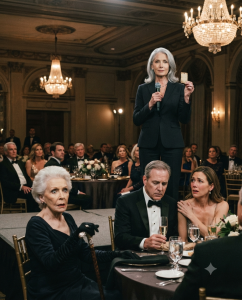
Maren Hale did not hurry.
That was the first thing people would remember later, long after the speeches were forgotten and the carefully planned gala had become a story told in lowered voices across Briar Glen. She did not rush the stage as if she were emotional, unstable, or hungry for spectacle. She climbed the steps with the composure of a woman who had already survived the worst thing the room could do to her.
The mayor was midway through a bland tribute to civic legacy when she reached him. He looked surprised when she extended her hand toward the microphone, but only for a second. Then something in her expression—something level, certain, and entirely beyond embarrassment—made him surrender it without resistance.
The ballroom went silent before she said a word.
It was the old Briar Glen ballroom, newly restored, all crystal chandeliers and polished walnut floors, with cream walls trimmed in gold leaf and a ceiling painted to resemble a sky no one in town had ever truly had to live under. The local paper had called it the crown jewel of the Marenwood Hotel reopening, though older guests still referred to it as the Ashbury Ballroom, using the name it had held back when the Ashbury family ruled half the county through banks, land deals, and the kind of private influence that never needed to be announced.
Tonight’s guest list reflected that world. Old family names. New political money. Charity board women. Business owners. Heirs. Their adult children. People who loved to call themselves pillars of the community because it sounded kinder than gatekeepers.
Maren stood before all of them in a dark tailored suit, her silver hair pinned cleanly at the nape of her neck, one diamond stud in each ear and not a single unnecessary gesture in her body. She looked like exactly what she was now: the owner of the hotel, the woman who had financed its restoration, and the reason everyone important in Briar Glen had accepted tonight’s invitation.
“Good evening,” she said.
Her voice was calm.
That calm made several people uneasy immediately, though they could not yet have said why. Anger could be dismissed. Emotion could be managed. But calm suggested preparation. Calm suggested evidence.
Maren let her gaze travel across the room before she continued.
“I worked in this ballroom in 1988,” she said. “Some of you remember that. Most of you probably don’t. I was one of the girls who carried trays and learned very quickly which families in Briar Glen confused money with character.”
A ripple spread through the room.
There were still a few guests old enough to remember the serving staff from those days, though most had not thought about them in years. To many of the people seated under the chandeliers, girls like Maren had once blended into the wallpaper. They delivered drinks, cleared plates, and vanished from memory as soon as the evening ended.
But Maren remembered all of it.
At nineteen, she had worked double shifts at the hotel while taking night classes at the community college two towns over. Her father had been dead three years by then, her mother too tired from factory work to do much besides sleep and worry, and Maren had learned early that grace was a kind of armor. She could carry five champagne flutes on one tray, smile through insults, and move soundlessly enough that rich people said terrible things in front of her because they forgot she counted as a witness.
That was how she had first noticed Thomas Ashbury.
He was twenty-three then, home from graduate school, restless in the manner of men raised inside privilege but not entirely comfortable with its choreography. He was handsome in a quiet, old-fashioned way. Not flashy. Not reckless. He had the polished restraint of someone who had attended expensive schools and learned exactly how much charm to reveal at a time. He also had the dangerous habit of looking at staff members as if they were fully human, which in Briar Glen could feel revolutionary even when it was merely basic decency.
He had started with small conversations.
Her name. Her classes. A joke about one of the committee wives who sent back perfectly good wine because she enjoyed being served twice. Then a note left beside an untouched dessert plate after a charity dinner. Thank you for rescuing me from a speech about municipal landscaping. —T.
Maren should have ignored it.
Instead, she smiled.
Over the next weeks came more notes. Then longer letters left with the front desk. Then walks after her shift, always late, always careful, always in places where Briar Glen’s gossiping eyes were less likely to follow. Thomas spoke about leaving. About cities where people were known for what they built, not what their grandparents had owned. He spoke about his mother less often, but when he did, his tone sharpened. Evelyn Ashbury was not merely the family matriarch; she was the architect of its image. Her standards were absolute, her judgments permanent. She loved order, reputation, and bloodlines. Thomas said all of this with the tired intimacy of a son who had spent his life obeying out of habit and resenting it in secret.
Maren listened. Then she trusted him.
That was the part that cost her.
Weeks later, Thomas wrote asking her to meet him in Room 614 after a fundraising dinner. He said he had something important to tell her. He said he was done waiting. He said there were plans to make and decisions he was finally ready to stand by.
Maren arrived nervous and hopeful, her apron folded in her locker, her hair brushed loose over her shoulders because he had once said he liked it that way.
Thomas did not open the door.
Evelyn did.
Even decades later, Maren could still recall the smell first: gardenia perfume and old polished wood. Evelyn stood in the doorway in a pale silk blouse and pearls, one hand on the knob, expression unreadable. Then she stepped aside as if welcoming a guest.
Maren should have left immediately.
Instead, she entered.
On the small table near the window sat an envelope.
Evelyn did not raise her voice. Women like her rarely needed to. She simply invited Maren to sit, then remained standing while she explained the situation in precise, devastating terms. She knew about the letters. She knew about the meetings. She knew her son had become distracted by fantasy. But fantasies ended. Families remained. Briar Glen had its order, and girls who mistook attention for advancement usually learned too late how cruel towns could become.
Then she opened the envelope.
Cash.
More money than Maren had ever seen in one place.
Beneath it were copies of Thomas’s letters.
Not originals. Copies.
That detail had chilled her most. It meant forethought. Surveillance. An organized defense.
Evelyn had spread them out with manicured fingers, one by one, so Maren could see how thoroughly the situation had been controlled. Every promise, every affectionate line, every mention of secret meetings and future plans. The implication was obvious: if Maren ever spoke, the letters could be framed however the family liked. She would become a manipulative girl from the service staff trying to force herself into a powerful name. Briar Glen would believe it because Briar Glen preferred stories that preserved the hierarchy it understood.
Take the money, Evelyn had said softly. Move on with some dignity. That would be best for everyone.
Maren had stared at the cash, then at the letters, then at the woman who had arranged the entire performance in her son’s room.
“No,” she had said.
Evelyn’s face had barely changed. That was almost worse than anger.
Maren left without the envelope. But at the door, when Evelyn turned slightly toward the table, Maren’s hand had moved on instinct. She took the room key card and slid it into her pocket.
Not because she knew she would need it. Because something inside her refused to leave with nothing.
The next morning, she expected Thomas to find her.
He did not.
Instead there was distance. Silence. One ugly rumor she recognized as planted. Then two. She lasted another three months at the hotel before the whispers became unbearable. After that she left Briar Glen, first for Hartford, then Chicago, then farther still into a life built through labor and refusal.
She worked in hospitality, then operations, then property turnaround. She learned where luxury hid its weaknesses. She learned how badly managed institutions could be bought, repaired, and made profitable again by people old money never bothered to take seriously. She did not marry. She did not come back. She became wealthy slowly, the unromantic way: by outworking people who underestimated her and purchasing what the arrogant were forced to sell.
Years passed. The Ashburys remained the Ashburys, though less invincible with each decade. Banks merged. Land got sold. Influence thinned. Their name still carried weight in Briar Glen, but it was no longer untouchable.
When the old hotel finally failed and went on the market under layers of debt, Maren bought it through an acquisition group before anyone in town realized her name was behind the deal. By the time the papers caught up, the sale had closed.
People treated her return as an eccentric triumph. The local profiles praised her business instinct, her design taste, her commitment to preserving local history. A few older residents vaguely remembered she had once worked there, but no one guessed the building itself held the sharpest memory of her life.
Then, a year into renovations, Maren asked to see the archived administrative boxes.
She told herself it was curiosity. An owner’s due diligence. A practical review of records before transfer to the historical society. But when she opened the old incident files, part of her already knew what she was looking for.
The papers had yellowed. Ink had faded. There were banquet reports, staffing disputes, maintenance requests, insurance forms, and correspondence clipped in careless bundles. Then, in a folder misfiled beneath a half-completed incident report, she found it.
A letter from Thomas Ashbury to the hotel manager.
Dated the morning after Room 614.
Short. Formal. Urgent.
Thomas asked whether his room key had been accessed after he left his briefcase in his car and whether his mother had requested entry to his room in his absence. He wrote that certain private correspondence may have been removed and that any unauthorized use of his room should be documented immediately.
At the bottom, in a hurried handwritten note, were the words that changed everything:
If Miss Hale was approached last night under false pretenses, the fault is mine for not anticipating what my family would do.
Maren sat with that page for a long time.
There was more. Another letter, unsent but folded into the same set, clearly drafted for her. In it Thomas apologized. Not heroically. Not in the public, redemptive way that would have cost him something meaningful. The apology was full of weakness and delay and the language of a man who had understood too late what his silence made possible. Yet it was still an apology. He admitted he had intended to meet her. He admitted his mother had intercepted his briefcase, which contained the original letters. He admitted he had failed to protect her from the consequences of his hesitation.
And near the end, almost buried in shame, he wrote: One day she’ll have more right to that place than any of us.
Maren had read that line three times.
Not because it softened the past. It did not. But because it named something nobody in the Ashbury world had ever imagined: that history could outlast humiliation, and that a servant girl written off as disposable might one day return as the only person in the room whose place had been earned.
She kept the letters. She said nothing.
Until the gala.
Now, before the entire town, she held up the old key card.
“Thirty-eight years ago, I was asked to meet someone in Room 614,” she said. “He didn’t come. His mother did.”
The crowd shifted toward the front table where Evelyn Ashbury sat with her son Thomas and her granddaughter Claire.
No one stared directly. They did not have to. Shame in a room like that acted almost like weather—you could feel where it gathered.
“I was offered money to disappear quietly,” Maren said. “I declined the money. But I kept this. Because people who humiliate you in private always assume shame will do the rest of their work for them.”
Thomas had gone pale around the mouth.
Claire, who was in her early thirties and had spent her whole life inheriting polished family mythology, looked at him with open confusion. She had likely heard versions of many things over the years—whispers, omissions, unfinished references—but not this. Certainly not from the stage of the hotel her family once treated as an extension of its influence.
Then Maren looked directly at Evelyn.
“The envelope you brought that night didn’t just hold cash,” she said. “It held copies of letters. Letters your son had written me first. Promises, plans, dates. You wanted me to see that you had them. You wanted me to understand that if I ever spoke, your family could paint me as a girl chasing a name.”
Evelyn’s cane slipped slightly against the floor.
That tiny loss of control did more damage than any outburst could have.
Maren continued.
“What you didn’t know was that Thomas mailed one more letter the morning after. Not to me. To the hotel manager. Asking whether his mother had used his room key after taking his briefcase from the car.”
Gasps moved through the room.
Thomas looked up sharply, as if hearing his younger self spoken aloud by someone he had failed irrevocably. Evelyn closed her eyes.
“I found that letter last year in the hotel archives,” Maren said. “Still clipped to the incident report no one filed properly. Your son knew something had been arranged. He just didn’t stop it in time.”
Claire had tears in her eyes.
That reaction reached people more deeply than the scandal itself. It is one thing to witness an old accusation. It is another to watch a daughter discover, in public, that her family’s version of decency has been constructed on concealed damage.
Then Maren said the final part.
“He apologized. Not to save me. Not publicly. Not bravely enough. But he apologized. And in that same letter, he wrote something I don’t think your family ever imagined I’d live long enough to prove true.”
She paused.
Then she looked out across the ballroom she now owned.
“He wrote: ‘One day she’ll have more right to this place than any of us.’”
Silence followed with almost physical force.
The line was unbearable in its precision. A prophecy and a confession, spoken inside a room that had once rendered Maren powerless and now bore her name on every invitation. No argument could neutralize it. No reputation strategy could blunt what people were seeing with their own eyes.
Claire stood.
“Is it true?” she asked her father.
Thomas rose too quickly. “Claire—”
“No,” she said, her voice shaking. “Don’t do that thing where you try to sound calm so no one notices you’re lying.”
A murmur ran through the crowd.
Evelyn tried to intervene. “This is not the place.”
Claire turned to her, devastated and furious. “Then where was the place? In private? With cash on a hotel table? With threats wrapped in manners?”
Evelyn did not answer.
Thomas’s shoulders seemed to fold inward. For a brief moment he looked less like an heir than an aging man who had spent decades living beside his own cowardice. “I wrote to her,” he said quietly. “I meant to go. My mother took my briefcase before dinner. By the time I realized what she’d done—”
“You still said nothing,” Claire snapped.
He closed his eyes.
“Yes,” he said.
That simple admission finished what Maren had begun.
It was not dramatic. It was worse. No shouting. No theatrical denial. Just a truth finally stepping into air after years of being sealed away.
Claire turned back to Maren. “Do you still have the letter?”
“Yes,” Maren said.
She reached into her bag and removed the archival sleeve.
Several people in the crowd were recording now. The mayor looked mortified. Board members exchanged rapid whispers. One of the older Ashbury allies quietly left the room.
Maren could have read the letter then. She did not need to. Thomas had already confirmed the bones of it, and Evelyn’s silence had supplied the rest. Instead she handed the sleeve to Claire.
The younger woman stared at it as though it might burn her. Then she opened it carefully and read.
No one in the ballroom spoke.
When Claire finished, her hand trembled. She looked first at her father, then at her grandmother. Her face had changed. Some losses happen all at once, and in that instant she lost not only the illusion of her family, but the instinct to protect it.
She gave the letter back to Maren with extraordinary care.
“I’m sorry,” Claire said.
It was the first honest sentence from the Ashbury table that night.
Maren inclined her head. She appreciated the apology for what it was, but she did not confuse it with repair. Some harms cannot be undone by sincerity from the next generation. Still, she respected the courage it took to speak when silence would have been easier.
Evelyn rose at last, leaning on her cane.
Even now she tried for dignity. “You have made your point,” she said, voice thin but steady.
Maren met her eyes. “No, Evelyn. I made yours. Mine was made thirty-eight years ago when you decided a girl with less power deserved less truth.”
For the first time, Evelyn looked genuinely uncertain. She had built her life on control—of rooms, of narratives, of people too dependent or frightened to resist her. But control has an expiration date, and hers had just arrived under chandeliers she no longer owned.
Without another word, she turned and walked toward the exit.
Thomas did not follow immediately. He remained standing beside his chair, watching his mother leave with the blank horror of a man who understood that obedience had protected nothing worth saving. Then he looked at Maren.
“I was weak,” he said.
“Yes,” she replied.
Nothing about her tone was cruel. That made it impossible to resist.
Thomas nodded once, as though the truth, spoken plainly, was a punishment he had been waiting for. Then he followed his mother out of the ballroom.
Claire stayed.
The crowd slowly began making noise again—whispers, movement, the rustle of people deciding what kind of witness they intended to become by morning. Some would condemn Evelyn. Some would blame Thomas more. Some would privately resent Maren for disrupting the event, though none would dare say so publicly after what they had seen. A few would finally remember the names of women they had once treated like furniture.
Claire stood near the stage and looked up at Maren. “What do you do,” she asked softly, “when the people who raised you turn out to be the people you’d warn others about?”
Maren thought about the nineteen-year-old girl in the hallway outside Room 614. About the envelope. About the years it took to rebuild a self after strangers decided your shame was convenient. About the archived letter and the absurd mercy of surviving long enough to outlast the story told about you.
“You stop protecting what hurt people,” she said. “Even when it shares your last name.”
Claire absorbed that.
Then she left the ballroom not beside her family, but alone.
The gala never recovered. The speeches were canceled. Reporters began calling before midnight. By morning, three board members had resigned from associated charitable posts, insisting they had known nothing. The Ashbury family released a statement so polished it collapsed under its own emptiness. No one believed it. Too many guests had heard Thomas confirm enough of the truth. Too many had seen Evelyn’s silence.
But the real ending happened after the headlines.
Late the next afternoon, Maren walked through the now-empty ballroom while workers dismantled floral arrangements and stacked chairs. Sunlight poured through the tall windows, catching dust in the air like glitter. The room looked ordinary again. Smaller, somehow. Less mythic.
She paused near the stage and set the old key card on the edge of the podium.
For years she had kept it as proof that one night had happened exactly as she remembered it. Not because she doubted herself, but because power has a way of making the injured feel absurd for carrying evidence of what others insist was trivial.
Now she no longer needed the reminder.
One of her staff approached to ask whether the Ashbury crest carved into the molding should remain during the next renovation phase. It had been preserved as part of the hotel’s historical detailing, but after last night the question felt newly charged.
Maren looked up at it.
Then she smiled, very slightly.
“Take it down,” she said.
The staff member nodded and walked away.
Maren stayed where she was a moment longer, gazing across the ballroom that had once witnessed her humiliation and had now witnessed something else entirely—not revenge, exactly, and not closure in any neat sentimental sense. The past had not changed. Thomas had not been brave enough when bravery mattered. Evelyn had not become sorry. The years stolen by shame would not be returned.
And yet.
Truth had finally occupied the room without asking permission.
For Maren, that was enough.
As she turned to leave, her eyes caught the reflection of the chandeliers in the windows—bright, fractured, impossible to hold. She thought of Claire reading the letter with shaking hands. She thought of Thomas’s face when he heard his younger self quoted back to him. She thought of Evelyn, walking out under the weight of a silence money could not soften.
Everyone in Briar Glen would spend days deciding who had been the villain, who had been the coward, and who had earned forgiveness. But the harder question would linger longer than the scandal itself:
What was the bigger sin—what Evelyn did in that room, or what everyone else had always been willing to believe about a girl like Maren?