The church van hadn’t moved in three days.
At first, Marlene Kowalski noticed that the same way she noticed everything else in Birch, Montana: automatically, without effort, like her eyes still worked a mail route even though she’d retired six years ago.
White Ford Econoline. Church-owned. Parked crooked behind the Fellowship Hall. Frost on the windshield every morning. No tire tracks leading away.
It was the kind of thing most people would see without really seeing. But thirty-two years delivering mail through snowstorms, muddy springs, and summers hot enough to soften the glue on envelopes had trained Marlene to catch what didn’t fit. A package left too long on a porch. A curtain that stayed closed three days in a row. A truck parked where it didn’t belong.
By the third morning, she had almost convinced herself it was none of her business.
Then she saw breath on the inside of the back window.
It was just a little cloud, no bigger than her hand. It fogged the glass, vanished, then came again.
She stood at the mailbox in her robe and slippers, cold air cutting through the flannel at her wrists, and felt a familiar sensation settle into place.
Decision.
Not fear. Not curiosity.
Decision.
The snow squeaked under her feet as she crossed the church lot. Pine trees behind the Fellowship Hall bent in the wind, and the steeple bell rope knocked lightly against the brick. The van looked dead from the outside. When she got close, she rapped her knuckles against the rear door.
No answer.
She knocked harder.
Something shifted inside.
The door gave an inch, then another, and Marlene looked into the back of the van.
The boy lay curled along the bench seat under a donated church blanket too thin for Montana winter. A gym bag propped under his head. Two velvet offering-plate collection bags were pulled over his feet. His face was sharp with hunger, dark circles pressed under both eyes, and the skin at his lower lip was split open from the cold.
He woke swinging.
His fist came at her wild and fast, more instinct than strength. Marlene stepped back, raised both hands, and said, “Easy. Easy now. I’m not going to hurt you.”
The boy froze.
His chest heaved under a coat two sizes too big. He blinked hard, dragging himself up from sleep into panic. And before he said a word, before he even looked fully at her, his right hand flew to his chest and pressed something flat beneath the coat.
An envelope.
She caught only the corner of it. Water-stained. Soft with wear. Then it disappeared again.
Marlene had learned long ago that frightened people answered badly to questions. So she didn’t ask any.
She only said, “You’re coming inside.”
He hesitated, looking past her as if calculating the road, the church, the open lot, the chances of running.
Then he looked down at his own feet covered in velvet donation bags and nodded.
Her house sat across the gravel lot and down one narrow side street, a green Cape Cod with white trim and a Christmas wreath still hanging on the door though January was giving way to February. She had never bothered to take it down. Since Dale died, the rules for such things seemed less urgent.
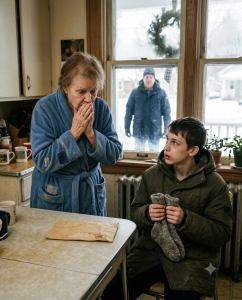
Inside, the kitchen held the kind of heat only old houses make, uneven and stubborn. The radiator knocked. The windows hummed faintly with wind. Marlene told the boy to sit and took eggs from the fridge, sausage from the freezer, bread from the box above the stove.
He lowered himself into the chair like he expected to be thrown out before the pan got hot.
She scrambled six eggs, browned the sausage, and pushed the plate in front of him. He ate in silence, too fast at first, then slower when he realized no one was going to snatch the food back. She gave him toast, then two more slices, then jam. Put coffee on for herself and hot water on for tea in case he wanted it.
Twice while she stood at the stove, she saw him touch the envelope hidden beneath his coat.
It wasn’t a casual check. It was protective, almost reverent.
When he finished eating, she went to the linen closet and pulled out a pair of gray wool socks from Dale’s old drawer. Her husband had ordered the same socks every October for twenty years, convinced no other manufacturer understood feet. After he died, she couldn’t bear to throw them away.
She set the socks beside the boy’s plate.
His eyes locked on them. His jaw tightened. For one second, it looked as though he might cry.
“You don’t have to tell me anything,” Marlene said, sitting down with her coffee. “But you can.”
He looked at the socks a little longer. Then he looked up.
“What’s your name, hon?”
He answered with a last name.
Her maiden name.
The cup nearly slipped from her hands.
There had been a time when hearing that name was ordinary. It belonged to the farm on Route 9 in Cascade County, to hay fields and flood ditches, to a mother who canned peaches in August and a brother who could fix any engine built before 1985. Then came marriage and distance and grief. She became Marlene Kowalski, her mother died, old hurts hardened, and her brother Raymond stopped taking her calls.
The silence between them had lasted eleven years.
“How do you know that name?” she asked.
The boy reached into his coat and laid the envelope between them.
It was sealed. No stamp. No mailing address on the front. Just a hundred small creases and the look of being carried too long.
“He said if anything happened to him,” the boy said quietly, “I was supposed to find you.”
The kitchen felt suddenly too small.
Marlene studied the boy’s face properly then. The jawline. The eyes. The stubborn set to the mouth. She saw Raymond at seventeen standing by the barn with grease on his hands and a fight in his posture. The resemblance was no longer something she imagined. It was right there, impossible to ignore.
“Who are you?”
“My name’s Eli,” he said. “Raymond was my granddad.”
Marlene stared.
Raymond had a grandson.
All those years of silence, and there had been a child — now a nearly grown one — she had never met, never sent birthday cards to, never watched at Christmas, never known.
Her hands shook as she turned over the envelope.
There, on the back flap in faded blue ink, was an address written in Raymond’s unmistakable hand.
Not her current house.
Her childhood address.
Route 9.
The old farm.
Only one person on earth would have written it like that, preserving a home that no longer existed because in his mind it still did.
“Where is he?” she asked, already afraid of the answer.
Eli looked down. “He died two weeks ago.”
The room tilted.
He told her the outline first. Raymond’s pickup had slid off a county road during a storm. The snow came down hard that night, and no one found him until morning. By the time authorities called it in and things got sorted, Eli had already discovered that some men were looking through Raymond’s trailer, asking questions they pretended were casual.
“What kind of men?” Marlene asked.
Eli hesitated.
“My granddad used to work maintenance at a storage facility outside Billings,” he said. “But sometimes he did side jobs. Repairs, hauling, watching places. A few months ago he started acting strange. Locking his truck. Sleeping with a flashlight next to the bed. Telling me if anybody asked, we never talked about his friend Marcus.”
“What friend Marcus?”
“I don’t know if that was even his real name.”
A hard knock rattled the front door.
Eli flinched. Marlene’s head snapped toward the porch.
Then came a man’s voice, smooth and controlled. “Mrs. Kowalski? I know he’s in there. Tell the boy to hand over the letter.”
Eli’s face drained of color.
Marlene stood at once. “Back room,” she said.
He grabbed the envelope, the socks, and his coat and disappeared through the pantry toward the tiny laundry room. Marlene went to the door and opened it only as far as the chain allowed.
A man in his fifties stood on her porch in an expensive dark parka with leather gloves and boots too clean for county roads. A black pickup idled behind him. Someone sat in the passenger seat.
“I’m looking for a kid,” the man said. “Scared. Might’ve broken into church property.”
Marlene leaned against the door. “Then go look somewhere else.”
The man smiled without warmth. “Raymond and I were associates.”
“Then you can tell me your name.”
He didn’t. His eyes slid over her shoulder, measuring the hallway.
“Raymond took something that didn’t belong to him,” he said. “The boy doesn’t know what he’s carrying.”
“What’s in the letter?” Marlene asked.
A tiny crack appeared in his expression. Too quick for most people to catch. Not for her.
That told her enough.
He wanted the letter. Badly.
“I’m asking politely,” he said.
“And I’m saying no.”
She shut the door.
Her hands trembled, but her mind had gone crystal clear. In thirty-two years on a route, she had seen what panic looked like when people feared getting caught. She recognized it now.
She hurried back to the pantry.
Eli stood in the laundry room with the envelope open. Inside were three folded pages, a small key taped to the last sheet, and a flash drive sealed in plastic.
“What does it say?” she asked.
Eli handed her the pages.
Raymond’s handwriting filled each one.
Marlene,
If this letter reached you, I’m either dead or too close to it. I’m sorry I waited this long. I’m sorry for all of it.
The first page hit like a fist. Raymond confessed that years earlier, after their mother’s funeral, he had accused Marlene of manipulating the estate. He had believed their mother changed the will because Marlene stayed close and he moved away. He let resentment turn into silence. Later, he learned the truth: their mother had not changed anything. The missing money he thought she stole had been taken by a man Raymond trusted, a drifter called Marcus Vale who had been helping on the farm during that last year. By the time Raymond discovered it, the farm was sold, their mother was gone, and shame had done what anger started.
Marlene had to stop reading.
She had spent eleven years thinking her brother simply no longer loved her enough to answer. The truth was uglier and sadder: he had been wrong, and too ashamed to say it.
“Keep reading,” Eli whispered.
She did.
Months before his death, Raymond crossed paths with Marcus again — only Marcus was no drifter now. He was tied to a group using a storage facility and church charity shipments as cover for financial fraud and theft. Donations, equipment, and insurance claims were being manipulated. Raymond discovered records tying Marcus and two local businessmen to the scheme. He copied everything onto the flash drive and took one key from a safety deposit box holding original ledgers.
If anything happens to me, Raymond wrote, give this to Marlene. She still knows who to trust and who not to. She was always braver than me.
Marlene’s vision blurred.
Below that, Raymond wrote something that hurt even more.
Eli is my daughter’s son. You never met him because my daughter, Leah, died four years ago. I raised him after. He’s all I have left. If I failed him the way I failed you, don’t let that be the end of the family.
There was a pounding at the back of the house.
Not the front door this time.
The men were circling.
Marlene folded the pages once, tucked them into her apron pocket, and looked at Eli. The boy was shaking but steady-eyed.
“Do you trust me?” she asked.
He nodded.
“Good. Because we’re going out the cellar.”
Dale had always said the old coal chute was useless except for letting mice in. For the first time in fifty years, it proved him wrong. Marlene led Eli down the basement stairs, across the concrete floor, and out through the side hatch buried behind stacked storm windows and two rusted snow shovels. They came up in the narrow alley between her garage and Mrs. Pollard’s hedge just as one of the men rounded the opposite side of the house.
Marlene grabbed Eli’s sleeve and pulled him low.
They cut through the backyard, crossed into the church cemetery, and moved behind rows of headstones half-buried in snow. Marlene’s phone was still in the house. That left only one place close enough and safe enough: the sheriff’s residence two blocks over.
As they hurried, Eli said, “Granddad said you’d figure it out.”
“Your granddad thought I could figure out everyone but him,” Marlene muttered.
The sheriff’s wife opened the door before Marlene even knocked a second time. One look at Marlene’s face, one look at Eli, and she ushered them in. Sheriff Ben Harlow arrived from the garage still carrying a box of road salt. Marlene handed him the letter, the flash drive, and the tiny taped key.
Ben read fast. His face hardened slowly.
“I know Marcus Vale,” he said. “Or I know of him. He’s been sniffed around before, never enough to stick.” He looked at Eli. “You did the right thing coming here.”
Within an hour, state investigators were called. The black pickup was found abandoned on a service road outside town. The man from the porch turned out to be tied to one of the businesses named in Raymond’s letter. The flash drive contained insurance records, fake invoices, photos of storage lockers, and scanned ledgers showing donations rerouted and sold off. The key opened a safety deposit box in Billings containing original handwritten books, names, dates, and signatures.
Marcus Vale was arrested three days later in Idaho.
The fraud ring reached farther than Marlene expected: storage thefts, staged losses, charity diversion, and years of stolen funds hidden behind churches and nonprofits people trusted too easily. Raymond had stumbled onto it because a man who once stole from his family assumed he could still move unseen through small places.
But that wasn’t the part that stayed with Marlene.
What stayed with her was the letter’s first page. Raymond’s apology, every line of it pressed into paper he never lived to explain in person.
At his funeral, held the following week in a town forty miles east, Marlene sat in the front pew beside Eli. The pastor called Raymond stubborn, loyal, and complicated. Marlene almost laughed through her tears because that was the most accurate thing anyone said all morning.
Afterward, when the casseroles came out and people spoke softly in circles, Eli stood beside her like he didn’t quite know where to put his hands or his grief. Marlene took him back to Birch that evening.
Not forever, she told herself at first.
Just until things settled.
Just until school paperwork got sorted.
Just until they both caught their breath.
But life rarely announces when temporary becomes something else.
Eli moved into the spare room. He was quiet at first, always asking before taking food, always leaving his shoes by the mat as if he expected the rules to change. Marlene bought him proper winter boots, more socks, and a coat that fit. He fixed the hinge on her shed without being asked. She taught him how to make her mother’s stew and how to sort bills from junk mail on sight. Some nights they talked about Raymond. Some nights they didn’t.
In spring, he asked if she had any pictures of the old farm.
She pulled out the albums.
They sat at the kitchen table under the yellow lamp while wind rattled the new rain against the windows, and for the first time in eleven years Marlene said her brother’s name without anger in it.
By summer, Eli laughed more. By fall, he argued with her about football and forgot to clear his plate. She took that as a sign of healing.
One evening, nearly a year after the van, they drove out past Cascade County and found the road where the old farm used to be. The house was gone. The cottonwoods remained. The fence line had shifted, and someone else’s cattle grazed where her father once stacked hay. Eli stood beside her with Raymond’s letter folded carefully in his pocket.
“He really thought you’d help,” Eli said.
Marlene looked at the land, then at the boy her brother had carried through his final years, and answered honestly.
“He knew I’d be mad first.”
Eli smiled.
Then she added, “But he also knew I’d show up.”
She never got the chance to say goodbye to Raymond while he was alive. That ache never really left. Neither did the bitterness over what eleven years of silence had cost them both. But sometimes grief doesn’t end by making sense. Sometimes it ends by leaving you one last thing to carry.
In her case, it was a boy in a church van, an apology written too late, and a second chance she never saw coming.
People in Birch still talk about the fraud case when gossip runs dry. They talk about the arrest, the storage lockers, the men led away in cuffs. But Marlene almost never thinks about that part anymore.
When she remembers that winter morning, she thinks about a tiny cloud of breath on cold glass.
How close she came to walking past.
How many lives can turn on one person noticing something is a little too still.
And on harder days, when she wonders whether forgiveness given after death still counts, she remembers Raymond’s handwriting on that envelope and asks herself the question she can’t stop living with:
Was the biggest tragedy that he didn’t trust her for eleven years…
or that he trusted her completely when it mattered most?