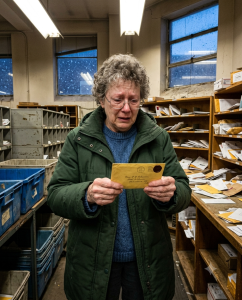
When the downtown post office in Duluth announced it was closing for good, most people treated it like another sad local headline. Another old building with too much history and not enough funding. Another service folded into a newer system that promised efficiency and delivered less soul. For Helen Mercer, it felt more personal than that.
She had spent thirty-two years working behind those brick walls.
For most of her life, the post office had been more than a job. It had been routine, purpose, and in many years the only reason she got dressed before noon. She had sorted mail there in blizzards, trained new carriers there, cried in the women’s bathroom there after receiving news she didn’t want to carry home. She had retired five years earlier and had managed, with effort, to stop waking at 4:30 every morning. When the station manager called and asked whether she would come back for one final week to help sort old undeliverable records before the building was shut down, she said yes before he finished asking.
“You remember the archive system better than anybody,” he told her.
That was true. Helen remembered everything. She remembered routes, names, apartment codes, dead-end forwarding requests, and handwriting styles from neighborhoods that had changed three times over. She could tell who had mailed a Christmas card just by looking at the slant of the address. She had built a life around tiny details other people ignored.
What she didn’t know was that one of those details had been waiting for her all along.
The sorting room was on the second floor, in the oldest part of the building. The windows were high and narrow, and years of lake wind had rattled the panes until the glass sounded tired even on calm days. The archive bins smelled like dust, paper glue, and cold metal. Helen worked slowly, gloved hands moving through stacked trays of returned mail that dated back decades.
Most of it was ordinary in the saddest possible way.
Cards returned because the recipient had died. Anniversary notes sent to addresses emptied years earlier. Legal notices ignored, then resent, then abandoned. A package containing a ceramic angel wrapped in newspaper from 1992. A postcard from Arizona with a smiling cactus on the front and no zip code on the back. Traces of people still reaching for one another after the system had already failed them.
Late on Thursday afternoon, she found the yellow envelope.
It was wedged at an angle inside a damaged box, trapped between two packets of bound correspondence as if someone had slid it there in a hurry. Helen nearly missed it. But the paper was a strange faded gold, darker than manila, softer at the edges, and sealed with old red wax that had cracked into a delicate web.
She lifted it out carefully.
The envelope was addressed to her.
Not to Helen Mercer, the name she had carried for most of her adult life. To Miss Helen V. Stensrud, in the exact name she had used before marriage, written above the address of the green house on East Fourth Street where she had grown up.
Her breath left her in one quiet rush.
She knew the handwriting instantly.
It was her mother’s.
The recognition hit with such force that she had to sit down. Ingrid Stensrud had been dead for twelve years, but her penmanship was carved into Helen’s memory. Small, controlled loops. Upright capitals. A hand so disciplined it somehow looked stern. Helen had seen it on birthday cards, church envelopes, recipe notes, and carefully folded grocery lists. As a child, she had believed her mother wrote the way she lived: neatly, sparingly, and without room for mistakes.
Then Helen saw the postmark.
October 14, 1985.
The day the hospital told her her newborn daughter had died.
She read the date again. Then again, as if numbers could change under enough pressure. They did not.
She was twenty-three that autumn. Unmarried, frightened, still trying to believe that the man who had promised to marry her after the baby came meant it. He had not. By the time she went into labor, he was already drifting in and out, full of excuses and tobacco-smelling apologies. Her mother had driven her to St. Luke’s through cold rain and spent the first hours of labor correcting nurses in that clipped tone she used when she believed the world was failing at basic competence.
Helen remembered pain, exhaustion, bright lights, and then the fog that followed. She remembered hearing that the baby was a girl. She remembered crying because she had already chosen the name Lucy. She remembered asking three times if she could hold her.
And she remembered the doctor saying there had been complications.
The details had never stayed still in memory. Some pieces sharpened over time; others blurred. She remembered an injection after delivery. She remembered sleeping harder than she expected. She remembered waking and knowing instantly something was wrong because no one would look at her directly. Then a doctor she did not know stood near the bed and said her daughter had not survived the night.
Everything after that happened around her instead of to her.
Forms appeared. A social worker spoke. Someone offered sedation. Someone told her it would be better not to see the body. Her mother took the pen from her hand more than once because Helen couldn’t stop shaking. There was talk of arrangements, but no real arrangement ever materialized. No service. No grave she was taken to. No death certificate she remembered holding.
At the time, she was too shattered to understand what was missing.
In the years after, she noticed the holes but never knew what they meant. Whenever she asked for details, she was told that hospitals handled infant loss differently then. Records were inconsistent. There had been complications. Her mother hated discussing it. The child’s father disappeared entirely by Christmas.
Helen learned to live with an absence she could never properly picture.
Now she was holding a sealed envelope written in her mother’s hand on the very day Lucy supposedly died.
She turned it over. The flap was still closed. The wax seal remained intact, stamped with a small impression almost rubbed away by time. Holding it closer to the light, Helen made out a symbol that looked like a pair of balance scales.
A legal seal.
On the back, a return address had been typed: Wexler, Shaw & Pritchard, 214 West Superior Street, Duluth.
Her mother had mailed her something from a law office on the day of the death.
Helen walked to the dusty office computer in the corner and looked up the address. The firm no longer existed. But the building did. When she pulled up the map, her hands began to shake again.
It was three blocks from the house where she and her mother had lived.
Three blocks.
For forty-one years, whatever truth this envelope held had remained practically within walking distance of her life.
That night Helen did not go home first. She drove straight to East Fourth Street. The old green house had been sold years earlier, but she still kept the key out of habit, a strange leftover from the estate sale when the new owners had changed the locks but handed her one old skeleton key they found in a drawer. She parked across the street and sat in the car, staring at the porch where her mother had once stood every evening waiting for Helen to come back from work.
Memory shifted under pressure.
Two days after the hospital, Helen had come downstairs in the dark and found her mother sitting at the kitchen table in her church coat and gloves. Her purse was open. A stack of papers lay in front of her. Helen had asked what she was doing. Ingrid had looked up with red-rimmed eyes and said only, “Taking care of what has to be taken care of.”
Helen had assumed she meant funeral paperwork.
Now that sentence sounded like a locked door.
She drove to Superior Street the next morning.
The building was narrow and old, though the law office was long gone. A tax preparation service occupied the front suite; a coffee shop took the corner. Inside the lobby, the tile had been replaced, but the staircase still curved the way old downtown buildings did, with polished wood rails worn smooth by generations of hands.
At the reception desk sat a woman with silver hair cut in a practical bob and reading glasses hanging from a chain. Helen showed her the return address on the envelope and asked whether any records remained from the old firm.
The woman’s expression changed instantly.
Not panic exactly. Recognition.
“Where did you get that?” she asked.
“In the dead-letter archives at the post office.”
The woman stood slowly. “Please wait here.”
“No,” Helen said, more sharply than she intended. “Please don’t disappear on me. I’ve been waiting forty-one years without knowing I was waiting. If you know something, tell me now.”
The woman studied her face. “Your name?”
“Helen Stensrud Mercer.”
That did it. The color drained from the woman’s face.
She led Helen into a small back office and closed the door. On the wall hung file cabinets and a framed black-and-white photo of Superior Street in winter sometime in the 1950s. The woman introduced herself as Marianne Foss. She had started as a clerical assistant in the building in the late 1980s and stayed through two ownership changes. Old records, she explained, had been boxed and moved to basement storage, though many had been destroyed when the original firm dissolved.
“Not all of them,” Helen said.
Marianne looked at the envelope. “No.”
After a long silence, she admitted that years earlier, a man had come asking about one particular probate box from the mid-1980s. He had been insistent, even agitated. He wanted to know whether anyone had ever inquired about a private infant placement connected to St. Luke’s Hospital.
Helen felt as if someone had struck the air from her lungs.
“Placement?”
Marianne pressed her lips together. She regretted saying it, but it was too late.
“What kind of placement?” Helen asked.
“You deserve to hear this with documentation, not from my memory alone.”
“Was my child adopted?”
Marianne’s eyes lowered. “I don’t know that for certain. I know there were papers. I know your mother’s name appears on an intake ledger. I know the file was flagged to notify a surviving signatory if there was ever an inquiry.”
“Surviving signatory?”
“The woman who signed the original papers.”
Helen’s voice thinned. “My mother.”
Marianne gave the smallest nod.
The basement smelled of damp cardboard and radiator heat. Marianne unlocked a metal cage and led Helen past shelves of accounting boxes until she stopped in front of one marked WSP 1985-PROBATE/MISC. Inside were folders brittle with age. Most were unrelated wills and property transfers. At the bottom sat a slim file tied with cotton tape.
Written on the tab: STENSRUD / PRIVATE MATTER.
Helen’s hands failed her. Marianne untied the tape instead.
Inside were copies, carbon duplicates, and one notarized affidavit. The names swam at first. Ingrid V. Stensrud. St. Luke’s. Temporary guardianship authorization. Confidential relinquishment review pending maternal incapacity. Private placement consultation.
Maternal incapacity.
Helen read that phrase three times before she understood its cruelty. She had not relinquished her daughter. Someone had declared her incapable of making decisions after childbirth. There was a physician’s notation attached, partly illegible, referencing sedation, emotional instability, and inability to consent. The signature beneath it belonged to a doctor whose name Helen barely remembered from the hospital.
Then came the page that turned her blood to ice.
A typed memorandum between the law office and a couple from Minneapolis regarding “newborn female, healthy, immediate placement requested.” No death. No stillbirth. No loss certificate. Just placement.
Lucy had lived.
Helen made a sound Marianne would later remember for the rest of her life, because it wasn’t exactly a cry. It was the sound of grief being forced to change shape too quickly.
She had to sit on an overturned archive crate.
The rest emerged slowly, in fragments cruel enough to require pauses between each one. Helen’s mother had consulted the law office before the birth, apparently after learning that Helen intended to raise the baby alone. Ingrid had belonged to a generation that feared scandal more than loneliness, and in 1985 an unmarried daughter with a newborn in a small church community felt, to her, like a disaster to be managed. The law office specialized in quiet family arrangements. Private ones. Ones that rarely invited scrutiny.
But something had gone wrong.
Marianne found another letter in the file, this one never mailed, drafted by one of the attorneys weeks later. It stated that “the birth mother was not adequately informed” and that further legal exposure could arise if she contested the placement. There were notes about urgency, hospital cooperation, and the need to maintain confidentiality because “the presumed narrative of neonatal death has already been communicated.”
Presumed narrative.
Communicated.
Helen sat trembling while every year of her life rearranged itself around two facts: her daughter had not died, and multiple adults had allowed her to believe she had.
“Who took her?” Helen asked.
Marianne turned to the final folder. “There’s a name.”
The adoptive couple had later formalized the placement through another firm. Their names were Daniel and Ruth Bennett of Minneapolis. An amended birth record had been requested under the name Claire Bennett.
Claire.
Helen pressed her hand to her mouth. Her daughter had grown up under another name. Somewhere in Minnesota, perhaps elsewhere by now, Lucy had become Claire and lived a whole life while Helen mourned someone who had never been dead.
There was more.
A letter from Ingrid, dated six months after the birth, begged the firm for photographs. It spoke of “Helen’s suffering” and “my own unbearable burden.” Another, two years later, asked whether the family was still in Minneapolis and whether “the child has Helen’s eyes.” The replies became curt. The firm warned Ingrid not to attempt contact. In the final note, one attorney stated that all future communication would cease and advised her to destroy duplicates.
Instead, Ingrid had mailed a letter to Helen.
The yellow envelope.
Helen opened it there in the basement.
Inside was a single folded page.
My dearest Helen,
If this reaches you, then I have failed to keep silent, and perhaps that failure is the only decent thing I have left in me. Your daughter was born alive. I told myself I was saving you from ruin, from shame, from raising a child without a husband, from the life I feared would swallow you. I let men in suits and men in white coats speak as if there was still time to decide, and by the time you woke, the decision had been made and I helped keep it from you.
There is no forgiveness for what I have done.
I have asked for her location and have been denied. They say it is final. They say the family is respectable. They say you were not in a condition to choose. None of that changes the truth. She lived. She cried. I heard her myself.
Her name in their file is not the name you chose, but I remember the name you whispered before they took her.
Lucy.
I do not know whether I am sending this because you deserve the truth or because I cannot carry it alone another day. I only know that if I tell you face to face, you will look at me and I will become exactly what I am.
Mother
Helen finished reading and folded in half.
The letter had been there all along. Her mother had tried, at least once, to tell her. But the envelope had vanished into the same system Helen would later devote her life to serving. The truth had entered the mail and never reached its destination.
For a long time she blamed only her mother. That was easiest. Ingrid had done the unforgivable thing. She had taken a frightened, grieving daughter and buried her in a lie. She had chosen reputation over mercy and control over love. Helen felt rage so clean and powerful it almost steadied her.
But anger widened as the documents did.
The doctor had signed. A social worker had processed paperwork. Lawyers had arranged the transfer. An adoptive couple had accepted a child whose mother had been declared incapacitated under suspicious circumstances. Even if they had not known the whole truth, someone had known enough. A roomful of adults had stood around Helen’s life and decided she did not deserve to keep it.
Marianne helped her obtain copies and directed her to the county office that handled sealed records petitions. It took months, not days. There were affidavits, requests, a consultation with a family law attorney, and a modern DNA search that finally did what the old system had prevented. Claire Bennett was alive. Forty-one years old. Living in St. Paul. A teacher. Married. One son.
Helen stared at the information sheet for an hour before she called.
Claire answered on the fourth ring.
Her voice was lower than Helen expected, calm and warm, with that particular Minnesota softness at the edges. Helen nearly hung up. Instead she said, “My name is Helen Mercer, and I believe I may be your birth mother.”
Silence.
Then a sharp inhale.
Claire had known she was adopted. Her parents had told her that much. But they had also told her the story was private and painful and that her birth mother had signed papers willingly after a difficult delivery. Claire had never pushed too hard because Daniel and Ruth Bennett had loved her well. They had not been cruel people. They had, in many visible ways, been good parents. But over the years Claire had felt seams in the story. Dates that did not line up. Evasions when she asked for records. A strange resistance to discussing the hospital.
They met two weeks later at a park near Lake Harriet after both agreed a lawyer’s office would be unbearable.
Helen knew her instantly.
Not because they looked identical. They didn’t. Claire carried herself with more confidence than Helen ever had at that age, and time had shaped them along different lines. But when Claire turned at the sound of Helen’s footsteps, there it was: the eyes. Helen’s eyes. And Ingrid had known it would happen. That was why she had asked in a letter whether the child had Helen’s eyes.
Neither woman knew how to begin.
Claire finally said, “Did you really think I died?”
Helen nodded, and the first tears came before words did. “For forty-one years.”
Claire covered her mouth with one hand and cried too.
They sat for hours. Helen told the story as honestly as she could bear. Claire listened without interrupting, except once to ask whether Helen had named her Lucy. When Helen said yes, Claire whispered the name to herself as if testing the weight of an invisible inheritance.
Daniel and Ruth Bennett had both died by then. That complicated everything and softened nothing. Claire loved them. That remained true. She also felt betrayed by what they had accepted and never questioned. That remained true too. Helen did not ask for a place in Claire’s life she had not earned. She did not call herself “Mom” out loud. She answered questions. She apologized for what had happened even though the choice had been stolen from her. Claire, in turn, did not offer easy absolution, because there wasn’t any to give. What they had was stranger and more fragile than reunion stories like to admit.
It was a beginning, not a repair.
Months later, Claire invited Helen to meet her husband and son. The boy was eleven and suspicious of adults in the casual, healthy way children often are. Helen brought lemon bars she was too nervous to eat. During dinner, Claire’s son asked whether it was true Helen used to carry mail in snowstorms. Helen said yes. He asked whether she had ever found anything important in a lost letter.
Helen looked across the table at Claire.
“Yes,” she said. “The most important thing in my life.”
That winter, Helen visited her mother’s grave for the first time in years. She stood in the cold with her coat buttoned to the throat and told Ingrid what she could not have said while she was alive: that love without trust turns monstrous, that fear dressed as protection can ruin generations, that silence is not the same thing as sacrifice.
Then she told her something else.
“I found her.”
The wind moved through the cemetery pines. Nothing answered, which felt right.
Helen would never know whether her mother mailed the letter out of guilt, courage, or both. She would never know who diverted it or whether the post office simply swallowed it by accident. She would never recover Lucy’s first cry, first steps, first fever, first day of school, or any of the ordinary miracles theft disguises as paperwork. Some losses remained losses even after truth arrived.
But Claire was real. Living. Laughing. Sometimes cautious, sometimes tender, sometimes angry in ways she had every right to be. They met for coffee. They exchanged recipes. They moved slowly. On birthdays, Claire now received two cards: one signed Claire, from the life she had lived, and one signed Lucy in Helen’s careful hand, for the life that had been taken before either of them could choose it.
People like simple endings. They want a villain clearly named and forgiveness beautifully timed. Life rarely does that. Ingrid Stensrud was both a mother who loved fiercely and a woman who committed an unforgivable act. Daniel and Ruth Bennett may have given Claire a loving home while benefiting from a lie they should have examined harder. Helen herself sometimes wondered whether, at twenty-three and alone, she could truly have fought the system if she had known in time.
What matters most is not that every question was answered.
It’s that one yellow envelope, lost for forty-one years in a room full of undeliverable mail, finally arrived before it was too late for the truth to matter.
And even now, when Helen thinks about everything that was stolen, she still comes back to the smallest, sharpest red flag of all: on the worst day of her life, they told a new mother not to see her baby—and she was in too much pain to understand that was the moment she should have screamed the place down.