The little girl had barely been pulled from the raging river when she opened her eyes, looked straight at the firefighter carrying her, and whispered, “Daddy.”
For one suspended moment, the chaos on Riverside Bridge seemed to disappear.
Rain had been slamming the city for hours, hard enough to turn gutters into currents and streets into dark sheets of moving water. The river below the bridge had swollen past its banks, wild and brown and furious under the storm. Red and blue emergency lights cut through the downpour, reflecting off twisted metal and pooling floodwater. Paramedics shouted over the wind. Police tried to push back the small crowd gathering behind the barriers.
And in the middle of all of it stood Ethan Cole, soaked to the bone, chest heaving, his fire department jacket streaked with mud and engine grease, holding a shivering child in both arms.
He had just gone into the river after a sedan punched through the guardrail and dropped nose-first into the flood below. He had smashed the window with a rescue tool while half-submerged in freezing water, felt around blindly through broken glass and tangled seatbelts, and dragged out an unconscious woman first. Then he found the child. Four years old, maybe. Curled against the woman’s body, barely responsive, tiny fingers clenched in the fabric of her mother’s sweater.
He had brought her up gasping.
That should have been enough to leave him shaken for weeks.
But then the girl blinked rain out of her eyes, looked straight into his face, and said, with heartbreaking certainty, “Daddy.”
Ethan froze.
The medics heard it. One of them glanced at him, confused. Another kept working, checking the child’s pulse, wrapping her in thermal foil, asking questions she was too cold to answer. But Ethan could only stare.
The little girl had dark wet curls plastered to her forehead. Her lips were purple from the cold. Her whole body trembled violently. But her eyes—those soft brown eyes—hit him with such force that it almost hurt to breathe.
They were Sarah’s eyes.
Five years had passed since he buried his wife, and some part of him still measured time by the shape of her absence. Sarah had died after a brutal fight with cancer, the kind that steals slowly and leaves nothing untouched. In the end, Ethan had been there for every doctor’s appointment, every treatment, every exhausted smile she forced for his sake. He had memorized the antiseptic smell of hospital rooms and the way hope could shrink one test result at a time.
He had also memorized the sound of her voice when she talked about the future they might not get.
Before the treatments started, doctors had laid out options in calm professional tones. Chemotherapy could save Sarah’s life, they said, but it could also destroy her fertility. If they wanted any chance of having children later, they needed to preserve embryos beforehand. Ethan still remembered the way Sarah squeezed his hand that day, trying to pretend it wasn’t heartbreaking to plan for a family while planning for war against her own body.
They went through with it. They created embryos. They signed forms. They filed everything away under the category of maybe someday.
Then someday died before it ever arrived.
After Sarah’s funeral, Ethan never went back to it. The embryos became one more sealed room in his life, one he refused to open because inside it lived every version of the future he had lost.
Now a little girl with Sarah’s face was shaking in his arms and calling him father.
At the hospital, that single word kept echoing in his head.
A nurse tried to get him into an exam room to check for hypothermia, cuts, and possible concussion, but Ethan refused. He paced the hallway outside the trauma bay instead, water dripping from his pants and boots onto the white floor. He was cold, but he barely felt it. Every few seconds he replayed the rescue in his mind. The car striking the barrier. The angle of impact. The speed. The way the woman behind the wheel hadn’t looked panicked in the split second before the plunge.
She had looked determined.
That detail bothered him in a way he couldn’t explain.
A doctor came out at last. “The child is awake. She’s asking for you.”
“She doesn’t know me,” Ethan said.
The doctor gave him a measured look. “She keeps calling you her father.”
Ethan went in with his jaw tight and his nerves raw.
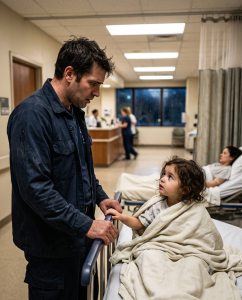
The child was on a hospital bed under warming blankets, her skin still pale but less gray than before. Beside her, the woman from the car lay unconscious, bruised and swollen, oxygen mask in place, an IV in her arm. The little girl turned the instant Ethan entered.
“Daddy,” she said again, relief flooding her face. “Mommy won’t wake up.”
He stopped.
“Sweetheart,” he said gently, though his voice felt strange to him, “I think you have me confused with someone else.”
She shook her head. “Mommy showed me your picture.”
His stomach dropped.
“She did?”
The child nodded. “She said if something bad happened, you would come.”
“Your mother said that?”
“She said you were brave,” the girl whispered. “She said you would protect me.”
Ethan felt the room narrow around him.
A stranger had shown her daughter his photo. That meant she knew exactly who he was. And if she knew exactly who he was, then this was bigger than a traumatized child mistaking a rescuer for a parent.
“What’s your name?” he asked.
“Lily.”
The name hit him like an impact to the ribs.
Years ago, before cancer hollowed out their plans, Sarah had once leaned against him on the couch and talked about baby names. She had laughed at how serious he got about it. For a boy, they never fully agreed. For a girl, Sarah had chosen instantly.
Lily.
She said it sounded soft and strong at the same time.
Ethan gripped the bedrail.
“And your mom?”
“Grace Miller.”
Almost on cue, the woman in the next bed stirred.
Her eyelids fluttered open. She looked disoriented for a moment, then frightened. Her eyes found Ethan and widened—not in confusion, but in recognition. Relief flashed across her face so quickly it might have gone unnoticed by anyone else.
“We found you,” she whispered.
The nurse leaned in. “Ma’am, try not to move.”
But Grace pulled at the oxygen mask, ignoring the nurse. She scanned the room and then the hallway beyond the partially open door.
“Did anyone follow us?” she asked hoarsely. “Did you see a black car?”
Ethan frowned. “Who would be following you?”
Grace reached for Lily with frantic urgency and drew her close. “They can’t take her. Not again.”
The phrase sent a chill through him.
“You know who I am,” Ethan said. “How?”
Grace looked at him for a long second, tears filling her eyes before she spoke.
“I was Sarah’s nurse,” she said. “At St. Catherine’s in Portland. During her final treatment.”
Ethan stared at her.
He remembered St. Catherine’s. He remembered too much about it. The parking garage. The oncology wing. The chapel on the ground floor where he used to sit when he couldn’t bear another waiting room. But he didn’t remember Grace. Then again, grief had a way of erasing faces while preserving pain.
“Sarah never mentioned you,” he said.
Grace’s expression twisted. “She was protecting you. She knew she might not make it. Before she died, she made me promise something.”
“What promise?”
Grace looked down at Lily, then back at Ethan.
“That if the truth ever came out,” she said, “I would bring her daughter to you.”
Ethan felt his heartbeat stumble.
“Sarah didn’t have a daughter.”
Grace’s voice broke. “She did.”
“No.” The word came out harder than he intended. “Sarah couldn’t have children.”
“She couldn’t carry a pregnancy,” Grace said. “That isn’t the same thing.”
The silence that followed felt electric.
Before treatment, Ethan and Sarah had preserved embryos. It had been one of the most private, painful choices of their marriage. A backup plan for a life they might still get. Not many people knew. The fertility specialist. A few hospital administrators. Sarah’s oncology team, because medications and timing had to be coordinated.
Certainly not strangers.
Ethan’s mouth went dry. “How do you know about that?”
Grace closed her eyes for a second, as though what came next still cost her something every time she said it.
“Because St. Catherine’s took one.”
The room seemed to lose all air.
“What?”
“They used one of your embryos without permission,” she whispered. “There was an internal program. Off the books. Hidden under research billing and donor coding. Not legal. Not ethical. They made it impossible to trace.”
Ethan just stared.
Grace kept going because now that it had started, there was no stopping it.
“There were people inside the hospital working with an outside fertility network. Wealthy clients. Private contracts. Misreported samples. Embryos transferred under false identities. Some were destroyed when records were cleaned. Some disappeared entirely.” Tears slid down the sides of her face. “I found out by accident.”
Lily had gone very quiet. She looked between them, not understanding the words but feeling the fear in them.
Grace stroked her daughter’s hair. “I was assigned postnatal care on a case that didn’t add up. Wrong codes. Missing signatures. A patient who didn’t match the genetic file attached to her chart. I started asking questions. I shouldn’t have, but I did.”
“What does that have to do with Sarah?” Ethan asked, though part of him already knew.
Grace looked at him steadily. “Everything.”
According to Grace, Sarah had become suspicious in the final months of her treatment. She had signed documents, then been asked to sign them again. She had received contradictory calls about storage timelines. Once, she’d been told one of the forms in her file was incomplete, even though Ethan clearly remembered signing it. Sarah mentioned the inconsistencies to Grace during a late-night treatment when fear loosened her usual caution. Grace remembered because Sarah had cried afterward, not from pain, but from humiliation. She already knew she might never carry a child. The thought of losing even the chance of one felt unbearable.
Grace promised she would keep an eye on it.
Then Sarah died.
Months later, Grace uncovered evidence that one embryo tied to Sarah and Ethan’s file had been reassigned internally and transferred to a surrogate arrangement hidden behind fabricated donor consent. By the time Grace understood what had happened, the child had already been born.
Lily.
Ethan felt sick.
“So you took her?” he asked.
Grace flinched. “Not at first.”
That was the worst part of the story, and Grace told it through tears.
She had not been part of the original theft. She had discovered it later. By then, Lily had been placed into a private adoption path intended to bury the trail permanently. But one of the middlemen on the operation got careless. Files were moved. A payment dispute erupted. Grace copied records before they disappeared. She kept digging. What she found convinced her Lily was Sarah’s biological child—and Ethan’s.
“She was about to vanish into a system built to make sure you never found her,” Grace said. “I couldn’t let that happen.”
Grace had taken Lily and run.
Not through any clean legal process. Not with police help. She had tried once, she said, to bring evidence to a senior administrator. Two days later her apartment had been broken into. Nothing was taken except a folder of copied medical records. After that, she understood how protected the people behind the operation were.
So she disappeared with Lily.
For four years, they moved from place to place. Different names. Cash jobs. Cheap motels. Friends of friends. Grace kept a small packet of evidence hidden and another packet in a location she never revealed to anyone. She also kept one photo of Ethan, printed years ago from an old hospital fundraiser page where he appeared in uniform beside Sarah.
“Why not come to me sooner?” Ethan asked, anger and grief tangling together. “Why keep my daughter from me for four years?”
Grace’s face collapsed under the weight of the question.
“Because I didn’t know who to trust,” she said. “And because I needed proof strong enough that no one could take her from you once I did. I kept waiting until I had everything. Then they found us.”
The black car.
She had seen it twice in three days, she said. The same model. Same damaged rear light. Parked too long outside the motel. Then behind them on the highway. On the bridge, it came up fast. She thought they were going to ram her. She swerved. The guardrail gave way.
Everything that happened after that was survival.
Before Ethan could ask more, medication pulled Grace under again. Her head sank back to the pillow, her fingers loosening around Lily’s blanket.
“They’re coming for her,” she murmured. “If they find us… they’ll make her disappear.”
Then she lost consciousness.
Detective Elena Torres entered the room minutes later.
She was sharp-eyed, practical, and visibly unconvinced by easy explanations. She had come to ask about the bridge accident, but one look at Ethan’s face told her the questions had changed.
“It wasn’t just an accident,” he told her. “The driver was fleeing someone. And that child may be the reason.”
Torres listened without interrupting as Ethan repeated only the most immediate facts. Not the entire impossible story—not yet—but enough to tell her that the woman in the bed feared pursuit and believed the child was in danger.
Torres stepped into the hall to make calls. She ordered an officer posted outside the room and requested traffic camera pulls from routes leading to the bridge.
For a brief moment, Ethan thought that might be enough.
Then he saw the man outside the room.
Tall. Dark coat. Motionless. Watching.
Not a doctor. Not a relative. Not hospital staff.
Ethan moved at once, placing himself between Lily and the door.
“Detective,” he said.
By the time Torres looked out, the man was gone.
But Lily had seen him too.
“That’s the car,” she whispered. “The black one.”
Torres’s expression changed instantly. She closed the room door, called for two more officers, and relocated Grace and Lily to a secure ward under a different patient name before midnight.
It was the first smart move in a race none of them fully understood.
The second came from Ethan.
Once the shock settled enough for him to function, his firefighter instincts gave way to something colder and more focused. He asked Grace, when she woke again at dawn, exactly what evidence she still had and where it was. She hesitated, then told him about a storage locker under an alias in a nearby town. Inside was a box containing photocopied charts, chain-of-custody irregularities, partial lab records, surrogate payment ledgers, and a flash drive she had never managed to decrypt.
Torres secured a warrant.
What they found blew the case open.
The flash drive contained scanned internal memos from St. Catherine’s, account numbers tied to shell entities, and an encrypted spreadsheet linking embryo IDs to private client payouts. One ID matched Ethan and Sarah’s file. Another document included a prenatal case summary under a false donor designation that matched Lily’s birth date and genetic markers.
There was no longer any meaningful doubt.
Lily was Ethan’s daughter.
The news should have shattered him. In some ways, it did. But there was no time to sit with it. Torres handed the material to a state investigator specializing in medical corruption, and within forty-eight hours, subpoenas began flying. St. Catherine’s denied everything publicly. Its attorneys called the documents fabricated. A former administrator claimed the files reflected abandoned experimental protocols, not live births. Then a lab technician agreed to cooperate.
Once that happened, the structure collapsed fast.
The technician described a hidden side channel inside the fertility program—embryos flagged as unusable, unclaimed, or administratively delayed were sometimes redirected. Consent documents were altered. Identities were masked. A small number of staff profited. Oversight had failed because the operation stayed fragmented; no one person handled the full chain on paper. Sarah and Ethan’s embryo had been selected because Sarah’s worsening prognosis made the case seem unlikely to be revisited.
It was monstrous in its logic.
Worse, someone had tried to clean it up once Grace started digging. Records vanished. Witnesses were pressured. A fixer with ties to one of the brokers had indeed been following Grace in the days before the crash.
The man from the hospital was identified on security footage. He wasn’t hospital staff. He had a record of contract work for private security firms tied to the same network now under investigation.
He was arrested trying to leave the state.
Grace cried when Torres told her.
Not from relief alone, but from exhaustion. Four years of fear had left marks everywhere—her nerves, her sleep, the way she flinched at ordinary sounds. She expected judgment for taking Lily and running, and in the end, that judgment was complicated. What she had done was not lawful. But the evidence supported what she had believed: there had been a real threat, and official channels might not have protected Lily in time.
Family court proceedings followed. So did criminal hearings, media attention, and more legal paperwork than Ethan thought any human being should survive. DNA testing confirmed what Grace had said from the beginning.
Lily was his daughter.
Sarah’s daughter.
The child they had created before cancer had stolen almost everything else.
The first time Ethan was allowed to tell Lily the truth in simple words, he sat across from her in a quiet room with toys in one corner and a social worker nearby. He had rehearsed a hundred versions on the drive over, and all of them vanished the moment she climbed into the chair and looked at him with those familiar brown eyes.
“So you really are my daddy?” she asked.
His throat tightened. “Yes.”
She considered that seriously, then asked the question that nearly broke him.
“Did you know where I was?”
He shook his head, tears burning unexpectedly. “No, sweetheart. I didn’t. But I would have come for you the second I knew.”
She climbed into his lap as if that answer was enough for now.
Children had a way of stepping over emotional wreckage adults spent years circling around.
Grace remained in Lily’s life, but differently. Not as the mother Lily had always called Mom, at least not in the legal sense. Yet no judge could ignore that Grace had fed her, held her, hidden with her, and risked everything for her. In the end, the arrangement that emerged was imperfect but humane: Ethan received full parental custody, and Grace was granted structured contact after the court acknowledged both her wrongdoing and the extraordinary circumstances behind it.
It wasn’t neat.
Nothing about the case was neat.
The first time Lily visited Sarah’s grave, the sky was clear.
Ethan brought flowers. Lily carried a small paper drawing she had made that morning: three stick figures holding hands under a yellow sun. One had curly hair. One had a firefighter hat. One stood between them smiling.
“That’s Mommy Sarah,” Lily said, kneeling carefully by the stone.
Ethan couldn’t speak for a moment.
Lily placed the drawing against the base of the headstone and looked up at him. “She picked my name, didn’t she?”
He nodded.
A slow smile spread across her face, soft and proud. “I knew it sounded like somebody who loved me.”
That sentence stayed with Ethan longer than any court ruling or news headline ever would.
Months later, when the scandal surrounding St. Catherine’s finally settled into charges, settlements, and public disgrace, people kept asking Ethan some version of the same question. Was he angry? Grateful? Could he forgive Grace? Could he forgive the years he lost? Could he forgive Sarah for not telling him more, even though she herself may not have known the full truth?
He never found one clean answer.
He was angry at the theft.
At the corruption.
At the arrogance of people who treated human life like inventory.
He was grateful for Grace’s courage, even while resenting the years of silence.
He was heartbroken that Sarah never got to meet the little girl she had already named in her heart.
And he was stunned—daily, humbly stunned—that out of all that cruelty, Lily had somehow remained warm, trusting, funny, and capable of love.
Life had not given Ethan back what he lost. It had done something stranger and harder. It had placed a frightened child in his arms on a storm-dark bridge and forced him to become the man his wife had believed he would be.
Some nights, after Lily had gone to sleep, he still stood in the doorway of her room just to make sure she was there. Curled under blankets. Dark curls across the pillow. Safe.
And every now and then he thought about the first word she ever said to him.
Not because it had solved anything.
Not because it had healed the five missing years.
But because somehow, impossibly, she had known before he did.
In the end, that may have been the most unsettling part of all.
Not that strangers stole a future from him.
Not that a hospital buried the truth.
Not even that a child came out of a river carrying his dead wife’s eyes.
It was this:
The people who caused the damage were easy to name once the evidence surfaced.
The harder question was who deserved forgiveness after the truth arrived—those who hid it, those who delayed it, or the man who had spent years grieving a family he never realized was still out there waiting for him.