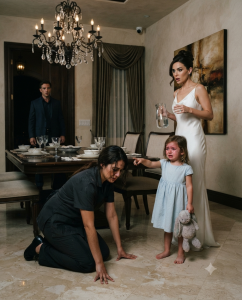
The little girl’s voice was shaky, broken by tears, but every word landed with brutal clarity.
“She hurts my mommy when you’re not here.”
For a second, the mansion seemed to lose all sound.
The crystal chandelier above the dining room still glittered. A drop of water slid from the edge of the polished table and fell onto the marble. Somewhere deeper in the house, a clock kept ticking. But inside that room, everything had stopped.
Mariana was still on her knees.
Her dark service uniform clung to her body, soaked through from the pitcher of cold water that had been thrown over her just seconds earlier. Wet strands of hair were stuck to her face and neck. Her hands trembled against the floor, and her shoulders had the stiff, defeated posture of someone who had learned the cost of reacting.
Beside her stood Sofía, her three-year-old daughter, clutching a worn stuffed rabbit to her chest. The rabbit had once been white, maybe pink, but years of washing and love had faded it into something nearly colorless. Sofía’s cheeks were wet, her nose red, her eyes wide with the kind of fear no child should know well enough to name.
Across from them, still holding the empty pitcher, stood Renata Cárdenas.
Even with anger in her face, Renata looked flawless. Her white tailored outfit fit her perfectly. Her heels clicked sharply on the marble. The diamond on her engagement ring flashed every time she moved, as if it insisted on being noticed. She was beautiful in the precise, polished way that made strangers trust her immediately and envy her even faster.
And in the doorway, silent and motionless, stood Alejandro Larios.
He had arrived at the exact wrong moment for the woman he planned to marry.
Alejandro was the kind of man people described with admiration before they ever met him. At thirty-five, he was one of the country’s most successful tech founders, known not only for his money but for the way he used it. He had built his company from almost nothing. He funded school labs in poor neighborhoods. He paid for surgeries. He spoke about opportunity, decency, and remembering human dignity no matter how wealthy you became.
He had spent years earning a reputation as a good man.
And now he stood in his own home, staring at something that suggested he had failed to protect the very people under his roof.
He looked first at Sofía.
Then at Mariana.
Then at Renata.
Nobody spoke.
Renata recovered first, drawing in a quick breath and forcing a laugh that sounded thin and unnatural.
“Alejandro, this is ridiculous,” she said. “The child got scared. Mariana dropped the tray and I—”
But Sofía cut across her, voice breaking as she ran toward Alejandro.
“She throws water on my mommy,” she cried. “She squeezes her arm here. She says my mommy is worth nothing.”
The child pointed with her small hand, not at the floor, not at the pitcher, but directly at Renata.
Alejandro’s jaw tightened.
“Mariana,” he said quietly. “Roll up your sleeve.”
Mariana looked like she might faint.
“Sir, please,” she whispered. “I don’t want any problems.”
His eyes stayed on her. “Roll up your sleeve.”
With trembling fingers, she pulled the fabric back.
The bruises were impossible to ignore.
Old yellow marks. Green ones. Purple shadows. Some nearly faded. Some fresh enough to look painful just from being seen.
The room changed.
Even Renata noticed it. Her posture shifted, just slightly. Her grip on the pitcher tightened.
“You cannot be serious,” she said sharply. “You’re going to believe a maid over me?”
Alejandro didn’t answer. He turned his head toward the security camera mounted high in the corner of the dining room wall.
Then he said the sentence that made the color drain from Renata’s face.
“Let’s see what the house recorded.”
The head of security arrived within minutes.
No one asked questions. In houses like that, staff learned quickly when silence was survival. But the man’s eyes flicked from Mariana’s soaked uniform to Sofía’s frightened face, then to Renata’s rigid expression, and he understood enough to look uneasy.
Alejandro held out his hand for the tablet.
“Dining room footage,” he said. “Today. And the last ninety days.”
“Ninety days?” Renata snapped. “This is absurd.”
Alejandro ignored her.
The first clip loaded.
Mariana was visible in the dining room on a different afternoon, polishing the table. Sofía sat nearby, coloring. Renata entered from the hall, smiling at first because she had been on the phone. The second the call ended, her face changed. She said something to Mariana. The camera had no audio, but the contempt in her body language was unmistakable. Mariana lowered her head. Renata stepped closer. Then, with a sudden movement, she grabbed Mariana’s arm and dug in hard enough to make her recoil.
Nobody in the room watching the footage said a word.
The second clip showed Renata shoving a stack of napkins onto the floor after Mariana had folded them. She pointed at the mess and forced Mariana to kneel and redo everything while guests crossed the hallway outside, unaware.
The third clip was worse.
Sofía was singing softly to herself while sitting with crayons. Renata walked over, bent down, and said something inches from the little girl’s face. Mariana rushed toward them, but Renata turned and seized Mariana by the wrist so hard that Mariana froze instantly.
The fourth clip showed water being poured into Mariana’s cleaning bucket, then cleaning chemicals dumped in afterward while Renata watched with cold amusement, forcing her to start over.
By the fifth clip, the head of security lowered his gaze.
Alejandro kept watching.
Renata stopped trying to interrupt.
Something in her face shifted from outrage to calculation.
Mariana stood near the wall as if she wanted to disappear into it. Every clip dragged another layer of humiliation into the light. She had hidden so much, swallowed so much, that seeing it exposed felt less like relief and more like being skinned open. Sofía wrapped both arms around her mother’s leg.
Alejandro finally turned to Renata.
“How long?” he asked.
Renata straightened. “I have no idea what performance this is supposed to be, but if you think—”
“How long have you been doing this in my house?”
His voice was low. Controlled. Dangerous in a way shouting never could be.
Renata lifted her chin. “You’re overreacting.”
That answer told him more than a confession would have.
Mariana suddenly spoke, barely above a whisper. “Please, don’t make this worse.”
Alejandro looked at her then, and for the first time since entering the room, his expression cracked. Not into softness. Into shame.
“Worse?” he repeated. “You think this is the worst part?”
Mariana lowered her eyes. She had the instinct of someone used to surviving powerful people: make yourself small, say little, pray it ends quickly.
But Alejandro was no longer looking at her.
He was looking at the woman he had asked to marry him.
He remembered things now that had seemed harmless at the time. Renata insisting Mariana be “more discreet.” Renata complaining that the child was too present in common areas. Renata saying some staff became “too comfortable” if boundaries weren’t reinforced. Small remarks. Sharp remarks. Remarks he had dismissed because they came wrapped in elegance.
He had mistaken cruelty for sophistication.
That realization hit him harder than he expected.
“You touched her,” he said.
Renata crossed her arms. “She works here.”
The words hung in the air like poison.
Mariana shut her eyes. Sofía buried her face in her mother’s wet skirt.
Alejandro took one slow step toward Renata. “Say that again.”
“She works here,” Renata repeated, though with less confidence now. “I was correcting someone who forgot her place.”
The head of security looked visibly uncomfortable. A housemaid from the kitchen had paused in the doorway, then quickly looked down. The butler had gone still.
Alejandro stared at Renata as if he had never seen her before.
“No,” he said at last. “You were hurting someone you thought couldn’t fight back.”
Renata laughed once. This time it was brittle and ugly. “Do not turn this into some moral speech. You have no idea how manipulative she’s been. She uses the child to gain sympathy. She cries. She acts helpless. Women like her always know how to—”
“Enough.”
The word cracked through the room.
Renata stopped.
Alejandro’s face had gone cold.
“Do not ever speak about them like that again.”
Renata blinked. “Them?”
He turned to the security chief. “Call my lawyer.”
Then to the butler: “Get Dr. Salgado’s clinic on the phone. I want Mariana examined today. Full report. Document everything.”
Mariana looked up in alarm. “Sir, please, that isn’t necessary.”
“It is now,” he said.
Renata stepped forward, finally losing composure. “Alejandro, think very carefully about what you’re doing.”
“I am.”
“You’re humiliating me because of a servant.”
He looked at the engagement ring on her finger.
Then back at her face.
“No,” he said. “I’m seeing you clearly because of what you did to one.”
The room went silent again.
Renata’s lips parted. For a second, she seemed to realize the performance she had relied on for so long no longer worked. Charm would not save her. Indignation would not save her. Class would not save her. Not now.
So she changed strategies.
“You think she’s innocent?” Renata said, her voice sharper, more desperate. “Ask her what she’s taken from this house. Ask her how many times she lied. Ask her how many things mysteriously disappeared.”
Mariana’s head jerked up in horror. “That’s not true.”
Renata seized the opening. “Of course she’d deny it.”
Alejandro did not even look at Mariana this time. “Do you have proof?”
Renata hesitated.
That tiny pause was devastating.
“No,” Alejandro said before she could answer. “Because if you did, you would have shown me already.”
Renata’s breathing quickened.
The house she had ruled through intimidation was slipping from her.
The staff could feel it. So could Mariana.
For the first time in months, Mariana straightened a little.
Only a little.
But enough.
Alejandro turned to Mariana more gently. “Why didn’t you tell me?”
She stared at the floor. “Because people like her are always believed first.”
The truth of that landed hard.
She did not say it with bitterness. That was what made it worse. She said it like a fact learned through repeated pain.
“My daughter needs medicine,” Mariana continued, voice shaking. “I need work. I thought if I stayed quiet, maybe it would stop. Or maybe I could last until I found something else.”
Sofía tugged on her mother’s hand and whispered, “I told.”
Mariana looked down at her little girl, and her face broke open with a grief too deep for tears alone. She knelt and held her daughter close.
“Yes,” she whispered back. “You told.”
Alejandro had to look away for a second.
Then he slipped the engagement ring off Renata’s finger himself.
She stared at him, stunned. “What are you doing?”
“Ending this.”
Her face hardened. “You will regret embarrassing me like this.”
He placed the ring on the dining table. The diamond flashed once under the chandelier, cold and meaningless.
“No,” he said. “I regret not seeing you sooner.”
Renata’s composure shattered completely.
She called Mariana ungrateful. Called Sofía spoiled. Called Alejandro weak. Claimed everyone was turning against her. At one point she even tried to lunge toward the tablet, but the head of security stepped between them.
Alejandro didn’t raise his voice again.
He didn’t need to.
He instructed security to escort Renata to the guest suite while her belongings were packed and her driver was called. His lawyer, he said, would contact her family. She was not to speak to staff. She was not to delete anything from her phone. And she was never to enter the property again after that day.
The wedding was canceled before sunset.
By evening, the magazines that had expected glossy photos of an elite ceremony were receiving a very different kind of silence. Guests were told only that the event would not take place. Rumors began immediately, of course. They always did. But inside the house, none of that mattered as much as the image of Sofía sitting in the clinic later that afternoon, swinging her little legs while Mariana finally let a doctor look at the bruises she had hidden for months.
The report documented everything.
The next week, Alejandro arranged legal support for Mariana and helped her file a formal complaint. He also reviewed every internal household policy, interviewed staff privately, and discovered that Renata’s cruelty had not been limited to one target. Others had been belittled, threatened, and humiliated, though Mariana had endured the worst of it because she was vulnerable, quiet, and needed the job too badly to risk losing it.
That knowledge sickened him.
He offered Mariana paid leave, but she hesitated.
“I don’t want charity,” she said softly.
He nodded. “Then take this as what it should have been from the beginning. Protection. Respect. Back pay for every hour you gave this house while being mistreated in it.”
She looked at him carefully, as if kindness itself had become suspicious.
That made sense. After what she had lived through, promises were cheap.
So Alejandro did not make speeches. He acted.
He covered Sofía’s medical treatment for the next year. He connected Mariana with a legal advocate and a therapist. He arranged secure transportation for several weeks and helped her move into a better apartment closer to reliable childcare. He also offered her a different position, not as live-in domestic staff under social scrutiny, but as an administrative assistant in one of his company’s offices, with training, benefits, and normal hours.
Mariana cried when she received the contract.
Not because she wanted to owe him anything.
Because for the first time in a long time, the future looked like something other than endurance.
Months later, when the bruises had faded and Sofía had begun drawing brighter pictures again, Alejandro visited the office one afternoon and saw a small rabbit sitting on Mariana’s desk beside neatly stacked files.
The same faded stuffed rabbit.
For a moment he just looked at it.
Then at Mariana, who was working quietly, more confident now, though still reserved.
Sofía was in preschool by then. Her asthma was under control. She laughed more easily. She no longer flinched when elegant women walked too close.
Some wounds healed slowly. Some never completely did.
Alejandro understood that better now.
He also understood that the worst danger in a house like his had not been obvious malice. It had been how easy wealth made it to look away. How quickly power covered ugliness with taste, manners, and expensive fabric. How often people assumed kindness at the top would naturally protect everyone below.
It didn’t.
Not unless someone was willing to see.
Not unless someone was willing to listen when the truth came from the smallest voice in the room.
In the end, it wasn’t an adult who broke the illusion. It wasn’t status, evidence, or reputation that first cracked Renata’s mask.
It was a frightened three-year-old with a worn stuffed rabbit and enough love for her mother to say the thing everyone else had been too afraid to speak.
Some people later said Alejandro had done the right thing.
Others whispered that canceling a high-profile wedding over household “drama” had been excessive.
But anyone who had seen the footage knew better.
The real question was never whether he had overreacted.
It was how many moments of quiet cruelty had already happened before one small child finally made silence impossible—and how many people, in houses just like that one, were still waiting for someone brave enough to point and say, “It was her.”