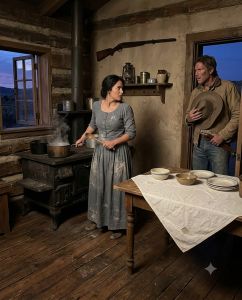
“Who made this stew?” the rancher asked the woman he never should have allowed into his kitchen.
It was the first thing Judson Crane said when he stepped through the doorway and found Nell Archer standing over his stove like she belonged there.
For a moment he could only stare.
The kitchen had not looked alive in years. Not since his mother died during a winter storm with the wind hammering the walls and snow forcing itself through every crack in the house. After that, the room had remained useful, but never warm again. It had become a place for boiling water, cutting meat, swallowing coffee, and getting through the day. Nothing more.
But now the windows were open.
The floor had been swept.
A clean cloth covered the splintered table.
A pot simmered over the fire, filling the room with the thick, rich scent of onions, beef drippings, herbs, and something so deeply familiar that it set every nerve in Judson’s body on edge.
Nell had flour on her dress and a wooden spoon in her hand. The dark braid over her shoulder had started to loosen, and there was color in her face from the heat of the stove.
She looked too alive for that house.
She turned when he spoke and met his anger without lowering her eyes.
“No one gave me permission,” she said when he demanded to know who allowed her into the kitchen. “The kitchen was dying too.”
Judson had faced down violent men with less of a reaction than that sentence gave him.
He had not brought Nell Archer to the Crane ranch to revive anything. He had brought her because she had nowhere else to go and because he needed help with meals, washing, and keeping order while he handled the cattle and the land. That was all. Or at least that was what he had told himself.
Three weeks earlier, he had found her in Copper Creek standing near the station platform with a single bag, a worn coat, and the unmistakable look of someone trying not to let strangers see her disgrace.
Her fiancé had lured her West with letters. Eight months of promises, plans, and tenderness written in a neat hand. Martin Vale. He told her to bring her savings and trust him. He told her he would have a home ready. A minister waiting. A future prepared.
When Nell arrived, there was no Martin Vale.
No house. No welcome. No explanation.
Only a few townspeople who vaguely recognized the name from a boardinghouse register weeks earlier, and the ugly speed with which pity became gossip.
A woman alone was already suspect.
A woman abandoned was entertainment.
By sunset, Copper Creek had decided exactly what kind of woman Nell Archer must be.
Judson had seen it happen from outside the mercantile while loading wire into his wagon. He heard the whispers. Saw the women glance at her and then away. Saw two men smirk openly as she walked past.
He should have minded his own business.
Instead he walked over and asked, “Can you cook?”
Nell looked at him as if she suspected mockery. “Is that your way of offering help?”
“It’s my way of offering work.”
She held his gaze. “What do you need?”
Judson paused longer than he should have.
“Someone steady,” he finally said.
He did not tell her about Elias.
Did not tell her his father had locked himself inside a back room and slowly withdrawn from the world after his wife died.
Did not tell her that for five years, the old man had barely spoken, barely eaten, and seemed to be lingering out of stubbornness alone.
Did not tell her that Judson had stopped inviting anyone into the house because people either stared, advised, pitied, or judged.
Nell went with him anyway.
During the first weeks at the ranch, she worked hard and spoke little. She never complained about the isolation, the silence, or the heaviness that seemed built into the walls. She asked where things belonged. She kept her room neat. She mended what she could. She did not pry into the locked door at the end of the hallway, though more than once Judson caught her glancing at it.
He thought that meant caution.
He was wrong.
The day he found her in the kitchen was the day she crossed the only line in that house he had never expected her to cross.
“That stew won’t be served here,” he told her.
“I didn’t make it for the table,” she said.
When she admitted she had already taken a tray to his father, something hot and sharp moved through him.
“My father doesn’t receive strangers.”
“He didn’t receive me,” she answered. “But the tray was gone this morning.”
Judson did not believe her until he saw the empty bowl himself outside Elias’s door.
Then came the voice.
Dry. Ragged. Real.
“Tell that woman it needed more salt.”
Judson felt the world tip.
Behind him, Nell put one hand against her chest in shock. Her eyes had widened, but she did not speak.
Judson had waited years for that voice. Begged for it in silence. Raged at it in silence. Threatened, pleaded, argued through a closed door like a fool talking to a grave. And now Elias Crane had chosen to speak over a bowl of stew made by a stranger.
He should have been grateful. Instead he was shaken in a way gratitude could not settle.
Then he found the note.
It had been left beside the empty tray. A folded scrap of paper in his father’s crooked hand.
Send the woman in alone tonight.
Judson hid it before Nell could see.
“What is it?” she asked.
“Nothing.”
She knew instantly he was lying.
Before she could press him, Elias knocked from inside the room. Twice. Deliberate and impatient.
Then Judson asked the question that rose from nowhere and yet felt inevitable the second it left his mouth.
“What was your mother’s name?”
Nell frowned. “Mae. Why?”
Inside the room, Elias gave a strange, broken laugh and said, “I knew she’d come back.”
The words struck all three of them differently.
To Nell, they sounded like madness.
To Judson, they sounded like the beginning of something he did not want named.
To Elias, they seemed to mean exactly what he intended.
The rest of the afternoon passed under a tension so thick it made ordinary movement feel unnatural. Judson went out to the barn and came back twice without remembering what task he had gone to do. Nell tried to occupy herself with bread dough and washing, but her hands were unsteady. Once, Judson found her standing in the hallway staring at Elias’s closed door with a look that was not fear anymore, but something sharper. Recognition without context.
As dusk gathered outside, Judson finally took the folded paper from his pocket and showed it to her.
She read it once. Then again.
“He wants to see me alone?”
“So it seems.”
“You’re not going to let me.”
It was not quite a question.
Judson leaned one shoulder against the wall and watched her. “I haven’t decided.”
Nell folded the note carefully and handed it back. “You don’t trust me.”
“I don’t trust what this is.”
That made her expression harden. “Neither do I.”
For a moment they stood in silence, the last light from the western window falling across the floorboards between them.
Then Nell said, “My mother died when I was twelve.”
Judson looked up.
“She was from out West originally,” Nell went on. “She never said much about it. Only that she had once known a place where the sky felt too big and the wind never stopped talking.”
Judson said nothing.
“She had a recipe,” Nell said slowly. “For this stew. She made it when money was thin and weather was bad. Said it came from someone she used to know a long time ago.”
His jaw tightened. “Did she say who?”
Nell shook her head. “No names. Just that the woman who taught her made enough to feed grief itself.”
That sentence settled between them like a warning.
At full dark, Elias knocked again.
This time Judson opened the door.
Only a hand’s width.
The room smelled of old medicine, stale air, and lamp smoke. Elias Crane was little more than angles under blankets, his beard overgrown, his face hollowed by years of shutting the world out. But his eyes were alive. More alive than Judson had seen since his mother’s funeral.
“Send her in,” Elias said.
Judson’s throat tightened. “I stay.”
“No.”
It was a weak word, but absolute.
Nell stepped forward before Judson could refuse for her. “It’s all right.”
“No, it isn’t,” he snapped.
She looked at him, and something unspoken passed across her face. Fear, yes. But also resolve. The same resolve that had brought her across half a country on the strength of promises and betrayal and still left her standing.
“If I don’t go in,” she said quietly, “you’ll spend the rest of your life wondering.”
Judson almost laughed at that. He already knew enough about wondering to last a lifetime.
Still, he stepped aside.
Nell entered the room.
Elias closed the door behind her himself.
Judson remained outside with every muscle in his body rigid.
He heard almost nothing at first. Only the low murmur of voices, too soft to make out. Then a long silence. Then the scrape of a chair. Then Nell speaking louder, one sentence he caught clearly through the wood.
“That can’t be true.”
His stomach dropped.
He nearly opened the door then and there. The only thing that stopped him was Elias’s voice, suddenly stronger.
“Ask him about the storm.”
When the door opened several minutes later, Nell came out pale and furious.
Judson straightened. “What did he say?”
She looked at him as if she were seeing him for the first time and did not yet know whether to hate him for something he had not done.
“Were you ever going to tell me,” she asked, “that your mother had another name?”
Judson stared at her.
“She was Claire,” Nell said. “Before she was Claire Crane.”
The air left his lungs.
“My mother’s name was Claire,” Nell continued, each word trembling with anger. “Mae Claire Archer. She used Archer after she left. She was your mother’s sister.”
Judson said nothing because he could not.
Nell’s voice broke, then steadied. “That makes us cousins.”
The word landed like a blow.
He looked toward the bedroom. “My father told you this?”
“He told me more than that.”
Elias spoke from inside the room without opening the door. “Tell the boy not to look so surprised. He never did know how to listen.”
Judson pushed the door open and entered.
The lamplight showed his father propped against the pillows, his face drawn but alert, his eyes fixed on him with an old bitterness that had not weakened with the years.
“What is she talking about?” Judson demanded.
Elias’s mouth tightened. “Your mother had a sister. Younger. Stubborn. Wild. Left home after a fight with her father and swore she’d never return. Years later, she wrote one letter to Claire. Said she had a daughter. Said she’d named her Nell.”
Judson looked from his father to Nell and back again.
“Then why didn’t Mother ever tell me?”
At that, something like shame crossed Elias’s face.
“Because I burned the letter.”
The room went silent.
Nell drew in a breath so sharp it almost sounded painful. “Why?”
Elias shut his eyes for a moment. “Because your mother had finally found peace here. Because every name from her old life woke the homesickness in her. Because I was a selfish man and I believed if the letter disappeared, the past would stay buried with it.”
Judson stared at him in disbelief.
“She searched for her sister for years,” Elias said, voice fraying. “Asked in every town. Wrote to every church she could think of. Never got an answer because I made sure the only real answer never reached her.”
Nell’s face had gone white.
“She died not knowing,” she whispered.
Elias nodded once.
Judson had thought he knew the worst thing grief could do to a man. He had been wrong. Sometimes grief came after guilt. Sometimes silence was not sorrow at all, but punishment.
“That’s why you shut yourself away,” Judson said.
“That’s part of it.”
Elias looked at Nell then, and for the first time his voice softened.
“When I smelled that stew, I thought I’d gone mad. Claire’s sister learned it from the same woman. Same way of browning the onions too long on purpose to deepen the broth. Same pinch of thyme at the end. I heard your mother in the hallway for one foolish second.”
Nell swallowed hard. “My mother used to say food could drag memory out of the dead.”
“She was right.”
Judson pressed a hand to the bedpost as the room seemed to shift around him. All these years he had believed the silence at the ranch began and ended with his mother’s death. But it had begun earlier, in a lie no one knew had been told. A single stolen letter. A single choice. Then years of punishment carried out inside the same walls where Nell had now opened windows and set a pot on the fire.
“There’s more,” Elias said.
Judson gave a harsh laugh. “There always is.”
Elias looked at Nell. “The man who tricked you. Martin Vale. He used another name before.”
Nell’s brows drew together.
“Samuel Rusk,” Elias said. “A drifter. Gambler. Pretty talker. He worked these parts years ago. Ran off with money that wasn’t his. Your mother’s money.”
Nell stared at him. “No.”
Elias nodded. “I remembered the description when Judson brought you here. I said nothing because I wasn’t certain. Then you told Judson his name, and I knew.”
Nell’s hands began to shake.
“My mother kept a tin box,” she said faintly. “Letters, receipts, small things. There was one note from a man named Samuel. She burned it when I asked who he was.”
“Because he courted her first,” Elias said. “Promised marriage. Took what he could. Vanished.”
The room spun into a pattern none of them had seen before: old betrayal folding itself into new betrayal, the same kind of man wounding mother and daughter under different names.
Nell closed her eyes. “He knew exactly how to speak to women with no one to protect them.”
“Yes,” Elias said. “Men like that always do.”
Judson looked at her and felt something shift inside him that had nothing to do with obligation anymore. He had pitied Nell when he brought her from town. Respected her when she refused to break. Wanted her in ways he had barely admitted to himself before discovering the truth that now forbade even the thought. But what he felt at that moment was simpler and fiercer.
Rage.
Not at her. Not even first at his father.
At the men who built their lives from women’s trust and called it cleverness.
“What happened to Samuel Rusk?” Judson asked.
Elias gave a tired smile with no warmth in it. “He thought he could cheat the wrong rancher once. I broke two of his fingers and ran him out of the territory.”
Judson’s eyes sharpened. “You know where he went.”
“I know where such men go when one town sees through them. East some years. South when that fails. Then back under another name where no one asks questions.”
Nell opened her eyes. “He wrote from Denver first. Then from Cheyenne. The last letter sent me to Copper Creek.”
Judson understood before she said it.
“He’s close.”
Nell nodded.
The next morning they rode into town together.
Copper Creek looked different to Nell now. Less like the place where she had been left behind and more like a trailhead to the truth. Judson went first to the telegraph office. Then the station clerk. Then the hotel ledger. By noon they had what they needed: Martin Vale had signed a freight receipt two days earlier under yet another name, collecting a parcel and asking when the next coach left for Red Hollow.
He had not gone far.
By dusk, Judson and Nell found him in a saloon on the edge of Red Hollow, laughing over cards with two men who did not know they were drinking beside a thief.
When he looked up and saw Nell, the color left his face so quickly that even before he rose, she knew.
For one dangerous second, Judson thought she might slap him.
She didn’t.
She walked straight to the table and laid down the last letter he had sent her.
“You forgot one thing when you stole from me,” she said.
Martin—Samuel—whatever his name truly was—tried to smile. “Miss Archer, I can explain—”
“No,” she said. “You’ve done enough explaining for a lifetime.”
Judson stepped beside her.
Recognition flickered in the man’s eyes. Fear followed.
That part ended quickly.
The sheriff took over when names, receipts, and two other complaints came loose the moment Nell spoke publicly. Men like him survived on women’s silence and on towns deciding shame belonged to the wrong person. Once that silence cracked, everything else followed.
When they returned to the ranch two days later, the house felt changed again.
Not healed. Not entirely.
But altered in a way that could no longer be undone.
Elias had the bedroom door open.
Just open.
It was a small thing, and somehow the largest thing in the world.
He ate at the table that evening for the first time in years, thin and shaking and impatient with being watched. Nell set down a bowl of stew in front of him. He tasted it and grunted.
“Still needs salt.”
Nell laughed despite herself.
Judson looked from one to the other, then toward the window where the late light turned the clean kitchen cloth gold. He thought of his mother, whom he now understood less simply and loved no less. He thought of a lost sister found too late to be embraced, and of the daughter that sister had sent into this house without knowing why fate had chosen that road.
Family, he realized, did not always arrive in the right season.
Sometimes it came starving. Angry. Misled. Carrying old recipes and newer wounds.
After supper, Nell stood alone on the porch while dusk spread over the fields. Judson joined her, keeping a respectful distance.
“You should have a say,” he said quietly, “in whether this place remains yours too.”
She looked out over the darkening land. “Mine?”
“You have kin here,” he said. “However broken the path was.”
For a while she did not answer.
Then she said, “I came West for a promise that was false. I don’t know what to do with one that’s real.”
Judson understood that better than she knew.
“You don’t have to decide tonight,” he said.
She turned to him then, and there was sorrow in her face, but also something steadier. Something like belonging, though both of them were still learning its shape.
Behind them, through the open window, Elias’s voice drifted out.
“Nell,” he called. “Bring the salt.”
She laughed again, softer this time, and went back inside.
Judson stayed on the porch another minute, looking at the house that no longer sounded dead.
The biggest red flag had not been the locked door or the silence. It had been the secret someone told himself was too small to matter. One hidden letter. One stolen truth. That was all it took to bury a family while everyone in it was still alive.
Whether Elias deserved forgiveness, Judson did not yet know.
Whether Martin Vale deserved mercy, he knew exactly.
As for Nell, she had come to the Crane ranch as a stranger with flour on her dress and nowhere else to go.
By the time the house finally woke, she had given it more than a meal.
She had given the buried back their names.