The logbook had her dead sister’s handwriting in it.
Every single page.
Three years’ worth.
—
My name is Carrie Ohlsson, and I have spent the last eleven years learning how to live without my twin.
Meg died in November of 2013. A car accident on a frozen highway outside of Duluth. They said she didn’t suffer. They say that about everyone, and I’ve never once believed it, but I hold onto it anyway because that’s what you do.
You hold on.
So when the county called looking for a substitute lighthouse keeper for the Apostle Islands station — just four nights, they said, routine maintenance rotation, nothing complicated — I said yes before I even knew why.
Maybe I needed the quiet.
Maybe I needed Lake Superior.
Maybe something else was pulling me there.
—
The supply boat dropped me at the dock on a Tuesday afternoon in late September. The sky was that particular shade of grey that Lake Superior does better than anywhere on earth — not angry, just ancient. Like it has been watching people come and go since before anyone had a word for grief.
The dock master, a heavyset man named Dale, handed me a laminated instruction sheet and a ring of keys.
“Logbook’s on the desk,” he said. “You sign in every morning, every night. Date, conditions, any vessel traffic. Real simple.”
He tied the supply line to the dock cleat before he left.
I noticed the knot.
A bowline. Looped through a short length of red woolen thread, the kind of scarlet that doesn’t belong on a working dock. Bright. Almost urgent.
I thought it was odd.
I didn’t think about it again for maybe twenty minutes.
—
The keeper’s quarters smelled like cedar and old coffee. There was a woodstove, a narrow bed with a quilt the color of winter wheat, a radio mounted on the wall, and on the desk — just like Dale said — the logbook.
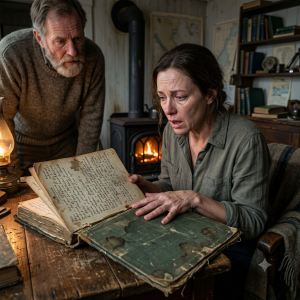
It was bound in dark green canvas. Worn at the corners. A strip of red woolen thread was tied around the spine in a bowline knot.
I told myself Dale must use the same thread for everything. Some kind of personal system.
I told myself that.
I sat down and opened the logbook to the first blank page.
And then I turned back one page.
And then another.
And then I couldn’t breathe.
—
The handwriting was Meg’s.
I would know it anywhere. The looping capital L. The way she always crossed her sevens like a European. The tiny perfect star she drew at the end of every final entry, the same star she used to draw on the corners of her school notebooks, on birthday cards, on the foggy bathroom mirror when we were teenagers.
Page after page after page.
Three years of daily entries.
Dates beginning in 2022.
Nine years after she died.
—
My hands were shaking so badly I had to put the book down.
I told myself there was an explanation. A woman with similar handwriting. A coincidence. A trick of exhaustion and grief and the particular loneliness of being on a rock in the middle of a lake at dusk.
I told myself all of it.
Then I walked back out to the dock.
The red woolen thread on the cleat was still there.
But now there was a second one.
Tied around the dock post.
Same knot. Same thread. Same impossible shade of red.
—
I went back inside.
I read every entry in that logbook.
They were mundane, most of them. Weather conditions. Visibility. Vessel traffic. The small, careful observations of someone doing a solitary job with great attention.
But at the bottom of the last entry — dated six days ago — was a single line that wasn’t a weather report.
*She’ll come. She always comes when I need her.*
Below it, a tiny star.
—
I sat in that room for a long time.
The woodstove ticked.
The lake moved against the rocks the way it always has and always will, completely indifferent to what any of us need from it.
And then I noticed the doorknob.
There was a length of red woolen thread tied around it.
A bowline knot.
I had not put it there.
It had not been there an hour ago.
I was standing up, reaching for it, when the radio on the wall crackled once — just once — and then went still.
And then a voice came through.
A voice I had not heard in eleven years.
It said the nickname. The one she gave me when we were four years old and nobody else on this earth ever knew.
And then it said —
*”Did you find my note yet?”*
—
I couldn’t speak.
My hand was on the doorknob and I couldn’t feel my fingers and the only thing in the entire world was that voice coming through the static, and the word it had just said, the name that had lived only between the two of us for thirty-seven years.
I found my voice somewhere. It came out wrong. Too small.
“Meg.”
The radio popped. Held. Then: “The note, Car. Under the woodstove. Did you look?”
I looked at the woodstove.
I had been sitting eight feet from it for the past hour.
I crossed the room and got down on my knees on the cold plank floor and looked underneath. There was dust and a dead moth and a piece of red woolen thread, and tucked behind the left rear leg, an envelope. Plain white. The kind you buy at a drugstore. My name was written on the front in handwriting I would know anywhere.
Not *Carrie.*
The nickname. Four letters that had never been written down in my life. That I had not seen or heard since a Tuesday morning in November 2013, when Meg called me from a gas station in Two Harbors to tell me she was running late and she’d explain when she got home.
She didn’t get home.
I sat on the floor of that lighthouse with the envelope in my lap and I said into the open air, “Is this real?”
The radio said, “Open it first. Then I’ll explain what I can.”
—
Inside was a single sheet of notebook paper, folded in thirds. The handwriting was hers but looser than the logbook entries. More like the way she wrote when she was tired, or emotional. We always wrote looser when we were emotional.
It said:
*Car —*
*If you’re reading this you said yes, which means you needed the lake, which means you’re not okay, which means I was right to set this up. You were always the stubborn one about asking for help. Don’t argue with me about that. You know I’m right.*
*Here is what happened. I know you need the facts first. You always needed the facts first.*
*I didn’t die in that car.*
I had to stop reading.
I put the paper face-down on my knee and breathed through my nose the way our mother taught us when we were little, the way that’s supposed to slow everything down, and I looked at the ceiling of the keeper’s quarters, at the water stains and the bare bulb and the dark beyond the window where Lake Superior was doing what it always does, carrying on.
Then I picked the paper back up.
—
*I didn’t die in that car. I need you to understand that I know how that sounds. I know what it cost you. I am so sorry for what it cost you. I have been sorry every single day.*
*The accident was real. The car went off the highway, that part is true. But I walked away from it. I walked away and I was not in a condition to be found.*
*I can’t tell you everything in a letter. There are things I could not tell anyone. There are people I was afraid of in a way I did not have language for yet, and the only way I knew how to keep you safe was to not be Meg anymore.*
*I have been Margaret Voss for eleven years. I have been careful. I have been a lighthouse keeper, which turns out to suit me, which I think would make you laugh.*
*I have kept track of you. I hope that is not frightening. I know where you live. I know you teach fourth grade. I know you have a dog named after a baseball player. I know you still drive too fast and I know you still can’t cook rice properly and I know you are not okay, Car. I have known that for a long time.*
*The county posting was not a coincidence. Dale is a friend of mine. He doesn’t know everything but he knows enough. When I saw your application come through I almost called the whole thing off. And then I thought about that bathroom mirror. The stars we used to draw in the steam.*
*I thought: she’ll come when I need her. And I need her. I need her to know I’m alive.*
*I am alive, Carrie.*
*Look up.*
—
I looked up.
I don’t know why the letter told me to look up inside the keeper’s quarters, but I did it, and there was nothing there but the ceiling I had already been staring at.
And then I heard a knock at the door.
Three knocks. Measured. The way she always knocked, the same rhythm since we were children, the same three beats she’d use on my bedroom door when she wanted to come in. Not two. Not four. Always three, and always with that particular pause before the third one, like she was giving you a chance to say no.
Nobody knocks like that but Meg.
I got up off the floor. I don’t remember standing. I was just suddenly at the door with my hand on the knob and the red woolen thread still looped around it, and I opened the door.
—
She looked like herself and she didn’t.
She was fifty-eight pounds lighter, or I was, or both of us were, and her hair was short where she’d always kept it long, and there were eleven more years on her face than the last time I saw it — but there are eleven more years on mine too, I know, and she was looking at me the way I was looking at her, like she was searching for something she had memorized and was relieved to find still there.
She was wearing a canvas jacket the color of the logbook.
She was holding a piece of red woolen thread in her right hand, looped around her fingers.
We stood there in the doorway of the lighthouse keeper’s quarters with the lake behind her going grey to black in the early dusk and neither of us said anything for a long time.
Then she said, “You didn’t look up.”
“I looked up.”
“I meant look up from the letter. I was on the roof. I’ve been on the roof for twenty minutes.”
“You were on the roof.”
“I needed a minute. I didn’t know if you’d be angry.”
I was. I was furious. I was so angry I couldn’t locate the edges of it, it was too large, it was eleven years of a particular kind of grief that I now understood I would have to renegotiate from the ground up, and I had no idea yet what that would cost me or what it would give me back.
I also couldn’t stop looking at her face.
“You have the dog’s name wrong,” I said. “It’s not after a baseball player. It’s after a second baseman specifically.”
Meg made a sound that was almost, but not quite, a laugh. “That is a distinction without a difference.”
“It really isn’t.”
We stood there another moment.
Then she said, quietly, “I didn’t know how else to do it.”
And I said, “I know.”
And I stepped back from the door.
—
We talked for six hours.
We sat on either end of the narrow bed with our backs against the walls the way we used to sit on the floor of our childhood bedroom, knees up, facing each other, and she told me things that I am not going to put in this post. Some of it is hers to keep. Some of it is still in process. There are things she’s been carrying that I cannot describe without making them smaller than they are.
What I will say is this: the danger was real. The disappearance was the only option she could see. She has spent eleven years making it safer, incrementally, carefully, the way you’d approach a fire you weren’t sure was out. She was not there yet. But she was closer. And she had gotten to a point where not telling me felt like its own kind of harm.
“I kept the logbook,” she said, around two in the morning. “I knew someday someone would look at it. I think I always meant it to be you.”
“The handwriting.”
“I know you, Car. I knew you’d recognize it.”
“What if I hadn’t recognized it? What if I’d just written it off as a coincidence?”
She looked at me steadily. “Did you?”
I thought about it.
“No,” I said.
“No,” she agreed. “You never could leave a thing alone.”
—
I did not call anyone that night. I did not call our mother, who is seventy-one and lives in a duplex in Duluth and lights a candle for Meg every year in November. That call is coming. That conversation will be its own enormous thing, and we will do it together, and I won’t pretend I know how it goes.
I stayed all four nights.
During the day I did the actual job — weather conditions, visibility, vessel traffic, the laminated instruction sheet — and Meg showed me how she kept the lens clean and how she read the lake’s particular moods and how she had learned, over years of solitude, to be comfortable in her own company. She was not someone I had expected her to become, and she was completely, recognizably herself. Both things were true.
On the last morning, before Dale came with the supply boat, I picked up the logbook and turned to the next blank page and signed my name, the date, the conditions. Clear. Visibility unlimited. No vessel traffic.
Then I drew a star at the bottom of the entry.
Meg was watching from across the room. She didn’t say anything. Neither did I.
—
I have been home for two weeks.
There is a legal process and there is a personal process and they are not the same process and they move at different speeds. There are people who have helped her over these years who deserve more protection than I can offer by being careless with details in a public post, so I am being careful.
What I can tell you is that she is alive.
What I can tell you is that I know her voice.
What I can tell you is that grief — the particular grief of losing a twin, of losing the person who knew your nickname, of losing the one who knocked in three beats with a pause before the third — is not simple to put down even when the reason for it turns out to be wrong. I am doing something complicated in my chest that I don’t have a word for yet. A kind of unclenching that hurts the way a frozen hand hurts when it starts to warm up. You’re glad for it. You’d choose it. But nobody warned you it would feel like this.
I keep finding red woolen thread in my coat pockets. She must have put it there.
I keep tying it in bowlines and untying it again, the way she taught me when we were nine, at the lake, the summer our father had the boat.
A bowline holds no matter what you put on it.
She always said that was the only knot worth knowing.
I think she was right.
She usually was.