Snow had already begun to harden along the sidewalk when Salvatore Marchetti stepped out of the car with his daughter asleep on his shoulder and a small cake box in one hand.
The city was dressed for elegance that night. Golden light spilled from restaurant windows onto the street. Valets stood in neat black coats. Couples hurried past in expensive shoes, heads bowed against the wind, laughing as they disappeared through warm doors.
Salvatore noticed none of it.
His attention was on the child in his arms and the box in his hand.
Giana’s breath warmed the side of his neck in soft, even bursts. She had fallen asleep ten minutes earlier, clutching her old stuffed rabbit with the bent ear, the one she refused to leave at home no matter how many newer toys appeared in her room. The cake box was light, almost absurdly small for the weight it carried. Inside sat a six-inch vanilla cake with white frosting, one candle, and a name written in delicate icing that made his chest tighten every time he looked at it.
Rose.
He stood for a second under the sign of Castellanos and let himself remember.
Years ago, long before hospital rooms and funerals and impossible promises, Rose had once laughed in this place so openly that everyone around her had turned to look. Not because she was loud, but because her happiness was the kind that startled people. She had stolen the cherry off his dessert, leaned back in her chair, and told him this was the first restaurant where she didn’t feel like everyone was watching to see who mattered most.
“Here,” she had said, looking around at the soft lights and polished stone, “it just feels warm.”
That had mattered to him. More than she knew.
When he later acquired the struggling chain under a holding company nobody traced back to him, he kept this location because of that one sentence. He renovated the dining room but kept the warm tone she had loved. He improved the food, replaced management twice, expanded the brand, made it profitable, made it respected. He never put his own name on the walls. He never needed to.
For the public, Salvatore Marchetti was attached to other businesses, other headlines, other rumors. Castellanos remained anonymous on paper to everyone but accountants, attorneys, and a narrow circle of people who understood how carefully his worlds had to stay apart.
Rose had wanted distance between his daughter and the shadows around his life. He honored that wish with obsessive precision.
Once a year, only once, he came here on Rose’s birthday with Giana.
He brought a small cake.
He lit one candle.
He told his daughter a story about her mother that was gentle enough for a child and true enough to matter.
It was the ritual he protected most.
By the time he crossed the threshold, the snow had begun melting off his coat. Heat embraced them immediately, carrying the scents of garlic butter, wine, rosemary, and polished wood. A pianist played softly near the bar. Crystal glasses glittered under dim gold chandeliers.
At the host stand stood Brenda Castellano, sharp-featured and immaculate in a fitted black suit, her smile practiced and selective. She had built a reputation among staff for running a tight floor. Among staff, however, the private word was cruel.
She looked Salvatore up and down once and saw only what fit her assumptions: a tired man in a worn coat, carrying a child and a box from a bakery that wasn’t theirs.
Before he even spoke, judgment had already settled in her face.
“I need a small table,” he said quietly. “Somewhere private. My daughter’s tired. We won’t be any trouble.”
Brenda glanced at the dining room. Several tables sat empty. One corner alcove stood untouched beneath a wall of candles.
“I’m sorry, sir,” she said with polished coldness. “We’re fully booked.”
Salvatore’s eyes drifted briefly to the obvious vacancies, then back to her.
“I won’t keep the table long.”
“I’m afraid that won’t be possible.”
There was a tiny pause in which he might have corrected her, introduced himself, ended the exchange instantly.
He didn’t.
Over the years, he had learned more from letting people reveal themselves than from forcing outcomes. Power spoken too early prevented honesty. Silence let it bloom.
So he remained still, and Brenda’s contempt grew bolder.
“Perhaps another place would suit you better,” she added.
That was when Dileia Brooks, who had been carrying a tray of water glasses toward the back station, stopped just within earshot.
Dileia knew Brenda’s tones the way other people knew weather. There was the fake warmth reserved for wealthy regulars, the clipped authority used on staff in front of guests, and the special strain of contempt that surfaced when Brenda believed someone had no status worth respecting.
Dileia had lived under all of them.
At twenty-seven, she looked older when the light hit her face the wrong way. Not from age, but from strain. Her rent had gone up three months ago. Her hours had gone down the week after. She was the sort of employee who arrived early, covered shifts, and apologized for problems she hadn’t caused because survival had trained her to confuse endurance with safety.
Brenda exploited that without mercy.
Tips that should have been untouched mysteriously came up short. Schedule changes appeared as punishment for imagined slights. Public scoldings landed on Dileia because she was less likely than others to fight back. Once, when a customer spilled red wine over himself after insisting she overfill his glass, Brenda had marched Dileia into the kitchen and told her humiliation built character.
Dileia had swallowed it all because she needed the paycheck.
But the sight before her at the host stand pushed against some final internal boundary.
The little girl sleeping against her father’s shoulder looked too small, too trusting, too completely dependent on the adult being dismissed.
“Excuse me,” Dileia said before fear could pin her in place. “It’s really cold out. She can sit for a minute. I’ll figure something out.”
Brenda turned as if slapped.
Her fingers closed around Dileia’s arm with painful precision, and she dragged her into the service corridor.
“Have you lost your mind?” Brenda hissed. “I said no. Do you understand English? That man is not coming in.”
Dileia’s heart knocked hard against her ribs.
“I was only trying to help a child.”
“You are here to do what I tell you.”
Brenda stepped closer, lowering her voice into something meaner.
“If you give him water, food, or a chair, you’re finished. No shift tomorrow. No shift next week. Maybe no final pay either if I decide you walked out.”
The threat landed exactly where Brenda meant it to.
Dileia pictured her rented room. The cracked window that let in cold air. The landlord’s note. The nearly empty refrigerator. The humiliating arithmetic of buying food versus making rent.
Then she pictured the sleeping child again.
Something in her straightened.
“I understand what you’re saying,” Dileia replied, though her voice shook. “But I’m not going to stand here and act like I didn’t see a little girl who’s exhausted.”
Brenda stared at her in disbelief.
Dileia used that moment to pull free and return to the dining room.
Her whole body felt electric with fear. She went into the employee kitchen, poured milk into a glass, warmed it, and paid for it herself with wrinkled bills from her apron pocket. She found a two-top table behind a wide marble column where the room grew quieter and set fresh silverware there with hands she had to force not to tremble.
Then she approached Salvatore.
“You can sit here,” she said softly. “It’s private.”
He looked at her with a stillness that made her suddenly aware of how unusual he was. Not because of danger exactly, though there was something contained in him that made the air feel deliberate. It was the quiet. Most men embarrassed in public either blustered or pleaded. He did neither.
“Thank you,” he said.
When he lowered Giana into the chair, the little girl blinked awake. She had dark curls gone messy from sleep, enormous solemn eyes, and the disoriented sweetness of a child waking in the wrong place.
Dileia set down the warm milk. Giana held her rabbit tighter. One ear was folded under, and Dileia fixed it automatically.
The child looked at her and whispered, “Thank you.”
The words were so soft they nearly disappeared under the music.
Salvatore noticed the gesture, the rabbit ear, the milk, the care with which Dileia placed the glass far enough from the table edge that a sleepy child couldn’t knock it over.
It had been years since anyone around him had done something kind without first calculating the price of his gratitude.
“You’re risking your job for strangers,” he said.
Dileia’s mouth twitched with a humorless half-smile. “Sometimes strangers are the easiest people to do the right thing for. They can’t owe you.”
He almost smiled at that, but the thought of Rose stopped it in his throat.
He opened the cake box and rested his fingertips on the white candle taped inside.
Memory came all at once, as it always did when he handled anything meant for her.
He remembered meeting Rose in a bookstore café, her sweater sleeves pushed over her wrists, a novel open in front of her and a look on her face that suggested she had already decided he was trouble. He remembered how she continued to think so long after she fell in love with him. He remembered her insistence that tenderness was not weakness, and his private astonishment that she could say such things to a man who had spent half his life rewarded for the opposite.
Most of all, he remembered the hospital.
Her hand had been thin in his. Her voice had broken around the edges. But her eyes were steady when she said, “Promise me Giana won’t grow up afraid of the same things I was.”
He had promised.
For years, that promise governed every choice he made about his daughter.
Giana knew her father as quiet, watchful, and impossibly patient with her small rituals. She did not know the reach of his name. She did not know why certain men nodded nervously when he entered rooms. She did not know the history attached to Marchetti in the city’s darker corners. He had kept that darkness away from her with brute force disguised as discipline.
Tonight, he had wanted only a table, one candle, and peace.
Then Brenda spotted them.
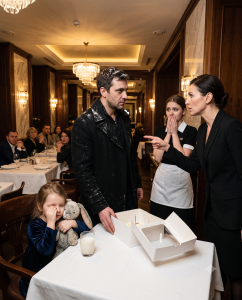
Her approach announced itself in the hard striking rhythm of expensive heels on stone. Several diners turned before she even spoke. When she stopped beside the hidden table, her anger arrived loud enough to collapse the room’s pleasant illusion.
“I told you not to serve this man!” she shouted at Dileia. “Are you deaf?”
Conversations died. The pianist faltered.
Dileia stood frozen, color draining from her face.
Brenda pointed toward the exit. “You. Him. The child. Out. Now.”
Then she rounded on Dileia with visible satisfaction.
“And you can take off that apron. You’re done here.”
The cruelty of doing it publicly was the point. Dileia knew that. The room knew that.
What nobody there knew was whose grief they had interrupted.
Giana startled awake, confused by the shouting. She looked first at Brenda, then at her father, then at the little cake between them.
“Daddy,” she murmured, rubbing one eye, “aren’t we going to light Mommy’s candle?”
The words changed everything.
Salvatore’s face did not twist with anger. He did not slam his hands on the table. He did not raise his voice.
He became still in a different way.
Anyone observant enough could have seen it—the abrupt disappearance of softness, the flattening of expression, the sense that something controlled had just slid into place behind his eyes.
Brenda, still carried by her own arrogance, mistook silence for weakness.
“Did you hear me?” she demanded.
Salvatore reached for a linen napkin and wiped a single drop of milk from Giana’s fingers. The tenderness of the gesture made what came next feel colder.
“Pick up your apron, Dileia,” he said without looking at Brenda. “You still work here.”
Brenda laughed sharply. “That isn’t your decision.”
Only then did he lift his eyes to her.
“No?” he asked.
He slipped a hand into the inside pocket of his coat. Several nearby diners visibly tensed. Dileia held her breath. Brenda herself drew back half an inch.
He withdrew a black card and placed it on the table beside the cake box.
“Read it.”
Brenda glanced down with irritation. Then she went absolutely still.
The card bore the restaurant’s crest embossed in silver. Beneath it was a name she had seen in ownership records, legal notices, and internal files she clearly had never bothered to study closely enough.
Salvatore Marchetti.
Her face lost color in a single sweep.
The senior sommelier, who had just emerged from the back, saw the card and stopped moving. A floor captain near the wine wall muttered something under his breath and hurried away, likely to call someone higher up. The maître d’ looked like he wanted to disappear into the marble.
Brenda’s lips parted. “Mr. Marchetti, I… I didn’t realize…”
“I know,” Salvatore said.
He stood then, carefully enough not to jostle Giana, who was now fully awake and staring between the adults with the watchfulness of a child sensing danger she could not name.
Salvatore crouched beside her chair for a moment and adjusted the blanket around her shoulders. “It’s all right,” he told her softly. “Stay with your bunny.”
Then he rose and faced Brenda fully.
“You turned away my daughter on the night we came here to remember her mother,” he said. His voice remained quiet, which somehow made every syllable hit harder. “And you fired the only employee in this building who showed her compassion.”
Brenda swallowed. “Sir, I made a mistake.”
Dileia stared at him, realization dawning slowly. The owner. The hidden owner. Her eyes widened with shock, then confusion, then something almost like dread as she wondered whether she had unknowingly stepped into a far more dangerous story than she had imagined.
Salvatore turned toward the back just as a heavyset man in a charcoal suit came hurrying from the office hallway, breathing too fast. Victor Hale, regional director. Competent, discreet, perpetually anxious around ownership.
“Mr. Marchetti,” Victor said, already pale.
Salvatore did not take his eyes off Brenda. “Bring me every payroll record signed off by her in the last twelve months. Every complaint. Every schedule revision. Now.”
Brenda’s knees seemed to loosen.
“Sir, please,” she whispered. “We can discuss this privately.”
“We are,” he said. “You made it public.”
Victor vanished at once.
Around the room, the guests were pretending not to listen with the transparent failure of people desperate to hear everything. The pianist had stopped entirely. One server, young and new enough not to hide his panic well, nearly dropped a tray while backing away from the scene.
Dileia found her voice. “You own this place?”
Salvatore looked at her, and the severity in his expression softened by one shade. “Yes.”
She glanced at Brenda, then at the floor, then back at him. “I didn’t help because of that.”
“I know,” he said. “That’s why it matters.”
Fifteen minutes later, the records arrived.
Victor carried a folder thick enough to suggest history. Another woman from human resources had appeared behind him, face tight and careful. They set the files on a nearby table. Salvatore opened them himself.
The first few pages were enough.
Missing tip allocations. Shift removals with no basis. written warnings contradicted by manager notes. Complaints from two former employees never escalated beyond Brenda’s desk. A pattern so obvious it no longer resembled misconduct. It resembled habit.
Brenda’s voice broke. “I can explain.”
“No,” Salvatore replied. “You can listen.”
He set the papers down.
“In this room, you judged a man by his coat, a child by who carried her, and an employee by how much fear you thought she would swallow.” His gaze sharpened. “You were wrong all three times.”
Brenda looked around as if hoping someone would interrupt, rescue, soften, negotiate.
No one did.
“You’re terminated,” Salvatore said. “Effective now. Security will escort you after you turn over your keys, access card, and office code. Payroll is being audited tonight. If the missing money is what it appears to be, attorneys will handle the rest.”
A sound escaped Brenda then, half protest and half disbelief, but it had nowhere to go. The authority in the room had already moved past her.
She turned to Victor. “You can’t just—”
Victor didn’t meet her eyes. “Please hand me your keys.”
In less than a minute, the woman who had made Dileia feel powerless for months was standing stripped of title, voice, and certainty in front of the same dining room she had ruled through intimidation.
Salvatore looked at Dileia.
“Your job is yours if you want it,” he said. “With back pay for every stolen tip that audit confirms. And beginning tomorrow, you will not be reporting to anyone who thinks cruelty is management.”
Dileia stared at him as if the words were too improbable to understand.
“I don’t know what to say.”
“You don’t have to say anything.” He glanced toward Giana. “You already said the important thing when it counted.”
Tears rushed into Dileia’s eyes so suddenly she laughed once in embarrassment and covered her mouth. For perhaps the first time in months, someone had not asked her to prove she deserved basic fairness.
Brenda was led away without another word.
Silence lingered after her exit, strange and delicate, as though the whole restaurant was learning how to breathe again.
Then Salvatore turned back to the table.
He sat beside Giana, opened the cake box properly, and set the candle into the center. The room remained respectfully still now, no longer from shock but from a kind of collective shame and tenderness. Even the guests who knew nothing of his history understood that something sacred had nearly been trampled.
Dileia stepped closer. “Would you like me to light it?”
Salvatore looked at Giana. “Do you want to do it with me?”
She nodded solemnly.
Dileia brought a match with both hands, as if offering something ceremonial. Salvatore lit it and guided Giana’s fingers around his wrist while they touched the flame to the white wick together. The candle caught with a small bright glow.
For a moment, the room fell away.
Giana looked at the flame and whispered, “Happy birthday, Mommy.”
Salvatore closed his eyes.
Rose lived in that second—not literally, not impossibly, but in memory strong enough to ache. In his daughter’s voice. In the candlelight trembling over white frosting. In the fact that mercy had survived long enough to greet them at the door, even if it had worn the face of an exhausted waitress instead of fate.
“What was she like tonight?” Giana asked.
Salvatore swallowed. “Your mother?”
Giana nodded.
He looked at the candle. “Brave,” he said. “And warm. She always made places feel softer than they were.”
Giana considered this seriously. “Like her?”
She pointed at Dileia.
The question hit with such innocent precision that Dileia’s eyes filled again.
Salvatore looked up at her. “Yes,” he said. “A little like her.”
Dileia turned away for a second, pretending to fuss with a napkin.
They shared the cake quietly. The kitchen sent fresh plates without charge. Someone in the back had remade the milk in a nicer glass. Another staff member placed a vase with a single white rose at the edge of the table and vanished before thanks could embarrass him.
When Salvatore finally stood to leave, the storm outside had eased.
At the door, he paused beside Dileia.
“I have a different offer for you,” he said.
She blinked. “Sir?”
“You notice people others ignore. You act when it costs you. Those are rare instincts.” He handed her a card with a private number on the back. “Come to the corporate office Monday. There may be a better place for you than the floor.”
Dileia looked down at the card as if afraid it might disappear.
“I’ve never worked anywhere but restaurants.”
“That’s not the same as saying you’ve only been capable of one thing.”
For a second, she couldn’t answer.
Then Giana tugged on Salvatore’s sleeve and held up her rabbit toward Dileia. “Bye,” she said. “Thank you for Mommy’s candle.”
Dileia bent and kissed the rabbit’s bent ear because crying in front of a child felt too unfair. “Goodnight, sweetheart.”
Salvatore inclined his head once, not as an owner, not as a man used to obedience, but as a father acknowledging a debt that money could not cleanly repay.
He carried Giana back out into the cold.
Inside, the dining room slowly returned to motion. Music resumed. Glasses clinked again. But something had shifted. Servers stood straighter. Victor remained at the bar speaking quietly into his phone, already reorganizing a leadership structure that would no longer include fear as policy.
On Monday, Dileia did go to the corporate office.
The audit confirmed everything. Not only were her stolen tips repaid, but two other former employees were contacted and compensated as well. Salvatore offered Dileia a paid training position in guest relations and staff advocacy across all Castellanos locations. Her first reaction was laughter from sheer disbelief. Her second was terror. Her third, finally, was yes.
Months later, she would still remember that first night every time she visited a new location and watched how employees were treated. She learned quickly. She listened harder than she spoke. She became known as the person who noticed when hostesses were being humiliated, when servers were being shorted, when a dishwasher had worked twelve hours without a proper break, when a guest with a child or a worn coat or a heavy silence deserved dignity more than scrutiny.
She never became polished in the empty way Brenda had been polished.
She became something better.
As for Salvatore, he continued to keep most of his worlds separated. Giana remained protected. Rose remained present in stories, rituals, and the kind of promises that did not expire. And once a year, on Rose’s birthday, a corner table at Castellanos was quietly reserved without needing to be requested.
No one ever challenged it again.
People who heard the story later told it in different ways. Some focused on the manager who fired the wrong waitress. Some on the hidden owner who revealed himself in silence rather than spectacle. Some on the poor server whose one decent act changed her life.
But the truth of the night was simpler than any version retold afterward.
Everything turned because one exhausted woman saw a tired child and chose humanity before caution.
And maybe that was the sharpest lesson left behind when the candle burned down and the room returned to normal: the biggest red flag had never been Brenda’s cruelty once she was caught. It was how comfortable she had become thinking kindness should only be reserved for people who looked important.
The rest was consequence.