Walt Mercer had not intended to become the kind of man who lingered in parking lots just to waste time.
But that was what retirement had done to him.
Not in the way people imagined retirement, with fishing trips and grandkids and a peaceful porch swing. Walt’s version was quieter and harder to explain. It was made of errands stretched too long, drives down roads he no longer had business traveling, and the strange habit of delaying his return to an empty house that still felt occupied by memory.
For thirty-eight years he had carried mail across a wide rural route in eastern Montana. He had driven through snow so thick the road vanished, through summers so hot the metal in the truck could burn skin, through calving season, harvest season, funeral weeks, wedding weeks, and all the ordinary Tuesdays in between. People on his route had trusted him with more than envelopes. They had trusted him with routine, with recognition, with the comfort of being expected.
Even after he retired, people still waved when they saw him. To most of them, he was Walt the mailman, even though he hadn’t delivered a letter in seven years.
To himself, he was something harder to name.
He was a widower. A father with no grave to visit. A man living in the same white clapboard house on Cotton Lane where his daughter had vanished thirty-one years earlier and where, against all reason, he still turned on the porch light every evening.
That afternoon he had gone into Miles City for dog food, furnace filters, and a box of nails he didn’t need. He could have been home an hour earlier, but home had a way of pressing on him once the sun started dropping. So he took the longer route back, the one that cut across old county highway 14.
The road was nearly empty. Pale grass bent in the wind. Fence lines stitched the land into enormous squares. Far off, low blue hills sat under a white sky bleached by heat.
He saw the pickup from half a mile away.
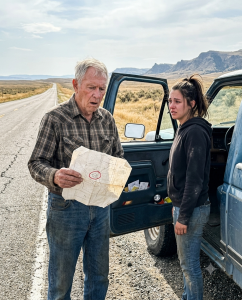
It was a faded blue truck pulled crooked onto the shoulder, hood raised, hazard lights blinking weakly in the daylight. A young woman stood beside it with one hand on her hip. When she spotted Walt’s truck, she straightened fast, trying to look more relieved than alarmed.
He slowed, rolled to a stop a few yards ahead of her, and lowered his window.
“You all right?”
She stepped closer. She was in her late twenties, maybe younger, wearing dusty boots, old jeans, and a gray T-shirt darkened with sweat at the collar. Her hair was tied back loosely, and there was dirt on one forearm, as though she had already tried and failed to fix the problem herself.
“Truck died,” she said. “No signal out here. I was hoping someone might stop.”
Her voice was steady enough, but there was a tautness beneath it, like a string pulled too hard.
Walt nodded. “Let’s see what we can do.”
He parked fully, got out, and raised the hood the rest of the way. He was no mechanic, but years on isolated routes had taught him enough to handle the basics. He checked the battery, looked at the terminals, listened to the crank. Strong turn, no start. Not battery. Maybe fuel. Maybe a sensor. Whatever it was, it wasn’t something he would solve with an old crescent wrench and stubbornness.
The woman hovered nearby. She kept thanking him, but she watched him as much as the engine.
“Do you have roadside assistance?” he asked.
“I think so. My insurance might cover towing.”
“Well, that’s your best bet. Town’s twelve miles that way.” He pointed west. “Once you get a signal, you can call it in.”
“Right.” She gave a quick nod and moved to the driver’s side. “I just need my insurance card.”
Walt stepped back, wiping his hands on a rag from his pocket.
She opened the door and leaned in.
Then she pulled the glove box.
It dropped open hard. A flashlight tumbled onto the floor. Some crumpled receipts slid out. And then a folded paper, old and yellowed and oddly delicate compared to everything else, slipped free and landed near the seat edge.
The woman reacted too late.
Walt saw the paper and felt something he could not explain. An instinct, maybe. A snag in the mind. He bent automatically and picked it up before it fell into the dirt.
It was a map.
Not printed. Drawn by hand.
The roads were simple lines in dark faded ink. The landmarks were labeled in block letters. There was the church, the grain co-op, the creek crossing. It took him only a second to realize what he was holding.
Then he stopped breathing.
It was a map of his town.
More than that, it was a map of his neighborhood.
And one house on Cotton Lane was circled in red.
His house.
For a moment nothing moved. Not the woman, not Walt, not even the wind in his perception of the world. He looked at the map again as if it might become something else.
“What is this?” he asked.
The woman’s face had drained of color. “I can explain.”
“Can you?” His voice came out harder than he intended. “Because that’s my street.”
Her mouth parted, then closed.
Walt unfolded the map carefully. It was old, softened at the creases, the edges worn by handling. Tiny X marks sat beside some driveways. The handwriting was familiar in a way that made the hairs rise on his arms.
Memory opened like a trapdoor under him.
His daughter Emma had loved drawing maps.
When she was six, she mapped the backyard and marked the lilac bush as a castle. At eight, she made treasure maps for neighborhood kids and hid marbles in coffee cans. At ten, she drew the route to Mrs. Greeley’s house with such careful seriousness that Walt had laughed and pinned it to the refrigerator.
At ten, she had vanished.
It had been a Thursday in late spring. Emma went down the street to return a pie tin. That was all. Three houses there, three houses back. The distance was so short his wife had let her go alone. When she didn’t come back in ten minutes, nobody panicked. At twenty, they called neighbors. At forty, Walt took the truck and drove every road he knew. By dark the sheriff was involved. By dawn half the county was searching.
No body. No clear suspect. No answer.
Years passed, and uncertainty hardened into a kind of private torture. If there had been a grave, maybe grief could have settled somewhere. But there was only absence, and absence kept changing shape.
Walt’s wife, Joanne, had lasted longer than most people expected. She organized searches for two years after the sheriff stopped calling them searches. She answered every prank tip with shaking hands. She kept Emma’s room untouched until mold crept into the wallpaper and practicality won over hope.
But practicality never won in Walt.
He stayed in the same house. Kept the same porch light on every night. Told himself that moving would be surrender.
Now, on the shoulder of a rural highway, thirty-one years later, he stared at a map that should not exist in a stranger’s truck.
“Where did you get it?” he asked.
The woman looked down. “I found it.”
“Where?”
“In my mother’s things.”
That landed differently.
Walt narrowed his eyes. “Why would your mother have a map of my house?”
The woman’s hands shook at her sides. “I came here to find out that exact thing.”
He studied her then, really studied her, as if the truth might be visible in bone structure. She was around twenty-nine, maybe thirty. Too young by the math. Or maybe not, if the dates shifted, if birthdays had been changed, if names had been altered, if someone had spent decades hiding a child inside paperwork.
The thought was so enormous that his mind recoiled from it.
“What’s your name?” he asked.
“Claire.”
“Claire what?”
She hesitated before giving a surname he had never heard before.
Walt glanced back at the map. On the reverse side, beneath smudges and age stains, was pencil writing. Faint, almost rubbed away.
Two dates.
Then two words.
Dad’s house.
His chest clenched so violently he had to grip the truck door.
He knew that writing. Not with certainty, not in a courtroom sense, but with the terrible recognition of a parent whose memory had starved for details and never forgotten the hand that once made them.
“No,” he said under his breath.
Claire’s eyes lifted to his face. They were dark and wet and frightened, and something about the shape of them caught him off guard. He had seen those eyes before. In school portraits. In a child’s face pressed to the kitchen window waiting for him to come home. In Emma.
He raised his head slowly.
“What did your mother tell you about where you were born?”
Claire wrapped her arms around herself. “Almost nothing.”
“What about your father?”
“She said he left before I could remember him.”
“Did you believe her?”
“I did until three weeks ago.”
She took a breath and glanced toward the open glove box as if it contained the rest of the story and she did not know how to let it out.
“My mother had a storage room she kept locked,” she said. “Always. Since I was little. No one went in there. When I asked, she’d tell me it was old junk, or papers, or things from before. Last month she fell and cracked her wrist. She was on pain medication and sleeping a lot. I found the key in a coffee tin in the pantry.”
Walt listened without moving.
“There were boxes,” Claire continued. “Mostly old clothes, account records, random stuff. But in one trunk there were children’s things. A bracelet. Hair ribbons. A stuffed rabbit with one ear sewn back on. Drawings. A school paper with the name Emma on the top. And this map.”
The name hit him like impact. He had to swallow before he could speak.
“Did your mother see you with them?”
Claire nodded. “Not right away. I put everything back. I thought maybe it belonged to a relative I’d never heard about. But then I found a photograph in another box.”
“What photograph?”
“A little girl on a swing. There was writing on the back. ‘Emma, age 9.’”
Walt closed his eyes for half a second.
Joanne had taken that photo at the school picnic. Emma on the rusted swing set behind the elementary school, grinning so hard one front tooth looked too big. He could see the image as clearly as if it were pinned in front of him now.
“Do you have it?” he asked.
Claire shook her head. “No. My mother found me in the room before I could take much. She got… strange. More frightened than angry. She kept saying I shouldn’t have touched any of it. That some things were over and buried and had to stay that way.”
Walt’s jaw tightened. “Buried.”
“I started asking questions. She lied. Then she cried. Then she said I was imagining things. The next day, the trunk was gone.”
“But not the map.”
“I hid it.”
He looked at the yellowed paper in his hand and felt the world tilting.
“Why come here?”
Claire’s answer took a moment. “Because I couldn’t stop thinking about that circle. And because I found one more thing.”
She reached slowly into the glove box, this time carefully, and pulled out a folded photocopy. It was a newspaper clipping, old enough that the image quality was poor. Walt knew what it was before she fully opened it.
Missing Girl, Age 10.
Emma’s school picture stared out from the grainy black-and-white square.
Claire’s voice dropped. “I found this online first. I searched the town name from the map. Then I found her name. Then I found yours.”
The edges of the clipping quivered in her fingers.
“I drove out this morning,” she said. “I told myself I was only coming to see if the address was real. If you were real. I didn’t know what I’d do if I actually found you.”
“Did your mother know where you were going?”
“No.”
“Would she come after you?”
Claire’s face changed. “Maybe.”
That answer chilled him for reasons he couldn’t yet sort.
Walt should have called the sheriff right then. That was the sensible move. But sensible was difficult in the middle of a miracle, a lie, and a possible crime that had reached across three decades.
“Look at me,” he said.
She did.
He searched her face with an intensity that would have embarrassed him in any other circumstance. The chin had Joanne’s softness nowhere in it, but the cheekbones, the brow, and above all the eyes—
He looked down at the map, then back at her face, and for the first time in thirty-one years, he saw his daughter’s eyes staring back at him.
His knees nearly gave out.
Claire stepped forward instinctively, then stopped, unsure if she had the right.
“How old are you?” he asked, because his mind needed something measurable.
“Twenty-nine.”
That made no sense on the surface. Emma would have been forty-one now. But if Claire was Emma’s daughter—
The thought moved through him slowly, painfully.
“You think Emma was your mother,” he said.
Claire swallowed. “I think… something happened to her. And I think whatever happened has something to do with me.”
Walt leaned against the truck.
He had spent years imagining every ending. Accident. Abduction. A wandering child overtaken by weather. A stranger passing through. He had imagined Emma dead. He had imagined her alive and unable to remember. He had imagined she grew up under another name somewhere far away.
He had never imagined this exact possibility: that his daughter had lived long enough to have a child, and that child was now standing in front of him on the side of the road.
“Tell me about your mother,” he said.
Claire hesitated. “Her name is Denise Parker. At least that’s what I know. She moved us a lot when I was little. Idaho, Wyoming, back to Montana, then Washington for a few years. I never stayed in one school long. She homeschooled me off and on. She hated records. Hated doctors. Hated photographs. She always said people who ask too many questions are dangerous.”
“Dangerous to who?”
“She never said.”
“Was there ever a man around? Someone she was afraid of?”
Claire looked away toward the horizon. “Not just one.”
Walt felt a deep cold settle behind his ribs.
“When I was about twelve,” she said, “she started having nightmares. Real ones. She’d wake up screaming names I didn’t know. Once she said, ‘I didn’t mean for the girl to get pregnant.’ I remember it because I didn’t understand what she meant.”
Walt stared.
“You never forgot that.”
“No.”
“Did she ever mention Emma?”
“Not out loud. But when I found the trunk, some of the drawings were signed Emma M.”
Walt’s throat tightened. Emma Mercer. Joanne used to insist their daughter sign her full name on drawings because “artists should claim their work.”
He turned away, pressing a fist to his mouth for a moment, then composed himself.
“Get in my truck,” he said.
Claire blinked. “What?”
“We’re not having the rest of this conversation on the shoulder of a highway. I’m calling Sheriff Dobbins.”
Fear flashed in her face. “Please don’t make me go back with her.”
Walt shook his head sharply. “You’re not going back with anyone. Not until I understand what’s happening.”
He dialed the sheriff from the one patch of signal his carrier still sometimes caught. Dobbins was younger than the old sheriff who had worked Emma’s case, but he knew the history. Everybody in town knew. When Walt said his name and then said, “I think I found something,” the line went so quiet he could hear the static.
He did not explain much over the phone. Just enough to get Dobbins moving.
They waited in Walt’s truck with the AC rattling weakly. Claire sat rigid, clutching the folded newspaper clipping and map. Walt stole glances at her whenever she looked away. Every glance brought a fresh shock. A tilt of the head. A way of pressing lips together before speaking. Little echoes.
When Dobbins arrived with a deputy twenty-five minutes later, the meeting shifted from impossible to procedural. Questions. Names. Dates. A careful chain of possession for the map and clipping. Claire told the story again, this time with more detail. Walt said very little, afraid that if he spoke too much the fragile structure of facts would dissolve into grief.
The next forty-eight hours broke open decades of buried ground.
Denise Parker was found at a rental house outside Glendive trying to leave before dawn. The storage trunk, half-packed. Inside it were children’s drawings, old clothing, a rabbit with one ear sewn on in blue thread, and a bracelet Joanne had made for Emma at summer Bible camp.
More important than all of it were the documents hidden beneath the false bottom of the trunk: forged birth records, school records with altered dates, and a sealed packet of letters tied in twine.
DNA testing moved faster than Walt thought possible once the case connected to a long-unsolved child disappearance. Claire was not Emma.
Claire was Emma’s daughter.
The result was both miracle and wound. Walt had a granddaughter. But to gain her, he first had to understand what had happened to his daughter.
The letters did that in fragments.
Emma had not died at ten. She had been taken by Denise, a woman connected to a drifter named Roy Baines who had worked seasonal jobs outside town that year. Baines had a criminal history in two states under other names. Denise had helped lure children before, according to what investigators eventually pieced together, but Emma’s case had spiraled in a way neither of them planned.
Emma had been kept, moved, isolated, and renamed. She tried to run at fourteen. She failed. At sixteen she became pregnant.
Claire was born the following year.
The letters were Emma’s, written secretly over many years and never mailed. Some were addressed simply to Dad. Some to Mom. One began, If I can’t get out, maybe she will.
That sentence nearly destroyed Walt.
Emma had hidden things for Claire to find someday: the map to Cotton Lane, the old school photo, the drawings signed with her true name, the clues Denise overlooked or failed to throw away. She had taught her daughter pieces of memory disguised as games. Street names. The shape of a mailbox. The church steeple. She had planted a path back home inside ordinary objects.
There was one final answer left.
Emma had died eleven years earlier from untreated pneumonia after Denise refused to take her to a hospital. She was buried under a false name in a cemetery outside Spokane. Investigators found the grave through one of Denise’s account ledgers and a funeral payment record that had sat unnoticed for years.
Walt flew there with Sheriff Dobbins and Claire.
The cemetery was small, windy, and ordinary in the cruelest possible way. The marker bore a name Emma had never truly owned. Walt stood over it with Claire beside him, and grief came through him in layers. First for the ten-year-old girl he lost. Then for the teenager who had survived the impossible. Then for the young mother who had left a trail of clues for her daughter like sparks in the dark.
Claire cried openly, one hand over her mouth.
Walt put an arm around her because there was nothing else left to do and because by then he knew with absolute certainty that she was his.
They brought Emma home.
The town turned out in a way small towns do when they finally get the chance to finish mourning. People Walt had delivered mail to for decades lined the church steps. Old classmates came. Mrs. Greeley’s son, now white-haired himself, stood in the back pew and wept. Joanne was gone, but Walt carried her wedding ring in his pocket through the service and thought, You were right to keep hoping. I was right too. We were both right and it still was not enough.
Claire moved into the spare room in Walt’s house two months later.
At first everything about it felt delicate. She had her own life to reconstruct, her own rage, her own grief. He had his habits, his silence, his years of talking to memory instead of a living person. But healing, he learned, was not always dramatic. Sometimes it was coffee on the porch. Sometimes it was showing someone where the floorboards creaked. Sometimes it was opening an old box of school papers and hearing the granddaughter of your lost child laugh exactly once in the same place your daughter used to laugh.
Claire kept the map.
She had it framed eventually, not because she wanted to preserve the fear attached to it, but because she wanted to honor what it had really been: a breadcrumb left by a girl who became a mother and never stopped trying to get home.
Walt still turned on the porch light every evening.
Only now it was not for a ghost.
And whenever he looked at Claire across the dinner table, or caught her standing in the yard studying the sky the way Emma once did, he felt the aftershock of everything that had been stolen and everything somehow returned.
Some losses never become acceptable. Some reunions do not heal cleanly. Denise Parker died in prison awaiting trial, and Roy Baines was long dead before the truth fully surfaced. There was no punishment large enough, no apology possible, no version of justice that could hand back the years.
But there was this: Emma had not vanished into nothing.
She had fought to be remembered. She had left proof. She had protected her daughter as best she could inside a life built on captivity and fear. And in the end, a worn map in a glove box had done what decades of searching could not.
It brought part of her home.
Even now, people in town still ask Walt when he knew. Not suspected. Knew.
He always says it was not the map. Not really.
It was the moment he looked up and saw those eyes.
That was when hope stopped being memory and became a person standing right in front of him.
And depending on who hears the story, the question that lingers afterward is never exactly the same.
Some ask how a mother could spend years hiding a child and then a grandchild without breaking under the weight of it.
Some ask whether Emma, if she had survived longer, could ever have forgiven the people who stole her life.
Some ask whether Walt lost more by refusing to move on, or saved more by keeping that porch light burning.
Walt does not claim to know the answer.
He only knows that sometimes the smallest thing—a folded map, a familiar word, a pair of eyes—can split open the past and force the truth into daylight.
And when it does, you find out whether hope was foolish all along…
or the only reason anyone ever makes it back.