The goat would not stop chewing the mayor’s campaign banner.
At first, nobody at the county fair thought it meant anything.
It was just Daisy being Daisy—ornery, stubborn, and far too clever for a goat who spent most of her life escaping perfectly good fences for reasons known only to herself. She was white except for a gray streak down her back, with one bent horn that made her look permanently unimpressed. Children adored her. Farmers swore at her. Hannah Mercer had spent half her teenage years chasing that goat out of feed sacks, flower beds, and once, memorably, the church picnic.
So when Daisy got loose near the livestock pens and made a straight line for Main Street’s busiest display, people laughed before they even knew what was happening.
The mayor’s campaign banner had been hung across the front of Mercer Feed & Supply that morning. It was impossible to miss—new, bright, expensive, stretched wide across the weathered brick building like a declaration. The mayor’s face beamed down from the center beside his slogan, and in smaller print near the bottom was the phrase everyone in town had been repeating all day: A NEW CHAPTER FOR THE OLD MERCER BUILDING.
The phrase had a pleasant, polished sound to it.
That was the point.
The mayor, Daniel Reeves, was good at making ugly things sound generous. By noon he had already told reporters and half the crowd that the building was being donated to the town after the late Earl Mercer failed to settle longstanding debts. He said it with the grave compassion of a man burdened by civic responsibility. He placed a hand over his heart when he said Hannah had his sympathies. He called the future transfer unfortunate but necessary.
People nodded because Reeves knew exactly how to say a lie like a favor.
Then Daisy grabbed the corner of the banner in her teeth and started chewing.
Children screamed with delight. Vendors leaned over their booths. A kettle-corn seller laughed so hard he dropped his scoop. Someone shouted, “That goat’s got opinions!” Even the band, trying to stagger through a parade number near the fountain, lost time as heads turned toward the commotion.
Daisy planted all four hooves, lowered her head, and worked her jaw with deep concentration.
The banner twitched.
Then it moved.
Mud splashed up her legs as she backed away with surprising force, dragging one end of the expensive campaign display through a puddle. The mayor’s volunteers lunged forward. Daisy twisted. One volunteer lost hold. The goat won.
The crowd roared.
Everyone laughed except Hannah.
She stood at the edge of it all with her hands clamped around the fence rail so tightly her fingers hurt. She barely noticed. Her eyes were fixed not on the goat, but on the building behind the banner.
Her building.
Her father’s building.
Mercer Feed & Supply had belonged to Earl Mercer for thirty-eight years. The place smelled of feed grain, leather, dust, and machine oil. Earl had built it into the kind of store where nobody left without being asked about their family, their crops, or whether their truck still made that strange noise on cold mornings. If a farmer was short until harvest, Earl wrote it down in a ledger and waited. If somebody needed help unloading seed in the rain, Earl did it himself.
He was not a careless man.
He trusted kindness, but he trusted paper more.
Every receipt went into a cleaned coffee can by month. Every tax document went into a labeled folder. Every bill paid got stamped, copied, and filed. Hannah had spent enough afternoons in the cramped office beside his desk to know his system by heart. People joked that if the county courthouse burned down, Earl Mercer could probably rebuild half the public records from memory and the other half from his file cabinets.
That was why none of this made sense.
Her father had died six weeks earlier after a short illness that seemed to steal him by inches and then all at once. The funeral had filled the church. People cried. People brought casseroles. People told Hannah how much he had meant to them. And somewhere in the blur that followed—during the condolences, the cleanup, the legal paperwork, the numb days when she moved from room to room feeling like she had forgotten how to breathe—the folder proving the feed store had been fully paid off vanished.
Not all the records.
Only that one.
At first Hannah thought grief had made her overlook it. Then she searched again. Then again. She emptied drawers, opened every file box, checked the office, checked the house, checked the shelves behind the desk where her father used to stash overflow papers. The tax folders were there. Equipment receipts were there. Insurance papers were there.
The payoff records for the building were gone.
Three days later the mayor announced the town was reviewing debt issues related to the property.
A week after that, he said the building might be turned over for “community use.”
And that morning, without asking permission, they had hung his campaign banner across her father’s storefront.
So no, Hannah did not find Daisy funny.
She watched the goat chew through painted fabric while the mayor laughed for cameras and felt something hot and bitter coil tighter inside her chest.
Reeves finally stepped forward when it became obvious his volunteers were losing the battle. He lifted both hands with practiced ease, smiling as though the whole thing were a charming interruption he was too humble to resent.
“Well,” he called, “somebody better save my banner before she eats the whole election.”
The crowd laughed again.
Hannah didn’t.
Daisy stared directly at him, ears flicking.
Then she yanked.
The fabric stretched hard across the front of the store. One hook squealed against brick. A grommet tore. The banner twisted sideways, revealing part of the old red-painted sign beneath. Mud sprayed as Daisy dug in and pulled again.
Then came a dry cracking sound.
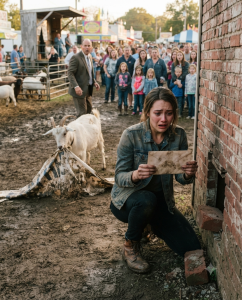
A single brick, high on the right side of the doorway and partly hidden all morning by the banner, shifted outward and dropped to the ground.
The laughter died with it.
For one second nobody moved. They all looked at the dark slit left behind in the wall.
Daisy kept chewing.
The mayor stopped smiling.
Hannah was already moving.
She stepped off the curb and crossed the muddy patch, barely aware of the cold water soaking into her shoes. She crouched by the wall, heart pounding so hard it made her fingertips shake, and brushed dirt from the gap where the brick had loosened. The opening was narrow, but deep enough for more than masonry.
She reached inside.
Dust coated her wrist. Her fingers brushed rough stone, then empty space.
Then paper.
Her breath caught.
Carefully, slowly, she pinched the edge of something and drew it toward her. An envelope slid free, long and sealed, gray with dust and age. The paper had yellowed around the corners. On the front, in her father’s square, careful handwriting, was one word.
Hannah.
The fairground went silent.
Somewhere behind her a child whispered, “What is it?”
The mayor took one step forward and stopped.
Hannah broke the seal.
Inside was a thick stack of folded documents. Payment records. Stamped receipts. A lender’s signed release. Tax filings. She saw the words PAID IN FULL before her mind had fully caught up. Beneath the official papers was a handwritten letter on lined paper torn from the yellow pad her father kept by the office phone.
Her vision blurred before she finished the first line.
If you’re reading this, then someone started asking questions after I’m gone.
The words were unmistakably him—plain, practical, careful with every phrase. Hannah swallowed hard and kept reading while the crowd waited.
Earl wrote that he had settled the final loan on the building years earlier. He listed the date, the amount, the bank officer’s name. He wrote that he had kept multiple copies of the release because “documents disappear easier than buildings, especially when a building suddenly becomes useful to the wrong people.”
A murmur rippled behind her.
Hannah turned the page.
He went on to explain why he had hidden these copies inside the wall of the store. Three months before his death, Mayor Reeves had come by after closing with what he described as “a too-friendly offer.” Reeves suggested the town might eventually want the property and hinted that settling things now would make life easier later. Earl refused. After that, small irregularities started happening. Someone asked unusual questions at the bank. A file drawer in the office was left slightly open after Earl was certain he had locked it. A document he knew he’d seen on his desk turned up in the wrong cabinet.
Nothing major. Nothing that could be proven.
Enough to make an old shopkeeper stop trusting appearances.
So he made duplicate copies and sealed them in the wall behind a loose brick known only to him.
Hannah’s hands trembled as she read. The paper smelled faintly of dust and old office drawers. For a moment she could practically hear her father’s voice: steady, a little dry, maddeningly calm even when he was right about something nobody else wanted to admit.
Around her, the fair had changed.
What had begun as entertainment now felt like a courtroom with no judge. Faces hardened. Smiles faded. People shifted their weight and looked from Hannah to the mayor and back again. A few stepped closer, trying to read the papers upside down. Others folded their arms.
Reeves cleared his throat. “Now, let’s not jump to conclusions. There may be some misunderstanding in old records—”
“Those are bank stamps,” someone from the crowd said.
“That’s Earl’s handwriting,” said another.
Hannah kept reading.
Her father’s next paragraph struck harder than the first.
If Daniel Reeves ever says this building was donated, transferred, surrendered, or taken for debt, he is lying.
The sentence was underlined once.
A sharp hiss of breath moved through the people nearest her.
Reeves’s jaw tightened. “This is hardly the place—”
“You made it the place,” Hannah said, before she even realized she was speaking.
Her voice rang out clearer than she felt. She stood up slowly, papers in hand, dust streaking her fingers and knees. Across from her, the mayor seemed suddenly smaller without the shield of easy applause.
Daisy chose that moment to tear off another chunk of the banner.
The absurdity of it snapped some of the tension. A little boy laughed. Then his mother didn’t, because she was staring straight at the documents in Hannah’s hand. A vendor muttered, “Well, I’ll be damned.” The band members, who had drifted closer with their instruments hanging awkwardly at their sides, exchanged glances and stopped pretending they were headed anywhere else.
Hannah unfolded the next page.
It was still her father’s letter, but his tone changed. It became more personal, more direct.
If this reaches you, sweetheart, don’t let them make you feel small for asking for proof. Men who count on confusion always hate paper. Paper ruins stories they tell in public.
Her throat tightened so hard it hurt.
He wrote that he had not told her about the hiding place because he hoped he would outlive the trouble and hand her everything himself. He wrote that he was sorry if that hadn’t happened. He wrote that grief made people vulnerable and that anyone rushing her through legal decisions after his funeral was not trying to help her.
Hannah remembered every conversation from the last six weeks with a new, sick clarity. The mayor’s office calling to “assist.” The town clerk telling her not to worry about old property records yet. The bank manager who suddenly became hard to pin down. The casual way people had started discussing her father’s store as if it were already no longer hers.
She turned the final page of the letter.
Attached behind it with a rusted paperclip was another folded statement in different handwriting.
Hannah frowned and opened it.
This one was signed by Carl Benton, owner of the hardware store two doors down. Carl was not a man given to drama. His note was brief and direct: On the night after Earl Mercer’s funeral, I saw Mayor Reeves exit the side door of Mercer Feed & Supply carrying a file box. I assumed Hannah had given permission. If she did not, this should be known.
The crowd exploded into whispers.
Reeves lifted his voice. “That is absurd. I was asked to secure materials for estate review.”
“By who?” someone yelled.
He didn’t answer fast enough.
Daisy dragged the ruined banner another foot through the mud.
Hannah looked back down at the envelope, suddenly aware that it felt thicker than the papers should account for. She ran her fingers along the seam and found one more object hidden inside the fold of the paper lining.
A photograph.
Old-fashioned glossy print, slightly curled at the edges.
She slid it free.
The image made her go cold.
It showed her father’s office. The desk. The green banker’s lamp. The missing folder open in plain view. Standing beside it was Mayor Reeves. Beside him, leaning over the documents, was not a bank officer or a courthouse clerk.
It was Lydia Shaw, the deputy county records clerk.
The same Lydia who had looked Hannah in the eye the week before and said the property archive showed “ongoing debt complications” and that some files might have been misfiled.
The crowd couldn’t see the image yet, but they saw Hannah’s face change.
“What is it?” Carl Benton called.
Slowly, Hannah lifted the photograph for those closest to see.
One woman gasped.
Carl swore.
Someone near the pie booth said, “No. No way.”
Lydia Shaw, who had been standing near the mayor’s volunteers all afternoon with a clipboard and a campaign button pinned to her collar, turned white and took a step back.
That was enough. Heads swung toward her. The movement rippled through the crowd like wind through corn.
Reeves reached for control. “This is being wildly mischaracterized. There are administrative processes—”
“Is that you in the picture?” Carl shouted at Lydia.
She opened her mouth and closed it again.
Hannah could feel the whole town tipping.
Not because they had suddenly discovered politicians could lie. Everybody knew that. Not because corruption was unimaginable. It wasn’t. But because this was personal. Earl Mercer had lent feed on credit when families were strapped. He had donated to school auctions, repaired hinges for free, opened early for people who needed medicine for livestock before sunup. He was woven into the town’s ordinary decency. Trying to take his store after his funeral was not just a legal trick.
It was an insult.
Reeves saw it too. Panic flickered beneath his expression for the first time.
“Hannah,” he said, lowering his voice as though they were alone, “you don’t want to do this here.”
She laughed then. One short, disbelieving sound.
“You already did,” she said.
He looked around and understood the crowd was no longer his crowd.
A town sheriff’s deputy, who had been managing traffic at the far end of the fair, finally pushed forward after hearing enough fragments to know this was no longer campaign nonsense. “Let me see those papers,” he said.
Hannah handed him the payment records first, then the letter, then the witness statement, then the photograph. The deputy read fast, jaw working. He handed the lender’s release to another officer who had just arrived from the street. Reeves tried to interrupt and was told, not politely, to wait.
Lydia Shaw began to cry.
Not the wounded tears of someone falsely accused. Quick, frightened tears of a person realizing silence was no longer protection.
“I didn’t take anything,” she blurted. “I only copied files.”
Reeves turned on her so sharply it looked almost violent. “Be quiet.”
That did him no favors.
The deputy’s head came up. “Copied for what?”
Lydia pressed a hand to her mouth, then dropped it. “He said the building was headed to forfeiture anyway. He said Earl was sick and paperwork would be easier if things were… streamlined. He said Hannah wouldn’t fight it because she didn’t know where anything was.”
The entire square seemed to inhale at once.
Reeves tried to step away.
The deputy moved in front of him. “Don’t.”
“What she’s saying is nonsense.”
“Is it?” the deputy asked.
Carl Benton spoke up from the crowd. “I saw you carrying that file box.”
Another voice joined in. Then another. People who had ignored little things before now remembered them all at once: Reeves asking questions about the property in recent months, Lydia lingering near the records office after closing, campaign volunteers measuring the storefront before any transfer had been finalized.
Small things. Harmless things. Until they weren’t.
Reeves made one last attempt at dignity. “This is a political attack staged with stolen materials and emotional manipulation.”
Daisy, as if offended by the speech, swallowed the corner of the banner.
A surprised bark of laughter escaped the crowd. Then more followed, not kind laughter this time, but the rough, disbelieving kind that comes when a powerful person starts looking ridiculous in real time.
The deputy asked Reeves for his phone. Reeves refused. The second officer stepped closer. Lydia began talking too quickly, words spilling over one another now that fear had split whatever loyalty remained. She admitted Reeves had asked her to flag the Mercer file, delay requests, and keep quiet if “discrepancies” appeared. She insisted she never meant for it to go this far.
But it had already gone further than she understood.
Because Hannah was still holding her father’s last letter.
While the officers separated Reeves and Lydia from the crowd, she stepped back toward the store and leaned one hand against the old brick. For the first time all day she looked at the building not as something slipping away, but as something returned.
The banner hung in ruined strips.
Mud streaked the mayor’s smiling printed face beyond recognition.
Daisy stood triumphantly over the mess, chewing with peaceful satisfaction.
Hannah looked down at the final lines of her father’s note.
You’ll know what to do when the truth finally has witnesses.
That was all.
No grand speech. No instructions for revenge. Just trust.
She folded the letter carefully and pressed it to her chest.
The fair resumed only slowly after that. News spread from booth to booth, then down the street, then out toward the parking field where late arrivals were still trying to understand why the band had stopped and why Daniel Reeves was standing red-faced between two deputies. Reporters who had come expecting cheerful fair photos instead scrambled for real statements. The town clerk, suddenly very interested in procedure, arrived breathless and found nobody eager to hear his explanations.
By sunset, the campaign banner was gone, the officers had taken copies of every document, and the courthouse had announced an immediate review of all filings connected to the Mercer property. By morning, Reeves’s donors were distancing themselves. By the following week, Lydia Shaw had signed a formal statement and surrendered email records that made denial impossible. Reeves resigned before charges were publicly filed, insisting he was stepping aside to “prevent distraction to the town.”
Nobody believed that either.
The store remained Hannah’s.
It took months to untangle every false filing, every delayed record request, every quiet favor Reeves had counted on staying buried. But paper, just as Earl Mercer had promised, ruined the story told in public. The original stamped release held. The witness statement held. The photograph held. And once one lie broke open, others cracked with it.
When Hannah finally reopened Mercer Feed & Supply under her own name, half the town turned up. Carl Benton brought new hinges for the side door. The kettle-corn vendor delivered a tin “for luck.” Even the band came by and managed a less chaotic tune than they had at the fair. Someone tied a blue ribbon around Daisy’s neck, which she ate within an hour.
Hannah left one thing unchanged.
Near the right side of the front door, high in the old brick, the repaired section remained slightly lighter than the wall around it. People noticed and asked about it. Hannah never gave the whole explanation to strangers. She usually just smiled and said, “That’s where the truth was hiding.”
And every now and then, when the afternoon light hit the storefront just right and Daisy wandered too close to anything made of fabric, Hannah would think about how close she had come to losing everything to a polished lie told at exactly the right moment.
She would think about grief, and paperwork, and power.
About how some people mistake kindness for weakness.
About how others count on the bereaved being too tired to fight.
About how a town can laugh at the wrong thing until the truth forces everyone to stop.
Most of all, she would think about her father writing her name on that dusty envelope and trusting that one day she would find it.
He had known something she was still learning.
The biggest red flag is often not the person who threatens you openly. It is the one smiling in front of a crowd, calling theft generosity, and hoping no one asks to see the papers.