Thomas Halstead had built his life around silence.
Not peace. Not calm. Silence.
The kind that came with thick walls, polished marble, expensive rugs no one was allowed to stain, and staff trained to move through rooms like shadows. The kind that made a mansion feel less like a home and more like a museum dedicated to control.
By the time his driver turned into the long curved driveway that evening, Thomas felt as though the city had wrung him dry. Fourteen straight hours of meetings. Endless calls. Investors wanting reassurance. Partners making demands. Rivals smiling while threatening him with elegant language and polished shoes.
He sat in the back seat with his tie loosened just enough to breathe and stared out at the fading Connecticut sky. The Halstead mansion rose ahead of him, lit from within like a display window. Perfect. Immaculate. Predictable.
Exactly the way he had designed it.
Exactly the way he suddenly dreaded.
Vincent opened the car door, but Thomas barely acknowledged him. He carried his briefcase inside and stepped into the grand foyer, already anticipating the hush that always greeted him.
Instead, he heard music.
He stopped so abruptly that Vincent nearly walked into him from behind.
A guitar.
Not a recording. Not one of the classical playlists the staff used during formal dinners. A real guitar, warm and imperfect, the notes soft around the edges.
And underneath it, laughter.
A child’s laughter.
Thomas’s chest tightened.
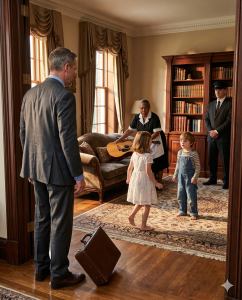
He followed the sound down the hall and into the main living room, and there, in the center of one of the most expensive rooms in his house, was a scene so simple it felt unreal.
His daughter was dancing.
Sarah, barefoot and flushed, was spinning in circles over the antique Persian rug he’d once insisted nobody step on with outdoor shoes. Her white lace dress swung around her knees as she laughed, not politely, not carefully, but with her whole body. Opposite her, a small boy in faded overalls tried to copy her steps. He was awkward and joyful and utterly unconcerned with where he was.
On the sofa, Jessica strummed an old acoustic guitar.
Thomas knew Jessica only in fragments. She arrived early, worked quietly, kept the house spotless, and was always gone before he cared to notice how tired she looked. She was competent. Invisible. Efficient.
That was what he had expected from everyone in his orbit.
Near the bookcase stood Vincent, arms crossed, watching the scene with an expression Thomas couldn’t place.
Not worry.
Not disapproval.
Something gentler than that.
Thomas dropped his briefcase.
The crack of it against the floor ended the music instantly.
Jessica jumped to her feet, pale with panic. Sarah ran toward Thomas before he had formed a single thought.
“Daddy!” she cried, wrapping her arms around him. “You’re home! This is David! He’s my best friend!”
The words hit him in a strange order.
Daddy.
Best friend.
As Thomas knelt and gathered Sarah into his arms, he was struck first by how small she still felt. Then by how tightly she clung to him. Then by the scent of chocolate and warm skin and grass and movement.
She smelled alive.
Not groomed for a school photo. Not tucked away in a room arranged by adults. Alive.
He looked past her at the boy.
David had gone still, his eyes fixed on Thomas with the wariness of someone who had already learned the rules of class without anybody having to explain them. He could not have been more than six, but there was something guarded in the way he held his shoulders, as if preparing for anger was already a habit.
Jessica set the guitar down carefully.
“Mr. Thomas,” she said, her voice shaky, “I’m so sorry. I can explain.”
What followed came out in pieces. Her babysitter had fallen sick. She had no one else. She couldn’t miss work. Thomas had made it clear the house needed to be flawless for a dinner the following evening. She had brought David with her and hidden him in the service room, telling him to stay quiet until her shift was over.
Then Sarah had heard him.
“I asked him to come out,” Sarah said, still in Thomas’s arms. She pulled back to look at him with devastating honesty. “Because I’m alone all the time, Daddy. All the time.”
The room seemed to tilt.
Thomas slowly stood, Sarah still pressed against him, and turned his eyes over the expensive landscape of his own success. Every object had been chosen with care. The paintings, the furniture, the chandeliers, the imported stone. After his wife left, he had bought and upgraded and expanded with a desperation he never named.
His ex-wife, Helena, had not left with screaming or public humiliation. That might have been easier to survive. She had left with composure. With a note folded on her side of the bed.
I was never meant to be a mother.
That was all.
Thomas had responded the only way he knew how. He worked harder. He made more money. He turned grief into structure and structure into success. He told himself Sarah would be protected by all the things money could provide.
He just hadn’t noticed how loudly loneliness echoes in a large house.
He asked Jessica if David was her son.
“Yes, sir.”
“And his father?”
Jessica’s face changed at once. Not just sorrow. Caution. Shame mixed with anger, layered over something older.
“He left when I was pregnant,” she said.
David edged closer to her, protective despite his size. Thomas caught the motion and felt something sharp in his chest.
Vincent stepped in then, more boldly than usual. He told Thomas he had known Jessica was desperate. That she had never asked for special treatment. That she was doing her best.
Thomas almost snapped at him for keeping secrets. Then he looked at Jessica again and understood that the greater offense had not been secrecy.
It had been indifference.
He asked her salary, though he likely knew it somewhere in a spreadsheet.
“Two thousand,” she answered.
The figure sounded obscene in that room. He thought of the bottles of wine he ordered for client dinners, the art he bought because someone said it would appreciate in value, the money he had spent maintaining appearances while the woman helping raise his daughter was surviving on almost nothing.
He doubled her salary on the spot.
Jessica tried to refuse. Called it charity.
“It’s not charity,” Thomas said. “It’s a correction.”
Then Sarah asked whether David could stay for dinner.
Thomas looked out the long windows at the guesthouse near the edge of the property. Stone walls. Two bedrooms. A small kitchen. Empty for two years. He had kept it maintained without any real reason.
By the time he turned back, the decision had already been made.
Jessica and David would move into the guesthouse rent-free.
The relief that broke across Jessica’s face was so raw it embarrassed him. No one should look that shocked to be offered safety. Sarah screamed with joy and hugged David. Vincent lowered his head, blinking hard.
David, however, remained serious.
“Are you going to throw my mom out later?” he asked.
Thomas felt that question more deeply than anything said in the boardroom that week.
“No,” he told him. “Never for being a mother.”
That should have been the end of the moment.
Instead, the doorbell rang.
Vincent checked the entry camera, and the change in his expression wiped the warmth out of the room.
“There’s a man outside asking for Jessica,” he said.
Jessica went white. David disappeared behind her instantly, gripping the back of her uniform.
“Don’t open it,” she whispered.
The knocking started before anyone moved. Heavy. Aggressive. Not the knock of a visitor but of someone announcing possession.
Then came a voice from the other side of the door.
“I know you’re in there, Jessica!”
Sarah flinched.
Thomas crossed the foyer in three long strides and looked at the monitor himself. The man outside was in his thirties, unshaven, tense, his eyes darting around the front entrance with the restless energy of someone who was angry and desperate at once.
“You told me he left,” Thomas said without taking his eyes off the screen.
Jessica nodded, tears filling her eyes. “He did. Until he needed money. Or someone to blame.”
The man outside pounded again. “You think you can hide my son from me?”
Thomas turned.
There was no mistaking it now. David was terrified in a way children only are when they know exactly what a person is capable of.
Thomas lowered himself to the boy’s height.
“David,” he said gently, “what happens when he finds you?”
The child looked at him for a long second, then whispered, “He tells my mom she has to choose which one of us gets hurt first.”
The air in the foyer seemed to freeze.
Jessica covered her mouth with one hand. Sarah slipped closer to David and held on to his wrist.
Thomas stood.
“Vincent,” he said, “call security. And the police.”
The man outside started shouting as if he could sense the shift inside. He kicked the base of the door hard enough to rattle the glass.
Jessica winced at the sound.
Thomas had negotiated with hostile men his entire career. He knew bluster. He knew intimidation. He knew the dangerous kind too—the kind rooted in the certainty that weakness lived on the other side of a locked door.
What he had never done before that moment was use his power for anything that mattered more than profit.
He opened the inner panel of the intercom.
“This is private property,” he said, his voice cold and clear. “You will leave immediately.”
The man barked out a laugh. “Who the hell are you?”
“The owner of the house you’re trespassing on.”
“I’m here for my son.”
“No,” Thomas said. “You’re here because you think Jessica is still alone.”
Silence crackled for one beat.
Then the man leaned toward the camera. “Tell her to come out and say that to my face.”
Jessica made a choked sound behind Thomas.
He glanced back and saw her trembling—not with uncertainty, but with old fear. The kind rehearsed over years. The kind that rewrites posture and breathing. Sarah stood beside her now, one arm wrapped around David as though trying to share courage by contact alone.
The police arrived within minutes, followed by private security from the gate. The man outside started arguing immediately, changing tactics with every sentence. First angry father. Then misunderstood ex. Then victim. Then threatening again when those roles failed.
Thomas watched through the front glass while an officer questioned him.
Jessica did not.
She sat at the edge of a chair in the living room with David in her lap even though he was almost too big for it, rocking him gently while Sarah sat on the rug at her knees. Vincent brought water none of them drank.
When the officers finally asked Jessica if she wanted to make a statement, she looked like she might refuse out of sheer exhaustion. Thomas saw it happening before she spoke: the old instinct to survive quietly.
He sat across from her and said, “You don’t have to be afraid of what comes after today. Not here.”
Jessica looked up at him, searching for any sign he might be saying the right thing without meaning it.
“What if he comes back?” she asked.
“He won’t get through the gate,” Thomas said.
“And if he does?”
Thomas held her gaze. “Then he’ll have to come through me first.”
It was not a line meant to impress. It was simply true.
Jessica gave her statement.
The officers informed her there had already been previous complaints tied to the man—harassment, disorderly conduct, failure to comply with support orders in another county. With her testimony, the messages on her phone, and the disturbance he had caused at the property, they had enough to remove him that night and begin the process for a restraining order.
When the officers led him away, David finally lifted his head.
“Is he gone?” he asked.
“For tonight,” Thomas said.
David stared at him for a moment, then nodded with grave acceptance, as though “for tonight” was the kind of promise life had trained him to trust more than forever.
Dinner that evening was unlike any meal the Halstead dining room had seen.
No formal place settings. No polished performance. Sarah insisted on sitting next to David. Jessica kept apologizing for everything until Thomas finally asked her, with as much firmness as he used in business, to stop apologizing for surviving. Vincent, to everyone’s surprise, laughed out loud twice. The cook made grilled cheese and tomato soup because Sarah declared that “important nights need comfort food,” and no one argued.
David barely spoke at first. But by dessert, he quietly admitted he liked comic books and knew how to fix a bicycle chain. Sarah announced that meant he was definitely staying forever. Jessica almost cried again. Thomas nearly did.
That night, after Sarah was asleep and Jessica had taken David to the guesthouse with fresh linens and a key Thomas told her was hers now, Thomas stood alone by the living room window.
For years he had believed protection meant money. Insurance. Locks. Elite schools. Staff. Structure.
But what Sarah had needed was not a fortress.
She had needed warmth.
And Jessica—someone he had barely seen though she moved through his house every day—had not needed pity. She had needed dignity. Safety. Enough room to breathe without terror pressing on her chest.
The next morning Thomas canceled the meaningless dinner he had spent a week preparing for. His assistants panicked. He did not care. Instead, he called his attorney. Then a family counselor. Then a school administrator. Then a property manager to make sure the guesthouse was not merely habitable but comfortable. Really comfortable.
By the weekend, the guesthouse had new groceries, repaired shutters, toys for David, books for Sarah to share with him, and a small garden Jessica said she used to dream about planting one day.
The restraining order was filed within days. Jessica’s ex tried calling from unknown numbers until Thomas’s legal team buried him in consequences. Child support enforcement followed. Old debts and failures that Jessica had been forced to endure silently were suddenly dragged into daylight where they belonged.
And with each practical step, something quieter happened inside the main house.
Life returned.
Not all at once. In pieces.
Guitar music in the afternoons.
Shoes kicked off by the door.
Sarah racing across the hall to see whether David could come out and play.
Jessica no longer lowering her eyes every time Thomas entered a room.
Even Vincent seemed lighter, as if he had been waiting years for the mansion to feel inhabited by human beings rather than expectations.
One Sunday morning, Thomas walked into the kitchen and found flour on the counter, Jessica laughing, David trying to crack an egg with unnecessary force, and Sarah giving instructions she clearly did not understand herself.
The scene was messy. Loud. Imperfect.
It was the most beautiful thing he had seen in that house.
Weeks later, Sarah asked him a question while they sat on the back steps watching David chase a soccer ball across the lawn.
“Daddy,” she said, “why were you sad for so long?”
Thomas looked at his daughter, then out at the guesthouse where Jessica was hanging small shirts on a line in the sun.
“Because I thought building walls was the same as keeping people safe,” he answered.
Sarah considered that in the solemn way children do when they are deciding whether adults have finally made sense.
Then she leaned against him. “I like this better.”
“So do I,” he said.
He meant more than the afternoon. More than the laughter. More than the company.
He meant the new discomfort too—the one that came with seeing clearly. With understanding how many people he had overlooked while telling himself he was responsible. With realizing that wealth had not made him cruel, but it had made it easy for him not to notice other people’s fear.
That was the thought that stayed with him longest.
Not that Jessica and David needed saving.
But that they should never have had to survive alone long enough for his help to feel miraculous.
And if there was any aftershock left when the crisis was over, it lived there—in the uneasy question Thomas could not shake:
How many times had he mistaken order for goodness, and how many people had paid the price for that mistake before one little boy danced across an expensive rug and forced him to see it?