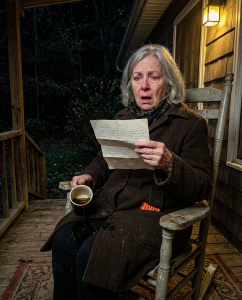
Marge Calloway had been retired for six years, but retirement had never quite taken.
She no longer rose before dawn to sort trays of envelopes under fluorescent lights. She no longer drove winding county roads in a government truck with a thermos wedged beside her seat. She no longer knew exactly which dogs barked hardest, which porches creaked at the wrong step, or which grandmothers liked their medicine brought all the way to the kitchen table.
But the habits remained.
She still woke before sunrise. She still glanced toward the front window when she heard tires on the gravel road. And every time she left the house, she slipped two butterscotch candies into her coat pocket without even thinking.
Forty-one years carrying mail through Harlan County had trained kindness into her bones.
On a cold Tuesday afternoon in late October, Marge stopped at the Piggly Wiggly for coffee filters, canned soup, and cat food. She wore her brown coat, the one with deep pockets and a loose button she kept meaning to sew. By the time she joined the checkout line, she had already clocked three things without trying: Missy Tabor had dyed her hair darker, the new cashier was too nervous to make eye contact, and the young father in front of her was doing arithmetic he didn’t want his little boy to see.
The little boy sat in the cart seat, no more than three years old, drumming a box of animal crackers against the metal bar and humming to himself. He had one sneaker untied and a red mark on his chin like he’d fallen recently. His father wore work boots powdered with drywall dust and a black ball cap pulled low enough to shadow his face.
The conveyor belt held a handful of things. Bread. Chicken thighs. Peanut butter. Milk. Apples. Diapers.
The total on the screen rose.
The father quietly reached for the bread and set it back in the cart.
Then the chicken.
Then the peanut butter.
He kept smiling at his son the whole time.
Not a forced smile. Not exactly. More like an act of protection. As if he could hold the whole shape of worry behind his teeth long enough for the boy not to feel it.
Marge had seen that kind of smile before.
Not on children. On the adults trying to keep children from becoming scared adults too early.
She stepped forward and started putting the groceries back on the belt.
The father turned. “Ma’am—”
“I carried mail in this county for forty-one years,” she said. “I know what hard times look like. You let me do this.”
Something flickered across his face then, fast and strange. Recognition, maybe. Or fear. Marge could not tell which.
The cashier scanned everything. Marge paid. Then she reached into her pocket, unwrapped a butterscotch, and gave it to the little boy.
“Tanks you,” he said solemnly, making her smile.
The father took the bags in both hands. He stood there under the buzzing checkout lights for one long second, looking at her as though he had expected this moment for a very long time and still wasn’t ready for it.
Then he shifted the bags to one arm, pulled out a folded notebook page from his jacket pocket, and placed it in her palm.
“Please read it later,” he said softly. “Not right now.”
Before she could answer, he lifted the child, gathered the groceries, and walked out.
Marge almost called after him. Almost asked his name.
But something in his voice had stopped her.
At home she set the note on the kitchen table, made instant coffee, sat down, then got right back up. She could not explain why she didn’t open it. She only knew that the young man had said not right now in a tone that made the words feel less like a request and more like a warning.
So the note traveled with her.
From coat pocket to cardigan. From cardigan to housecoat. From housecoat to the apron she wore while feeding the cats. By Thursday she had touched it a hundred times and opened it not once.
Her neighbor Dot came over Friday morning, bringing gossip and store-bought muffins.
“You look distracted,” Dot said, stirring too much sugar into her coffee. “What’s wrong with you?”
“Nothing,” Marge said too quickly.
Dot narrowed her eyes. “You hiding a lottery ticket or a love letter?”
Marge laughed, but it came out thin. “At my age, both would be trouble.”
Twice she nearly showed Dot the folded paper. Twice she stopped herself. She could not have said why. Only that it felt private in a way she didn’t understand.
By Saturday evening, curiosity had turned into dread.
The sun went down behind the ridge in a smear of copper and violet. Her porch light clicked on. Marge sat in her rocker with a mug of coffee gone lukewarm and a butterscotch candy dissolving slowly in her cheek.
Finally, she took out the note.
It was folded small and tight, softened at the corners from being handled too much. She unfolded it carefully.
The handwriting was deliberate. Careful. Familiar in some buried place she couldn’t yet name.
Then she read the first three words.
Mama Marge,
The cup tilted in her hand.
No one had called her that in eleven years.
Her mind went backward so fast it felt like falling.
Eli Mercer had been ten the first time she noticed him standing barefoot by the leaning mailbox on Cane Branch Road. He was all elbows and watchful eyes, too thin for his age, hair always in need of cutting. His mother, Lorna, was soft-spoken and worn down to the bone. His stepfather, Wade Mercer, had the heavy stare of a man who wanted every room to know he had entered it.
At first Eli hardly spoke. He would take the mail from Marge and thank her in a voice so quiet she sometimes wondered if she had imagined it.
Later he started asking questions.
“What’s this word mean?”
“Where does this zip code go?”
“Why do some envelopes say urgent on them?”
Marge began saving old catalogs and circulars for him. The boy devoured them. He sounded words out with his finger under each line. Once, while waiting for a signature from Lorna, Marge found him reading an advertisement for power tools like it was scripture.
“You like books?” she asked.
He shrugged. “We don’t have any.”
So she brought him some from the church giveaway shelf. Torn paperbacks, old children’s dictionaries, a book of state birds. Eli handled them like fragile treasure.
The first bruise she saw was yellowing along his collarbone.
The second sat dark along his jaw.
When she asked, Eli said he had fallen.
When she asked again, he smiled with one side of his mouth and said, “I’m clumsy.”
She reported it once. Then twice. A county worker drove out. A deputy drove out. Nothing changed except that Eli grew quieter for a while.
The name Mama Marge came the summer he turned twelve. She had brought him a biscuit left over from breakfast because he looked pale and shaky.
He ate half, wrapped the rest in a napkin, and said, “Thanks, Mama Marge.”
She laughed. “I’m not your mama.”
He looked away and said, “I know.”
From then on, whenever his stepfather wasn’t around, that’s what he called her.
The winter Eli disappeared, the whole county seemed to crack open for a week and then close right back up.
Lorna had died the month before from pneumonia complicated by everything poverty makes worse. Wade Mercer drank harder afterward. Neighbors heard shouting. One woman claimed she saw Eli running across a field at dusk with no coat on. Then he was simply gone.
Wade said the boy had stolen money and run away.
Three days later a burned truck was found off an old mining road. The remains inside were badly damaged. The sheriff’s office said the body was likely Eli’s based on timing, clothing scraps, and circumstances. Wade identified a belt buckle. The county accepted the tragedy because it fit easily into the shape already built for it.
Poor boy. Bad home. Ran away. Died cold and scared.
Marge never believed it fully, but belief and proof were different things. She attended the memorial. She cried in the back pew. She watched Wade stand with dry eyes and a jaw clenched too hard.
Then life, cruel as ever, moved on.
Now, on her porch eleven years later, Marge read the rest of Eli’s letter.
If you are reading this, then I finally stood close enough to know for sure it was really you. I saw you once outside the clinic two months ago but couldn’t get out of the truck in time. I wasn’t sure you’d want to see me if you knew who I became, or who I look like now.
I know this is cruel in a note, but I couldn’t say it in front of my boy. I need you to know I never ran away. And the man buried under my name in Resthaven Cemetery is not me.
Her stomach dropped.
Eli wrote that the night before the burned truck was found, Wade had beaten him so badly he thought he might die. He had escaped through the feed shed and hidden behind sacks of grain until nearly dawn. That was when Deputy Carl Blevins found him.
Carl had been part of the original missing-person search. He was known as quiet, dependable, the kind of man older women called a good one.
According to Eli, Carl took one look at him and said, “If I put you back there tonight, he’ll finish it.”
Eli wrote that Carl drove him out of county before sunrise, first to a cousin’s trailer in Bell County, then to a church-run shelter farther west. Carl told him he was doing the only thing that could keep him alive. Stay gone. Don’t write. Don’t call. Let people think what they need to think until Wade can’t reach you.
At thirteen, bleeding and terrified, Eli had believed him.
Years passed. He worked odd jobs under the name Elias Cole. Construction. Roofing. Warehouse shifts. He married young, badly. That ended quickly. He kept his son. He learned how to be gentle by remembering every rough thing done to him and choosing the opposite.
Then Carl Blevins died of a stroke the year before.
At the funeral, Eli returned from the edge of the parking lot, staying hidden among cars, hoping only to pay a debt he had never understood. Instead he overheard two retired deputies talking beside a truck.
One of them said, “Carl carried that Mercer mess to his grave.”
The other answered, “Had to. Once the body turned out not to be the boy, they were all in too deep.”
Marge read that paragraph twice, pulse hammering in her throat.
Eli had spent months afterward trying to find records. Most were gone or sealed or incomplete. But one thing led to another. A clerk remembered a fire-damaged evidence file. An old mechanic remembered repairing Wade Mercer’s truck after a fender dent that same week. A woman who used to date a deputy remembered hearing there’d been “a box of stuff” taken out of the Mercer house before the search was over.
At the bottom of the page, Eli’s writing pressed harder.
I came back because my son is the age I was when you first asked about the bruises. I can’t keep pretending silence is the same thing as survival. I think you were the only person who ever noticed everything. If you still do, look at the return address on the Christmas card you sent my mother the year she died. She kept it in her sewing tin. It was never thrown away. That’s where he hid the second box.
Second box.
Marge lowered the letter slowly.
She knew that Christmas card. Knew it because Lorna had cried over it one snowy afternoon when Marge delivered a money-order form and found her trying to mend Eli’s coat sleeve under weak kitchen light.
“You’re the only one who still sends me cards with glitter,” Lorna had said, giving a watery laugh.
Marge had written her return address in thick blue ink. If Lorna kept the envelope, and if Eli remembered that after all these years, then whatever was hidden with it mattered.
She read the last line on the back.
Don’t call the sheriff. Not until you know which one.
Sleep was impossible.
At dawn, Marge drove to the storage shed behind her house, where she kept old route mementos in labeled bins: retirement plaques, Christmas tins, rubber bands, postcards, change-of-address forms she should have thrown out years earlier. Buried in the back of one box was a stack of cards she had sent but had leftover copies of, each with the same year’s glittering church design and the same return label.
That gave her the exact card she had mailed Lorna.
By ten o’clock she was standing outside Dot’s cousin’s antique shop, because Dot’s cousin had bought the contents of the Mercer house after Wade went to prison on unrelated charges five years earlier. Drunk driving. Possession. An assault charge that had finally stuck.
“Mercer sewing tin?” the cousin said, frowning. “Might still be in the lot from the back room. Nobody wanted that junk.”
An hour later Marge was kneeling in dust and old furniture smell, opening a rusted biscuit tin filled with buttons, thread, bent needles, and yellowed scraps of paper.
At the very bottom lay her Christmas envelope.
And beneath it, taped to the tin, a small metal key.
Marge stared at it.
Second box.
She called Eli from the number scrawled in faint pencil on the edge of the note. He answered on the second ring but did not speak.
“It’s me,” Marge said.
A breath. Then, “I didn’t think you’d call.”
“I found the key.”
Silence on the line turned sharp.
“Then he told the truth about that part,” Eli said.
“Where’s the box?”
“I don’t know,” he replied. “But Carl once told me some secrets don’t belong in houses. He said people search houses first.”
Together they thought through old properties and habits. Wade Mercer had worked part-time years ago at a shuttered feed store outside town, a place with a back room and rusted lockers that locals still used for illegal dumping. Eli remembered seeing Carl there once after his disappearance, talking to Wade in the lot.
By late afternoon they met there.
Marge recognized him before he got out of the truck this time. Without the cap shadowing his face, the resemblance to the boy was unmistakable. The same eyes. The same way he held his shoulders as if bracing for bad news even while standing still.
His son was not with him.
For a moment they simply looked at each other.
“You’re alive,” Marge whispered.
Eli gave a broken little laugh. “I am.”
Then she crossed the gravel and wrapped him in both arms. He held still for a heartbeat before hugging her back with the caution of a person long unused to being touched kindly.
Inside the ruined feed store, dust floated in shafts of light. The lockers along the far wall were rusted nearly shut. The tiny key opened the third one from the end.
There was a box inside. Metal. Army green. Heavy.
Marge’s hands shook as Eli carried it to the cracked office desk and lifted the lid.
Inside were documents, photographs, and two cassette tapes sealed in plastic.
The photographs hit first.
One showed Wade Mercer with Deputy Carl Blevins and another deputy Marge recognized with a jolt: Sheriff Nolan Pierce, the man who had signed off on the identification of the body all those years ago. The three men stood behind Wade’s truck, grinning over a deer carcass.
Another photo was worse. It showed the burned truck before it burned, the tailgate down, a dark stain near the bumper and what looked terribly like a work boot visible beneath a tarp.
Marge pressed a hand to her mouth.
There were insurance papers too. Wade had taken out a policy on his truck and a separate small accidental-death rider on Eli months before the boy disappeared, listing himself as guardian beneficiary. The dates lined up too neatly to be chance.
The documents beneath that made the room go cold.
Statements. Handwritten notes. A photocopy of an intake form from a shelter signed by Carl Blevins under a false explanation for why Eli had no identification. A page of numbers showing insurance payouts. And, at the bottom, a single envelope labeled in Carl’s writing:
In case Wade turns on us.
Eli opened it.
Inside was a typed confession, unsigned but specific. It said Wade Mercer had beaten a drifter nearly to death after finding him sleeping in the old truck. Carl and Sheriff Pierce had helped move the body after realizing Eli was gone and the timing offered “a clean ending.” Wade would claim Eli stole the truck and ran. Carl would move the real boy out of county. Pierce would close the case. Insurance would pay out. The county would stop looking. Everyone would be protected.
Except the dead man.
Except the child.
Except the truth.
Marge sat down hard in the desk chair because her knees no longer felt reliable.
“Why would Carl keep this?” she asked.
Eli stared at the confession. “Maybe guilt. Maybe insurance. Maybe he was afraid Wade would talk first.”
There was one last item in the box: a cassette labeled Interview.
Dot’s grandson, who ran the electronics stall at the flea market, still had an old tape player in his garage. They drove there in darkness, saying almost nothing.
The tape hissed before a voice emerged.
Carl Blevins.
Older than Marge remembered, roughened by smoke and regret.
If you’re hearing this, he said, then either I’m dead or I finally did what I should’ve done years ago and turned this over. The body in the truck was an unidentified transient male. Sheriff Pierce ordered the file buried. Wade Mercer paid him from the insurance money. I moved the boy because I thought I was saving him. Then I kept quiet because by then I was saving myself.
Marge closed her eyes.
The tape continued. Carl described where the original coroner photos were hidden, who altered the paperwork, how the evidence room log had been falsified. He named names. Dates. Amounts. He cried once, briefly, and kept talking.
By the time the tape clicked off, the room had gone silent in the way only truth can make it silent.
Pierce was long retired but still alive.
The state police took over within forty-eight hours once Eli, under his full legal affidavit, turned over the box, the tape, and his statement. The story tore through the county like wind through dry leaves. Reporters came. Old rumors resurfaced. Men who had once worn badges stopped answering their phones.
Wade Mercer, dragged in from a halfway house on a parole violation, denied everything for six hours.
Then they played the tape.
By morning he had confessed to the beating that killed the drifter, though he blamed the rest on Carl and Pierce. Pierce, confronted with the insurance papers and evidence logs, held out three more days before his attorney negotiated a surrender.
The unidentified man in the truck was eventually named: Thomas Reddick, forty-two, estranged from family, missing from Knoxville, forgotten by almost everyone except a sister who had spent years wondering why he simply vanished.
There was a second burial. A real one this time.
Eli attended with his son beside him, small hand wrapped in his. Marge stood on the other side.
Weeks later, the county held another service too, one unofficial and crowded, for the boy they had once mourned under the wrong circumstances and the man who had returned carrying his own ghost. People brought casseroles and apologies and the kind of soft-eyed regret that comes too late to fix anything but still insists on showing up.
Not everyone deserved forgiveness.
Marge knew that.
Some people had looked away because it was easier. Some had accepted a convenient story because hard truths are expensive in small towns. Some had been cruel. Some had just been tired.
Eli didn’t forgive all of them. He didn’t need to.
But he did something harder.
He stayed.
He rented a small house on the edge of town. He found steady work with a contractor in Middlesboro. His boy, Noah, started preschool and came home talking nonstop about finger paint and dinosaurs. On Sundays, Noah sat on Marge’s porch eating apple slices while she unwrapped butterscotch candies one careful twist at a time.
One evening in spring, as the light faded over the ridge and the peepers started up in the ditch, Eli said quietly, “You were the first person who ever looked at me and saw something was wrong.”
Marge kept her eyes on the yard. “I should’ve done more.”
“You tried,” he said. “Most people didn’t.”
That was the trouble with surviving evil. The question that stays is never only who did it. It’s who saw enough to know, who told themselves it wasn’t their place, who chose comfort over interruption.
Marge still thought about Thomas Reddick, the stranger buried under another boy’s name so an entire system could stay neat and untroubled. She thought about Lorna Mercer keeping that glittery Christmas card in a sewing tin like some tiny scrap of proof that tenderness had once reached her house. She thought about Carl Blevins too, and how a man could be both the one who saved a child and the one who helped erase a dead man.
Nothing in the story came clean.
That was the part people struggled with most.
Eli had lived because a corrupt deputy made one merciful choice inside a chain of monstrous ones. A sheriff had protected himself behind procedure. A brutal man had almost gotten away with murder by borrowing the county’s own hunger for simple endings. And a retired mail carrier with butterscotch in her pocket had become the hinge the whole thing turned on because she still noticed when someone was quietly putting food back on the belt.
Sometimes the biggest red flag is not a bruise or a lie.
Sometimes it is how quickly everybody accepts an explanation that lets them go home early.