Black-tie events are especially cruel to grieving people.
They ask for a performance no one admits is a performance. Smile at the right time. Nod through speeches. Stand under flattering light and speak softly enough that no one has to feel awkward about what happened to you. In a ballroom full of money and polished shoes, sorrow becomes a breach of etiquette.
Jillian Mercer had learned that after her husband died.
For the first six months, people had been gentle. They brought casseroles she did not eat, sent cards with embossed corners, offered to “take anything off her plate,” then vanished the moment grief failed to stay neat. By the second year, the kindness had hardened into expectation. She was still invited everywhere, but now every invitation carried a second message: show us you are functioning. Show us you are still the woman we admired. Show us that tragedy did not make you inconvenient.
So she went to the museum gala.
She went because her husband, Andrew, had served on the education board for nearly a decade. She went because she still chaired the children’s literacy fundraiser he had loved. She went because every time she considered stepping away, she was seized by the irrational terror that quitting his last commitments would erase him faster. And she went because in this city, widows who stopped appearing were discussed in the same hushed tone as bankruptcies and scandals.
Her daughter Annie was six and should never have been there at all.
But the sitter had canceled forty minutes before the car service arrived. Jillian’s mother was visiting her sister in Arizona. Two neighbors had apologized warmly and meant it. The event manager at the museum promised there was a quiet office behind the east gallery where Annie could color, watch cartoons on a tablet, and fall asleep if needed.
Jillian had almost stayed home anyway.
That decision would haunt her for reasons she could not have imagined.
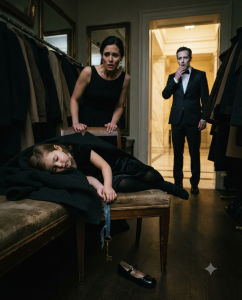
By nine-thirty, Annie had fallen asleep not in the office but in the coatroom, after wandering there with Jillian during the auction. She was curled beneath Jillian’s wrap on a padded bench, one patent leather shoe off, curls flattened against a crumpled program, her little hand closed around what she insisted on calling her treasure.
The treasure was an old brass key tied to a faded blue ribbon.
It had come from a donation box months earlier while Jillian was sorting through her late husband’s study. Andrew had saved everything—old lecture notes, ticket stubs, school flyers, loose change from trips no one remembered, broken pens, museum passes, random keys that opened nothing they could identify. Annie had found the ribboned key in the bottom of a banker’s box, lifted it up with delight, and announced that it belonged to a castle. Jillian had almost taken it away, then hadn’t. Since Andrew’s death, she had become less interested in controlling which objects her daughter loved. Some things were easier left unexplained.
At a little after ten, with the gala thinning into its final hour, Jillian slipped into the coatroom to check on Annie.
That was when Daniel Voss walked in.
Daniel was the museum’s chief curator, a man whose reputation for brilliance was matched only by his talent for distance. In another life, Jillian thought, he might have been charming. He had the bones of that sort of face. But grief had sharpened him. It lived in the set of his mouth, the hollows under his eyes, the way he seemed always to be bracing for impact no one else could see.
Jillian knew him socially. Committee meetings. Planning lunches. Occasional strategic calls about donor cultivation. Nothing personal.
But everyone in the city knew one personal fact about Daniel Voss.
His son, Caleb, had disappeared eleven years earlier during the museum’s winter exhibition.
The case had never been solved.
People still spoke of it carefully, in fragments. A child lost in a building full of adults. Security failures. A family that never truly returned to public life. Rumors that surged every anniversary and then died when no breakthrough came.
Daniel stepped into the coatroom, probably just looking for his coat.
Then he saw Annie.
Or rather, he saw the key in her hand.
He stopped so abruptly Jillian thought at first he was ill.
“Where did she get that?” he asked.
His voice was quiet, but it was not calm.
Jillian stood. “What?”
He didn’t answer. He was looking only at the ribbon.
Blue. Faded. Frayed along one edge. A tiny dark stain near the knot.
“That ribbon,” he said, and his voice changed on the final word, “my son wore a key on that ribbon.”
The room seemed to lose oxygen.
Jillian’s first response was practical denial. There were countless old keys in the world. Ribbon meant nothing. Children collected strange objects constantly. But Daniel looked like a man whose body had recognized something before his mind could survive it.
“What kind of key?” she asked.
A terrible smile flickered across his face and died at once. “If I knew that, my life might look different.”
Annie stirred, and the brass key slid farther into view.
Daniel took one involuntary step closer. “Same shape,” he whispered.
Jillian folded her arms over herself. “You think that was Caleb’s?”
Daniel looked at her then, and for the first time she saw no professional veneer at all. Only a father stripped down to the fact of his hope.
“Yes.”
Annie opened her eyes.
She stared at Daniel for a moment, unfocused and sleepy, then gave him the soft, solemn smile children sometimes offer strangers they feel sorry for.
“Oh,” she murmured. “You found the sad room.”
Daniel physically recoiled.
Jillian dropped to her knees beside Annie. “What did you say?”
Annie yawned. “The boy said you’re not supposed to sell it.”
“What boy?”
“The one in the stairs room. He gave me the ribbon too.”
Jillian’s pulse began to pound in her throat.
Because Annie had been saying strange things for weeks. Little comments easy to dismiss if you were tired enough, grief-struck enough, eager enough not to invite nonsense into a fragile life. She had mentioned a museum boy once after Jillian dragged her through a donor brunch. Another time she had asked why someone kept locking the blue room if “he” was still in there. Jillian had laughed it off, blaming old portraits, overheard conversations, imagination. Children were magpies for detail. They built stories from adult fragments.
But Annie had never been down in the sub-basement.
At least Jillian had believed that absolutely until this moment.
Daniel sat on the bench opposite them as if his legs had given way.
“My son disappeared in this building on December 12, 2015,” he said. “He was wearing that ribbon.”
He pulled an old folded map from inside his jacket. Not a public brochure, but an internal museum floor plan softened by repeated handling. He unfolded it over his knee with shaking fingers and tapped a boxed area beneath the western galleries.
“There was one room police never searched,” he said. “An old conservation chamber. It had been taken out of use during renovations, and the key vanished the same night Caleb did.”
“Why wouldn’t they force it?” Jillian asked.
“They intended to. Then there was a structural concern in an adjoining wall, the search shifted outward, and by the time access was revisited the theory had changed. They began treating the museum as a point of exit instead of a point of confinement.” His jaw tightened. “I never believed that.”
He showed her the square of the map. Beside it, in faded handwriting, someone had written BLUE ROOM.
“The old service staircase connected here,” he said. “Staff called it the stairs room before the redesign.”
Annie pressed her face into Jillian’s shoulder. “He said you were late.”
Daniel closed his eyes.
Jillian should have called security. Or the police. Or anyone. Instead she put Annie’s shoe back on, lifted her into her arms, and followed Daniel through a staff corridor behind the ballroom while the quartet played on for people who had no idea the night had split open a few rooms away.
As they moved deeper into the museum, the public face of the building fell away. The flattering lights disappeared first. Then the polished floors. They passed crates, maintenance doors, shelves of boxed archives, exposed pipes, concrete walls painted over too many times. The air cooled. The sound of the gala faded until only the faintest pulse of music remained.
Annie, half awake against Jillian’s shoulder, pointed once down a narrow hall.
“That way.”
Daniel stopped. “Have you been down here before?”
“No,” Annie said. “He just stands there.”
At the end of the hall, behind rolling archive shelving, was a steel door set into the wall. A strip of old cobalt tile ran above the frame, dulled by dust.
Daniel approached it slowly, like a man walking toward a grave he had built in his own mind a thousand times.
“Police searched every room they could open,” he said without turning. “This one stayed locked.”
Jillian looked from the door to the key. “How did Andrew end up with it?”
Daniel faced her. “That,” he said, “may be the worst part.”
He held out his hand. Annie gave him the key.
His fingers closed around it with reverence and fear.
He slid it into the old lock.
For a moment nothing happened.
Then, from deep inside the mechanism, came a grinding metallic shift so stiff and loud it sounded almost alive. Daniel turned harder. Something released with a cracking thud.
The door opened three inches.
Dust spilled from the frame.
A smell drifted out first—sealed air, old paper, stone, and something else beneath it: not decay, exactly, but the stale trapped odor of a place untouched for years.
Jillian nearly told him to stop.
Then Daniel pulled the door wider.
The beam from the corridor fell into a room lined with blue tile on the lower walls. Metal tables stood under yellowed tarps. Shelving units leaned at angles under boxes and old conservation equipment. A narrow secondary door in the back hung crooked off one hinge, revealing a shallow service alcove beyond.
And on the floor near the center table, half hidden by dust and a fallen cloth, lay a small navy blazer.
Daniel made a sound Jillian would remember for the rest of her life.
He crossed the room in three steps and dropped to his knees.
The blazer was child-sized. Museum-school uniform. Caleb’s initials were stitched inside the collar in white thread.
Jillian clutched Annie tighter. Her daughter had gone very still.
Daniel reached beneath the table and pulled out a battered metal lunch box decorated with faded astronauts. When he opened it, his shoulders shook.
Inside were old drawings, a flashlight with dead batteries, a fossil-shaped eraser, and a stack of folded papers.
The papers were notes.
Some were in a child’s handwriting.
Dad, I’m still here.
It started as a game.
He said not to yell.
There were more, written at different times, some frantic, some uneven, some barely legible. Caleb had been alive in this room after the disappearance. For hours? A day? Longer? Jillian felt sick trying to imagine it.
Daniel read one page, then another, and went white with a different kind of horror.
There was an adult name in the notes.
Andrew Mercer.
Jillian’s dead husband.
For a second her mind refused to connect the letters.
“No,” she said aloud, though no one had accused her. “No.”
Daniel held out the page with shaking fingers.
Caleb’s writing looped across it in pencil:
Mr. Andrew said we were hiding for the surprise. He locked the door and said Dad would come after the speech, but then I couldn’t get out and he didn’t come back. I heard him and another man fighting later. I kept yelling.
Jillian stared so hard the words blurred.
Andrew?
Her Andrew, who volunteered at reading drives and repaired broken toys before donation pickups? Who remembered every child’s birthday at the literacy center? Who cried during school concerts? Who had died two years earlier in a highway accident she had spent months trying to survive?
“This can’t be real,” she whispered.
Daniel said nothing. He was searching the room with frantic precision now, opening boxes, pulling back tarps, looking not just for evidence but for the shape of what had happened to his son.
In the rear alcove, behind a wheeled shelving rack, he found more.
Not a body.
A vent panel removed at floor level. Behind it, a crawl passage leading to an old service shaft large enough for a child to enter.
Daniel shone the dead flashlight out of reflex, then dropped it and reached in with his bare hands. He recovered a small sneaker, then bones.
Jillian turned away instantly, pressing Annie’s face into her shoulder before the child could see. Annie began to cry, not loudly, just a broken little whimper as if she understood enough.
Security arrived minutes later, summoned by a gallery manager who had noticed Daniel’s absence and then the open restricted corridor. Police followed. The room became lights and radios and careful voices. Jillian sat on a crate outside with Annie wrapped around her, answering the same questions again and again while the world she knew rearranged itself into something unrecognizable.
The investigation that followed tore through the city.
The notes were authenticated. So was the blazer. The remains in the shaft were confirmed as Caleb Voss.
The full reconstruction took months, but the shape of the truth emerged with brutal clarity.
On the night of the winter exhibition, Andrew Mercer had been helping manage donor families and children’s activities as a volunteer. Caleb, restless and fascinated by the building’s hidden passages, had slipped into the old service area. Andrew found him there. Why he led him into the Blue Room was never fully established. Some investigators believed Andrew was trying to keep the boy out of an unsafe renovation zone until Daniel finished speaking at the event. Others believed there had been a childish promise of a “secret surprise” involving museum storage. Either way, Andrew had used the key and locked the room.
Then something interrupted him.
A second volunteer encountered Andrew in the corridor and they argued about missing auction materials. Records placed them together for nearly twenty minutes. By the time Andrew returned, he no longer had the key.
Whether he panicked, searched privately, feared exposure, or convinced himself the room had another exit would remain partly unknowable. But he never reported Caleb being there.
Instead, when the disappearance caused chaos, Andrew told police he had seen the boy near the public staircase shortly before the alarm was raised. That statement redirected the search.
For years, he lived with it.
He attended fundraisers with Daniel. Helped organize memorial literacy drives in Caleb’s name. Sat in committee meetings while Daniel kept searching for a child trapped first by a door, then by an adult’s cowardice.
The key, it turned out, had been recovered by Andrew later that night from inside a rolling supply cart near the old corridor. He kept it. No one could explain that choice in a way that made moral sense. Shame? Fear? A decision that once hidden could never be confessed? Whatever the reason, he tied it into his own private box of forgotten objects and carried the evidence home.
Jillian learned all of this in stages, each fact a fresh injury.
At first she defended Andrew automatically, then hated herself for doing it. Then she clung to the possibility of accident, only to discover that accident did not survive the years of silence that followed. He might not have meant for Caleb to die. But he had chosen himself over a trapped child again and again, every day he stayed quiet.
Daniel never shouted at Jillian. That almost made it worse.
When they met months later after the official findings were released, it was in a quiet museum office stripped of flowers and speeches. The Blue Room had been emptied and sealed for forensic work. Caleb’s remains had finally been buried beside his grandparents.
“I know you didn’t know,” Daniel told her.
Jillian looked at him and said the only true thing she had left. “I don’t know what to do with loving someone who did this.”
Daniel, who had spent eleven years living beside a wound caused by another person’s choice, answered her with more mercy than she felt she deserved.
“You tell the truth about him,” he said. “And then you let the truth change the shape of your love.”
The museum created a memorial scholarship in Caleb’s name, this time without gala theatrics. Quietly. Properly. The city, embarrassed by its own appetite for the story, moved on faster than either Jillian or Daniel could. People always do.
But Annie kept asking the questions adults dreaded.
Was the museum boy still sad?
Did he know his dad found him?
Why did Grandpa Andrew—she still confused names sometimes, grief had shuffled generations inside her—keep the key if it hurt everyone?
Jillian had no answers clean enough for a child.
What she did have was the memory of Annie sleeping in the coatroom, fingers wrapped around a key that should never have reached her, and the impossible chain of carelessness, secrecy, guilt, and accident that had placed it there. She stopped going to galas after that. She resigned from the board. She donated Andrew’s papers to investigators, then to archives, then got rid of the rest.
Some objects deserved no shrine.
Months later, when the museum reopened the renovated lower wing, Daniel invited Jillian and Annie for a private visit before the public came through. The old service hall was gone. The Blue Room had been dismantled. In its place stood a small reading room painted in warm cream and deep blue, with low shelves and wide chairs for children.
Annie wandered in, looked around carefully, and then nodded as if to herself.
“He likes this better,” she said.
Jillian almost corrected her.
Daniel didn’t.
He just stood in the doorway, hands in his pockets, grief still present but no longer roaming without witness. Then he looked at Jillian, and for the first time since that night there was something in his face that resembled peace.
Not healing. That was too easy a word.
But peace, perhaps, in finally knowing where the locked door had been.
On the way out, Jillian paused beneath the museum lights and thought about Andrew as he had been when alive—kind in a hundred ordinary ways, beloved by her, guilty in the one way that mattered most. Human beings wanted saints and monsters because they were easier to carry. The truth was crueler. Sometimes the worst red flag was not cruelty, but weakness. Not rage, but cowardice dressed up as decency until it calcified into something unforgivable.
And sometimes the thing that finally opened the buried room was not justice, not investigation, not genius—
but a sleeping child who refused to let go of a key.