Nathan Cole had not wanted to spend his Saturday at a craft fair.
That truth sat in him like a stone from the moment he parked near the town square and shut off the engine. The place was already crowded. White tents lined the sidewalks. Handmade signs leaned against folding tables. Music drifted from somewhere near the fountain, cheerful and relentless. Children darted between booths carrying lemonades the size of their heads.
It looked like the kind of day that belonged to intact families.
Nathan almost suggested they leave before they even reached the first tent.
Then Ruby pressed both hands to the car window and gasped at a display of painted birdhouses, and he swallowed his resistance. She had been excited all week. Ever since she had heard one of the teachers mention the town fair, she had talked about ribbons and buttons and “making things” with that bright seriousness that made it impossible to say no.
Before Ellen died, Sundays had belonged to sewing.
Not fancy sewing. Not perfect sewing. Ellen worked with scraps and patience and the sort of imagination Nathan used to think was ordinary until he lost it. She sat with Ruby at the kitchen table and turned mismatched pieces into treasures. Felt strawberries, little stuffed moons, dolls made from old socks, hand-stitched bookmarks, tiny sachets of dried lavender. Ruby adored it all. She adored the mess, the ritual, the quiet instructions in Ellen’s voice.
After the funeral, Ruby began collecting objects the way some children collected pebbles. A button from the floor of the grocery store. A ribbon from a bakery box. Bottle caps, corks, shells, old beads, washers, odd little pieces of metal. Nathan kept finding them in her pockets, under couch cushions, lined up on the edge of the bathtub.
“They’re for making things,” she’d say, as if that explained everything.
Maybe it did.
So when she asked to go to the craft fair, he took her.
He told himself it was for her, but part of him hoped being around people who still made things by hand might reconnect her to the piece of Ellen she missed most.
For the first half hour, the plan seemed harmless enough.
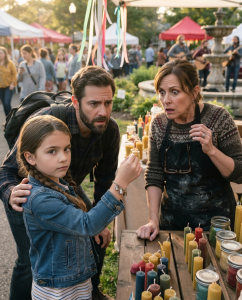
Ruby examined pottery with reverence. She stroked a knitted scarf as if it were a sleeping animal. She asked if jam jars counted as crafts because “somebody still had to make the jam part.” Nathan even smiled once or twice.
Then they reached the candle booth.
Later, Nathan would replay that moment so many times he would start to believe the entire day had narrowed toward it from the instant they left home.
The booth belonged to a woman in a wax-dusted apron with silvering hair pinned back neatly at the nape of her neck. Her candles were arranged by scent and color in careful rows. Vanilla. Cedar. Orange clove. Lavender. She had the practiced, gentle smile of someone good with customers and children.
She smiled at Ruby.
Then she saw the bracelet.
Ruby wore it almost every day. A lopsided chain strung with found objects. Nathan had seen it so often it had disappeared into the background, just another part of his daughter’s strange little world. A shell. A plastic bead. A tiny brass key. A silver thimble hooked on with a bent ring.
The moment the woman noticed the thimble, she stopped breathing.
Nathan saw it happen.
Her face did not merely register recognition. It emptied, as if something had reached inside her and pulled away a support beam she had been leaning on for years.
“Where did she get that?” she asked.
Ruby touched the charm. “This one’s for sewing wishes.”
The woman stared. “Where did she get it?”
Nathan stepped closer, suddenly protective. “Why?”
The woman swallowed. “My daughter had a thimble just like that. She lost it the day she left.”
Nathan asked what she meant by left.
She answered in a voice that had clearly spoken the sentence too many times. “She ran away. Fifteen years ago.”
That should have been the end of it. A sad coincidence. A charm that resembled another charm. A stranger with old grief and a child too eager to talk.
Then Ruby, with quiet sympathy, said, “She said she didn’t mean to.”
The candle maker went white.
Nathan knelt to Ruby’s height. “Who said that?”
“The girl by the ribbons.”
There had indeed been a ribbon booth next door. Dozens of spools and strips hanging in the breeze. But no girl.
Nathan looked at the woman again. “What was your daughter’s name?”
“Claire.”
Ruby nodded. “She still likes the blue one.”
The woman’s fingers tightened around the edge of her table. “She left wearing a blue ribbon.”
Nathan felt cold.
It got worse from there.
Ruby said Claire told her the woman had never opened the tin. The woman made a choking sound and admitted there had been a sewing tin hidden beneath winter scarves. Ruby said Claire had lied about the train. The woman nearly collapsed.
By the time Nathan followed her behind the booth to the van where she stored extra boxes, the afternoon no longer felt like an ordinary Saturday. It felt like standing on the edge of someone else’s unfinished nightmare.
The woman introduced herself at last as Mara Bennett. Her voice shook as she climbed into the back of the van and pulled aside stacked crates, folded blankets, and cartons of unsold candles. Under a pile of sealed storage bags and an old wool scarf, she found it.
A rose-patterned biscuit tin.
Dusty.
Ribbon-tied.
Undisturbed.
She held it like it might explode.
Nathan lifted Ruby into the van doorway so she could see without climbing inside. Ruby looked solemn, not frightened. Calm in a way that made Nathan increasingly uneasy.
Mara stared at the tin for several seconds before whispering, “I packed this years ago and never opened it. I couldn’t. My husband wanted to throw it out after the divorce, but I kept it. I told myself I was saving it for when I could bear it.”
Nathan glanced at her. “Your husband?”
“Dead now,” she said hollowly. “Three years.”
Something about the way she said it suggested the marriage had been dead much earlier.
Mara untied the ribbon with clumsy fingers, then froze when she saw the writing on the lid.
Don’t believe what he says.
Nathan read it over her shoulder.
“Who is he?” he asked.
Mara’s face changed. Memory moved through it like a shadow crossing water. “My husband’s younger brother. Daniel. He was the one who told us Claire had been talking about running off to the city. He said she was angry with me. Said she asked him where the train station was.” Mara shook her head once. “He was at our house the night she disappeared.”
Ruby, still quiet, said, “He opened the door.”
Mara turned sharply toward her, horror widening her eyes. “What?”
Ruby looked down at the bracelet, touching the silver thimble. “She said he opened the door and told her not to wake you.”
Nathan felt the air change.
This was no longer about a runaway note.
It was about whether Claire had ever run away at all.
Mara set the tin on a crate and lifted the lid.
Inside were sewing needles wrapped in cloth, several spools of thread, two folded squares of embroidered fabric, an old photograph, and a sealed envelope.
The photograph was on top.
Mara picked it up first.
It showed Claire, maybe sixteen, standing in the kitchen beside a younger Ruby-sized version of a little girl Nathan assumed must be a cousin or neighbor. Claire had dark hair in a braid tied with a blue ribbon. She was smiling, but not for the camera. She was looking sideways at someone outside the frame.
On the back, in faded ink, were the words: If he says I planned this, he’s lying.
Mara sat down hard on the van’s bumper.
“No,” she whispered. “No.”
Nathan took the envelope and handed it to her without opening it. Her hands shook too badly to tear it cleanly, so he helped by splitting the edge with his thumb. She unfolded several pages.
The letter was written in a hurried, slanted hand. Parts of it were smudged as if the writer had cried or written too fast.
Mara read the first lines silently, then covered her mouth.
Nathan didn’t ask. He simply waited.
When she finally spoke, her voice sounded scraped raw.
“Claire wrote that Daniel had been coming into her room at night. Not touching her—” Mara stopped, swallowed, and forced herself to continue. “Not yet. But standing there. Watching. Saying disgusting things. Telling her he knew she wanted to leave and no one would believe her if she accused him. She told my husband once and he said she was being dramatic because Daniel drank too much and crossed boundaries with everyone.”
Nathan felt sick.
Mara kept reading, words breaking apart as they came. Claire had written that she planned to leave for a friend’s apartment in the city for one night only, then go to her art teacher the next morning and tell the truth. She had not told her mother because she was afraid Mara would confront the family first and Daniel would twist everything. Claire wrote that Daniel found her packing. He said he would help her leave quietly before dawn. He told her not to wake anyone.
Ruby leaned into Nathan’s shoulder.
Mara turned another page.
Claire wrote that once they were outside, Daniel refused to drive her to the station. Instead, he said they needed to stop somewhere first. She had hidden the letter in the tin in case she never got the chance to come back for it.
Nathan’s throat tightened. “Is that all?”
Mara kept reading. “No.”
But before she could continue, Ruby looked past them and whispered, “He’s here.”
Nathan turned.
A man stood across the walkway near the soap booth. Mid-sixties. Heavyset. Ball cap. Hands at his sides. Expression fixed in alarm. He was staring directly at Mara, at the open tin, at the pages in her hand.
For one suspended second, nobody moved.
Then the man pivoted and started walking away.
Nathan reacted before he had time to think. “Stay here,” he said, handing Ruby to Mara, and jumped from the van.
He had not run hard in years, but fear gave him speed. The man shoved through the crowd, clipping a display of crocheted potholders, then veered toward the alley beside the post office. Nathan followed, ignoring shouted complaints behind him.
“Daniel!” Mara screamed from somewhere behind him.
The man looked back once. That was enough to confirm it.
By the time Nathan caught up, Daniel had reached the alley and fumbled for a truck door key. Nathan grabbed his arm and slammed the door shut before he could climb in.
“Let go of me,” Daniel snapped.
Mara arrived seconds later, breathless and shaking, clutching Claire’s letter.
She didn’t scream this time.
She held the pages up between them like evidence brought back from the dead.
“Where did you take her?”
Daniel’s face moved through three expressions in quick succession: denial, outrage, calculation.
“I don’t know what you’re talking about.”
“You’re in her letter.” Mara’s voice sharpened into something fierce. “She wrote what you did.”
Daniel’s eyes flicked to the paper.
That was the mistake.
Not confusion. Recognition.
Nathan saw it. Mara saw it too.
“You lied about the train,” Mara said. “You told us she ran away.”
Daniel’s jaw set. “She did.”
“Then why were you staring at that tin like you knew it existed?”
He said nothing.
People had begun to gather at the mouth of the alley. The music from the square sounded thin and surreal now.
Mara stepped closer. “Where did you take her?”
Daniel laughed, but there was no confidence in it. “You don’t want to do this here.”
Nathan answered for her. “Too late.”
Daniel looked around, measuring exits, witnesses, angles. Then something in his posture shifted. Not confession exactly. Resentment. The resentment of a man who had gotten away with something so long he had begun to think of questions as an insult.
“She got in the truck,” he muttered.
Mara went still.
Daniel rubbed a hand over his face. “She got in because she wanted out. She kept talking about the city, about art school, about how no one listened to her. I said I’d drive her. She started threatening me halfway there. Said she’d tell people things. Said she’d ruin the family.”
Nathan felt rage rise, cold and precise.
“What things?”
Daniel glared at him. “Things girls say when they know they can get their way.”
Mara slapped him.
The sound cracked down the alley.
“You vile bastard,” she whispered.
Daniel touched his cheek slowly. “I dropped her at a bus depot over state line. She had cash. She was alive when she got out.”
“Why didn’t you say that?” Nathan demanded.
“Because she told me if I said where I took her, she’d tell them why.” Daniel’s eyes darted toward Mara. “And because by the time people started asking questions, your husband already believed she’d run. So I let him.”
Mara stared at him with naked hatred. “You let me think my daughter abandoned me.”
“She wanted to leave.”
“She wanted to get away from you.”
He did not answer.
Police arrived quickly once someone in the crowd called. Mara handed over the letter with fingers that no longer trembled. Nathan gave his statement. So did several vendors who had seen Daniel watching the van. Daniel tried to insist it was all a misunderstanding, that he had only helped a rebellious girl leave an unhappy house.
The officers did not look convinced.
The rest unfolded in pieces over the following weeks.
The bus depot records were long gone, but the name Claire Bennett had eventually surfaced in another state two years after her disappearance. She had used variations of it while working odd jobs and later enrolled in a community art program under the surname Cole—her grandmother’s name. There were traces after that, then gaps. Longer ones. The kind life leaves when someone is surviving instead of documenting themselves.
The most important break came from the photograph in the tin.
The little girl standing beside Claire turned out to be the daughter of Claire’s high school art teacher. The teacher, now retired in Oregon, still had old contact information tucked in a portfolio box. Claire had reached out once, years ago, from Santa Fe. She wrote that she was safe, not ready to explain everything, and still painting. She asked that no message be passed to her family until she felt able.
The letter had never been forwarded. The teacher had fallen ill shortly after and forgotten where she placed it.
But she still had the envelope.
And inside was an address.
Mara made the trip herself.
Nathan never learned every detail of what happened when mother and daughter met again, because some reunions belong only to the people who bled for them. But Mara told him enough later, over coffee and trembling gratitude.
Claire was alive.
Forty-one years old.
An artist.
Thin, guarded, brilliant.
Still carrying the old terror in the way she checked door locks twice.
She had spent years believing her mother must have chosen Daniel’s story over hers. Mara had spent years believing her daughter had chosen to vanish. Both had been living inside a lie engineered by the same man and protected by everyone’s willingness, at the time, to call a troubled girl difficult rather than endangered.
The first hour of their reunion was apparently ugly. Tears. Accusations. Long silences. Claire demanding to know why the tin had stayed shut. Mara admitting the worst truth she had ever spoken aloud: that grief and fear had made her passive when her daughter needed her brave.
Then Claire cried too.
Not because everything was repaired, but because for the first time, someone had read the letter and believed her.
Months later, Mara returned to the craft fair with twice as many candles and a steadier face. Nathan and Ruby visited her booth together. This time, there was a framed photograph tucked beside the cash box: Mara and Claire standing in a sunlit studio, both unsmiling in the picture but shoulder to shoulder in a way that said more than a grin could.
Ruby noticed it first.
“She found the blue one,” she said.
Mara blinked at her. “The blue one?”
“The ribbon,” Ruby said matter-of-factly. “Claire kept it.”
Mara laughed softly, eyes bright. “Yes. She did.”
Nathan finally asked the question that had been sitting in him for nearly a year. “Do you think Ruby really talked to her that day?”
Mara looked at the silver thimble, which Ruby still wore on her bracelet.
“I think,” she said carefully, “that grief leaves doors open in places we don’t understand. And I think some messages wait for anyone kind enough to carry them.”
Nathan looked at his daughter, who was busy arranging wax sample chips by color as if the world remained, at its core, salvageable.
He did not know what he believed.
He knew only that a child had walked into a craft fair wearing a missing thimble, and a sealed tin had finally been opened. He knew a lie had been forced into daylight after fifteen years. He knew one mother had been given back the chance to say she was sorry, and one daughter had finally been told she had been right all along.
Sometimes that felt supernatural.
Sometimes it felt like the simplest thing in the world.
Because the real horror was not that a dead girl might whisper through a child. The real horror was how easily the living had ignored what Claire tried to say while she was still there to say it herself.
Nathan thought about that often after.
About fear.
About silence.
About how many families mistake avoidance for survival.
He also thought about the tiny dent in the silver thimble and the way Mara recognized it instantly. Love, he realized, does not always save people when it should. But it remembers. Even after years. Even after shame. Even after everyone has gotten used to the official version of the story.
And sometimes remembrance is enough to crack a lie wide open.
Nathan still took Ruby to craft fairs after that.
The booths no longer felt hostile.
They felt fragile instead.
Full of people carrying hidden things in broad daylight, hoping someone might notice the detail that did not belong—the wrong story, the sealed tin, the dent near the rim—and ask the one question that could change everything.