The morning they put her off that dock, Marvelle Dubose slipped something into her coat pocket and never once looked back.
That was eleven years ago.
Today, she was back.
—
You have to understand something about Vee before I tell you the rest of this story.
She grew up on the Mississippi Gulf Coast, daughter of a man who made his living knowing which way the water was running. Calvin Dubose had a compass — old, brass, the kind that had gone green around the seams and smelled like salt and machine oil. He kept it in his shirt pocket every single day of his working life.
“You always know where you are,” he used to tell her, “if you know which way you’re pointed.”
When Vee married into the Fontenot family, she thought she was pointed somewhere good.
The Fontenots owned half the charter fishing operation out of Biloxi. Three boats. A dock lease older than some of the families in the county. Delmond Fontenot had a jaw like a movie actor and a handshake that made men feel chosen.
For eight years, Vee kept the books, negotiated the contracts, and quietly earned her law degree at night while Delmond slept.
Nobody mentioned the law degree at the divorce.
—
The woman Delmond married next was named Shay-Lynn.
Shay-Lynn was not a bad person, exactly. She was the kind of person who says cruel things in a sweet voice and considers that good manners.
On the day the Fontenot family had Vee formally escorted off the dock — a dock Vee had personally refinanced twice — Shay-Lynn stood at the top of the gangway in a white linen sundress and said, loud enough to carry over the water:
“Bless your heart, Marvelle. Some women just never amount to enough to even bait a hook.”
The dock hands pretended not to hear.
Vee’s father was dying in Biloxi Memorial at the time. She drove straight from the dock to his room.
He pressed his compass into her hand without a word.
She put it in her coat pocket.
She never told him what Shay-Lynn had said.
Some things you protect your people from.
—
Eleven years is a long time to know which way you’re pointed.
Vee built a coastal property law practice so quiet and so thorough that half her clients didn’t know they were her clients until they needed her. She never advertised in Biloxi. She didn’t need to.
She held paper on four commercial dock leases in Harrison County.
Including, as it happened, the one the Fontenots had been operating on since 1987.
When the county announced an emergency auction on delinquent Gulf-front dock leases — the Fontenots were eighteen months behind, something Vee had known for fourteen of those months — she didn’t make a single call.
She just took her coat from the back of her office chair.
Felt the weight in the pocket.
Confirmed it was still there.
And drove down to the water.
—
The auction was held in the harbormaster’s conference room, which smelled like coffee and old carpet and salt air coming through a window someone had cracked open.
Delmond was already there when she walked in.
He was wearing his good boots and that expression men wear when they think a room belongs to them.
Shay-Lynn was beside him in a coral blazer, whispering something to their attorney that made him nod.
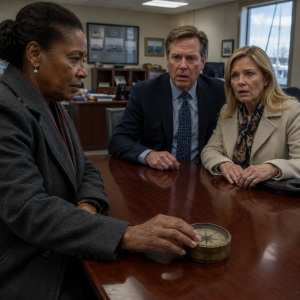
Vee set her briefcase on the table.
And then she reached into her coat pocket.
The compass came out tarnished the way old brass gets — not dirty, just worn into itself, the way something looks when it has been handled by hands that loved it. She set it on the mahogany surface between herself and the woman across the table.
Just set it there.
Didn’t explain it.
Shay-Lynn glanced at it the way you glance at something you don’t understand and don’t want to admit you don’t understand.
Delmond looked at it longer.
Something moved across his face.
The auctioneer cleared his throat, shuffled his papers, and looked from the compass to Vee’s face for what felt like a very long time.
Then he said the four words that made Delmond Fontenot go the color of old bait.
“Ma’am — you own everything.”
Shay-Lynn’s attorney stopped writing.
Delmond’s good boots didn’t move.
And Vee’s hand rested on that brass compass, warm from her pocket, steady as the needle inside it.
—
What the auctioneer meant, specifically, was this.
Vee had not simply shown up to bid on the delinquent dock lease. She had shown up as the lienholder.
Eleven years ago, when the divorce settlement was being carved up and everyone was paying attention to the boats and the business valuation and the name on the slip agreements, nobody paid much attention to a small subordinate financing instrument attached to the dock lease itself. The kind of thing that gets buried in page forty-something of a closing package. The kind of thing a tired attorney skims.
Vee had drafted it herself.
She had been the one doing the books, after all. She was the one who knew the lease was underwater the first time, when the refinancing happened. She had structured a personal loan from her own inherited savings — money from her father, money from years of her own careful living — as a secured instrument against the lease. Delmond had signed it without reading it, the way Delmond signed most things she put in front of him, because he trusted her completely right up until the moment he decided he didn’t need her anymore.
The instrument had never been paid off.
It had just been forgotten.
By everyone except Vee.
When the county moved on the delinquency, Vee’s position as a secured creditor gave her the right to step in front of the auction entirely and satisfy the public debt herself — which she had done, quietly, through a property holding company registered in her maiden name, six weeks before this morning.
She hadn’t come to bid.
She had come to inform.
—
Shay-Lynn’s attorney figured it out first. You could see it happen in real time — the way his pen stopped moving, the way he turned to a specific page in his folder, the way his face went carefully blank the way attorneys’ faces go when they are deciding how to bill for bad news.
He leaned over and said something low to Shay-Lynn.
Shay-Lynn said, “What do you mean?”
He said it again, quieter.
Shay-Lynn looked across the table at Vee for the first time since Vee had walked in.
Vee looked back at her pleasantly.
“I don’t understand,” Shay-Lynn said, and for once the sweetness was entirely gone from her voice. What was left underneath it was just a woman trying to understand how the floor had disappeared.
“It’s not complicated,” Vee said. “The lease reverts. The equipment on the dock, the slip agreements, the access easement — all of it runs with the lease. You’re welcome to have your attorney walk you through it. He seems like he’s already getting there.”
Delmond hadn’t said anything yet. He was still looking at the compass.
“Del,” Shay-Lynn said.
He didn’t answer her.
“Delmond.”
He finally looked up, and whatever he saw in Vee’s face made him press his mouth together in a thin line and look back down at the table.
Because here is what Delmond Fontenot understood, probably before anyone else in that room: Vee was not doing this to hurt him. She was not savoring it. She was not performing for anyone. She was simply completing a thing. The way you complete a navigation. The way the needle settles.
That was almost worse than anger would have been.
—
The formal paperwork took another three weeks.
Vee didn’t evict anyone immediately. That was never the point.
She offered the Fontenots a standard commercial lease at fair market rate — the same terms she offered the two other operators who worked out of that dock. No penalty provisions. No history written into it. Just a clean agreement going forward, if they wanted it.
Delmond’s attorney called her office about it.
Delmond did not call himself.
Shay-Lynn, to her credit or her pride or some combination of the two, declined in writing. They were relocating to a facility in Pascagoula, the letter said. Effective end of quarter.
Vee read the letter once, filed it, and went back to work.
—
There’s a particular dock hand who was there the morning Vee got walked off eleven years ago. His name is Terrence, and he has worked the Biloxi waterfront since he was nineteen years old. He doesn’t miss much.
He was coiling line on the dock the afternoon Vee came back to walk it for the first time as the owner.
He watched her come down the gangway in her good shoes, picking her way carefully over the boards she knew were soft, checking the cleats, looking at the water the way her father used to look at it.
When she got level with him, he stopped working.
“Miss Marvelle,” he said.
“Terrence,” she said.
He nodded slowly at the dock around them. At the water. At the boats sitting easy in their slips.
“Your daddy would’ve liked this,” he said.
Vee was quiet for a moment. The Gulf moved against the pilings the way it always has and always will, patient and indifferent and completely unbothered by the small human dramas conducted on its edges.
She reached into her coat pocket.
Held the compass in her palm and looked at it for a long moment.
“He would have said the water hasn’t changed,” she said. “That it’s never about the water.”
Terrence considered that. “What’s it about then?”
She closed her hand around the compass and looked out at the horizon, where the sky and the Gulf met in a line so clean it looked drawn.
“Knowing which way you’re pointed,” she said.
She stood there a while longer, just the two of them and the sound of the water, and then she walked back up the dock toward her car.
The compass went back in her pocket.
She’s still carrying it.