For years, Victor Carter had been the kind of man prison legends were built around.
His name moved through the cell blocks like a warning passed from one inmate to another. New arrivals heard it on their first day. Some heard it in the intake line. Others heard it whispered through the bars at night, usually followed by the same message: don’t cross him, don’t challenge him, and don’t ever embarrass him in front of people.
Victor had earned that reputation the hard way.
He was big, sharp, unpredictable, and smarter than most people gave him credit for. He knew exactly how to provoke, exactly how far to push, and exactly how to make fear do half his work for him. He controlled the atmosphere around him. That was his real skill. He could turn a room tense with one look and violent with one sentence. Some inmates admired him. Many feared him. Even men who hated him gave him space, because in a place like that, survival often meant recognizing who held the unofficial power.
The guards knew it too.
They followed the rules on paper, but in reality, many of them adjusted around Victor. They watched him carefully, spoke to him cautiously, and avoided direct confrontations unless absolutely necessary. There had been incidents over the years. Fights. Standoffs. One guard left after a particularly ugly altercation and claimed he simply wanted more time with family. Nobody believed him.
Victor liked that.
He liked being the man who could not be managed.
Then David arrived.
From the start, he looked wrong for the place.
He wasn’t physically imposing in the obvious way. He didn’t have the loud voice, the forced swagger, the habit of barking orders before anyone had done anything wrong. He didn’t insult inmates to keep them in line. He didn’t act like every interaction was a duel for dominance.
Instead, he was calm.
He greeted people. He spoke evenly. He listened. When an inmate requested medical attention and genuinely needed it, David followed up. When there was a legal complaint or a dispute that could be handled through procedure, he explained the process rather than dismissing it with a smirk. He treated the prisoners like human beings without becoming familiar with them.
That balance was rare enough to make everyone uneasy.
“Too soft,” one officer said in the break room after David’s third day.
“He’ll learn,” another replied.
But David didn’t change.
The prison began studying him the way prisons always study new people. Inmates tested boundaries with him in small ways. Delayed compliance. Sarcastic comments. Petty disrespect. The kind of behavior meant less to cause real trouble and more to discover what kind of man they were dealing with.
David handled each moment without theatrics.
He wrote reports when needed. He intervened early. He didn’t get baited. He didn’t overreact. He didn’t look scared, but he didn’t posture either.
That, oddly enough, made him harder to read than the tough ones.
Victor noticed.
At first he dismissed the new guard as another polite idiot who would eventually break. Then he began watching him more closely. David moved through the prison with an unusual steadiness, as if he’d already calculated the risks and accepted them. He didn’t seek approval from staff. He didn’t try to look brave in front of inmates. He was simply present, alert, disciplined, and strangely unaffected by the emotional pressure everyone else felt around Victor.
That became a problem.
Because Victor depended on visible reactions. Fear. Defensiveness. Anger. Submission. Once people gave him one of those, he could work with it.
David gave him nothing.
So Victor decided to make an example of him.
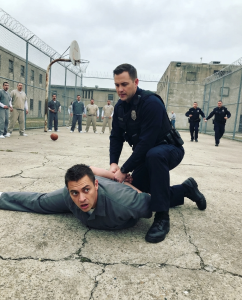
It happened during yard time on a gray afternoon when the sports field was crowded. A basketball game was going on near the far fence. Some inmates walked laps. Others sat in clusters talking. Guards stood in their usual positions, scanning faces and pretending the tension in the air wasn’t always there.
David was moving along the edge of the yard, checking the area the same quiet way he always did, when Victor changed course and headed straight for him.
People noticed immediately.
There was a shift in attention, subtle at first. A conversation died off. A few inmates turned their heads. One older guard on the perimeter straightened.
Victor came in with deliberate casualness and slammed his shoulder into David hard enough to stagger most men.
David took one step back.
Then stopped.
He didn’t reach for Victor. Didn’t yell. Didn’t even glare. He simply looked at him.
Victor grinned and threw out the line loud enough for half the yard to hear.
“Careful you don’t fall, boss.”
Laughter broke out.
Victor fed off it at once. He stepped closer, speaking louder, insulting the guard’s manner, his calmness, even the way he wore the uniform. He called him weak. Said he wouldn’t last. Said men like him came in thinking rules mattered and left understanding only power did.
David remained silent.
At first the silence looked like weakness, exactly as Victor intended. But the longer it continued, the stranger the scene became. David’s expression wasn’t frightened. His posture wasn’t defensive. If anything, he looked like a man letting another man make a serious mistake.
Victor sensed the shift in mood and pushed harder.
He shoved David again. Then again. This time he got close enough to speak directly into his face. He wanted anger now. A shove back. A threat. Something visible he could use to prove that the new guard was either weak or reckless.
Instead David said, “Let go of this now, Victor.”
Quietly. Almost gently.
That only made Victor angrier. A warning delivered that calmly felt insulting.
So he did the one thing no experienced inmate should have done with a man he hadn’t figured out yet.
He grabbed David by the front of the uniform.
The yard froze.
Even the basketball stopped bouncing.
What happened next was so fast that many men didn’t process it in real time. David turned, trapped Victor’s wrist, broke the grip, shifted his balance, and drove him to the concrete in one smooth motion. No wasted movement. No struggle. One second Victor was standing there with all the swagger in the world. The next he was face-down, arm pinned, his body locked under controlled pressure that neutralized every attempt to move.
A gasp rippled through the yard.
Victor tried to twist free and failed. He tried to rise and immediately froze when David adjusted his weight. There was no rage in the guard’s face, no panic, no victory grin. Just concentration.
“Put your other hand where I tell you,” David said.
Victor didn’t.
David increased pressure slightly.
The reaction was immediate. Victor inhaled sharply, the sound humiliating in its involuntary honesty.
For a man like him, public pain was almost worse than pain itself.
Nearby inmates stared as if reality had briefly broken. Some looked away. Others leaned closer, unable to believe what they were seeing. The veteran officers rushing across the yard stopped speaking when they realized this wasn’t a messy fight. It was controlled. Precise.
Trained.
Victor understood it too. He craned his head just enough to look upward, and for the first time his expression wasn’t angry.
It was unsettled.
Then David leaned down and said something quietly.
Only the nearest men heard it. But they all saw the effect. Victor’s face changed. Not with pain. With recognition.
“I know who you are,” Victor muttered.
David’s expression barely moved. “Hand out.”
Victor hesitated.
Then, to the shock of everyone watching, he obeyed.
The cuffs clicked shut around his wrist.
As David brought him to his feet, Victor twisted his head and whispered, “They told us you were dead.”
That was the moment the yard stopped treating the incident like a normal power struggle and started sensing something else.
An older inmate near the fence frowned. One of the guards beside David looked from Victor to the new officer in confusion. Victor’s swagger had vanished. He looked not beaten, but shaken, as though the man holding him belonged to a chapter of his life he had never expected to reopen.
David marched him toward the gate.
“Ask him what name he used before David,” Victor called out over his shoulder.
The words landed like a thrown match.
Whispers spread instantly. In prison, mystery could be more dangerous than violence. A hidden history. A false name. An old score. Men built entire survival strategies around information like that.
David didn’t answer.
He delivered Victor to a holding room near the administrative wing and secured him inside while two officers stood by. The warden was called. Reports were demanded. Questions were forming everywhere.
In the corridor outside, Sergeant Malone, a veteran officer who trusted almost nobody, folded his arms and stared at David.
“You going to explain what he meant?”
David looked through the narrow glass at Victor sitting on the bench inside. The inmate’s breathing had slowed, but not his intensity. He was smiling now, though it was a different smile than before—less arrogant, more dangerous.
“There’s nothing to explain to the yard,” David said.
“That isn’t what I asked.”
David was quiet for several seconds. Finally he said, “Before corrections, I worked with a joint task unit. Organized smuggling, violent networks, prison corruption. We built cases from the outside and the inside.”
Malone’s face hardened. “Undercover?”
“For a time.”
The sergeant glanced toward the holding room window. “Victor was part of one of those cases?”
David nodded once.
Years earlier, before Victor had become the undisputed king of this prison, he had been tied to a broader operation moving contraband, money, and information across multiple facilities. Guards, transport officers, outside contacts—enough people were involved that nobody on the investigating side could trust the full chain. David had entered under another identity during the early phase of the case. Not as an inmate, but close enough to the network to expose how messages and payments moved. It had nearly gotten him killed.
“We shut pieces of it down,” David said. “Not all of it.”
“And Victor recognized you just now?”
“Apparently.”
Malone cursed under his breath.
The worst part wasn’t the recognition itself. It was what followed from it. If Victor knew who David really was, then he also knew the old investigation had touched more than inmates. It had touched staff.
Corrupt staff.
Men who might still be working inside the system.
The warden arrived minutes later, and David gave a stripped-down version of the truth. Enough to explain the danger, not enough to spread panic before they knew who could be trusted. Victor, meanwhile, sat in the holding room with infuriating patience.
When David entered alone, Victor leaned back and smiled.
“I always wondered if you’d crawl out of whatever hole they buried you in.”
David remained standing. “You just made a bad day worse for yourself.”
Victor laughed softly. “For me? No. For you, maybe.”
He leaned forward, lowering his voice.
“You think this place feared me because I’m strong? That’s the part children notice. The real reason they feared me is because I knew things. Names. Routes. Accounts. Deliveries. Who gets paid to lose keys. Who signs forms without reading them. Who opens gates two seconds too late.”
David said nothing.
Victor’s eyes glittered. “And now the whole yard knows I recognized you. So tell me, how many people inside this building are nervous right now?”
That was the real threat.
Not Victor alone. The invisible web behind him.
David studied him carefully. Victor was baiting, but he was also proud. Men like him often spoke most when they believed control was slipping and wanted to seize it back with information.
“You’re not in charge anymore,” David said.
Victor smiled wider. “Then why did your jaw tighten at the gate?”
David left the room without answering.
By evening, the prison atmosphere had changed completely. Routine checks became targeted searches. Staff assignments were quietly shifted. Access logs were reviewed. The warden, now deeply concerned, authorized a closed inquiry with an outside unit David trusted. Malone coordinated internally, keeping the circle tight.
Victor spent the night in segregation, but his influence still moved through the building like smoke.
The breakthrough came from an unlikely place.
One young officer, rattled by the yard incident and by seeing Victor genuinely afraid for the first time, came forward after shift change. He admitted that over the past month he’d been pressured to ignore small irregularities in delivery checks. Nothing obvious enough to trigger alarms. Just enough to create blind spots. He named the man who pressured him: Lieutenant Harlan, a respected supervisor with fifteen years in the system.
Once that name surfaced, the rest started to move quickly.
Security footage was pulled. Paperwork was compared. Timing patterns emerged. Harlan had been creating gaps—small ones, careful ones—but consistent enough to show intent. He wasn’t just careless. He was facilitating movement inside the prison for someone.
Victor.
The next morning, Harlan was intercepted before briefing. He didn’t fight, but the look on his face gave him away before anyone touched him. In his office they found coded notes hidden inside inventory records and a phone he had no lawful reason to possess.
When Malone informed David, the sergeant let out a bitter laugh.
“So the calm guy wasn’t weak,” he said. “Turns out he was the only one who saw the whole board.”
David didn’t smile. “Not the whole board. Just enough.”
Victor was brought into an interview room later that afternoon. This time there was no audience, no yard, no theatrics. Just a metal table, a recorder, David, Malone, and the knowledge that the network around him was collapsing.
Victor entered with less swagger than usual, but not without pride.
“You won the yard,” he said as he sat down. “Don’t confuse that with winning everything.”
David placed a file on the table and opened it slowly. Photographs. Logs. Statements. Harlan’s initial admissions. Enough to show Victor that the walls had finally started closing in from directions he couldn’t intimidate.
For the first time, Victor’s expression shifted.
Not to fear exactly. More like the dawning realization that the thing he had built to protect himself had become the thing that would bury him.
“This started because you needed a crowd,” David said.
Victor looked down at the photographs.
“You couldn’t stand not being the biggest man in the yard,” David continued. “You grabbed my uniform because you thought control was the same thing as noise.”
Victor was silent.
“And now the people you trusted are saving themselves.”
That landed.
Victor leaned back and stared at the ceiling for a long time. When he finally spoke, the arrogance had thinned into something rawer.
“I should’ve known the quiet ones are the worst.”
David closed the file. “No. You should’ve known that respect and fear aren’t the same thing.”
Victor gave a dry, humorless laugh.
In the days that followed, the prison changed. Not magically. Not cleanly. Places like that never changed in neat lines. But the balance shifted. Harlan was removed. Additional names surfaced. Procedures tightened. Some inmates grew more cautious. Others seemed oddly relieved, as if a weather system they had lived under for years had finally started to break.
As for David, the rumors about him only multiplied, but they no longer painted him as soft.
The men in the yard still talked about the moment Victor hit the ground. But what stayed with them even more was the look on Victor’s face before the cuffs clicked shut. The look of a man discovering too late that the person he had chosen to humiliate was not weak, not naive, and not new to danger at all.
Victor remained dangerous. Men like him don’t become harmless overnight. But he was no longer untouchable, and in prison that difference means everything.
Weeks later, one inmate was heard telling a newcomer the story near the recreation fence.
“You know what Carter’s biggest mistake was?” he asked.
The newcomer shook his head.
“He thought a calm man was an easy man.”
That was the lesson that lingered long after the reports were filed and the whispers faded. The loudest person in a violent place often looks powerful, but sometimes real power is the person who doesn’t need to prove anything until the exact second it matters.
And maybe that was the most unsettling part of all.
Not that Victor finally got taken down.
But that for days he had been standing in front of a man he thought he understood, while the real danger had been looking back at him quietly the entire time.
Afterward, people argued about who had truly won. Some said David did, because he exposed the network and shattered Victor’s image in the only place image mattered. Others said Victor had still landed one blow by forcing David’s hidden past into the open. But nearly everyone agreed on one thing: the biggest red flag had never been David’s kindness. It was Victor’s certainty. The moment a cruel man becomes convinced nobody can stop him, he usually starts making the mistake that finally does.