“Touch her again… and you answer to me.”
The words were not shouted. They didn’t need to be.
In Bitter Creek, Wyoming Territory, men were used to loud threats, drunken boasting, and the swagger of those who believed power came from a gun belt or a rich man’s favor. But Gideon Hayes spoke the way winter arrived in the mountains—quietly, and with no concern for who survived it.
The whip froze in Boyd Rutled’s hand.
Around them, the whole street seemed to fold in on itself. Boots stopped scraping. A horse tied outside the mercantile snorted and tossed its head. Fourteen men stood within sight of the scene, and not one of them moved to help the woman in the middle of the road.
Amelia Dawson stood with blood trickling down the side of her neck, her shoulders rigid beneath the dust and sunlight, one hand clenched tight in the fabric of her skirt. She was trying not to bend. That was the first thing Gideon noticed. Not the blood. Not the fear. The refusal.
Boyd, foreman to Josiah Caldwell, recovered first. A grin pulled across his scarred face.
“Go back to the mountain,” he said. “This is Caldwell business.”
Gideon stepped closer.
“Touch her again.”
Boyd lifted the whip as though to prove no man in town could stop him. “Or what?”
No one saw Gideon begin. One blink he was still, the next his hand was wrapped around Boyd’s throat, dragging him half off the ground. The whip fell. Boyd clawed at Gideon’s wrist, boots scraping the packed dirt while his face darkened.
“And you answer to me,” Gideon said.
He threw Boyd into a hitching post hard enough to knock the breath out of him. Two of Caldwell’s men went for their sidearms, and Gideon’s Colt was suddenly in his hand, aimed between them with icy certainty.
“Pick him up.”
They obeyed.
That was how things changed in Bitter Creek. Not because decent men found their courage, but because one dangerous man decided he had seen enough.
Amelia did not thank him. Not then. She was breathing too carefully, as if every breath hurt, and there was pride in her eyes sharp enough to cut through pity before it could reach her.
“You should leave,” Gideon told her once the others were gone. “Caldwell won’t stop.”
“I have nowhere else to go.”
“That doesn’t make this place safe.”
She swallowed, then met his gaze. “Nothing’s been safe for a long time.”
There was something in the way she said it that stayed with him long after he rode back toward the mountains.
Amelia Dawson had come to Bitter Creek six weeks earlier with a mourning dress, two trunks, a legal deed, and a silence that made people curious. The land she claimed had belonged to her uncle Elias Dawson, a stubborn widower who had died the previous spring. Most thought Caldwell would absorb the parcel as he had absorbed half the valley. Instead a woman from Ohio stepped off the stage, signed the registry, and moved onto a hundred acres nobody expected her to hold.
She was younger than most had imagined from the black clothes and solemn expression. Not soft, exactly, but refined in the way eastern women often looked to frontier eyes. Her hands, though, told a truer story. They were not as delicate as her voice suggested. She had worked before. Survived before.
At first, Bitter Creek watched her the way it watched all newcomers—with suspicion disguised as boredom. Then Josiah Caldwell took an interest, and suspicion became pressure.
Caldwell was the kind of man whose power did not rely on shouting. He owned cattle, grazing rights, debt notes, and loyalties. The sheriff owed him money. The judge drank his whiskey. The storekeeper extended credit only where Caldwell approved. If a man wanted work, mercy, protection, or a future, Caldwell’s opinion mattered.
Amelia’s creek cut across the one corridor of reliable water south of Bitter Creek. Without it, Caldwell’s stock had to be pushed farther west, where winter losses climbed and profits bled out. He offered to buy the land. Amelia refused.
The offers stopped being polite after that.
First, the mercantile “ran short” on flour, coffee, lamp oil, and nails whenever she came to buy. Then a wagon wheel was stolen from her shed. One morning her well bucket reeked of coal oil. Another night she found a dead hen hanging from her porch with its neck twisted clean through.
Still she stayed.
People called it foolishness. Gideon, watching from the ridgeline through an old brass spyglass, called it something else.
Courage, perhaps.
Or desperation so deep it looked the same.
Gideon Hayes lived alone high above Bitter Creek in a log cabin tucked against the pines where the slope broke toward Wind River country. He trapped through winter, hunted in season, and sold hides, pelts, and game when he came down to town. The mountain had hardened him into a man others preferred to speak about rather than speak to. He had served years ago as a cavalry scout, tracking hostile ground, reading weather, surviving on too little sleep and less kindness. After that came trapping, guiding, and a long habit of staying out of other people’s troubles.
It wasn’t goodness that had preserved him. It was distance.
That was why his interference unsettled Bitter Creek so badly. Men who never involve themselves can be more frightening than men who always do. It suggests they have standards, and that something terrible must happen before they cross them.
For three weeks after the whipping, Gideon kept watch on Amelia’s place from the high ridge.
He saw her split wood with movements made stiff by healing wounds. Saw her carry water in two buckets when one alone would have been burden enough. Saw the light in her window burn late. Once, through the glass, he caught a glimpse of her sitting at her table cleaning a double-barreled shotgun with slow concentration.
She expected them to come.
He told himself that was none of his concern.
Then the snow came.
It began as a light dusting at dusk, silvering the fence rails and softening the hard ruts in the road. By midnight the valley looked ghostly under moonlight, all white ground and black timber. Gideon had banked his stove and settled into the chair beside it when he noticed an orange flicker far below where no light should have been.
He stepped outside and saw flames.
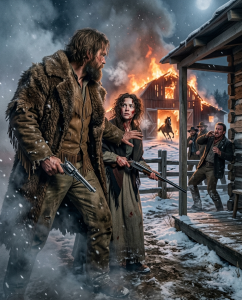
Amelia’s barn was burning.
By the time he reached his horse, he could already imagine the smell: hay, pine pitch, singed hair, and wet smoke. He grabbed the Sharps rifle from its wall pegs, slung on his cartridge belt, and rode hard downslope.
At Amelia’s place, chaos had already burst open.
She had made it outside in her nightclothes and coat, a shotgun in her hands, smoke streaking her face. Her horse and milk cow were trapped inside the barn, screaming in a way no person who ever loved an animal forgot. Boyd Rutled stood near the fence with five men, their torches making crude halos in the swirling snow.
“Told you accidents happen,” Boyd called.
Amelia raised the shotgun.
A shot snapped from the dark and splintered the doorframe beside her head. She reeled as wood shards cut her cheek.
“Burn the house,” Boyd said. “Teach her what stubborn costs.”
Then Gideon fired.
The Sharps cracked across the valley like a split in the sky. One of the torchbearers spun with a scream and dropped into the snow clutching his shoulder. Before the others understood where the shot came from, Gideon charged down through the trees on his black horse, rifle in hand, coat flaring, the animal’s hooves tearing dark grooves through fresh snow.
Men who have never faced a thing they cannot bully always need a second to recognize fear. Boyd needed two.
A second shot took the torch from another man’s hand. A third shattered the fence post near Boyd’s temple, showering him with splinters.
“Run!” one of the hired men shouted.
Two did.
The others tried to draw, but Gideon was off the saddle and moving before they cleared leather. One man caught the butt of the Sharps across the jaw and dropped flat. Another turned too slowly and found Gideon’s Colt pressed under his chin.
“Throw it down,” Gideon said.
The revolver hit the snow.
Boyd backed toward the burning barn, face lit red by the fire. The confidence he wore in town didn’t fit him here. Out beyond the last porch lantern, stripped of Caldwell’s witnesses and false dignity, he looked like what he really was—a cruel man who had grown lazy under borrowed power.
Amelia stood near the porch, shotgun wavering in her hands.
“Save the animals,” she gasped.
That was enough to bring Gideon to the barn instead of Boyd.
The front half was fully involved, roof timbers popping and dropping sparks into the night, but the rear side door was still intact. Gideon wrapped his coat over his mouth, kicked the latch, and disappeared into the smoke before Amelia could stop him. Inside, the horse slammed wildly against its stall while the cow bawled in blind panic.
He cut the horse first. It bolted past him, nearly crushing him against the wall, then burst into the yard trailing sparks and smoke. The cow fought harder, frantic and half-crazed, but he got the tether loose and drove her out with shouts and brute force moments before a beam came down where he had been standing.
When he emerged, blackened with soot and coughing, Amelia was there to steady him.
Their eyes met in the firelight.
That should have been the end of the moment. But Boyd, unwilling to retreat in silence, chose then to sneer, “Looks like you still haven’t told him.”
Amelia’s grip tightened on Gideon’s arm.
“Boyd—” she began.
He laughed, seeing her fear and mistaking it for weakness. “You really don’t know who she is?”
Gideon turned his head slowly. “Talk carefully.”
Boyd spat into the snow. “Ask her about Ohio. Ask her about her husband. Ask her what he was about to say in court before he turned up dead.”
The world seemed to tilt.
Amelia went pale beneath soot and blood. “Don’t.”
Gideon looked from Boyd to Amelia. He had wondered what hunted her. Now the shape of it was stepping into view, and he did not like how deeply it shook her.
Boyd grinned through split lips. “That’s right. Your brave little widow didn’t come west just because she fancied mountains.”
He lunged then, not with a gun, but with a knife hidden in his sleeve.
The blade flashed toward Gideon’s ribs.
Amelia fired first.
The roar of the shotgun shook the yard. At that distance, she didn’t kill Boyd, but the blast tore through his forearm and spun the knife into the snow. He screamed, collapsing against the fence.
For a heartbeat, all anyone heard was the crackle of fire and Boyd’s choking curses.
Then hoofbeats thundered in from the road.
Josiah Caldwell had arrived.
He came with the sheriff and three more riders, all armed, all grim, their horses steaming in the bitter cold. Caldwell was older than Boyd by twenty years and harder by twice that. Clean coat, neat gloves, silver in his beard, eyes like polished nails. He reined in slowly, taking in the burning barn, his bleeding foreman, Gideon blackened with smoke, and Amelia standing with the shotgun still raised.
“You’ve made a regrettable mess of things,” Caldwell said.
“No,” Amelia answered. “You did.”
The sheriff shifted in his saddle. “Now hold on—”
Caldwell lifted a hand, silencing him. He looked at Gideon. “You don’t belong in this.”
Gideon’s expression didn’t change. “Seems I do.”
Caldwell’s gaze slid to Amelia. “I offered you money. Protection. A way out with dignity. Instead you force unpleasantness.”
She laughed once, without humor. “You mean silence.”
Something flickered behind Caldwell’s eyes.
Gideon noticed.
Boyd, cradling his ruined arm, rasped, “Tell him, boss. Tell him what her husband knew.”
Caldwell dismounted.
The sheriff did not. That said something.
“I had hoped,” Caldwell said, taking slow steps across the snow, “that Mrs. Dawson understood discretion. Her late husband was an attorney in Cincinnati. A respectable man with unfortunate curiosity.”
Amelia’s eyes shone with fury. “He was decent. That’s what killed him.”
Caldwell stopped six feet away. “He inserted himself into matters that did not concern him.”
Gideon glanced at her. “What matters?”
She swallowed. The fire behind them sagged inward, sending a tower of sparks into the dark.
“My husband was preparing testimony,” she said at last. “Land fraud. false rail claims. cattle syndicates using dead men’s names to seize water routes in the territories.” Her voice shook, then hardened. “Your name was in the papers he found.”
Caldwell’s face remained calm, but one of his riders looked at him sharply, surprised enough to be dangerous.
Amelia went on. “My husband said there were judges, registrars, businessmen, and ranchers all tied together. He said if the testimony reached federal hands, men in three states would fall.”
“And then?” Gideon asked.
“And then he was killed on the street,” she said. “Officially a robbery. Except his watch was still in his pocket and the papers were gone.”
Gideon’s silence deepened.
Caldwell smiled faintly. “A widow’s suspicions are not evidence.”
“No,” Amelia said. “But this is.”
From inside her coat, she drew a packet wrapped in oilcloth.
Every man there saw Caldwell’s control slip.
Just a little.
But enough.
She had carried the documents west. That was why she ran. That was why Caldwell could not simply let her disappear into obscurity. As long as she lived with proof in her possession, she was not merely inconvenient. She was dangerous.
“Sheriff,” Caldwell said evenly, “arrest her. And arrest Hayes for murder and arson before this gets any uglier.”
The sheriff looked sick. He also looked indebted.
He started to dismount.
Gideon cocked his Colt.
“No.”
For a moment the entire yard balanced on the edge of open gunfire.
Then one of Caldwell’s own riders spoke from behind him. “Is it true?”
Caldwell didn’t turn. “Mind yourself, Tom.”
But the man—young, broad-shouldered, newly frightened—had been on enough cattle drives to know what lies smelled like. “My brother’s claim got stripped last year. They said the papers vanished from Cheyenne. You told him that was the law.”
“It was,” Caldwell snapped.
Amelia lifted the packet. “His brother’s name may be in here.”
Another rider swore under his breath.
The sheriff now looked less certain than afraid.
Power, Gideon knew, often survived not by strength but by everyone agreeing not to examine it too closely. Once doubt entered, rot spread fast.
Caldwell saw it too. His hand dropped toward his holster.
He never finished the draw.
Gideon fired low and fast. The bullet tore through Caldwell’s gun hand, and the revolver fell into the snow. Horses reared. The sheriff shouted. Boyd screamed something incoherent.
“Next one’s worse,” Gideon said.
For the first time in many years, Josiah Caldwell looked like a man who understood consequences.
The standoff broke not with courage, but with arithmetic.
Two of the riders backed away from Caldwell. Then the young one dismounted completely and walked to Amelia’s side. The sheriff stayed frozen, caught between old debt and new panic. Boyd was useless in the snow, bleeding and half-mad.
Caldwell looked around and saw what all tyrants eventually see—the moment borrowed loyalty comes due.
“You’re making a grave mistake,” he said.
Amelia’s voice came clear and cutting. “No. I made one when I thought men like you only existed back east.”
By dawn, half the valley knew Caldwell had been taken under guard to the jail he once treated as an extension of his own barn. The sheriff did not suddenly become honorable. He simply realized federal investigators would arrive sooner or later if those papers were real, and being on the wrong side of that was worse than betraying Caldwell.
The documents were real.
Over the next month, riders came from Cheyenne, then from farther east. Statements were taken. Ledgers examined. Signatures compared. Claims reopened. Names spread outward from Bitter Creek like cracks through river ice.
Josiah Caldwell was not the only man exposed, but he was the one people had feared most, and watching him dragged into court in irons did something strange to the town. Men who had spent years looking away began remembering what they’d seen. Those fourteen who had watched Amelia whipped found their voices once silence no longer seemed profitable.
Boyd Rutled survived his wound. He was sent to stand trial as well, and though he cursed everyone from the dock, nobody came to speak for him.
As for Amelia, she did not leave Bitter Creek.
The barn had to be rebuilt. The fencing had to be repaired. The horse took time to calm after the fire. The winter was long, and more than once she woke from dreams of Cincinnati streets slick with rain and the last morning she saw her husband alive. Grief did not disappear just because justice finally learned a new name.
Gideon helped without calling it help.
He arrived with timber one day, nails another, a repaired hinge after that. He taught her how to set trap lines higher up the creek in lean months. She taught him, with quiet amusement, that coffee tasted better when it wasn’t boiled into punishment. He remained a man of few words, but with Amelia he did not seem empty in the silence. Only careful.
One evening in early spring, when the snowmelt ran bright through the creek Caldwell once tried to steal, they stood together on the rise above her land.
“You saved my life,” she said.
He stared out over the valley. “You were doing your best to save your own.”
“That’s not the same thing.”
“No.” He glanced at her then. “It isn’t.”
Amelia studied him. The mountain man everyone feared looked, in that light, less like a legend and more like a man who had spent too long believing distance was safer than caring.
“My husband believed the truth mattered,” she said quietly. “Even when it cost him everything.”
Gideon’s jaw tightened. “Truth usually does.”
She nodded. “So does looking away.”
He gave the smallest hint of a smile, rough and unwilling. “That sounds aimed at me.”
“It is.”
The wind moved her hair. Down below, the rebuilt barn stood where the ashes had once steamed in the snow. Cattle moved across distant ground no longer owned by one man’s greed. Bitter Creek was still Bitter Creek—hard, dusty, suspicious—but something had shifted. People had seen power challenged and survive it. More importantly, they had seen a woman refuse to surrender and a man who had every excuse to stay uninvolved choose, finally, not to.
Amelia rested her hand on the fence rail.
“I used to think the worst thing that could happen was losing everything,” she said.
“And now?”
She looked at him, then out over the valley that nearly swallowed her. “Now I think the worst thing is letting evil convince everyone it’s normal.”
Gideon did not answer at once.
When he did, his voice was low. “Then maybe Bitter Creek finally learned something.”
Maybe it had.
Or maybe towns never changed all at once. Maybe they changed because one person refused to bow, and another refused to keep watching.
Years later, people would still tell the story wrong. They would make Gideon bigger than he was, Amelia softer than she had ever been, Caldwell stronger than truth allowed. That was the way of stories.
But those who had truly been there remembered the part that mattered.
Not the whip. Not the fire. Not even the gun smoke in the snow.
They remembered that the whole town had looked away until one man didn’t.
And they remembered that the woman everyone tried to break had been the strongest one in Bitter Creek all along.
That was the piece hardest to forget.
And maybe hardest to forgive, too—for the men who stayed silent, for the town that needed a stranger to do what neighbors would not, and for anyone who had ever mistaken endurance for weakness. Because in the end, Gideon may have forced the reckoning, but Amelia was the reason it came.