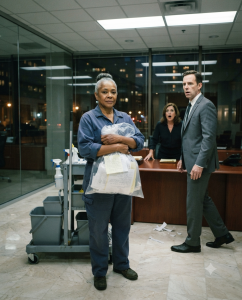
They told the night cleaner at the bank not to touch anything important.
Doris had heard it so often that the words felt stitched into her uniform. She heard them from assistant managers, from security guards, from junior staff trying to sound senior, and from executives who smiled without seeing her face. The meaning was always the same. Stay in your lane. Empty the bins. Wipe the glass. Don’t ask questions about the work done by people in better shoes.
So Doris nodded like she always did.
She was sixty-two years old and had spent most of her life in jobs that taught her how to become invisible. She had stocked grocery shelves before dawn, folded towels in a hotel laundry room, and cleaned office buildings where entire careers were built overnight while she polished the floors beneath them. She knew how to move quietly, how to make people comfortable without demanding attention, and how to leave a room looking better than she found it.
At Halbrook Community Bank, invisibility was practically part of the dress code for cleaners.
Every evening, Doris arrived just before closing. She clocked in, tied back her gray curls, pulled on rubber gloves, and began the same route through the branch. Lobby first. Then offices. Then conference rooms, teller stations, and the upstairs loan department. She pushed her battered cleaning cart with its one squeaky wheel and carried the smell of disinfectant and lemon polish behind her like a second uniform.
Most employees ignored her.
A few acknowledged her with distracted nods. One young teller sometimes said goodnight. But the higher up the ladder people went, the less likely they were to look her in the eye.
Then there was Trent Lowell.
Trent was a senior loan officer with sleek hair, sharp suits, and a talent for making cruelty sound like humor. He was the kind of man who spoke warmly to customers in the lobby and contemptuously to staff the moment the doors closed. Every Friday, without fail, he made the same joke when he saw Doris cleaning near his office.
“Make sure you don’t accidentally steal a pen.”
The first time, Doris let it pass.
The second time, she forced a smile.
By the tenth, she realized he enjoyed watching her swallow the insult.
At home, her daughter Lena was less patient.
Lena worked at a pharmacy across town and had inherited none of Doris’s willingness to let things slide. She was thirty-four, practical, and fiercely protective of the mother who had spent decades shielding everyone else from inconvenience.
“He says that every week?” Lena asked one night, setting down her coffee mug with a hard click.
Doris shrugged. “Some people need to hear themselves.”
“One day he’ll say it to the wrong person.”
Doris smiled. “Apparently I’m the right person.”
Lena hated that answer. A few days later, while helping Doris update her phone and clear old photos, she showed her how to use the camera more confidently.
“See?” Lena said, taking a picture of the sugar jar and enlarging it. “You don’t need to understand every setting. Just hold still, check the focus, and make sure the date saves. That’s enough.”
“For what?”
“For life,” Lena said. “Life gets slippery when nobody writes things down.”
Doris laughed at the time. But the lesson stayed with her.
A week later, she noticed shredded papers in the wrong bin.
Every office at the bank had clear disposal rules. Regular trash went in the open bins by desks. Anything sensitive was supposed to go into locked shredding consoles or sealed disposal bags. Doris knew that much because employees repeated it constantly whenever they left files lying around. Sensitive materials mattered—at least when they wanted them to.
Yet in Trent’s office, mixed with coffee cups and sandwich wrappers, Doris found narrow strips of paper that had clearly come from a shredder. She almost ignored them. Then one piece caught her eye.
A typed surname.
Below it, the tail end of a loan number.
Doris frowned. Maybe someone had dumped the shred tray in the wrong place.
The next evening, it happened again. More strips in the same bin. Another name. Part of an address. A block of printed numbers aligned like account data. She set the pieces on the desk and stared at them. They looked important. Important enough that they should have been destroyed properly. Important enough that they should not be in a wastebasket under a man’s desk.
That was when she remembered Lena’s lesson.
Doris took out her phone and snapped a few pictures before throwing the scraps away.
After that, she started noticing more than she expected.
Some nights there were only a few strips. Other nights there were dozens. She found partial signatures, internal routing notes, and approval sheets torn so carelessly that whole phrases survived. There were references to loans, modifications, account reviews, notices, and approvals. Doris did not know banking terminology, but she knew patterns. And a pattern was forming.
Certain names returned in fragments. Some addresses showed up more than once in ways that didn’t seem to match. One file appeared to be marked approved in one scrap and pending in another. Several forms carried signatures that looked almost identical, as though traced from the same hand.
She began photographing everything before disposing of it.
Soon she was doing more than that. She started laying the pieces out under the fluorescent light in the janitor’s closet, matching edges, comparing fonts, looking for clues. She kept no originals at first. Just photos. It seemed harmless enough. A private habit. A way to reassure herself that she was not imagining the sloppiness.
Then one Tuesday afternoon, the bank doors opened and an elderly couple walked in looking like they had aged ten years in a single morning.
Doris was wiping rainwater from the tile near the entrance when she saw them. The woman clutched a thick envelope to her chest with both hands. The man held himself stiffly upright, as though anger was the only thing keeping him from collapsing. They asked to speak to someone immediately.
Their voices rose in fragments across the lobby.
Foreclosure notice.
No warning.
We paid every month.
There must be some mistake.
A customer service employee tried to help, then looked overwhelmed and called a supervisor. Moments later, Trent appeared. Calm. Polished. Helpful in the way men like him practiced in mirrors.
He led the couple into a glass office.
Doris could not hear every word through the door, but she heard enough. The wife crying. The husband insisting the account had always been current. Trent speaking in an infuriatingly measured voice, pointing to paperwork laid out on the desk like the matter had already been settled.
After thirty minutes, the branch manager joined them.
After another twenty, the couple emerged shattered.
The wife wiped her eyes with trembling fingers. The husband paused by the front door and looked back, not at Trent, but at the building itself, as though trying to understand how a place they had trusted for decades could suddenly treat them like liars.
That night Doris found shredded scraps in Trent’s trash bin connected to the same last name.
It made her blood run cold.
One strip showed the couple’s surname. Another showed part of their street address. A third contained the word delinquent beside numbers circled in red ink. But the piece that stopped her was a torn note from what appeared to be an internal review sheet. Most of the sentence was missing, yet enough remained to read: transfer to secondary file before review.
Doris took photos. Then, for the first time, she did not throw the scraps away.
Instead, she slid them into a plain envelope and tucked it beneath the replacement trash bags in her cleaning cart.
The next morning, she called Lena.
“I think I found something I shouldn’t have.”
Lena listened without interrupting. When Doris described the foreclosure meeting, Lena’s tone changed.
“Do not get rid of anything else,” she said. “Not the photos. Not the paper. Nothing.”
“Maybe it’s a misunderstanding.”
“Maybe. But people don’t lose their home over a misunderstanding written in shredded strips.”
Over the next ten days, Doris collected more.
She no longer limited herself to Trent’s office. Once she began paying attention, the bank looked different. She found suspicious fragments in the loan department printer tray, in conference room bins after closed-door meetings, and in an overstuffed shredding bag left unsealed in a records room. Some papers referred to loans approved for customers with mismatched addresses. Others suggested notices had been generated on accounts not actually in default. One fragmented checklist seemed to indicate review steps had been signed off before documents were even complete.
Doris and Lena spent two evenings piecing together photos at Lena’s kitchen table.
“You see this?” Lena said, enlarging one image on her laptop. “The initials here don’t match the signature here.”
“I noticed that.”
“And this account number appears in two different forms with two different names.”
Doris sat very still. “Can a bank do that by accident?”
Lena looked at her mother. “No.”
The worst part was not knowing the exact scheme. It was knowing enough to understand that innocent people were caught in it.
Then, as though sensing pressure building around him, Trent grew more careful and more erratic at once. He stayed later. He closed his office door for calls. He snapped at coworkers. He once nearly collided with Doris in the hallway and flinched when he saw she was standing there, as if her very presence had become a problem.
Still, she said nothing.
Until he tried to blame her.
It happened on a Thursday evening just before full closing procedures began. The branch manager asked Doris to step into his office. Trent was already inside, arms crossed, expression blandly superior.
“There has been an issue,” the manager said.
Doris stood with both hands on her cart handle. “What issue?”
Trent answered first. “Confidential documents have gone missing.”
The manager cleared his throat. “Several items can’t be accounted for.”
Doris looked from one man to the other and felt a familiar exhaustion settle over her. She had seen this shape before in life, though never with stakes this high. A problem appears. The powerful panic. The nearest invisible woman becomes convenient.
“She has after-hours access,” Trent said. “We don’t know what she may have misunderstood or removed.”
Misunderstood.
Removed.
As if she were a child who had wandered into the wrong room.
For one heartbeat, Doris almost let the accusation hit her like all the smaller insults had over the years. Then something in her stiffened. Maybe it was the memory of the retired couple. Maybe it was the casual confidence in Trent’s voice, the certainty that she would bow her head and accept humiliation because that was what people like her were expected to do.
Instead, Doris stepped back into the hall, reached into her cleaning cart, and took out the folder she had wrapped inside a clear plastic trash bag for protection.
When she placed it on the manager’s desk, both men went silent.
“I didn’t misplace anything,” she said. “I kept what you threw away.”
The manager stared at the folder.
Trent’s face emptied of color.
Doris opened it carefully. Inside were labeled envelopes, printed photographs, dates, notes, and reconstructed scraps aligned in order. Lena had helped organize everything so a stranger could follow it. At the top sat the pieces related to the elderly couple’s foreclosure. Beneath them were other fragments showing inconsistencies in approvals, account references, and internal reviews.
“Where did this come from?” the manager asked.
“Your garbage,” Doris said.
Trent found his voice. “This is theft. She’s been stealing confidential—”
“No,” Doris interrupted, still calm. “I cleaned around what you left behind.”
The manager lifted one printed photo, then another. His expression changed with each page. By the third, he no longer looked irritated. By the fifth, he looked frightened.
“These signatures…” he murmured.
Doris said nothing.
Trent tried again, faster this time. “You can’t trust random scraps collected by a cleaning employee—”
“She remembered their name,” Doris said, looking directly at him. “The couple who came in crying Tuesday. Their file was in your bin that night.”
The room seemed to shrink.
The manager raised his eyes slowly. “Is that true?”
Trent did not answer. Not immediately. And that delay said more than any defense could have.
Within minutes, corporate security was called.
Doris was asked to wait in the hallway. She stood beside her squeaking cart while voices rose and fell behind the closed office door. Employees passing by glanced at her, then away, sensing something serious but not understanding what. After a while, two people in dark suits arrived carrying evidence envelopes. Another man from regional compliance followed.
This time, when they addressed Doris, they did so with unmistakable respect.
They asked how long she had been documenting the materials, whether she still had originals, whether anyone else knew. Doris answered carefully. Yes, she had photographs. Yes, she had some original scraps. Yes, her daughter had helped her organize them. No, she had not shared them beyond that.
By the time Doris left that night, the branch manager had locked himself in his office.
By the next day, Trent no longer had one.
Rumors spread quickly. Employees whispered near the break room. Some said Trent had been escorted out. Others said he resigned. A teller told another that regional investigators had copied hard drives. Nobody knew the whole truth. Doris certainly didn’t.
What she did know was that the retired couple’s case had been reopened. She learned this indirectly when a woman from compliance called to thank her and mentioned that “improper processing actions” were under review. It was bureaucratic language, but Doris heard the meaning underneath it.
Someone had done something terrible.
Maybe more than once.
She expected to feel victorious. Instead, she felt haunted.
At home, long after dawn, she sat alone at her kitchen table staring at the folder. She kept picturing the couple’s faces and wondering how many other damaged lives had passed through the bank disguised as paperwork. How many warnings had been shredded, misplaced, rewritten, or buried. How many people had blamed themselves because a system dressed in suits told them to.
Lena came over that evening with groceries and determination.
“You did the right thing,” she said.
“I should have realized sooner.”
“You realized at all,” Lena replied. “Most people looked straight at that man and still saw nothing.”
For a while, that seemed to be the end of it.
Then Doris received a phone call from an unfamiliar number.
The voice on the line was male, controlled, and oddly formal. “Do you still have the originals connected to the secondary file?”
Doris frowned. “Who is this?”
A brief pause. “Those documents do not only involve your branch.”
Her back stiffened.
“I gave everything to investigators.”
“That may not be enough,” the man said.
Then the call ended.
Lena was at her apartment within the hour. Together they reviewed the photos again, this time with fresh urgency. On one image, nearly hidden beneath overlapping strips, they saw a routing code belonging to a different office. Another fragment contained initials neither Doris nor Lena recognized. And on two separate scraps from different dates, the same phrase appeared:
secondary file.
“What does that mean?” Doris whispered.
Lena zoomed in on the screen. “It means Trent may not have been working alone.”
The thought sat between them like a living thing.
The next morning, before sunrise, they drove to the bank together. Corporate security vehicles already lined part of the lot. Lights glowed inside offices that should have been empty at that hour. At the front entrance stood the branch manager, pale and sweating, arguing with a woman holding a sealed evidence box.
When he saw Doris, he froze.
Then, in a burst of panic that sounded less like anger than fear, he blurted, “She wasn’t supposed to keep the Wednesday bag.”
Everything stopped.
The woman with the evidence box slowly turned toward him.
Lena’s face hardened.
Doris felt the ground shift beneath her. In one sentence, the manager had done what Trent had failed to do: he had confirmed that there was something specific, something known, something larger than a single dishonest loan officer. There had been a Wednesday bag. People above Doris knew about it. And they had expected it to disappear.
The investigators moved fast after that.
The manager was separated from everyone else and taken inside through a side door. Doris and Lena were brought to a conference room, where a legal investigator asked them to go through the timeline from the beginning. This time the questions were different. More precise. Less focused on Trent alone and more focused on process, access, and chain of custody.
By afternoon, the outlines became clearer.
Trent had been altering or moving foreclosure-related files, but he was not acting independently. Certain accounts marked healthy were being shifted into internal review channels under false delinquency codes. Notices were generated prematurely, and supporting documentation was manipulated or reassigned. Some cases appeared designed to create urgency and confusion so customers would accept settlements, fees, or restructurings they did not actually owe. Other files suggested fraudulent loan approvals tied to shell borrowers, then folded into broader internal accounting adjustments.
In simple terms, it was a mess built from greed and arrogance.
The “secondary file” was not an official banking term at all. It was an internal nickname used by a small group of employees for records they pulled aside before standard review—files that could be altered, delayed, or redirected away from normal oversight. According to what investigators later told Doris, Trent had been one of the people handling those files, but the branch manager had known enough to keep asking the wrong questions at the right times. Whether he helped create the scheme or merely protected it when it became profitable was something lawyers would spend months arguing over.
The elderly couple’s foreclosure had become the break in the wall because their records were sloppy in a way the others were not. Too much had been moved too quickly. Too many scraps had ended up in the wrong bin. And Trent, under pressure, had made the fatal mistake of trying to frame the one person who had been quietly watching all along.
Several weeks later, Doris received a formal call. The foreclosure against the retired couple had been canceled. Their account was restored. Additional customer files were under review, and more than one employee had been suspended pending investigation.
The couple asked to meet her.
Doris resisted at first. She did not think of herself as a hero. She had emptied garbage. She had paid attention. That was all.
But Lena insisted.
So on a bright Tuesday morning, Doris met them in a small office borrowed from a legal aid organization. The wife cried again when she saw her, but these tears were different. The husband held Doris’s hand in both of his.
“We kept wondering whether we had missed something,” he said. “Whether we had done this to ourselves.”
Doris felt her throat tighten. “You didn’t.”
The wife asked why she had helped.
Doris thought about the long nights, the jokes about stolen pens, the years of being unseen. Then she answered with the simplest truth she had.
“Because I was the one who saw what they threw away.”
The bank eventually issued statements full of carefully polished language. There were references to procedural failures, internal misconduct, and a commitment to restored trust. Trent’s name appeared nowhere in public documents, but he disappeared completely from the branch. The manager did too. Lawsuits followed. Regulators got involved. Other customers came forward with questions about notices, fees, and sudden account changes.
As for Doris, she did not become someone else.
She still worked. She still wore practical shoes. She still preferred quiet to attention. But people looked at her differently after that. Not because she had changed, but because they finally understood that being overlooked was not the same as being powerless.
The young teller who used to whisper goodnight now stopped to ask how she was doing. Security held doors for her. Even the regional director shook her hand once with visible discomfort, as if unsure how to speak to someone the institution had underestimated so badly.
At home, Lena framed one photograph for the kitchen wall.
Not a dramatic one. Not a picture of investigators or evidence boxes. Just an image Doris had taken on her phone months earlier: a strip of torn paper on a gray metal shelf beneath fluorescent lights. Blurry at the edges. Ordinary. Easy to dismiss.
Lena wrote a caption on the back before sealing the frame.
This is what truth looked like before anyone else believed it.
Sometimes Doris stared at that frame while waiting for water to boil or listening to the evening news. She would think about how close those scraps had come to vanishing forever. How easily one cruel joke might have remained just a joke, one lost home just another file, one frightened couple just another pair of voices swallowed by a polished lobby.
Instead, a woman everyone overlooked had decided to pay attention.
And maybe that was the part that stayed with people most. Not only that the fraud existed, or that a banker fell, or that a foreclosure was reversed. It was the fact that the person who exposed it was the one the whole building had treated as background.
The one told not to touch anything important.
In the end, that was the bank’s biggest mistake.
Because the powerful always assume the important things belong to them.
They forget that sometimes the person cleaning up after them is the only one who notices what should never have been thrown away.
And once you think about that, it becomes hard not to wonder what matters more in a place built on trust: the people with keys to the vault, or the person quietly watching what they do when they think no one is looking.