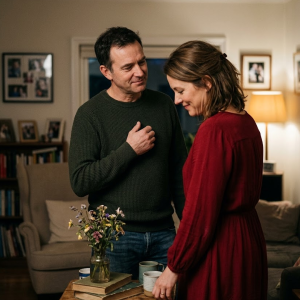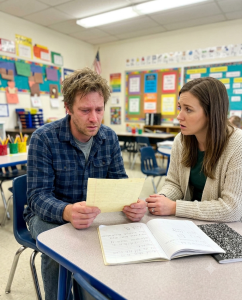
The single father expected a routine parent-teacher meeting. He expected comments about handwriting, maybe impatience during math, maybe the usual reminder that his son was bright but distracted. He did not expect to sit in a child-sized chair under paper leaves and fluorescent lights while a teacher handed him proof that his dead wife had somehow reached into this exact room years after her death.
And he definitely did not expect his eight-year-old son to already know about it.
Ethan Walsh had learned how to live in halves.
There was the half everyone saw: dependable, organized, calm enough to be admired. He showed up early for pickup. He remembered library day. He signed permission slips on time. He cut sandwiches into even triangles and knew which cereal brand Leo would reject if the box design changed too much. He answered emails. Paid bills. Smiled when other parents said, “You’re doing an amazing job.”
Then there was the other half.
The half that stood in the laundry room after bedtime with the door almost closed, one hand gripping the dryer, whispering into the roar of the machine because it was the only place in the house loud enough to bury the sounds he still made when Hannah felt too absent to survive.
Hannah had been dead for three years.
A sudden aneurysm, the doctors had said. Swift. Catastrophic. No warning.
She kissed Leo’s forehead one morning, teased Ethan for overwatering the basil plant, and by evening she was gone.
People who hadn’t lost anyone liked to say things like at least she didn’t suffer or at least you had time together or at least Leo was young. Ethan had learned not to answer. Grief had made him rude in ways that didn’t show on his face.
The truth was uglier: there was no merciful version of losing the person who held the center of your life together. There was just the administrative nightmare of death and then the daily insult of continuing.
So when he sat across from Leo’s teacher, Julia Bennett, in Room 12, he entered with all the practiced numbness he had developed to survive public spaces.
Julia was warm without being intrusive. Pretty in a way Ethan resented noticing. Her classroom looked like every elementary room in America had spilled itself inside it: motivational posters, sharpened pencils, tiny bins of glue sticks, cheerful chaos arranged with military precision.
They went over reading, math, behavior, art.
Then she opened Leo’s notebook.
My dad makes good pancakes.
He folds towels bad.
He checks the front door two times every night.
He thinks I don’t know he still talks to my mom in the laundry room.
Sometimes he cries there too because it’s the only room with a loud machine.
Ethan felt himself exposed so quickly it was almost physical.
He apologized reflexively. Julia told him not to. Then, with a steadiness that startled him, she said, “No. But maybe you do need help.”
No one had said that plainly before.
His friends praised him. His sister assured him. Other parents admired him from a careful distance. They all preferred the version of him that was coping, because it made them more comfortable.
Leo, apparently, had never been fooled.
And then Julia pulled out the note.
Old paper. Yellowed edges. Hannah’s handwriting.
If Leo ever ends up in Room 12, please be kind to his father. He’ll pretend he doesn’t need it.
At the bottom, a tiny set of initials: J.B.
Julia’s initials.
He asked if she knew Hannah. She said she didn’t think so, then went quiet in the way people do when memory starts arriving from very far away.
A pregnant woman, she finally remembered. Years earlier. During Julia’s student-teaching semester. The woman had visited the office and asked if teachers usually stayed in the same room. Julia had joked that Room 12 was impossible to escape. The woman had laughed and asked her name.
That woman had been Hannah.
Suddenly Ethan remembered scattered moments he had never taken seriously. School brochures spread across the kitchen counter before Leo was even born. Hannah visiting campuses while on maternity leave from a job she never returned to. Her delight in making plans years too early. Her habit of acting on intuition and only explaining later, once the future caught up.
But this felt bigger than planning.
This felt impossible.
Then Julia showed him Leo’s drawing.
Three figures standing outside a classroom.
A little boy in blue.
A tall man beside him with tears sketched in blue lines.
A woman with yellow hair standing at the doorway.
Above them, six words:
Mom said this is where we go.
Julia told him Leo had called it a memory.
Ethan was still trying to force logic onto the moment when Leo appeared in the doorway to retrieve a forgotten folder.
He saw the paper in Ethan’s hand and went pale.
Not confused.
Not startled.
Afraid.
“What is this?” Ethan asked.
Leo looked at the letter and whispered, “Mom said you weren’t supposed to read that until she knew you could handle it.”
Then Julia handed Ethan a second note Leo had apparently been carrying in his folder.
On the front, in Hannah’s handwriting:
Not yet. Wait for Room 12.
The world narrowed.
Ethan unfolded the paper with clumsy fingers.
Inside were two lines.
When he finally asks for help, give him this.
Tell Leo I kept my promise.
He didn’t understand any of it.
Before he could ask another question, Leo backed away and said, “She said if you opened it too soon, you’d go to the laundry room again.”
The room went silent.
Julia’s hand pressed against her mouth. Ethan could hear children laughing somewhere down the hall, absurd and distant, the ordinary soundtrack of a world that had no idea this one classroom had just split open.
He lowered himself slowly into the tiny chair and looked at his son.
“Leo,” he said, carefully, “what do you mean, Mom said?”
Leo twisted the strap of his backpack around his hand. His lower lip trembled, but he held himself together with the solemn effort children use when they sense adults are near breaking.
“At night sometimes,” he said. “Not every night. Just when I’m almost asleep.”
Ethan’s heartbeat turned heavy and irregular.
“What happens at night?”
Leo looked at Julia, then back at his father. “I hear her.”
It would have been easy to dismiss that. Children processed grief in strange ways. They dreamed vividly. They folded memory and imagination together. Every therapist on earth would say so.
But Leo had no memory of Hannah clear enough to invent this with such structure. He had been five when she died. He remembered flashes: her ring tapping a mug, the smell of her shampoo, a song she used to hum. Not conversations. Not secret instructions. Not future classrooms and teacher names.
“What does she say?” Ethan asked.
Leo swallowed. “Usually little things. Like where my left shoe is. Or when you’re sad before you cry.”
Julia made the smallest sound, almost a gasp.
Ethan forced himself to stay steady. “And the letters?”
Leo’s eyes dropped to the floor. “She told me there were two.”
“Where were they?”
“In the blue memory box in your closet. Under the hospital bracelet and the beach picture.”
Ethan went cold.
There was a blue memory box in his closet. Hannah had assembled it during pregnancy and added to it after Leo was born—tiny socks, ultrasound printouts, the wristband from the hospital, notes she wrote to “future Leo” for milestones she was sure she would be there to see. Ethan had barely opened it since she died because every object inside felt wired to his ribs.
“How did you know that?” he asked.
Leo looked up, eyes shining now. “She told me after the bad dream. The one where you forgot what her laugh sounded like.”
Ethan lost all the air in his lungs.
He had never told Leo about that dream.
Never.
Two months earlier Ethan had woken at 2:14 in the morning, panicked and sweating because in the dream Hannah stood in front of him speaking and he could not hear her laugh. Her mouth moved, her shoulders shook, but there was no sound. He had stumbled into the laundry room and cried so hard he had to sit on the tile floor until dawn.
Leo could not know that.
Julia was watching him now with a kind of terrified compassion.
The rational part of Ethan’s mind made one last attempt to seize control. Maybe Leo had overheard something. Maybe Ethan had sleep-talked. Maybe the notes had existed all along and Hannah had written them during some private season of fear he had never understood. Maybe this was grief twisting coincidence until it resembled design.
But that still left one impossible fact:
Hannah had written specifically about Room 12. About a teacher with Julia Bennett’s initials. About kindness Ethan would need years later. About timing tied not to Leo’s life, but to Ethan’s willingness to ask for help.
As if she had seen the shape of his collapse before he ever did.
Julia finally spoke.
“Would it be all right if I stepped out for a minute and asked the office to hold my next conference?” she asked gently. “I think you need privacy.”
Ethan nodded without really seeing her.
When she left, the classroom shrank around him.
Leo stood frozen near the door, as if unsure whether he had done something wrong.
Ethan opened his arms.
Leo came instantly.
He climbed into Ethan’s lap with the abrupt desperation children save for moments when words fail them. Ethan held him tighter than he meant to.
“Why didn’t you tell me sooner?” Ethan whispered.
“Because she said you’d be mad.”
“I’m not mad.”
Leo sniffed. “She said not mad like yelling. Mad like hurting in your face.”
That sounded exactly like Hannah. Her strange precision. The way she could name emotions sideways and still get them exactly right.
Ethan buried his face in Leo’s hair.
“What else did she say?”
Leo hesitated. “She said when I got to second grade and Room 12, I should give the first note to my teacher and wait. Then if you looked like you were still carrying all the broken parts by yourself, I was supposed to let you get the second one.”
“Still carrying all the broken parts.”
Again, Hannah.
Not poetic. Not vague. Specific enough to wound.
When Julia returned, she did not interrupt. She simply sat down again and waited until Ethan could look at her.
“There’s one more thing,” Leo said softly.
He reached into his backpack and pulled out a folded construction-paper star from an art project. Inside was a tiny key taped behind the glitter.
Ethan stared at it.
“Where did you get that?”
“It was in the memory box too,” Leo said. “She said this one was only for after the second letter.”
Ethan recognized the key after a long second. Their old lockbox key. The metal box they kept in the garage cabinet before Hannah died—passports, insurance documents, spare cash, the practical bones of a family.
“I thought I emptied that years ago,” Ethan murmured.
Hannah, apparently, had not.
He signed Leo out early from school. Julia walked them to the office, her expression full of questions she was too decent to ask. At the door, she touched Ethan’s arm and said, “For what it’s worth, I don’t think your wife was trying to haunt you.”
Despite everything, he almost laughed.
“No,” he said. “That would be less like her.”
The garage smelled like dust, motor oil, and summer heat. Leo stood near the workbench while Ethan unlocked the old metal box with the tiny key.
Inside were passports, expired warranty papers, a dead flashlight, and one sealed envelope.
For Ethan.
He sat down on an overturned bucket because his legs stopped cooperating.
The envelope was newer than the first notes but old enough to have waited years. Hannah’s handwriting slid across the front with devastating familiarity. He touched it with one finger first, like it might disappear.
Leo crouched beside him.
Ethan opened it.
Inside was a letter, three pages long.
The first line blurred immediately because of tears, but he wiped his face and forced himself to read.
Ethan,
If you are reading this, then I did the thing I swore I would never do: I planned around the possibility of leaving you. Before you panic, no, I do not know the future. I’m writing this because pregnancy made me weirdly superstitious and because ever since Leo kicked for the first time, I’ve had this relentless fear that love should never rely on timing alone.
If nothing happens to me, burn this and mock me forever.
If something does happen, then I need you to know three things.
First: this is not your fault, even if your mind becomes cruel and inventive after I’m gone.
Second: Leo will remember more love than you think, even if he cannot always name the source.
Third: you are the one I’m afraid for.
Ethan stopped and pressed the page to his mouth.
Leo leaned against his side, small and warm and real.
He kept reading.
You know how you disappear into competence when you’re in pain. You become useful so no one can ask what you feel. It is one of the things I love about you and one of the things that will break you if I die first.
So here is my unreasonable request: at some point, please let someone help you.
I met a student teacher today while touring schools like an insane woman whose child is not even born yet. Her name is Julia Bennett. She was kind in an unperformed way. I liked her immediately. Maybe she will still be there someday, maybe not. But if Leo somehow ends up in her room, I am taking that as a sign you still need nudging from beyond your own stubbornness.
Please do not make our son your witness to unspoken grief.
Let him know I was real, not holy.
Let yourself laugh without apologizing for it.
And when someone is gentle with you, do not treat it like a threat.
Ethan looked up sharply.
Julia.
A kind face. A calm voice. A woman he had noticed before he wanted to admit it.
He went back to the last page.
If this letter reached you, then Leo helped. That means he has been carrying something too heavy. Take it from him now.
And one more thing, because I know you: loving anyone after me is not betrayal. It’s proof I left you alive.
Hannah
For a long time the garage held nothing but Ethan’s uneven breathing.
Then Leo asked, “Is she mad at us?”
Ethan turned to him so fast it hurt. “No. No, buddy. Never.”
Leo looked relieved and devastated at once. “I kept thinking maybe if I said it wrong, she’d stop talking.”
Ethan pulled him close. “You did everything right.”
That night, for the first time in three years, Ethan did not go to the laundry room.
He sat on Leo’s bed after lights-out and answered every question his son had stored up in frightened silence. Yes, Mom used to sing off-key on purpose. Yes, she hated folding fitted sheets. Yes, she once locked herself out while taking the trash out in bunny slippers. No, she wasn’t a ghost in the scary sense. No, Leo wasn’t weird. Sometimes love just stayed loud in a family, even after someone was gone.
Leo fell asleep with one hand hooked in Ethan’s sleeve.
The house was quiet when Ethan finally walked downstairs.
On the kitchen counter sat Hannah’s letter.
Beside it, after ten full minutes of staring at his phone like it contained a bomb, Ethan typed a message.
Hi, this is Ethan Walsh. You were right. I do need help. Could you recommend the counselor the school uses for grief support? Also… thank you. For today.
He stared at it another minute, then sent it to Julia.
Her reply came a few moments later.
I’m glad you asked. I’ll send the information tonight.
And Ethan? She was right about one more thing. You don’t hide nearly as well as you think.
He laughed out loud.
It startled him.
The sound felt rusty, but not impossible.
Over the next months, things changed in ways that were small enough to be real. Ethan found a therapist. Leo started seeing the school counselor once a week to talk about grief, dreams, and the burden of being the child who notices everything. The laundry room went back to being a place for detergent and mismatched socks. Some nights still hurt. Some mornings still began with the automatic ache of remembering Hannah was not in the next room.
But the pain was no longer the only thing in the house.
Julia and Ethan began with practical messages about Leo, then longer conversations, then coffee after school pickup while Leo traded Pokémon cards on a nearby bench. Nothing rushed. Nothing dramatic. That would not have suited either of them.
The first time Ethan told her about Hannah’s letter mentioning kindness as if it were a test he had failed for years, Julia smiled and said, “Maybe not failed. Maybe postponed.”
The first time he reached for her hand, he did it with the full awareness that grief and love were not enemies. They were simply terrible neighbors forced to learn each other’s routines.
A year later, Leo asked if it was okay to put a framed photo of Hannah in the living room instead of Ethan’s bedroom.
“Of course,” Ethan said.
Leo nodded solemnly. “She should get to be where the laughing is.”
So they moved the photo.
It stood on the shelf near the books and the crooked pottery mug Leo made in third grade. Hannah in sunlight, head tilted back, laughing at something outside the frame.
Sometimes Ethan still caught himself looking toward the laundry room when the day hurt too much.
But now he understood what Hannah had known before he did.
Strength was never the same thing as silence.
And love, real love, did not ask to be preserved like a shrine. It asked to keep moving through the living.
Even now, if Ethan let himself think about the chain of events too hard, he could not fully explain it. Maybe Hannah had only been brilliant and intuitive and frighteningly good at predicting him. Maybe Leo’s nighttime conversations were dreams shaped by longing and memory and the strange porousness of children. Maybe Room 12 was coincidence. Maybe not.
In the end, the explanation mattered less than the rescue.
A woman who knew him better than anyone had loved him enough to prepare for the version of him that would refuse help.
A little boy had carried impossible instructions until the exact moment his father could finally survive hearing them.
And a teacher in an oatmeal-colored cardigan had opened a notebook, read one honest sentence, and changed the direction of a family without even realizing that she was stepping into a promise made years earlier.
Some stories end with certainty.
This one ended with something harder and maybe better: a father who finally stopped hiding, a son who no longer had to guard him, and a love that did not end when a heartbeat did.
The strangest part was not that Hannah had somehow reached them.
The strangest part was that even after death, she had still been right about everyone.
Especially Ethan.
Because the biggest red flag had never been his tears in the laundry room.
It was how determined he had been to make sure no one ever saw them.