Connor Mills had grown to hate the bright colors of children’s hospitals.
Whoever designed pediatric wings always seemed convinced murals could soften fear. Cartoon giraffes climbed the walls. Balloons and smiling stars covered the glass. Plastic toys sat in bins with the kind of sticky shine that made him wonder how often anyone actually cleaned them. Televisions played cheerful daytime shows with the sound low, as if silence itself might be too harsh for parents already trying not to break apart.
None of it worked.
Fear sat in those rooms anyway. It sat in half-empty coffee cups, in restless knees, in fingers tapping against armrests. It sat in the overcareful smiles parents gave one another, each silently pretending this was manageable, expected, routine.
Connor had learned to hate that word.
Routine.
That was what the surgeon had called June’s procedure three separate times that morning, and each time Connor nodded as if the word meant something to him now. Routine just meant nobody wanted him spiraling in front of the staff.
June was six. Fierce, funny, and almost offensively observant. She asked questions that made adults pause too long before answering. She fought sleep, hated mushy fruit, and could identify every bird that landed in the tree outside their apartment window. At home she was loud and sharp and impossible to trick. In hospitals, she became quiet.
That quiet unnerved Connor more than tears ever could.
The procedure itself was minor. Simple correction, the doctor had said. Quick sedation, short recovery, home by evening. Connor had agreed because delaying it made no sense, but he’d still spent the entire week imagining every terrible possibility his mind could manufacture.
When the nurse came to take June back, his daughter clutched her stuffed rabbit in one hand and his sleeve in the other.
“You’ll be here when I wake up?” she asked.
“I’ll be the first thing you see,” he promised.
She nodded solemnly, then pressed the rabbit into his hands.
“Don’t let him be scared.”
Connor had nearly laughed, nearly cried. “I’ll do my best.”
That was forty minutes ago.
Now he sat in a molded plastic chair with the rabbit on his lap and a paper cup of coffee turning cold beside him. He hadn’t taken a sip in at least twenty minutes. Across the recovery wing, monitors beeped behind curtains. Rubber soles squeaked over polished floors. Somewhere a toddler was whining. Somewhere else a vending machine hummed with infuriating normalcy.
He had been doing this alone for almost two years.
Alyssa’s death still made no sense when he let himself think about it directly. Sudden infections belonged in cautionary articles and tragic stories happening to other families. Not theirs. Not Alyssa, who remembered everyone’s birthdays, made too much pasta, and always left sticky notes in strange places for June to find. One week she was arguing with him over whether June needed new rain boots. The next, she was in intensive care with organs failing faster than doctors could explain.
Forty-eight hours later, Connor was signing forms with fingers so numb he couldn’t grip the pen.
After that came the strange, humiliating education of grief. People saying he was strong. People praising his composure. People handing him food as if casseroles could replace a human life. He understood quickly that what they admired was not strength. It was the fact that he did not collapse in public.
At home, after June slept, he sometimes stood in Alyssa’s closet with his forehead resting against her jackets and tried to remember the sound of her voice without hearing the hospital version over it.
A nurse approached a little after noon.
Connor looked up automatically.
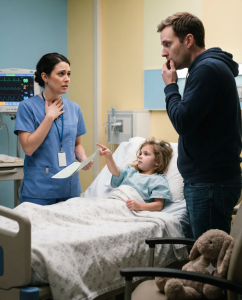
She was in navy scrubs, dark hair pinned neatly back, her badge clipped at the shoulder: ERIN LANGLEY. Late thirties, maybe. Calm face. Efficient posture. No wedding ring. There was a steadiness about her that Connor would usually have appreciated.
Instead, he felt something odd the second she spoke.
“She’s waking up nicely,” Erin said. “You can come back in a minute.”
Connor rose too fast. “Is she okay?”
Erin nodded. “She’s okay.”
The answer should have been enough. It wasn’t.
He had noticed her before the procedure too. The way she spoke to June with a gentleness that seemed to arrive from somewhere personal. The way her hand lingered when taping down the tiny IV. The way she smiled at June as though trying not to remember something painful.
Connor had assumed she was simply one of those nurses who genuinely liked children. Hospitals ran on people like that.
Still, when he followed her toward recovery, he couldn’t shake the feeling that Erin had looked at June more than once with recognition.
June lay in the recovery bed under a pale blanket, hair mussed, cheeks still flushed from anesthesia. The sight of her knocked something loose in Connor’s chest. Children always looked younger after sedation. Smaller. As if fear had peeled away all the extra layers and left only the raw truth of how breakable they were.
He moved beside the bed immediately.
“Hey, bug.”
June’s eyelids fluttered. Her lips parted. “Daddy?”
“I’m here.”
At the foot of the bed, Erin adjusted the chart. Connor noticed, even in that moment, that she kept glancing up at June’s face and then away again.
June turned her head.
Saw Erin.
And in the dream-heavy honesty of a child swimming up from anesthesia, she asked, “Why do you still wear Mommy’s necklace?”
The room froze.
Connor turned so quickly the metal chair behind him scraped harshly against the floor.
Erin nearly dropped the chart.
June lifted one hand and pointed vaguely toward the nurse’s throat. Hanging there on a thin silver chain was a small oval pendant. It was old, smoothed by years of wear, nothing anyone else would look twice at.
Connor knew it instantly.
Alyssa had worn a pendant just like that for years. Every day. Through showers, through sleep, through arguments, through holidays. He had fastened the clasp for her hundreds of times. He had kissed the back of her neck and felt the chain against his fingers. After she died, he searched their apartment for it once, then stopped when he couldn’t bear the idea of finding it among her things.
He stared at Erin. “Where did you get that?”
Her hand flew to the pendant. “It’s mine.”
June frowned, still half gone with sedation. “No. Mommy let you borrow it when you were crying in the car.”
Connor felt his entire body go cold.
Children said strange things after anesthesia. Everyone knew that. Random things. Dream things. Half-memories tangled with imagination.
But then there was the car.
Eight months before Alyssa died, she had come home late during a thunderstorm. He remembered the night with painful clarity because she had seemed unlike herself in a way that scared him. She was drenched to the skin. Her eyes were swollen as if she’d been crying, though she denied it. And her necklace—this necklace—had been wrapped so tightly around her fist that it left angry red lines in her palm.
He had asked what happened.
“A woman needed help,” Alyssa said.
He had asked what woman, what happened, whether she was hurt. Alyssa only shook her head, changed clothes, and stood under the shower for so long he sat outside the bathroom door listening to the water run.
At the time, he’d let it go. Marriage was full of half-finished conversations. You told yourself there would be time later.
Then later disappeared.
Now that forgotten night stood between him and a nurse wearing his wife’s pendant.
Erin placed the chart down on the counter with visible care. “Mr. Mills—”
“How does she know that necklace?”
“I don’t know.”
It was too quick. Too neat.
Connor stepped closer. “Did you know my wife?”
For a second Erin’s mouth opened and closed. Then she said, almost inaudibly, “Yes.”
The word landed like a strike to the ribs.
“How?”
“This isn’t the best place.”
“That’s not your choice.”
Erin glanced toward June, who had already begun sinking back into sleep. “Your daughter needs rest.”
Connor kept his voice low because his child was right there, because years of practiced control had fused into habit, because losing his temper in a hospital would terrify June. That did not make the words gentle.
“My daughter recognized my dead wife’s necklace on a woman I’ve never met. Start talking.”
Erin’s face changed then. Not to confusion. Not to offense. To guilt.
“I’m not a stranger,” she said quietly.
Connor stared at her. “Then what are you?”
June stirred and murmured. Connor automatically smoothed her hair back. She settled again, breathing evenly.
When he looked up, Erin’s eyes were shining.
“Your wife helped me once,” she said.
“With what?”
Erin swallowed, then gave a tiny helpless shake of her head as if the truth had too many sharp edges. “With my daughter.”
Connor waited.
“She died,” Erin whispered.
The anger inside him hit a wall of something more complicated.
Erin looked at the pendant as if she’d forgotten she was wearing it. “That night in the storm, I was sitting in my car outside the hospital because I couldn’t bring myself to drive home after they told me there was nothing else they could do. Alyssa knocked on the window because she thought I was injured. I was crying so hard I couldn’t even speak at first. She just stayed.”
Connor said nothing.
“She sat with me for almost two hours. She listened. She let me say all the ugly things people don’t want grieving mothers to say. That I hated everyone who still had a child. That I didn’t know how to go back inside and hold mine for the last time. That I wanted to disappear before morning.” Erin’s eyes closed briefly. “Your wife never judged me for a second.”
Connor remembered Alyssa after that storm. Hollow-eyed. Tender with June in a way that bordered on desperate. Standing in their daughter’s doorway long after bedtime.
“Before Alyssa left,” Erin went on, “she took off the necklace and put it in my hand. She said, ‘Give it back when breathing doesn’t hurt this much.’”
Connor’s throat tightened despite himself. That sounded exactly like Alyssa. Not polished comfort. Something human. Something unguarded.
“You didn’t give it back?” he asked.
“I tried.”
“Tried?”
Erin looked at him.
And in that look Connor understood there was more.
He felt his stomach drop. “You saw her again.”
A long silence followed. Then Erin nodded.
“How many times?”
“Several.”
His voice flattened. “Why?”
Erin glanced toward the hallway, then back to June, then finally settled her gaze on Connor as if she could see the point where every possible answer would hurt him. “Because after my daughter died, I wasn’t okay. I was functioning. I was working. I was breathing. But I wasn’t okay. Alyssa checked on me. At first by text. Then coffee. Then long drives because neither of us wanted to sit still with our own thoughts.”
Connor heard those words and, against his will, began sorting them through the map of his marriage.
The nights Alyssa had said she needed air.
The sudden habit of going for drives alone.
The private smiles at messages she answered facing away from him.
The sadness that had sharpened around the same period.
He had assumed it was stress. Then he had assumed it was grief over the miscarriage they’d suffered the year before. Then life had become a storm of school lunches, bills, doctor visits, and then Alyssa’s death, and every unasked question had been buried with her.
“What kind of relationship did you have with my wife?” he asked.
Erin said nothing.
That was answer enough to make something brutal split open in Connor’s chest.
He let out one short breath that almost sounded like a laugh. “Unbelievable.”
“It wasn’t simple.”
“No, I’m sure it was beautifully complicated.”
“Please,” Erin said, voice cracking. “Not here.”
Connor looked at June, asleep between them, and forced himself back from the edge. “Then tell me the truth before my daughter wakes all the way up and does it for you.”
Erin’s hands trembled at her sides. “It started after my daughter died. Alyssa kept checking on me. She said she knew what it felt like to carry grief around like acid. I didn’t know what she meant at first. Then one night she told me about the baby she lost.”
Connor shut his eyes.
Only a few people had known about the miscarriage. They had agreed not to tell June, not yet. Alyssa had mourned it quietly, fiercely. She bought a tiny knitted hat online and hid it in a drawer. Connor found it months later and sat on the bathroom floor holding something no one would ever wear.
“She said she felt guilty for grieving someone she had never met properly,” Erin continued. “She said she didn’t know where to put that grief because everyone expected her to be grateful for June, grateful for life, grateful to move on. She said I was the first person who understood what it meant to love a child you couldn’t keep.”
Connor opened his eyes.
The anger was still there, but grief had joined it now, old and familiar and sharp enough to make everything else worse.
“What happened between you?” he asked.
Erin’s voice fell lower. “We became each other’s hiding place.”
The words hung in the room.
Connor thought about every late errand, every unexplained hour, every time Alyssa came home emotionally wrung out and claimed she was tired. He thought about the way she had started watching June more intensely after that year, as if trying to memorize her. He thought about how guilt had seemed to live just under Alyssa’s skin and how he had mistaken it for stress.
He was still trying to absorb that when June stirred again.
Her eyes opened more fully this time. She looked groggy, but not lost.
Connor leaned in instantly. “Hey. Easy.”
June’s gaze moved from him to Erin. The little crease between her eyebrows deepened.
“Did I say the secret?” she asked.
Connor felt his pulse thud. “What secret, baby?”
June glanced at Erin as if seeking permission. Erin’s face had gone completely still.
“Mommy said we couldn’t tell you,” June whispered. “Because you were sad already.”
Connor had the strangest sensation that the floor had shifted under him and the room had not caught up.
“Sad about what?” he asked carefully.
June picked at the edge of the blanket. “The baby.”
Erin covered her mouth.
Connor stopped breathing for a moment.
He had never told June about the miscarriage. They had agreed on that together. Alyssa had said six was too young for a grief that shapeless. They had not even used the word around her. Not once.
“How do you know about the baby?” Connor asked.
June looked confused. “Mommy was crying with the lady. In the car.”
Connor turned very slowly toward Erin.
She looked devastated.
June kept going in the plain, terrible way children sometimes do when they don’t understand which truths adults survive by keeping buried.
“Mommy said she was sorry she couldn’t save hers either.”
Connor sat down hard in the chair beside the bed because suddenly his knees did not trust themselves.
Alyssa had brought June to those meetings.
That realization hit harder than the affair itself.
He thought back frantically. The occasional Saturday outing. The “quick errands” when he’d stayed home sick or worked late. June had always come back with a juice box or a bakery cookie or some small harmless evidence of an ordinary day. He had never questioned where they’d gone.
Erin sank against the counter. “I didn’t know June remembered any of it.”
“She remembers enough,” Connor said.
June watched them both uneasily. “Am I in trouble?”
Connor turned to her at once, every instinct rushing back into place. “No. Never. You’re not in trouble.”
She nodded, relieved, then frowned at Erin. “Mommy said she made the lady promise.”
Connor looked up. “Promise what?”
June answered before Erin could.
“That if the tests were right, she had to tell you.”
Connor’s blood went cold.
“What tests?” he asked.
Erin’s eyes squeezed shut.
June’s voice softened, almost drifting again with exhaustion. “Mommy said maybe Daddy isn’t the daddy kind. But you’re still my real daddy.”
Silence detonated in the room.
Connor stared at his daughter.
June had his dark hair? No. Alyssa’s dark hair. His eyes? People always said so. But babies were stories people told themselves out loud. He had never doubted. Not once.
He rose from the chair with the slow disbelief of someone standing inside a life that had just cracked down the middle.
He turned to Erin.
“What tests?”
Erin shook her head, tears spilling now. “Alyssa came to me because she was scared. She said something about June’s bloodwork after a pediatric visit not matching what doctors would expect if—”
Connor stepped forward. “If what?”
“If if you were her biological father,” Erin finished, breaking on the words. “She said it might have been nothing. She said she needed to know before she destroyed everything.”
Connor could barely process the sentence. “Destroyed what?”
“Your marriage. June’s life. Yours. Everyone’s.”
He felt sick.
“And did she find out?”
Erin looked at June, asleep again in the middle of the wreckage, then back at Connor with an expression of pure helplessness.
“She got the result,” Erin whispered. “But she died before she could decide what to do with it.”
Connor’s hands curled into fists. “Where is it?”
Erin stared at him.
“The result,” he said. “Where is it?”
Her answer came slowly, as if she had fought with herself about it for years.
“She sealed it in an envelope and told me if anything happened to her, I was supposed to burn it without reading it.”
Connor laughed once, hollow and disbelieving. “Did you?”
Erin’s silence gave him the answer before she spoke.
“No.”
He took another step toward her. “Then where is it?”
She hesitated, and for the first time since the conversation began, Connor saw not just guilt in her face but fear.
Because whatever Alyssa had learned all those months ago had not died with her.
It was still out there.
Folded into paper.
Waiting.
Erin reached into the pocket of her scrub top with shaking fingers, then stopped.
Connor watched the motion, his heartbeat pounding so hard it blurred the edges of the room.
And when she finally looked up at him, it was with the expression of someone about to hand over the one truth that could ruin every memory he had left of his wife.