The young firefighters laughed when the old volunteer showed up with a rusted helmet under his arm.
Walter Brennan pretended not to hear it, which only made it easier for them to keep going.
He was seventy-nine, tall once but bent a little now, with a stiff right knee that never quite straightened after an injury nobody at the station had ever bothered to ask about. He moved carefully, not weakly, though younger men often confused the two. His turnout coat was older than some of the firefighters making jokes at his expense. His helmet had a dent near the rim and smoke stains that had long ago settled into the metal like permanent memory.
To the new crew, Walter was a relic.
He came in, swept floors, cleaned old fittings, refilled coffee, and sat quietly through the station chatter while the younger firefighters talked about speed, strength, and split-second response times as if courage had been invented in their generation. They respected the badge. They respected the command chain. But Walter, the old volunteer who still showed up twice a week with that rusted helmet under his arm, was more station furniture than firefighter in their minds.
“Careful, guys,” one of them said that evening as Walter limped past the bay. “Don’t let him overwork himself.”
Another snorted.
The youngest of the bunch, Tyler Reed, leaned back in his chair and called out, “Stay by the coffee, Walt. We’ll call you if the flames need a bedtime story.”
A few of the others laughed.
Walter smiled politely, set his helmet down on the bench, and poured himself a cup.
He never argued. Never reminded them that he had fought house fires before thermal cameras, before lightweight composite gear, before the county had enough funding to replace dying radios every few years. He never said that back then, firefighters learned the bones of old houses the way hunters learned woods. They knew which staircases twisted tighter than they looked, which farmhouses had hidden storage under the eaves, which old kitchens had service doors and narrow back passages meant for servants decades before any of them were born.
He never said any of that.
Then dispatch broke across the room.
Farmhouse fire on Brackett Road. Multiple callers. Wind shifting. Two road obstructions. Possible child trapped upstairs.
Every joke died instantly.
The station became motion and noise. Gear slammed shut, radios clipped on, truck doors opened and closed in hard metallic bursts. Walter set down his coffee and reached for his coat without a word. Nobody told him not to come. In the rush, nobody thought about him at all.
By the time they reached Brackett Road, the sky above the fields was lit a sick orange through the dark. Smoke rolled across the open land in thick sheets, flattening under the wind before lifting again. One fallen oak blocked the shorter route, and another branch pile forced the truck to swing wide before they finally came up on the property.
The farmhouse was already well involved.
Flames punched out from the first-floor windows and crawled under the roofline. The front porch glowed from underneath as if the whole structure was being eaten from its foundation up. In the yard stood a woman in pajama pants and a coat thrown over a nightshirt, screaming so hard the sound was tearing apart in her throat.
“My daughter!” she cried when the firefighters jumped down. “She’s upstairs—please, please, she’s upstairs!”
“What room?” Lieutenant Harris shouted.
“Back bedroom—east side—Lila, she’s eight!”
The crew moved fast. Hose lines were pulled. Orders snapped across radios. Tyler and another firefighter made for the front entry with the thermal imaging camera while Harris coordinated attack and search. Walter stepped off the truck more slowly, taking in the structure with one long look.
Smoke was pumping hard from the upstairs hall.
The front team forced entry, but almost immediately they hit trouble. The central staircase was fully compromised by heat and thick, rolling smoke that dropped low and turned the interior into blackness. Tyler raised the thermal scanner, cursed, slapped the side of it, and cursed again. The screen flickered once, then died.
“Camera’s out!”
“Back out!” Harris shouted. “Back out and reposition!”
The team stumbled back through the front door, coughing. The mother grabbed Harris by the sleeve.
“Please tell me you got her!”
He pulled away, already looking for another access point. “We’re going again.”
Walter had not moved toward the front at all.
He was standing off to the left side of the yard, looking not at the fire, but at the shape of the house beneath it. Most people saw flames first. Walter saw architecture. The original square structure. The later addition over the kitchen. The narrow jut near the back where the pantry had once been extended. Even through the smoke and the years, the old line of the house was still there.
And with a sudden clarity that tightened his face, he knew exactly what he was looking at.
“There’s a servant stair behind the pantry,” he said.
Nobody answered.
Harris was shouting assignments. The younger crew was already dragging a line toward the side entrance. Walter stepped closer.
“There’s a narrow stair behind the pantry wall,” he repeated. “It runs to the back hallway upstairs.”
Tyler glanced at him, impatient and overheated. “Not now, Walt.”
Walter looked at the second-floor east window, where smoke pushed out in ugly bursts.
The mother was sobbing into both hands.
No one was listening.
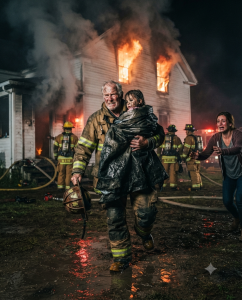
So Walter grabbed a blanket from the side compartment, soaked it under the tank outlet until it sagged heavy with water, draped it over his shoulders, and headed for the kitchen door.
“Walter!” someone shouted.
But he had already gone inside.
The kitchen was hotter than he expected and darker than he remembered. Half the room had been modernized since his sister’s day, but the bones were the same. Tile over old wood. New cabinets covering older walls. He stayed low, one hand on the counter edge, moving by touch when sight failed him. Smoke pressed into his eyes and lungs, but memory did what maps could not.
Pantry. Left wall. Narrow opening.
The hidden service stair was exactly where it had always been.
He shoved through and started up.
Each step sent pain through his bad knee, but pain was nothing new. Heat licked over the blanket on his shoulders. Somewhere below, something collapsed with a crash that shook the walls. He kept climbing.
At the top, the back hallway was nearly impossible to see through. The smoke was thicker, hotter, charged with that terrible urgency that means you are losing time faster than you think. Walter turned right by instinct, counted the doors in his head, and reached the east bedroom.
The little girl was on the floor beside the bed, curled small and terrified, trying not to breathe.
“I’ve got you,” Walter said, though his voice came out rough. “Come here, sweetheart.”
Her eyes were wide and glassy from smoke. She didn’t scream, didn’t fight him. She only clung.
As Walter wrapped the blanket around her and lifted her against his chest, he heard it.
A sound in the wall behind the room.
Not the crackle of fire. Not timber settling.
Movement.
A hollow knock, then the scrape of something against wood.
He turned his head sharply toward the built-in shelving along the sloped ceiling. For one second, through smoke and heat, he remembered the old hidden storage space his brother-in-law had once boxed in under the eaves. Hardly anyone had known it was there. Walter himself had found it only because his sister, Ruth, used to hide Christmas gifts in it.
Another sound came from behind the wall.
Someone was there.
But the child in his arms gave a weak cough, and the hallway was worsening by the second. He had no line, no radio, no time. He backed out of the room, carrying Lila tight against him, and made for the servant stair.
When he emerged through the kitchen door, the yard went silent.
A medic rushed in. The mother screamed her daughter’s name and nearly dropped to her knees when she saw the small hand move beneath the wet blanket. Harris caught Walter as his legs started to buckle. Tyler stood a few feet away, face gray beneath his mask, staring like the world had shifted underneath him.
Walter was coughing too hard to speak at first.
Then Harris asked, “How did you know where to go?”
Walter looked past him at the burning upper floor.
“Back room on the east side,” he rasped. “Used to be painted yellow.”
The mother froze.
Walter wiped soot from his mouth and added quietly, “This used to be my sister’s house.”
The words landed harder than the rescue itself.
The current owner, the mother—Emily Hart—turned toward him in disbelief. She and her husband had bought the farmhouse six years earlier from an estate broker. They had been told it was old, renovated in phases, full of local history. No one had mentioned Walter Brennan’s family. No one had mentioned a servant stair. No one had mentioned a hidden room under the eaves.
Walter kept staring at the second floor.
“There’s a space behind that bedroom wall,” he said. “A storage room. No window. Access used to be concealed.”
Emily’s expression changed. Her fear was still there, but something else slid in beside it. Recognition.
“Lila told me…” Emily’s voice trembled. “She told me she heard noises in her room some nights. Scratching. Footsteps. I thought she was having nightmares.”
Tyler looked at Harris. “You think someone’s in there?”
Walter answered before Harris could.
“When I picked her up,” he said, “I heard movement in the wall.”
That was all Harris needed.
He started redirecting the team immediately. Fire attack held the kitchen and front while a second crew pushed toward the east side. Walter grabbed Harris’s sleeve with surprising strength.
“The opening isn’t in the bedroom,” he said. “It used to be in the hall closet at the back. False panel.”
Harris nodded once and took Tyler with him.
The two firefighters entered from the rear with line protection while the rest of the crew fought to keep the second floor from flashing over. Minutes passed that felt stretched beyond reason. Emily stood with one hand over her mouth while medics worked oxygen over Lila nearby. Walter remained on his feet only because he refused to sit.
Then a shout came from inside.
“Lieutenant!”
A moment later Tyler and Harris emerged from the back door dragging a man between them.
He was not burned badly, only smoked and panicked, with soot all over his clothes and one hand bleeding from where he had tried to force an exit through hot wood. He looked to be in his forties. Thin. Unshaven. Wild-eyed in the flashing emergency lights.
Emily made a choking sound.
“David?”
Walter turned toward her.
The man on the ground tried to pull away from the firefighters. “Emily, listen to me—”
She stepped back as if he had become something unrecognizable.
David Hart was her husband.
Or rather, her estranged husband. Walter learned the rest in jagged pieces as deputies arrived and the fire finally began to lose its grip on the structure.
David had been staying “out of town” for contract work after Emily asked for a separation two months earlier. Their marriage had been deteriorating for more than a year. Emily thought his anger ended in slammed doors, broken promises, and long disappearances. She did not know he had quietly begun using the old hidden crawlspace months earlier during visits, entering from the back hall after Lila went to sleep, watching, listening, and leaving without being seen. Lila’s whispers about hearing someone in her room had been real.
He had been inside the hidden space that night when the fire began.
Whether he had set it or accidentally started it while hiding there was answered when deputies later found a lighter, singed insulation, and a small bag of his belongings tucked behind the false panel. He had not been trapped by chance. He had been discovered by fire in the place he never should have been.
The ugliest part came when Emily, shaking so hard she could barely stand, realized why Lila had been sleeping so lightly for weeks.
“She kept asking if I could leave the hall light on,” Emily said, voice cracking. “She said the room felt crowded.”
Tyler looked sick.
Walter said nothing. He simply closed his eyes for a second, as if the weight of what the child had endured was heavier than the smoke still in his lungs.
Ruth’s old house had almost claimed another child.
Years earlier, the same hidden space had been one of the reasons Walter knew the layout so well. After a stove flare-up when Ruth still lived there, he and her husband had talked for hours about how dangerous the concealed storage was if fire ever spread into the walls. Ruth wanted it removed. Her husband had patched and disguised it instead, too proud and too cheap to do the work properly. Time, resale, and renovation had buried the knowledge. Walter had never imagined it would matter again.
But it had.
The deputies took David away in handcuffs while he kept trying to insist there was an explanation, that he only wanted to talk, that the fire had been an accident. Emily did not answer him. She stayed with Lila, one hand on her daughter’s hair, staring at the farmhouse as firefighters continued overhaul under the glowing, collapsed roofline.
At some point Tyler approached Walter.
The younger man had none of his earlier swagger left. His face was smudged with soot, and his eyes would not quite settle.
“I’m sorry,” he said.
Walter glanced at him. “For what?”
Tyler swallowed. “For all of it.”
Walter looked out at the house, then down at the rusted helmet someone had retrieved from the mud and placed on the tailboard. He took it in his hands, thumb brushing the old dent at the rim.
“The thing about old houses,” he said, “is they keep what people forget.”
Tyler nodded, but it was clear the words hit him somewhere deeper than the lesson about buildings.
By dawn, the fire was out.
The second floor was heavily damaged, the kitchen nearly gutted, but the farmhouse still stood in broken silhouette against the paling sky. Lila was expected to recover fully. Emily left for the hospital with her wrapped in blankets and oxygen tubing, but before she got into the ambulance, she crossed back to Walter.
There were ashes in her hair and exhaustion all through her face.
“You saved my daughter,” she said. “And you found the truth before any of us even knew we were living beside it.”
Walter lowered his eyes, uncomfortable with praise.
“She was there,” he said simply. “That’s all that mattered.”
Emily looked at the house, then back at him. “No. What mattered was that you remembered what everyone else ignored.”
She reached out and squeezed his smoke-blackened hand once before climbing into the ambulance.
The sun came up pale and cold over Brackett Road. The younger firefighters moved more quietly than usual while packing equipment and checking lines. No one joked when Walter walked past. No one told him to stay by the coffee.
Later, back at the station, Tyler cleaned Walter’s old helmet himself.
He set it on the table between them with more care than anyone had shown it in years.
Walter looked at the polished metal, at the old dent still there, at the rust that couldn’t quite be erased. Then he looked around the room at the crew that had laughed before the call and gone silent after it.
No speeches came. He wasn’t that kind of man.
But the room had changed anyway.
And maybe that was enough.
Because long after the smoke had cleared and the reports were written, the thing people in town kept talking about was not only that a little girl had been carried out alive from an upstairs bedroom. It was the reason she had been saved at all: an old volunteer with a bad knee had seen what newer eyes overlooked, remembered what modern tools could not, and walked straight into a burning house built from the ruins of his own family’s past.
Some said the bravest part was the rescue.
Others thought it was the fact that Walter went in after hearing people laugh.
But the detail that stayed with everyone the longest was simpler than that.
When the young firefighters mocked him, Walter never once tried to prove who he had been.
He only showed them when it mattered who he still was.
And that leaves a harder question hanging in the quiet after the story is over: if experience speaks softly and pride speaks loud, how many warnings do people miss before the fire finally makes them listen?