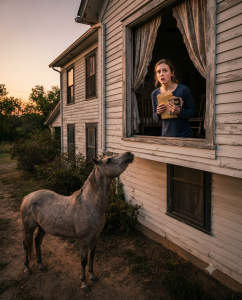
The old mare kept standing in front of the empty nursery window.
At first, Maggie thought it was just one of those strange habits animals developed when they got old. Belle had lived on the family farm longer than Maggie had been alive. She had once been strong enough to pull logs, clever enough to unlatch her own stall, and gentle enough to let neighborhood children braid wildflowers into her mane. Now she was thin through the haunches, graying around the muzzle, and slow enough that everyone except Maggie had started speaking about her in the past tense.
But every evening, just before sunset, Belle left the pasture, crossed the yard, and stood beneath the second-floor nursery window as if reporting for duty.
She would not graze there.
She would not lie down.
She would only stare.
The room above had been closed for twenty years.
It still had the crib, the moon-and-stars wallpaper, and the curtains Maggie’s mother had sewn while pregnant. No one said that out loud anymore, but Maggie knew. She knew because her grandmother had once let the details slip when Maggie was ten and asking too many questions. After that, the family had tightened again, as families do when one secret accidentally brushes against daylight.
Her mother, Evelyn, had died when Maggie was a baby. The official story had never changed. Evelyn had been overwhelmed, emotionally fragile, unable to cope. There had been no hidden money, no final letter, no unfinished plans. Just tragedy.
When Maggie was a child, she believed it because children believe what grief hands them. By the time she was fifteen, the story felt too smooth. By twenty-three, it felt polished into shape by people protecting themselves.
Then her grandmother died, and Maggie came back to the farmhouse for the first time in almost two years.
The place looked smaller than she remembered. The porch sagged at one corner. The white paint had yellowed. The paddock fence needed repair in at least four places. But the feeling of the house was exactly the same: silence pressed into the walls, something unspoken lurking just past every ordinary conversation.
Her aunt Lydia had taken control almost immediately. She was Maggie’s mother’s older sister, practical to the point of coldness, and she had already decided what would happen to everything. The house would be sold. The land might be parceled. Belle, she said matter-of-factly during the second day of funeral arrangements, would probably need to be euthanized before winter.
Maggie nearly dropped her fork.
“She’s still healthy enough to walk the pasture,” she said.
“She’s ancient,” Lydia replied. “Let’s not be sentimental.”
The word landed harder than it should have. Maggie glanced through the kitchen window toward the back field, where Belle was grazing under the last of the afternoon light. It was hard to explain why the mare mattered so much to her when she barely remembered her mother. But Belle had been one of the only things Evelyn left behind that still breathed, still moved, still reacted to Maggie as if blood memory existed in animals.
Belle had always known her.
That evening Maggie stepped out onto the porch just in time to see the mare leave the pasture and begin her familiar walk. Slow. Steady. Intentional. Belle stopped beneath the nursery window and lifted her head.
Maggie frowned. “Does she always do that?”
Her cousin Ben gave a snort from the porch swing. “For years. Creepy, right?”
“She’s senile,” another cousin said. “Grandma used to say the horse had a broken clock in her head.”
Lydia came to the screen door with a dish towel in her hand. “Ignore it. Animals repeat nonsense all the time.”
Then, as if remembering something, she looked up at the window too long and added, “That room should’ve been emptied ages ago.”
Maggie studied her aunt’s face. The words were casual. The tightness around her mouth was not.
That night, Maggie couldn’t sleep. The room she’d been given was across the hall from the nursery, and sometime after midnight she opened her bedroom door and stood in the hallway, staring at the closed room at the far end. The house was silent except for old wood shifting in the dark.
She went to the nursery door and tried the knob.
Locked.
Not swollen shut. Not painted over. Locked.
She crouched, running her fingers along the edge, then stood back up with her pulse knocking hard against her throat. Why would an untouched room be locked from the outside?
The next day she said nothing, but she watched more closely.
Belle came to her in the pasture, pressing her nose against Maggie’s shoulder and snuffling at her pockets the way she used to when Maggie smuggled apples out of the kitchen. There was something urgent in the mare’s behavior. Not distress exactly. Expectation.
At sunset, Belle made the same walk and took the same position under the nursery window.
Maggie followed and stood a few feet away. Up close, she noticed what she had missed before: the window frame had newer paint than the surrounding trim. A careful touch-up, not fresh enough to attract attention, but recent enough to contradict the family’s story that no one had gone in there for decades.
“You’ve been trying to show me something,” Maggie murmured.
Belle’s ears flicked toward her, then back to the window.
That was enough for Maggie.
Later that night, after the house went dark, she found a ladder near the shed and carried it around to the side yard. Belle was already there in the moonlight, waiting beneath the window with the eerie stillness of a witness who had repeated the same testimony a thousand times.
Maggie climbed, pushed at the sash, and after a stubborn groan the window gave way.
Dust hit her first, then the smell of stale fabric and old paper. She swung a flashlight across the room. The crib stood in one corner, intact. A rocking chair sat beside it with a folded blanket draped over the arm. Shelves held baby books. A cracked porcelain lamp rested on the dresser. Nothing looked destroyed. Everything looked intentionally preserved, as though someone had frozen the room and then hidden the key.
Maggie moved carefully, afraid of both noise and memory. She didn’t remember being in this room, but every object seemed to know who she was.
From outside, Belle neighed.
Maggie turned.
Another soft, insistent sound from below.
She moved toward the closet. Tiny clothes hung inside, yellowed with age. A stuffed rabbit had fallen onto its side. The beam of her flashlight slid downward across the floorboards, and there, near the back, one plank sat slightly higher than the others.
Her mouth went dry.
She knelt, dug her fingernails into the gap, and lifted. The board rose with a splintering protest, revealing a shallow hollow underneath.
Inside was a baby blanket wrapped around a thick envelope.
Maggie stared at the blanket before she even touched the envelope. The embroidery at one corner read E.M.—Evelyn Mae, her mother’s initials. The stitches were delicate, careful, unmistakably made by hand. Evelyn had hidden this herself.
Maggie unfolded the blanket and found an envelope addressed in faded ink:
To Maggie. When you are old enough that no one can tell you what to believe.
For a second she simply crouched there, unable to breathe. Her mother’s handwriting was something she knew only from old greeting cards and recipes tucked into a kitchen tin. But this—this was direct. Intimate. Meant for her and no one else.
She broke the seal with shaking fingers.
Several photographs slipped out first. In one, Evelyn stood in the pasture with Belle, visibly pregnant, one hand resting on her stomach. She was smiling, but her eyes were turned away from the camera, fixed on someone outside the frame. The expression wasn’t joy. It was caution.
In another photograph, Evelyn stood on the porch beside Lydia. Maggie stared at it for a long time. Lydia’s hand was wrapped around Evelyn’s arm, fingers digging in just above the elbow. Not sisterly. Controlling.
Then came a stack of documents.
Insurance papers.
Maggie frowned and sorted through them with growing disbelief. There was a life insurance policy in Evelyn’s name, larger than Maggie would have imagined her family could afford at the time. A beneficiary line had been changed. The original name was scratched out so hard it nearly tore the paper. The replacement signature looked familiar enough to make Maggie’s skin crawl.
Finally she unfolded the letter.
If anything happens to me, do not trust your Aunt Lydia.
The line struck like ice water.
Maggie sat back on her heels and kept reading. Evelyn’s letter was rushed, the handwriting slanting harder across the page as though time had been running out while she wrote. She described pressure in the house, whispered conversations that stopped when she entered a room, sudden discussions about debt and insurance and “what would be easier for everyone.” She wrote that Lydia had convinced others Evelyn was unstable whenever she tried to push back. She wrote that she feared something would happen and no one would believe her because the story had already been prepared in advance.
Then one line caught in Maggie’s chest.
I hid this where Belle would watch. She remembers kindness. She remembers fear. She sees more than people think.
A sound below made Maggie jump.
Belle gave a sharper, louder neigh.
At nearly the same instant, footsteps crossed the hallway outside the nursery.
Maggie killed the flashlight. Moonlight washed the room in a dull silver haze. She held the letter so tightly it crumpled at the edge. A shadow paused under the door.
Then came Lydia’s voice.
“Who’s in there?”
There was no confusion in it. Lydia didn’t sound startled that anyone might be inside. She sounded terrified that someone was.
Maggie backed toward the window, clutching the letter and papers. The knob turned once, then again, harder. The door held.
“Maggie?” Lydia said, lower now. “Open this door.”
Maggie stayed silent.
After a long moment, the footsteps retreated.
She waited another full minute before climbing out the window with the bundle tucked under her sweater. Belle stood beneath her, restless but steady, and Maggie pressed one trembling hand against the mare’s neck before hurrying across the yard to her room.
She didn’t sleep at all.
At dawn she spread everything across her bed. The insurance policy had been issued only months before Evelyn died. The beneficiary had originally been Evelyn’s daughter—Maggie—but the line had been altered. The replacement beneficiary was Lydia.
Maggie had just finished reading it for the fourth time when she noticed another folded page trapped inside the stack. It wasn’t in Evelyn’s handwriting.
The paper was a memo page torn from an old legal pad. Across the top, in shaky blue ink, someone had written:
I told Lydia this would ruin all of us.
The note beneath was fragmented, like something drafted in fear and never finished. It mentioned “the policy,” “doctor’s letters,” and “keeping Evelyn quiet until after the signing.” There was no signature, only initials Maggie didn’t recognize. But it was enough to prove one thing: Evelyn had not been imagining the danger around her.
Downstairs, voices rose around breakfast. Maggie tucked the papers inside her coat and went down.
Lydia was already waiting.
“I need the house keys,” Lydia said brightly, too brightly, not even pretending to be casual. “All of them.”
Maggie looked at her. “Why?”
“Because there are buyers coming this week.”
“No one said that.”
“I’m saying it now.”
Maggie let the silence stretch. “Do you mean the nursery key too?”
The entire kitchen stilled.
Ben looked up from his coffee. Maggie’s uncle Tom lowered the newspaper. Lydia’s face emptied for just a fraction of a second before she forced a laugh.
“There is no nursery key.”
Maggie held her gaze. “Then why was the door locked from the outside?”
Tom frowned. “It was?”
Lydia swung toward him too fast. “Your mother locked it years ago.”
Tom blinked. “No she didn’t. She always said she couldn’t bear to.”
A crack opened in the room.
Lydia saw everyone notice it.
“I’m not doing this,” she snapped, pushing back from the table.
She marched out the front door toward the gate, and Maggie followed. So did Tom and Ben.
Belle was already there.
The mare stood squarely in front of the gate, body rigid, ears pinned, gaze fixed on Lydia. When Lydia reached for the latch, Belle stepped sideways and blocked her. When Lydia tried to clap and shout, Belle bared her teeth and struck the dirt with one hoof so violently the latch rattled.
“Move that animal!” Lydia shouted.
But no one moved.
Because Belle did not look confused.
She looked protective.
Maggie stepped off the porch, the papers hidden beneath her coat. “What are you afraid I found?”
Lydia turned. “I’m afraid you’re acting like your mother.”
The words were meant to wound, but this time they sounded like a threat slipping out of habit.
Maggie took one photograph from her pocket and held it where Lydia could see. The one on the porch. Lydia’s grip crushing Evelyn’s arm.
Lydia went pale.
Tom stared from the photo to his sister-in-law. “What is that?”
“Insurance papers too,” Maggie said, not taking her eyes off Lydia. “A letter from Mom. She named the person she was afraid of.”
Lydia’s mouth tightened. “Your mother was sick.”
“That’s convenient,” Maggie said. “Since there’s a policy with your name on it.”
Tom took a step closer. “What policy?”
Lydia spun toward him, furious now. “Don’t stand there and listen to a child dig up old lies.”
But Maggie saw it then—the fear beneath the anger. Not fear of accusation. Fear of documents. Fear of dates. Fear that paper outlasted stories.
Tom held out his hand. “Show me.”
Maggie hesitated only long enough to decide which truth mattered more: family peace or her mother’s voice. Then she gave him the altered insurance form and Evelyn’s letter.
He read the first page. Then the second. His shoulders changed shape.
Ben, reading over his father’s arm, muttered, “Jesus.”
Lydia backed toward the gate. Belle surged forward again, stopping her escape.
“You don’t understand,” Lydia said, her voice dropping. “There were debts. Your grandmother was drowning. Evelyn refused to sign what needed signing.”
Tom looked up sharply. “What did you ask her to sign?”
Lydia’s eyes darted from face to face, calculating and cornered. “We needed the farm saved.”
“By making yourself beneficiary?” Maggie asked.
“It wasn’t like that.”
“Then tell us what it was like.”
Lydia said nothing.
Maggie pulled out the second note, the one in blue ink. “Who wrote this?”
Tom took it, read it, and went white. “This is Ruth’s handwriting.”
Ruth had been Maggie’s grandmother.
Silence slammed across the yard.
Tom read the note again, this time aloud in pieces: “I told Lydia this would ruin all of us… doctor’s letters… keeping Evelyn quiet until after the signing…”
His voice broke.
Maggie looked at Lydia. “You told everyone my mother was unstable.”
Lydia didn’t deny it.
Tom’s hands shook. “Did Evelyn even know she was taken off the policy?”
Lydia’s face hardened in a way Maggie had never seen before. Whatever shame had lived there was gone. What remained was the cold practicality Maggie had always felt beneath her aunt’s kindness.
“She knew enough,” Lydia said. “She made everything harder.”
Tom stared at her as if seeing her for the first time. “Harder than what?”
Lydia laughed once, bitter and cracked. “Harder than surviving. Harder than keeping this place. Harder than doing what had to be done after your father drank away half the year and your mother prayed over bills instead of paying them. Evelyn wanted ideals. She wanted truth. She wanted to leave. She didn’t care what happened to the rest of us.”
“She was pregnant,” Maggie said.
“She had leverage,” Lydia snapped. “That’s what she had.”
No one spoke after that.
The sentence hung in the yard like a confession too ugly to rush.
Tom lowered the papers slowly. “Did you kill her?”
Lydia’s face changed—not into guilt exactly, but into the expression of someone who has spent years drawing careful lines around what counts as responsibility.
“I never laid a hand on her,” she said.
Maggie heard the precision in it immediately.
Tom did too. “That wasn’t my question.”
Lydia looked toward the house, toward the upstairs window, toward the place where Evelyn had hidden her fear. “She was already frayed. I told the doctor she was unstable because she was. I told people to keep an eye on her because she frightened me. I told her she would ruin us if she exposed the policy changes before we fixed the debts. I told her no one would side with her because everyone knew how emotional she’d become.”
Maggie felt sick.
Lydia continued in a low, flat voice. “The night she died, we argued. She said she was taking the baby and leaving. I told her she wouldn’t make it a week. I told her if she disappeared with you, people would think she had another breakdown. I told her she was trapped.”
Tom made a sound Maggie would remember for the rest of her life.
A sound like grief realizing it had trusted the wrong person.
Lydia closed her eyes briefly. “The next morning she was gone. And after that… after that there was no fixing any of it. So yes, I told the story that protected the family. And yes, your mother wrote letters because she wanted to paint herself as the victim before anyone heard my side.”
Belle struck the ground again, violent and sudden.
Maggie stepped closer. “You threatened her. You isolated her. You took the money meant for me. Then you told the family she was unstable until no one questioned you.”
Lydia opened her eyes. “I saved this farm.”
“No,” Tom said, his voice hollow. “You buried my sister.”
He took out his phone and walked away to call the sheriff before anyone could stop him.
Lydia tried once more to go through the gate.
Belle blocked her.
This time the mare didn’t move until the patrol car came up the drive.
The investigation that followed didn’t produce the kind of ending people imagine when they want justice to look neat. There was no dramatic murder charge. Too much time had passed. Too many records were gone. Too many witnesses were dead or conveniently uncertain. But the insurance fraud was real. The altered policy was real. The false statements about Evelyn’s mental condition were documented in letters Lydia had sent and in one doctor’s note written after a meeting Lydia had attended without Evelyn present. The money trail was ugly, and uglier still was the pattern: pressure, coercion, character assassination, financial motive.
Lydia was charged with fraud, falsifying documents, and civil violations tied to the estate. The rest would remain in that painful territory where law and truth do not fully meet.
Still, the family story shattered.
Tom withdrew the sale of the house. Ben found additional boxes in the attic with more of Ruth’s notes—enough to prove their mother had known the scheme was wrong and had tried, too late, to pull back. Maggie sat through weeks of interviews, statements, and legal meetings while her entire childhood rearranged itself around a new center.
Her mother had not simply vanished into a tragedy no one understood.
She had been cornered inside her own home by someone who made survival sound like sacrifice and cruelty sound like necessity.
One afternoon, after the worst of it had passed, Maggie went back into the nursery.
This time she used the front door key Tom had found taped beneath a drawer in Lydia’s bedroom.
Sunlight streamed through the cleaned window. Dust still hovered in bright strands, but the room no longer felt sealed. It felt sorrowful, yes, but open. Honest.
Maggie stood by the crib and unfolded Evelyn’s letter again. She read the part about Belle three times.
She remembers kindness. She remembers fear.
Down in the yard, Belle grazed slowly through the tall grass, old and stubborn and still alive despite everyone’s plans for her. Maggie laughed through sudden tears. For twenty years that mare had walked to the same patch of ground, looked up at the same hidden room, and held her ground against forgetting.
A horse had kept faith longer than people had.
Maggie never sold the farm.
It took months to settle the estate mess and even longer to decide what staying would mean, but in the end she kept the house, the pasture, and Belle. She turned the nursery into a sitting room, though she left one thing untouched: the moon-over-field painting above the dresser. Her mother had chosen it. That felt reason enough.
Belle lived another eleven months.
On the last evening, Maggie led her to the pasture edge and stood with her facing the farmhouse. The sun lowered behind the trees, laying gold across the windows. Belle lifted her head once toward the second floor, not with urgency this time, but with something that looked almost like peace.
When the mare leaned her heavy face into Maggie’s shoulder, Maggie wrapped both arms around her neck.
“Thank you,” she whispered.
Belle’s breathing slowed. The wind moved through the field. Somewhere inside the house, old boards settled as if a weight had finally been put down.
After Belle was gone, Maggie buried her beneath the cedar tree where her mother used to tie ribbons in her mane. She placed the worn baby blanket in the cedar chest upstairs, not hidden anymore, just kept. The letters went into a fireproof box. The photographs stayed on her desk.
People in town still talked, of course. Some said Lydia had done what desperate people did. Some said Evelyn should have left sooner. Some blamed the grandmother for staying silent. Some thought family debt explained too much. Others thought it excused nothing.
Maggie listened to all of it and found that the question that remained was not who had suffered most, though everyone had suffered in one way or another. The real question was when fear had turned into permission—when saving a farm became more important than protecting a daughter, a sister, a mother.
And maybe the clearest answer had been standing in the yard all along.
Belle had known the difference.