The parrot repeated one sentence every time the widow’s brother entered the room.
“Don’t sign, Rose. Don’t sign.”
The first time it happened, people smiled the way they do when grief becomes too heavy and they need something absurd to break it. A neighbor with watery eyes laughed into her napkin. Victor shook his head as if the bird were putting on a strange little show. Even Rose, numb and sleepless and hollowed out by the funeral, managed a weak smile she did not feel.
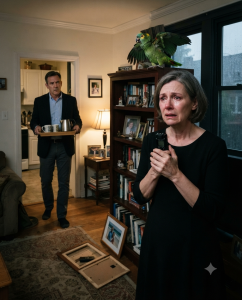
Captain had always been a difficult bird. He was a green parrot with a hooked gray beak, a red tail, and the temper of a suspicious old man. He bit delivery men, despised hats, and once lunged at a tax preparer so violently that Harold had laughed for days every time he told the story. Captain’s loyalties were strong, his dislikes were stronger, and his voice could travel from one end of the house to the other like an alarm.
Now Harold was dead, and Captain’s voice had become something else entirely.
“Don’t sign, Rose. Don’t sign.”
Victor laughed harder than anyone else.
“He’s confused,” he said. “Harold must have said it as a joke at some point, and now the bird’s stuck on it.”
Rose wanted to believe him. Believing him would have been easier than believing anything else.
Three days had passed since the funeral, but the house still looked as if Harold might walk through the door at any moment. His glasses were on the side table beside his chair. His robe hung behind the bathroom door. A screwdriver lay on the kitchen counter where he had left it after fixing a loose hinge two weeks before he died. The ordinary leftovers of a life were everywhere, and each one hurt.
Rose moved through the rooms in a stunned fog. People came and went. Flowers drooped in vases. Casseroles filled the refrigerator. Sympathy cards leaned in a sad stack against the bread box. She answered almost no calls and remembered even less of what people said to her.
Victor, however, remembered everything.
He arrived early each morning in pressed shirts and polished shoes, carrying a leather folder and a face arranged into perfect concern. He made coffee, answered the door, organized envelopes, and told everyone he was taking care of the paperwork. He sounded efficient and kind, the ideal brother stepping in while his widowed sister was too devastated to think clearly.
Rose had always known Victor could wear helpfulness like a costume.
He was four years younger, charming when it benefited him, irritated when it did not. As a boy he could borrow money with a smile and never mention repayment again. As a man he drifted from one venture to another, always explaining why the last setback was someone else’s fault. He and Harold had never been close. Polite, yes. Warm, no. Harold found Victor slippery. Victor found Harold judgmental.
Still, blood is powerful, especially in a crisis. Rose had let him take charge because she could barely remember to eat.
On the second day after the funeral, Victor set a stack of documents on the dining table and uncapped a pen.
“Insurance forms,” he said. “Then the bank needs a few signatures to freeze and release some accounts. Routine things.”
Rose stared at the pages until the lines blurred.
Captain, from across the room, erupted.
“Don’t sign, Rose. Don’t sign.”
Victor laughed. “See? The bird has opinions.”
Rose did not sign that afternoon because her hand shook too much. Victor told her it was fine, they could do it tomorrow. He spoke gently, but there was something underneath the softness—a push, a clock, a need to move things forward before she gathered enough strength to ask questions.
The next day he returned with the same folder.
Captain saw him and immediately flared his feathers.
“Don’t sign, Rose. Don’t sign.”
This time Victor did not laugh quite as easily. “Honestly, cover the cage. He’s upsetting you.”
Captain only said it when Victor came near. Not when neighbors visited. Not when the pastor stopped by to pray. Not when the florist’s assistant collected unused vases. Not when Rose sat alone in the kitchen crying into a mug of untouched tea. Only Victor.
The pattern lodged in her mind like a splinter.
That evening Rose stood in the hallway outside Harold’s study. The door was ajar. Light from the landing touched the edge of his desk. Victor had told her not to go in yet. “Too many financial files,” he had said. “I’ll sort the important things for you.”
At the time, she had been too drained to argue.
Now, with Captain muttering softly in his sleep and the house finally quiet, she pushed the door open.
Harold’s study smelled like cedar, dust, and aftershave. It was the most organized room in the house. The desk was lined with labeled trays. Pens stood in a ceramic mug from some long-ago vacation. A brass lamp cast warm light over a blotter, a fountain pen, and a stack of unopened mail tied with string. Harold had always believed that chaos outside was manageable if paperwork inside stayed in order.
Rose searched carefully. She opened drawers and found batteries, cables, receipts, old warranty cards, and a notebook full of household reminders. She found tax returns, investment statements, and a folder marked HOME REPAIRS. She found nothing that explained Captain’s warning.
But she also found no mention of the urgent deadlines Victor kept talking about.
The next afternoon Victor brought more papers.
“There are penalties if we delay too long,” he said, laying the stack in front of her. “These first. Then I’ll handle the rest.”
Rose looked up. “Can I read them?”
Victor smiled in a patient, tired way that made her feel childish. “Of course. It’s just a lot of legal language. I can summarize.”
“I asked if I could read them.”
For a brief moment something tightened in his face. Then he slid the papers toward her. “Go ahead.”
The first page was dense and intimidating. Her eyes moved over headings she barely understood. Before she reached the second paragraph, Victor leaned in and tapped the signature line.
“This section is standard,” he said. “What matters is authorizing access so nothing gets frozen.”
Captain shrieked from the living room.
“Don’t sign, Rose. Don’t sign.”
Victor closed his eyes. “I’m going to put that bird under a blanket.”
“No,” Rose said sharply.
He lifted his hands. “Fine.”
That evening it rained. The windows darkened early, and the whole house took on the dim, enclosed feeling of a place holding its breath. Victor was in the kitchen making tea. Rose sat at the dining table, staring at the latest set of documents. Captain was restless in his cage, pacing from perch to perch with quick, agitated movements.
Then, in one sudden burst of motion, he launched himself into the air.
Rose cried out, startled.
Captain flew across the room and landed on the tall bookshelf by the fireplace. He flapped hard, scrambling for balance, then began pecking and clawing behind a row of framed photographs. One frame tipped forward and fell to the rug.
“Rose?” Victor called from the kitchen. “What happened?”
She was already on her feet.
The fallen frame held a photograph from a beach trip years earlier. Harold stood with one arm around her, hair blown by the wind, grinning at the camera while Rose squinted into the sun. As she bent to pick it up, she saw the back had shifted loose.
Something was attached behind it.
A small digital recorder, taped carefully to the wood.
For a second Rose simply stared. She heard the kettle click. She heard Victor setting cups on a tray. She heard Captain rustling above her, tense and watchful.
Then she peeled the recorder free.
Her fingers trembled as she pressed play.
Static crackled. A pause. Then Harold’s voice filled the room—clear, unmistakable, and so close that Rose felt the breath leave her body.
“Rose, if Victor brings papers, call Eleanor before you touch a pen.”
Silence crashed into the room.
Victor appeared in the doorway carrying a tray with two cups of tea. He froze.
Rose looked at him over the recorder. “Who is Eleanor?”
His expression changed so quickly it was almost invisible. The sympathetic brother vanished. In his place was a man assessing damage.
“Let me hear that,” he said.
Rose stepped backward, clutching the recorder to her chest.
“No.”
Victor set the tray down on the sideboard with deliberate care. “Harold was very ill near the end. You know that. He wasn’t thinking clearly.”
“He hid this.”
“He was confused.”
“Why would he warn me about you?”
Captain puffed himself up and screamed, “Don’t sign, Rose. Don’t sign.”
Victor flinched. The reaction was tiny, but Rose caught it.
She also caught something else. Fear.
Not sorrow. Not irritation. Fear.
Rose’s mind began stitching together moments she had ignored because grief had made her slow. Victor always turned pages quickly. He always summarized instead of explaining. He always insisted on urgency. He had discouraged her from entering the study. He had placed sticky notes directly above signature lines as if the details elsewhere were irrelevant. He had said “trust me” too many times.
“Show me the papers,” she said.
“Rose—”
“Now.”
Victor hesitated.
That hesitation told her more than words could.
She crossed to the table, snatched the stack of documents, and pulled the first page free. Her eyes scanned the heading.
Transfer Authorization.
Her stomach tightened.
She turned the page. Temporary estate control. Financial authority pending probate review. A second set of pages referenced Harold’s business shares. Another mentioned discretionary management of certain assets. Victor’s name appeared again and again, not as witness or helper, but as the person who would gain authority to act.
Rose looked up slowly. “This isn’t insurance paperwork.”
Victor exhaled through his nose, the last of his performance cracking at the edges. “It’s a practical arrangement.”
“For you.”
“For the estate,” he snapped. “For you, actually, since you clearly aren’t in a condition to manage any of this.”
Captain let out a harsh, rattling screech.
Rose flipped through more pages. Some required only her signature. Some had lines folded over so she had not seen the full headings before. One referenced account consolidation. Another referenced temporary liquidation authority. The language was wrapped in legal phrasing, but the direction of it was obvious enough now.
“You said the bank needed forms.”
“It does.”
“You said the insurance company needed signatures.”
“Some of these are related—”
“You lied.”
Victor’s mouth flattened. “Harold left a mess.”
“What mess?”
He laughed once, bitterly. “You really think you knew everything?”
The question hit her harder than she expected. Because the honest answer was no. Harold had always handled investments himself. He did not hide money from her, but he spared her details, saying she hated numbers and he preferred the spreadsheets anyway. Rose had trusted his steadiness the way people trust foundations under their homes. She had not imagined needing to question it.
Victor saw uncertainty flicker in her face and pounced.
“That’s exactly my point,” he said. “You don’t know what he was doing. There are obligations. Debts. Commitments. Eleanor will turn this into a disaster.”
“Then why did Harold tell me to call her?”
Victor’s gaze flicked to the recorder, then away. “Because she filled his head with nonsense when he was vulnerable.”
Rose pressed play again.
Harold’s voice returned, weaker this time because the recording had continued after the warning.
“If anything happens too quickly, if he pressures you, Eleanor has the file. Don’t let Victor handle the estate alone.”
The message cut off.
Rose felt the floor tilt beneath her.
Victor swore under his breath.
“The file?” she whispered.
He took a step forward. “Give me that recorder.”
Captain launched from the chair and flew straight at him.
Victor threw up an arm with a shout. The tray on the sideboard rattled. One teacup toppled and shattered across the floor. Captain veered at the last moment and landed on the curtain rod, feathers wild, eyes bright with fury.
Rose used the distraction to grab her phone from the end table.
Victor saw.
“Rose, don’t be dramatic.”
She stared at him. “You’ve been trying to trick me into signing over control of Harold’s estate.”
“I’ve been trying to keep you from making a legal mess.”
“By lying to me?”
“By moving quickly before outside people get involved.”
“Outside people? You mean the attorney Harold trusted enough to hide from me because he was afraid of you?”
Victor’s face hardened. “You don’t know what he trusted.”
Rose’s thumb hovered over her phone screen. “Then tell me.”
He said nothing.
Rain lashed the windows. In the kitchen, the forgotten kettle began hissing again. Captain shifted overhead and let out a low, uncanny growl Rose had never heard from him before.
Victor’s eyes moved to the phone. “If you call anyone before understanding the full picture, you could destroy what’s left.”
That sentence landed strangely. Not what’s left for you. Not what Harold built. What’s left.
Rose swallowed. “What does that mean?”
Again, he hesitated.
And suddenly she knew the hidden warning was only one piece of it. Harold had not merely distrusted Victor. He had expected pressure, urgency, maybe even deception. He had hidden a recorder behind a family photograph and trained a bird to repeat a command. Men did not do that because of a minor disagreement over paperwork.
Rose tapped her contacts with shaking fingers and searched for Eleanor. There was no Eleanor.
Of course there wasn’t.
Victor noticed. His voice softened again, dangerously. “You don’t even have the number. That should tell you something.”
Rose looked at the recorder in her hand, then at Harold’s study down the hallway.
If Harold had hidden one warning, there might be more.
Without another word she turned and walked toward the study.
Victor moved to block her path.
Captain screamed so loudly the sound tore through the house.
Rose stopped, lifted her chin, and said, “Move.”
For one terrible second she thought he might refuse. His eyes had lost all pretense now. They were sharp, resentful, almost desperate. Then he stepped aside.
She went into the study and pulled open the top desk drawer again. Nothing. The second drawer held files. The third held old passports, insurance cards, and a slim black address book.
Her pulse jumped.
She flipped through it. Hardware store. Dentist. Neighbors. Accountant. A page marked simply E.
Eleanor Voss.
There was a number beside the name.
Rose turned, clutching the book.
Victor was in the doorway again. “Rose—”
She dialed.
He crossed the room in two fast strides, but before he reached her, a calm female voice answered on the second ring.
“This is Eleanor Voss.”
Rose’s throat tightened. “My name is Rose Bennett. My husband Harold died three days ago.”
A brief pause.
Then Eleanor said, with chilling steadiness, “Has Victor asked you to sign anything?”
Rose looked at her brother.
He stopped where he was.
Captain, from the hallway, shouted, “Don’t sign, Rose. Don’t sign.”
Rose’s grip tightened on the phone. “Yes.”
“Listen to me carefully,” Eleanor said. “Do not sign another page. Lock Harold’s study if you can. And do not let your brother leave with any documents. I’m coming there now.”
Victor’s face drained of color.
“What file did Harold leave you?” Rose asked.
Eleanor did not answer right away. When she did, her voice was lower.
“One that explains why Harold changed his will six weeks ago. And why Victor was never supposed to know until after probate.”
Rose’s knees nearly gave out.
Changed his will?
She had known nothing about that.
Victor took another step toward her. “Rose, hang up.”
She backed behind the desk.
“Why was I never told?” she whispered.
“Because Harold was trying to punish me,” Victor said. “He got suspicious and vindictive and let that attorney poison him against family.”
Eleanor was still on the line. “Rose, whatever he says, do not believe him without documentation. Harold recorded multiple statements. He believed there had been unauthorized access to business funds.”
Rose stared at Victor. “You stole from him?”
Victor’s silence was answer enough.
Then he burst out, “I borrowed money. He knew I was going to put it back.”
Rose felt sick.
Harold had once mentioned irregularities in one of the company accounts, then brushed it away when she asked. She had assumed it was bookkeeping. A clerical issue. Not this.
“How much?” she asked.
Victor laughed without humor. “Enough that if this goes the way Harold wanted, I lose everything.”
There it was at last. Not grief. Not concern. Not brotherly duty.
Need.
Desperation.
Self-preservation dressed up as help.
Rose heard Eleanor saying something about local counsel, emergency filings, and preserving documents, but the words blurred under the rush of memory: Victor insisting she hurry, Victor telling her she was too emotional to understand, Victor trying to keep her out of the study, Victor asking again and again for one signature, then another, then another.
Harold had known. Maybe not every detail, but enough.
And he had done the only thing he could think of to protect her after he was gone.
He had hidden a warning in his own voice.
He had trusted a lawyer she had never met.
And somehow, impossibly, he had made sure Captain would keep saying the one sentence Rose most needed to hear.
By the time Eleanor arrived forty minutes later with another attorney and a hard-sided briefcase, Victor was sitting rigidly in the living room under Rose’s watch, every document spread across the coffee table. Captain remained on top of the bookshelf like a green, furious sentinel.
Eleanor was in her sixties, silver-haired, composed, and not remotely surprised by the tension in the house. She greeted Rose with quiet sympathy, nodded once at Captain, and got straight to work.
The file Harold had left with her was thick.
It contained revised estate documents, notes about financial discrepancies, copies of transfers Harold had flagged, and sworn statements recorded shortly before his death. Harold had suspected Victor had been siphoning money through temporary business access under the guise of helping restructure a failing branch investment. When confronted privately, Victor had begged for time to repay it. Harold, already weakened by illness, had decided to protect Rose first and force the reckoning through legal channels later.
He had not told Rose because he feared the shock would devastate her while he was still alive.
He had also feared Victor would try something the moment the funeral was over.
So he had prepared.
The hidden recorder was real. The revised will was real. The attorney was real. Even Captain’s strange warning had an explanation: Harold had repeated the sentence in front of the bird while recording practice notes, enough times that Captain learned it by heart. Eleanor admitted Harold had mentioned it with grim humor. “He said if all else failed,” she told Rose, “the parrot might save you from your own politeness.”
Rose should have laughed. Instead she cried so hard she had to sit down.
Victor did not deny the transfers once confronted with the records. He only argued over intent, over repayment, over family, over what Harold had “owed” him. Each word made him smaller. Each excuse stripped another layer away. The brother who had arrived carrying coffee and concern was gone. In his place was a frightened man who had mistaken grief for weakness and nearly turned mourning into theft.
By midnight he had left the house with neither the papers nor Rose’s forgiveness.
The legal battle took months. There were accountants, hearings, letters, and ugly phone calls. Some of the money was recovered. Some of it was not. Victor tried apology once, then anger, then silence. Rose stopped answering.
In the end, Harold’s revised estate plan held. Eleanor became not only Rose’s attorney but, in time, a guarded sort of friend. She helped untangle Harold’s business holdings and explain the things he had hidden out of misguided protection. Rose learned more in six months than she had in twenty years of marriage about accounts, shares, and signatures.
Captain remained impossible.
He still hated hats. He still screamed at the mailman. He still bit anyone who reached into his cage without permission. But for weeks after Victor disappeared from daily life, the bird repeated the warning at odd moments, softer now, as if practicing it for a danger that had already passed.
“Don’t sign, Rose. Don’t sign.”
Sometimes Rose would stop in the doorway and look at him until tears blurred her eyes.
One evening, months later, she stood in Harold’s study holding the old beach photograph. The recorder was gone, preserved now with the case file, but the mark where it had been taped remained faintly visible on the wood backing. She traced it with her thumb and imagined Harold there alone, weak but determined, hiding one last protection where he hoped she would find it.
The betrayal still burned. So did the love.
That was the hardest part to live with: knowing the person who tried to save her had also kept painful truths from her, and the person who should have protected her because he was family had nearly used her grief against her. Rose never fully decided which wound cut deeper.
But she knew this much.
The biggest red flag had not been the paperwork itself. It had been urgency without clarity. Pressure without explanation. Help that demanded trust but resisted scrutiny.
And if not for a cranky green parrot shouting the truth from his cage, she might have learned that too late.