They laughed when the woman who sold pies at the county fair asked to see the auction records.
That was how it began—small, mean, ordinary. The kind of laughter that comes from people who think they already understand the room, the rules, and everyone’s place inside both.
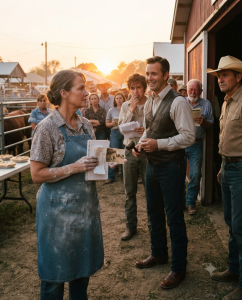
Bonnie Miller stood beside her folding pie table in a faded blue apron dusted with flour, one hand still resting on the pie server she had been using to cut peach slices. The county fair was loud around her: children dragging prize ribbons through dirt, teenagers shouting from the midway, generators humming, cattle lowing from the pens behind the auction shed. The air smelled like sugar, hay, diesel, and sun-baked manure. It was the kind of day where everything looked cheerful from a distance.
Up close, Bonnie could tell something was rotten.
Most people at the fair knew her in passing and knew her wrong. She was “Miss Bonnie,” the widow from the Miller place, the woman who always donated a pie to the church supper and gave the burned crust edges to children who wandered up to her table with sticky fingers. She had a gentle face, a quiet voice, and a habit of listening longer than she spoke. Men found that reassuring. Women found it useful. Children trusted her immediately.
But being overlooked and being harmless were not the same thing.
The cattlemen called her sweet.
The bankers called her harmless.
The auctioneer called her “ma’am” in a slow, syrup-thick voice that sounded polite until you heard the insult tucked inside it.
“Don’t worry your pretty head about numbers,” he told her, flicking his wrist toward the pie table as though he were returning a chicken to its coop. “This is livestock business.”
A few men nearby laughed, and one muttered something about pies and pencils. Bonnie smiled at them all in the same mild way she smiled at every rude customer. Then she turned back toward her table and lifted another slice of peach pie onto a paper plate.
Nobody noticed she had not stopped watching.
Before the pies, before the blue apron, before widowhood and debt and long stretches of silence in a farmhouse that used to hold two voices, Bonnie had spent eighteen years balancing books for the county feed cooperative. She had matched invoices against shipments, reconciled inventory against deliveries, corrected payroll errors the manager never noticed, and built a reputation for catching mistakes before they became disasters. More than once, a salesman had tried to charm his way past a discrepancy. More than once, Bonnie had quietly laid three clean sheets of paper in front of him and shown him exactly where he was lying.
She was not dramatic. She was precise.
And the auction records she had glimpsed from across the ring were wrong in ways no honest mistake could explain.
She first noticed the pattern around noon. A small farmer’s lot entered the ring: twenty-three head, healthy enough, clean-coated, decent weight. The auctioneer sang the numbers with practiced speed. Bidding started low, stayed low, and ended insultingly low. The winning paddle belonged to the same man Bonnie had seen take the front row that morning—a narrow-faced bidder in a tan hat who never seemed eager but always seemed present at exactly the right moment.
Then another struggling farmer’s lot came through, and the same thing happened.
And another.
And another.
Every time one of the county’s smaller operators brought cattle in, the room somehow softened around the bidding. Interested buyers lost their voices. The auctioneer rushed the chant. The tan hat lifted one hand lazily and walked away with animals priced at nearly half of what Bonnie knew they should bring.
Yet when larger ranch lots rolled through later, the ring came alive. Buyers competed. Voices sharpened. Prices climbed as if the market had suddenly remembered how value worked.
Bonnie sold pie, smiled when people thanked her, and kept count.
Same bidder.
Same clerk.
Same low settlements.
Same foul smell under the numbers.
Then she saw the clerk at the payment table.
He was a thin man with a red neck and narrow eyes, and he handled paperwork too carefully for someone pretending to be casual. Some slips went into one pile. Others went under the ledger. Once, Bonnie saw him compare two sheets, pause, and switch them with a speed that would have escaped anyone not trained to watch hands instead of faces.
When she stepped closer under the pretense of delivering coffee to one of the volunteers, the clerk turned his body to block her view.
That was enough to tell her she was right.
The auctioneer came out from the ring between lots, took a cloth from his pocket, wiped his forehead, and disappeared behind the barn with the tan-hatted bidder. Five minutes later he returned, coat buttoned though the day was hot, smiling as though he had just heard a pleasant joke.
Bonnie looked at the shape of one side of his coat.
Envelope.
When she was younger, the feed cooperative manager used to say there were only three kinds of crooked books: sloppy books, desperate books, and greedy books. Sloppy books came from carelessness. Desperate books came from fear. Greedy books were the dangerous ones, because the people making them believed they were smarter than everyone else.
This smelled like greedy books.
She went back to her pie table, reached beneath the cash box, and slipped out the notebook she had started carrying after the bank began questioning the debts on her own farm. It was a habit she had picked up from living too long with people who lost paperwork whenever it might help someone poor. She wrote down times, lot numbers, announced weights, winning bids, names she overheard, and anything else that did not sit right.
She had also brought copies.
Not because she expected trouble that day, but because she had learned something after her husband’s death: the moment a widow asks for proof, records get misplaced.
Her husband, Glen, had been the trusting one. He believed people meant what they said. He believed a handshake still mattered, that a banker who attended your funeral wouldn’t turn around and reassess your debt two weeks later, that men who ate pie at your table would not quietly bid on your equipment once the mortgage notices started. Bonnie had loved that softness in him. She had also buried him with the knowledge that softness did not survive every room.
When the farm bills stacked up, she had found herself alone against systems built to exhaust people. She learned fast. She copied everything. She noted every figure. She stopped expecting fairness and started documenting facts.
That was why, when the old farmer cried, Bonnie was ready.
Raymond Kessler stood at the clerk’s table holding a settlement sheet in both hands. He was built like a post driven too long into hard ground—bent, weathered, stubborn. He had been raising cattle for decades and was known for complaining only about weather and politics, never about pain. When Bonnie saw tears on his face, she felt something cold move through her chest.
“What happened?” she asked softly.
He looked up as if he had forgotten people could see him. “He says that’s what my herd brought.”
He held out the paper. Bonnie scanned it once and knew instantly it was false. The total was too low even before fees. The yardage charge was inflated. A transport deduction had been added that made no sense. Worst of all, the listed sale amount did not match the announced bid she had written down herself minutes earlier.
“Did you keep your lot tag?” she asked.
He nodded slowly.
“Did anyone else in your family hear the final bid?”
“My grandson did.”
Bonnie looked toward the ring, where the auctioneer was already warming up the crowd for the next lot with that booming practiced cheerfulness.
Something in her settled.
She untied her apron.
The gesture drew a few glances because it was so calm. She folded the apron once and laid it on the corner of her table beside the peach pies. Then she slid her notebook out of the flour-dusted pocket, followed by three copied receipts and a photograph she had taken earlier from beside the lemonade stand when the auctioneer thought no one was looking.
When she stepped toward the clerk’s table, the auctioneer saw her coming and smiled with annoyance.
“Yes, ma’am?”
Bonnie laid Raymond’s sheet beside one of her copies.
The clerk’s face changed before the auctioneer’s did.
“You didn’t sell cattle today,” Bonnie said, her voice steady enough to travel farther than shouting would have. “You stole farms.”
The ring went quiet in a way loud places sometimes do—sudden, unnatural, complete.
“What in the world are you talking about?” the auctioneer asked, but he said it too quickly.
Bonnie opened the notebook and started reading.
“Lot 114, twenty-three head, announced at twelve-fifty average. Paid as if sold at eight-sixty.”
She turned a page.
“Lot 127, eighteen head. Bid continued after the final offer and still settled low.”
Another page.
“Lot 131. Seller slip altered after signature.”
Farmers began stepping closer.
The tan-hatted bidder crossed his arms.
The clerk reached for the papers. Bonnie moved them back.
Then she placed the photograph on the table.
Even upside down, people could tell it was bad. When Bonnie turned it around, a murmur spread through the crowd. The image showed the auctioneer behind the barns shaking hands with the tan-hatted bidder. Between their palms, unmistakable in the angle of the picture, sat the edge of a thick envelope.
The auctioneer laughed the way cornered people laugh when they have run out of believable reactions.
“That proves nothing.”
“No,” Bonnie said. “The duplicate receipts prove it. The altered settlements prove it. The lot numbers prove it. The witness statements you didn’t expect prove it.”
“What witness statements?”
Bonnie looked over her shoulder. “Raymond. And his grandson. And whoever else is ready to say what they heard.”
Silence held for one more beat.
Then a ranch wife named Della stepped forward. “My husband’s slip was wrong too.”
A young man from the loading chute said, “I saw the clerk carrying two sets of papers.”
Another farmer said the tan-hatted bidder had somehow known which lots were desperate sales before the cattle even entered the ring.
The room shifted. Bonnie could feel it happen physically, like a change in pressure before a storm. The same men who had laughed now looked at one another, measuring what they had ignored. Wives moved closer. Sons came up from the rail. The banker from First County, who had been near the concessions speaking to a loan officer, pushed his way through the crowd with a face already turning tight.
“What’s going on?” he asked.
Bonnie did not answer with outrage. She answered with evidence.
She handed him Raymond’s sheet, her copied receipt, and the notebook open to the relevant entries. The banker’s eyes moved back and forth across the figures. He frowned. Then frowned harder.
The auctioneer tried to seize the moment. “There’s confusion here. Accounting errors. You know how these fair-day sales get.”
Bonnie looked him straight in the face for the first time.
“No,” she said. “Errors are random. This is a pattern.”
The banker swallowed.
A deputy was called. Then another.
By the time they arrived, the crowd was no longer willing to disperse. People were comparing paperwork, checking handwritten notes, confirming bids, and finding too many discrepancies to dismiss. The clerk tried to edge away from the table. Raymond Kessler, tears gone now, stepped into his path and blocked him with the blunt immovable stillness of a man who had just realized someone had treated his life’s work like a pile of loose bills.
One deputy asked, “Who’s making the accusation?”
Three farmers pointed at Bonnie.
The auctioneer saw that and made a mistake. He sneered.
“This is why women who don’t understand livestock accounting shouldn’t be stirring up crowds.”
The words hung in the air long enough for everyone to hear how foolish they were.
Bonnie did not even look at him. Her eyes were fixed on a truck parked in the shadows beyond the barn doors.
Same truck. Same place. Same driver. Same pattern.
“Open it,” she said.
The tan-hatted bidder stiffened. “That’s private property.”
The deputy stepped toward him. “Open it.”
He hesitated.
The clerk bolted.
He made it three steps before Raymond caught the back of his shirt and shoved him against the rail hard enough to knock his cap off. Gasps rose. The deputy moved in, but the damage was done: guilt now had motion.
The second deputy opened the truck door.
Under a tarp in the back were duplicate sale sheets, bundles of cash in paper envelopes marked by lot number, and a gray metal lockbox with names written across the top in black marker.
Farmer names.
Not random ones, either. Distressed ones. Families behind on payments. Smaller operations. Widows. Older men. Anybody vulnerable enough to be pressed from both sides—cheated at auction, then cornered by debt.
The banker went pale.
Bonnie stepped closer as the deputy lifted out the lockbox and set it on the truck bed. On top of the list, written first in block letters, was a name she knew too well.
MILLER.
Her own.
For a second the fairgrounds seemed to tilt.
She had suspected corruption. She had not yet understood its reach. This was not just a crooked auctioneer skimming money. This was a system. Depress the sale price, deepen the debt, tighten the mortgage pressure, then position friends or partners to buy land cheap when families collapsed.
You didn’t just steal cattle that way.
You stole the future off a map.
The banker looked as if he might be sick. “Who else has seen this?”
Bonnie answered before anyone could lie. “Apparently not enough people.”
Inside the lockbox were copies of liens, handwritten notes about seller pressure points, debt timelines, and suggested bid ceilings. One paper listed farms expected to fail within six months if cattle sold below target prices. Another included side notes on widows, medical bills, and pending refinancing requests.
Della covered her mouth.
Raymond stared at the papers as if they were in another language and he still somehow understood every word.
The auctioneer started talking fast then—too fast. He blamed the bidder. Then the clerk. Then “standard industry practices.” He said it was about recovering value, protecting lenders, stabilizing distressed assets. The more he spoke, the worse he made it sound, because greed always tries to dress itself as reason.
Bonnie let him talk until he ran out of smoothness.
Then she said, “My husband was in the hospital when our payment was late.”
No one answered.
“You sent notices while I was planning a funeral. Then our cattle sold low. Then the bank offered terms that would’ve pushed me off the land by winter.”
The banker shut his eyes briefly. Whether he knew the whole scheme or only pieces of it, Bonnie could not tell. But he knew enough now to understand how bad it looked.
“It wasn’t just bad luck,” she said. “Was it?”
He didn’t answer that either.
Deputies began collecting documents. Statements were taken. The tan-hatted bidder was searched. Another envelope was found inside his jacket. The clerk, suddenly eager to save himself, started talking in fragments—first denying everything, then blaming pressure, then claiming he “never thought it had gotten this far.” That phrase turned the crowd uglier than any confession could have. Because if even he had not known how far it had gone, then this had been bigger than one fair, one sale, one season.
As the sun dropped low, golden light stretched across the fairgrounds and caught every face in the crowd. Children had gone quiet. The midway music sounded far away. Bonnie’s pie table still stood near the shed, half sold, the peach filling softening in the heat.
It looked like another life.
The senior deputy came over with a firmer expression than before. “Mrs. Miller, we’ll need copies of everything.”
“You’ll get them,” she said.
“Do you have originals?”
Bonnie glanced toward her truck.
She had learned never to bring all her proof into a room run by men who preferred proof misplaced.
“Yes,” she said. “And I have records from two earlier sales too.”
The deputy gave a short nod that carried something close to respect.
By full sunset, word had spread through every corner of the county fair. The pie lady had stopped a cattle auction. The widow had exposed the books. The woman men had waved away had dragged a theft into daylight with a spiral notebook and a photograph.
People no longer passed Bonnie without seeing her.
They came up in twos and threes—farm wives with trembling hands, old ranchers with envelopes from past sales, sons asking how to read settlement sheets, daughters asking whether their father’s farm had been on the list. Bonnie answered what she could and wrote down what she couldn’t. She did what she had always done best: she turned confusion into order.
The auctioneer was taken away before dark.
The bidder went with him.
The clerk, sweating and pale, climbed into another vehicle after giving up enough names to guarantee the story was not ending there.
And Bonnie stood beside her pie table with her apron folded over one arm, looking out across the fairgrounds as the last light drained from the sky.
Raymond Kessler came over holding a corrected settlement estimate one deputy had helped sketch from the ring notes and witness statements. His voice was rough when he said, “You saved me.”
Bonnie looked at the paper, then at his face.
“No,” she said quietly. “I just stopped them in time.”
He nodded, but his eyes drifted toward the barn where the truck had been searched and the lockbox had been found. “Think they would’ve taken all of us?”
Bonnie did not answer immediately.
She thought about the list. About names marked like targets. About widows, overdue notes, hospital bills, drought years, quiet men ashamed of asking for help. She thought about how corruption rarely arrives wearing a villain’s face. More often it shows up in polished boots, friendly handshakes, and paperwork nobody expects to be weaponized.
“Yes,” she said finally. “I think they already had.”
Raymond looked away.
That was the aftershock of it—the part no arrest could fix by morning. The betrayal was not just in the money. It was in the confidence. The assumption that these people knew exactly which families were weakest and decided that weakness made them available.
Bonnie folded her apron once more and set it on the pie table.
Children approached carefully, unsure whether the adults were still angry about something they didn’t understand. Bonnie picked up the tray of burned crust edges and held it out to them as she always had.
One little boy took a piece and asked, “Are you still the pie lady?”
For the first time all day, Bonnie laughed.
“Yes,” she said.
But after that evening, nobody in the county ever said it like it meant harmless again.