When Kate arrived at Halston Women’s Correctional Facility, nobody looked at her twice.
That was unusual only in the sense that new inmates were normally the center of brief, hungry attention. Fresh faces meant fresh rumors, fresh weaknesses, fresh opportunities. The women inside had learned to size each other up fast. Who looked scared. Who looked connected. Who looked unstable. Who had money on the outside. Who might be easy to manipulate before they learned the rhythm of the place.
But Kate slipped through intake like a shadow.
She was young, maybe late twenties, with tired eyes and a calm face that gave away nothing. She answered every question with the fewest words possible. She accepted the standard-issue uniform, the folded bedding, the toiletries, and the prison’s plain white sneakers with no reaction at all. She didn’t complain about the size. Didn’t ask when she’d get a different pair. Didn’t look around in that wide-eyed way newcomers often did when they realized bars, concrete, steel doors, and surveillance cameras were now the whole shape of their world.
One of the intake officers noticed that and frowned.
“First time locked up?” she asked.
Kate looked at her for half a second too long before replying. “First time here.”
It was such a small answer that the officer almost missed the difference.
Almost.
Still, nothing in the paperwork seemed unusual enough to justify pushing harder. Kate was processed, assigned, and moved into general population.
By dinner, women in three different units had already started whispering about her.
Not because she looked dangerous. She didn’t. Not in the obvious way. She wasn’t loud, tattooed from neck to wrist, or desperate to prove something. She didn’t scan the room for enemies. She didn’t align herself with a clique. She didn’t try to buy protection.
If anything, she seemed too self-contained.
That was exactly what made a few people uneasy.
In prison, fear had a certain texture. It showed in hands, in posture, in the way someone carried a tray or flinched at sudden noise. Kate showed none of that. But she didn’t show swagger either. There was no performance in her. No fake toughness. Just restraint.
By lights-out, one woman in her cellblock had already muttered, “That one’s strange.”
Across the yard, in a much older section of the prison, Vanessa was hearing the same thing.
Vanessa did not care about strange. She cared about status.
For nearly four years, she had controlled the social order in her block through intimidation, selective generosity, and violence delivered at exactly the right moments. She was bigger than most of the women inside, stronger than nearly all of them, and mean enough to make size only half the problem. She took what she wanted because nobody consistently stopped her. Not other inmates. Not the staff, unless they were forced to. She knew exactly how far she could push before discipline became inconvenient. She knew which officers could be manipulated, which ones avoided paperwork, and which inmates were too scared to testify when trouble landed in segregation.
That kind of power fed itself.
Vanessa had become a myth inside those walls. Women warned newcomers about her in the showers and at the sinks. Don’t meet her eyes too long. Don’t sit in her spot. Don’t touch food she leaves unattended. Don’t say no if she asks for something small, because small things never stay small.
By the time Kate arrived, Vanessa no longer even needed to threaten people clearly. Her presence did most of the work.
The next morning, recreation hour brought everyone into the yard under a pale sky and flat light. The concrete still held the night’s chill. Groups formed quickly. Smokers gathered in their usual corner. Two women walked laps. Others clustered along the fence, trading gossip in low voices.
Kate stood by herself near the far side.
Her hands were loose at her sides. Her shoulders relaxed. Her gaze low, though not timid. To anyone watching carelessly, she looked like the easiest kind of target: quiet, isolated, new.
Then Vanessa saw the shoes.
White, clean, barely scuffed.
She stopped mid-conversation.
A woman beside her followed her gaze and immediately looked away. She knew what was coming.
Vanessa grinned. “Well, well.”
She crossed the yard with deliberate slowness, making sure people noticed. And they did. Heads turned. Voices softened. There was always a perverse energy before one of Vanessa’s public humiliations, part dread and part morbid curiosity. Some women hated her but watched anyway. Others aligned themselves with her and enjoyed the cruelty. A few simply wanted to know whether this new girl would cry, beg, or fight badly enough to entertain them.
Vanessa stopped directly in front of Kate and looked down at the sneakers.
“Nice pair,” she said.
Kate lifted her eyes.
Vanessa’s grin widened. “Take them off. They’re mine now.”
A few women nearby smirked automatically. It was the same script every time. A demand, a show of resistance, a quick lesson.
But Kate didn’t move.
“No,” she said.
The answer was soft enough that some people didn’t hear it. They only saw the reaction on Vanessa’s face.
For one second, the older woman looked almost puzzled.
Then she laughed. “Nobody explained how things work around here?”
Kate said nothing.
Vanessa stepped closer. “You don’t make rules in my yard.”
She shoved Kate’s shoulder. Hard.
Kate shifted with the force, but her feet stayed planted.
That tiny detail changed the atmosphere instantly.
Vanessa noticed.
So did the crowd beginning to gather.
It wasn’t just that Kate stayed upright. It was the way she absorbed the shove, balanced, and reset without panic. Efficiently. Naturally. Like someone who had been taught not to waste motion.
Vanessa’s eyes narrowed.
“Take. Them. Off.”
Kate looked at her steadily. “No.”
The circle around them tightened. Someone raised a phone near chest level. Another woman whispered, “This is going to be bad.”
Vanessa, sensing the audience, turned theatrical.
“She thinks she’s special,” she called out.
A few women laughed, though the sound was thinner now.
Then Vanessa leaned in and said, loud enough for everyone to hear, “Either you take them off right now, or I’ll take them off with your feet still in them.”
There it was. The line that would make the scene memorable. The part people would repeat later over lunch trays and in cells.
Vanessa bent suddenly and grabbed for Kate’s sneaker.
What happened next unfolded so fast the first few people who watched it back on video later still couldn’t believe what they were seeing.
Kate moved before Vanessa had a proper hold.
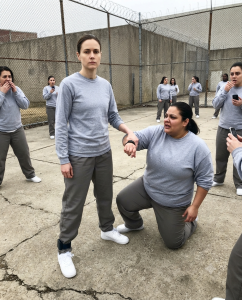
She trapped Vanessa’s wrist, rotated sharply, stepped off-line, and redirected the larger woman’s momentum downward. It was not the clumsy panic of a cornered victim. It was clean. Controlled. Practiced. Vanessa made a raw sound of shock as her arm twisted and her balance disappeared. A second later she hit one knee in the dirt, her torso bent forward, her captured arm forced into a lock that made further resistance dangerous.
The yard fell silent.
Not quiet—silent.
Vanessa tried to rise with brute strength, but Kate adjusted her position and tightened the hold without visible effort. It was terrifying precisely because she didn’t look enraged. Her face was calm. Focused. Almost detached.
The strongest woman in the prison was trapped by the “quiet new girl.”
One phone slipped from someone’s hand and hit the concrete.
At the far end of the yard, an officer shouted and began running with two others. But before they got there, Vanessa made the mistake of jerking her shoulder. Kate shifted again, and Vanessa gasped through clenched teeth.
Then Kate leaned down and whispered something into her ear.
No one heard the words.
Everyone saw the effect.
Vanessa’s face drained white.
Fear replaced rage so abruptly it seemed unreal. Her mouth parted. Her eyes searched Kate’s face in a way that looked less like hatred and more like recognition.
The officers reached them seconds later.
“Break it up!”
One grabbed Kate’s shoulder—and froze.
It was only for an instant, but several nearby inmates saw it. The officer’s expression changed from aggression to startled understanding. Then she recovered and barked for the crowd to move back.
Kate released Vanessa immediately and stepped away without resistance.
Vanessa stayed on one knee, clutching her wrist, breathing hard.
She didn’t charge.
Didn’t scream.
Didn’t issue threats.
She just stared.
That alone spread more fear through the yard than the takedown itself.
As the officers repositioned themselves, one inmate near the front narrowed her eyes at Kate’s pant cuff. During the struggle, the fabric had ridden up just enough to reveal a dark, fitted strap around the ankle—something secured under the uniform, not part of standard issue.
“What is that?” the woman whispered.
Another inmate leaned in. “That’s not prison gear.”
The whisper started small, then widened.
“Who is she?”
“She’s not normal.”
“She came in for Vanessa.”
“No way.”
Vanessa heard them. The panic in her face deepened.
She finally spoke, and her voice came out cracked. “Wait.”
The women closest to her stared. Vanessa did not say wait. Vanessa made other people wait.
The officers separated both women and marched them inside. The yard remained unsettled long after they disappeared through the steel door. Some inmates swore Kate had to be law enforcement. Others thought she was military. A few believed she was from another facility and had simply lied about being new. But those guesses all missed the truth by just enough to be useless.
Inside, Kate was taken not to a holding cell but to an interview room.
That was the first confirmation.
The second came ten minutes later when the prison warden entered with a folder and shut the door herself.
Kate sat waiting, posture straight, the calm from the yard now sharpened into something official.
The warden exhaled slowly. “That was earlier than planned.”
Kate’s answer was flat. “She escalated faster than expected.”
“Your cover is compromised.”
“It was compromised the moment she touched me.”
The warden gave a brief nod. “Did you get a response?”
Kate thought back to the exact moment Vanessa froze. “Yes. She recognized the name.”
That name had been the key to the entire operation.
Six months earlier, an inmate named Marisol Velez had died after an alleged overdose inside the same prison. Officially, it was ruled accidental. Unofficially, too many details failed to fit. Marisol had been preparing to give a statement about contraband routes, officer cooperation, and an internal extortion network run through certain inmates on the warden’s payroll years earlier. Before she could speak, she was dead. Most women inside believed Vanessa knew exactly what happened, if she had not ordered it herself.
No one could prove it.
Witnesses recanted. Records vanished. Fear swallowed testimony.
Then Marisol’s younger sister came forward.
Her name was Kate Velez.
She was not law enforcement. She had never been a police officer, never carried a badge. She had something more useful for this job: years working in corrections transport, defensive training, and an obsession no one could shake her from after Marisol died. When internal investigators finally reopened the case quietly, Kate offered something reckless and hard to refuse. She knew the names. She knew the rumors. She knew what Vanessa looked like. And if Vanessa ever heard Marisol’s name from the right mouth, in the right moment, she might reveal what fear had kept hidden.
The plan had been simple in theory, dangerous in practice: get Kate into the facility under a temporary sealed identity, keep her in long enough to draw Vanessa out, and watch who moved to protect whom.
It was already going sideways.
Because Vanessa had recognized more than a name.
“She looked at me like she remembered my sister’s face,” Kate said.
The warden set the folder down. “We pulled camera footage from the yard. After you whispered, she stopped resisting immediately.”
“I said, ‘Marisol screamed your name before she died.’”
The room went still.
The warden’s jaw tightened. “And?”
Kate looked up. “She believed me.”
Outside the room, the machine of the prison kept moving—meals, counts, locked doors, shouted orders—but beneath it a different current had begun. Staff who had been comfortable were suddenly nervous. An assistant supervisor made three unexplained calls. One corrections officer requested emergency leave. Two inmates known to run errands for Vanessa started asking whether she would be transferred.
Pressure created movement.
Movement created mistakes.
Within hours, investigators monitoring internal communications had their first break: a staff member with long-suspected ties to contraband tried to access archived segregation records linked to Marisol’s final week. That request alone was enough to trigger interviews.
Vanessa, meanwhile, had stopped acting like a queen.
By evening she had refused chow, refused rec, and refused to return to her usual table. She asked twice whether Kate was still in the building. She demanded to speak privately with the deputy warden, then changed her mind. She shouted at one officer and apologized to another. The women watching her from neighboring cells were stunned.
By the next morning, the legend around her had cracked.
And cracked things do not hold pressure well.
Kate was brought in for one final monitored conversation.
Vanessa sat across from her in restraints, larger than the chair seemed made for, but diminished all the same. Her wrist was braced. Her eyes were bloodshot. She tried to look hateful. It didn’t quite work.
“You shouldn’t have come in here,” Vanessa said.
Kate didn’t blink. “My sister shouldn’t have died in here.”
Vanessa looked away first.
For several seconds, there was only the hum of the ventilation system.
Then Vanessa said, almost to herself, “She wasn’t supposed to die.”
That was it. The shift investigators had been waiting for.
Kate leaned forward. “Then tell me what was supposed to happen.”
Vanessa swallowed. Her mouth twitched. For the first time, the famous bully looked less like a predator than a woman crushed by the size of what she had helped build.
“It started with debts,” she said. “Always debts. Protection, contraband, favors. Your sister heard something she wasn’t meant to hear. One officer was moving pills in through kitchen supply. Another was making money selling information—who had family money, who was vulnerable, who could be pressured.” She closed her eyes briefly. “Marisol said she was going to report all of it.”
Kate’s voice stayed level. “And you told them.”
“I told them she was talking.” Vanessa’s answer came out ragged. “I thought they’d scare her. Isolate her. Move her. I didn’t know…” She stopped, then laughed once, bitterly. “Maybe I did know. Maybe I just didn’t want to say it out loud.”
“What happened that night?”
Vanessa’s fingers tightened against the restraints. “They staged the overdose. One inmate delivered it. An officer looked the other way. By morning everyone had the same story.”
Kate felt the words like a blade sliding slowly under old scar tissue. She had imagined this moment for months—anger, satisfaction, justice, vindication. Instead there was only a hollow ache and a pressure behind her ribs.
“Did she suffer?” Kate asked.
Vanessa looked at her then, and the answer in her face came before the words.
“Yes.”
Kate shut her eyes once. Opened them again. “Why tell the truth now?”
Vanessa’s shoulders sagged.
“Because when you whispered her name in that yard,” she said, “I remembered her begging me. And I realized I’ve been more afraid of losing power than of what I became.”
It wasn’t redemption. Kate knew that. Confession did not restore the dead. Regret did not erase complicity. But truth, finally spoken aloud, had weight. And weight changed things.
By the end of the week, two officers were suspended pending criminal charges. Another resigned before he could be questioned formally. Three inmates were moved into protective separation after agreeing to testify. Vanessa was transferred to a higher-security unit outside the state while the investigation expanded. Marisol’s cause of death was officially reopened.
Kate did not stay long enough to watch the rest unfold.
When she left the facility through a secured side entrance, she was carrying a small envelope the warden had handed her without ceremony. Inside was Marisol’s old chain necklace, recovered from property storage after the case reopened. It had been logged incorrectly, then forgotten. Kate stood in the parking lot for a long time, the metal cool in her palm, the world outside feeling too wide after so much concrete.
Justice, she realized, did not arrive like relief.
It arrived in fragments. In documents. In names finally spoken. In doors opening too late.
A week later she attended the first hearing connected to the reopened case. Vanessa’s testimony would come later. The officers’ defense teams were already trying to minimize everything, to suggest confusion, coercion, incomplete memory. The usual machinery had started grinding. But this time it no longer had silence protecting it.
Marisol’s name was in the record now.
That mattered.
The video from the yard was never released publicly, though everyone inside the prison seemed to know every frame by heart. For months afterward, new inmates heard the story in whispers: about the day Vanessa tried to steal a new girl’s sneakers and ended up on her knees in the dirt. Depending on who told it, Kate was described as an undercover officer, a fighter, a ghost, or vengeance itself. The details shifted. The feeling did not.
Because what stayed with people wasn’t the takedown.
It was the look on Vanessa’s face after the whisper.
The moment power recognized the past had come back for it.
And for all the women who later argued about the story—whether Vanessa deserved any mercy, whether Kate had been brave or reckless, whether the prison itself had created monsters or merely protected the ones already there—one question lingered longer than the rest:
At what point had the real crime become worse than the one anyone was sentenced for?
Maybe it was when people first looked away.
Maybe it was when fear started passing for order.
Or maybe it was the moment someone decided a human life was worth less than a secret.
Whatever the answer, one thing was certain.
Vanessa reached for a pair of white sneakers expecting easy humiliation.
Instead, she put her hands on the one person she never should have touched.