They laughed when the quiet woman from laundry asked to speak at the hotel safety meeting.
It was not a cruel laugh at first. Not the loud, theatrical kind meant to humiliate someone in front of a crowd. It was worse than that. It was the dismissive kind, the reflexive kind, the kind people used when they had already decided someone did not belong in the room. A few smirks. One exhale through the nose. A glance exchanged between two supervisors. The unspoken message moved faster than sound: here we go, basement staff wants attention.
June stood with her hands folded in front of her apron and let them laugh.
She was used to being underestimated.
For six years, she had worked below the grand public floors of the Halcyon Crest Hotel, a property so expensive and so meticulously polished that guests often described it as effortless. The lobby always smelled faintly of white tea and polished wood. The chandeliers caught light in a way that made even exhausted travelers straighten their posture. The penthouse suites had marble bathrooms larger than some city apartments. Weddings filled the ballroom every weekend. Celebrities slipped through the private entrance. Executives held strategy meetings in glass rooms overlooking the river and congratulated one another on the standards that made the hotel exceptional.
June worked three levels beneath all that.
She folded bath sheets, counted pillowcases, sorted stained linen, logged missing robes, and pushed carts through service hallways so narrow that two people could not pass without turning sideways. Her world was steam, detergent, fluorescent lights, and the constant rattle of industrial machines. She knew the hotel by its hidden systems: which chute jammed on wet towels, which dumbwaiter stuck between floors, which service elevator doors needed an extra shove with the hip. She could tell by touch whether a towel came from the spa, the standard suites, or the penthouse collection. She knew which floors generated the most laundry and which departments lied on their paperwork when they wanted something buried.
But upstairs, they barely knew she existed.
If a manager mentioned her at all, it was usually as a category instead of a person. “Send this to basement staff.” “Ask basement staff why the count is off.” “Tell basement staff they need to move faster.”
Her name was June.
Only a few people used it.
That morning began before sunrise with the sort of panic only luxury hospitality could produce. A famous actress was checking into the penthouse for one night before a charity gala across town. Her arrival had triggered an absurd chain reaction by dawn. Fresh flowers were replaced because the first arrangement looked too common. The chef was told to revise the fruit plate. Housekeeping was ordered to steam drapes that no guest would inspect. The general manager, Victor Hale, seemed personally offended by the possibility of imperfection.
Victor was the type of man who used calm as a performance and rage as a management tool. He spoke softly in front of guests and sharply everywhere else. He cared about optics the way some people cared about oxygen. That morning, he called department leads and available staff into a service corridor and gave a speech about excellence, discretion, and the damage one careless employee could do to the reputation of the entire hotel.
“Today is not the day to make mistakes,” he said.
He stood under a buzzing fluorescent panel with his suit jacket buttoned and his silver cufflinks flashing every time he moved his wrist. He did not shout. He did not need to. Everyone could hear the threat folded neatly inside his tone.
“Do your jobs. Stay invisible. And do not embarrass me.”
June stood in the back with a stack of fresh bath towels balanced against her side. She watched him, as she always did, not because she liked him but because men like Victor often revealed more when they thought they were being impressive. He kept checking his watch. He kept glancing toward the private service elevator reserved for upper management. He looked tense long before anything had gone wrong.
That detail stayed with her.
By late morning, the actress had arrived. Her presence moved through the building like weather. Makeup artists, assistants, and security floated in and out of the penthouse suite. Room service was revised twice. The spa sent products upstairs. Someone from public relations took a call in the hallway and whispered as if the walls might leak headlines.
June remained below, logging linen returns and sorting loads from the upper floors.
Around one-thirty, the first radio call came through: security requested immediate assistance on the penthouse level.
Then another: all nonessential staff hold positions.
Then another, clipped and tense: item missing, possible theft.
The news spread fast because fear always did.
The actress’s diamond bracelet had disappeared.
According to the assistant, it had been taken off in the penthouse bathroom during wardrobe prep and left near the sink for only a short time. When they went back for it, it was gone. Not misplaced. Gone. The kind of bracelet that cost more than most of the hotel staff would earn in years.
Victor shifted instantly from polished host to furious commander. Staff were pulled from hallways and stations. Service doors were locked. Security teams started moving floor by floor. Anyone who had been near the penthouse was identified, then expanded into anyone who had been near the service corridors connected to the penthouse, then widened further because panic never stays in its lane.
June saw the fear on people’s faces before she heard the order.
No one leaves until the bracelet is found.
Security began searching lockers.
Victor personally oversaw bag checks.
A young housekeeper named Lina stood red-eyed while a supervisor opened her purse in front of coworkers. A banquet server kept repeating that he had been on ballroom setup all morning. A bellman who had delivered ice to the wrong floor was questioned twice because his route touched the elevator bank near the penthouse. No one said it openly, but the suspicion moved in one direction: downward. Toward the workers least protected, least believed, least likely to fight back.
June felt anger rise in a way she had spent years teaching herself to hide.
This was not the first time.
Over the past year, things had been disappearing with odd regularity. A watch from a diplomat’s suite. Cash from a wedding guest’s room. Earrings after a high-profile anniversary stay. Each incident followed the same pattern. Shock upstairs, scrutiny downstairs. Laundry delays were cited. Linen counts were flagged. Service routes became excuses. Reports surfaced with odd notations and false time stamps that made it easier to suggest mishandling by housekeeping or laundry. Nothing was ever fully proven against anyone, but the stain always settled where management wanted it to settle.
June had noticed because laundry noticed everything.
She noticed when a room reported three bath towels sent down but only one ever arrived. She noticed when soiled-linen tags were rewritten. She noticed when loads that should have been routed through the main service elevator were marked as special handling and redirected through management access. She noticed the same initials on the paperwork authorizing those changes.
At first she assumed it was sloppiness. Then coincidence. Then something else.
So she bought a small notebook from a corner pharmacy and began writing things down.
Dates. Room numbers. Shift times. Missing-item complaints. Linen discrepancies. Names of supervisors on duty. Codes stitched into towels. Which elevator had been locked. Which report had arrived too late. Which initials appeared again and again on paperwork that did not make sense.
She never told anyone.
Not because she was afraid of being wrong.
Because she understood the structure she lived inside. A woman from laundry accusing management without undeniable proof would not be heard. She would be called bitter, confused, disruptive, unstable, maybe even dangerous. The notebook would disappear. She might disappear with it.
So she waited.
Then the actress’s bracelet vanished, and the waiting ended.
Staff were herded into a back service area while security coordinated the search. Victor walked up and down the line like a man performing control for an audience. He spoke about procedure, professionalism, and the need to cooperate. June watched him as he spoke. His irritation was real, but beneath it was something else. He was too eager to shape the narrative. Too quick to direct attention toward staff lockers, bags, and housekeeping routes. Too careful to avoid one specific question: how could something leave the penthouse without touching the regular laundry system at all?
When he called for final statements from anyone who had relevant information, June stepped forward.
“I know where the bracelet is,” she said.
The reaction was immediate.
One of the front-office supervisors rolled his eyes. A security guard shifted his weight and looked away. Victor closed his eyes for a moment, as though summoning patience for a child.
“Please,” he said. “This is not the time for imagination.”
June ignored him and looked at the head of security, Marcus Reed, a former police officer whose default expression was controlled annoyance.
“Check the laundry chute,” she said.
Marcus frowned. “Why?”
“Because if I’m right, it never made it to the basement.”
He hesitated only a second before signaling two guards to follow him.
Curiosity broke the room open. Staff who were not explicitly ordered to stay behind drifted after them. Victor came too, perhaps because refusing to follow would have looked suspicious, perhaps because he still thought this would end in June’s embarrassment.
The chute access panel was behind a locked door off the service hall between upper guest floors and the main management level. Wet towels and bath mats sometimes snagged there before falling through to the sorting area below. One guard unlocked the panel. Another pulled on gloves and used a hooked rod to fish inside.
He caught something almost immediately.
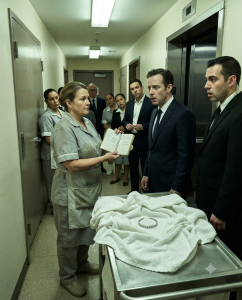
A bundled white towel, twisted tightly and wedged between metal seams.
It looked too deliberate.
Marcus took it himself, laid it across a utility cart, and unfolded the first corner. Then the second.
Diamonds flashed under fluorescent light.
No one breathed.
The bracelet sat nested in the towel like it had been tucked there by a hand that believed no one would find it until much later.
The actress’s assistant, who had followed halfway down the hall with a face tight from fury, let out a sharp sound that was part relief and part shock. Two housekeepers exchanged a glance that said the same thing without words: we were right, it wasn’t us.
Victor recovered first.
“There,” he said quickly. “An accident. It got swept with the towels. We return it, apologize, and move on.”
But June had already picked up the towel.
“It wasn’t an accident,” she said.
Victor’s expression hardened. “June.”
She turned the towel hem outward and held it beneath the light. Most people would have seen only white terry cloth. June saw the faint blue stitch marking near the edge and the tiny inventory code inside the seam.
“This towel didn’t come from the penthouse bathroom,” she said.
Marcus stepped closer.
“The penthouse stock was changed in March,” June continued. “Cream towels, heavier weave, gold tags. This one is from the older lot still used in only a few restricted service areas.”
She paused and met Marcus’s eyes.
“One of them is the private elevator lounge for management.”
For the first time since the search began, Victor looked unprepared.
The color left his face so fast it was almost startling. His mouth opened, but nothing came out immediately. Around them, the hallway shifted from relief to something colder and more dangerous.
June reached into her apron pocket and pulled out the notebook.
Marcus took it from her without a word.
The pages were cramped but orderly. Dates lined in sequence. Missing-item reports cross-referenced with laundry anomalies. Room numbers connected by arrows to service routes. Notations about late filings and altered counts. And again and again, next to false laundry diversion forms, the same initials.
V.H.
Victor gave a small laugh that cracked in the middle.
“This is absurd,” he said. “Those are operational approvals. She’s reading records she doesn’t understand.”
June answered softly. “Read the dates.”
Marcus did.
Room 1812: missing watch, linen reroute authorized by V.H.
Suite 2407: missing cash, private-elevator collection note signed V.H.
Room 1519: jewelry complaint, revised towel transfer filed after midnight, V.H.
Penthouse: emergency laundry notation entered before the bracelet was even officially reported missing.
Marcus stopped on that line and looked up.
The actress’s assistant stepped forward. “What does that mean?”
June said, “It means someone filed a laundry diversion before the room called down to report the bracelet gone.”
Silence dropped hard.
Victor began speaking fast then, too fast, layering explanation over explanation. Clerical overlap. Preliminary notes. Security protocol. Staff misunderstanding. He sounded less like a manager and more like a man trying to outrun paper.
Marcus closed the notebook.
“Who else had access to the private elevator this morning?” he asked.
Victor did not answer immediately.
That was answer enough.
At that exact moment, the private elevator doors at the end of the hall opened with a soft chime.
Everyone turned.
A woman in a navy suit stepped out, phone still in hand, expression prepared for a manageable crisis. It was Evelyn Cross from corporate operations, someone Victor usually treated with polished deference. She slowed when she saw the scene in front of her: security clustered around a utility cart, the actress’s assistant gripping a diamond bracelet, staff lining the corridor, Victor pale and sweating, and a laundry worker standing at the center of it with the unshaken posture of someone who had finally been forced to speak.
“Am I interrupting?” Evelyn asked.
“Actually,” June said, “you’re right on time.”
Victor snapped. “This employee has wildly overstepped. She’s been collecting private records—”
“No,” June said. “I’ve been doing my job long enough to notice when someone keeps using it to hide theirs.”
Evelyn looked at Marcus. “What am I looking at?”
Marcus handed her the notebook.
She read three pages in silence. The actress’s assistant watched her face change. First skepticism, then concentration, then dawning alarm.
Victor tried to take control again. “This is a misinterpretation of internal movement logs.”
Evelyn lifted one hand without looking at him. “Stop talking.”
The hallway went very still.
June had never heard anyone say that to Victor before.
Evelyn flipped to the latest entry. “Emergency laundry notation entered at 1:08 p.m.,” she read. “The assistant reported the bracelet missing at 1:16.” She looked at Victor. “How did you authorize laundry movement for an item that had not yet been reported missing?”
Victor’s jaw tightened. “Because staff informed me informally.”
“Which staff?”
He hesitated.
And then a second voice answered from the back of the corridor.
“I did.”
Everyone turned again.
It was Daniel, one of the junior guest-relations managers, a nervous man who usually moved through the hotel as if apologizing for taking up space. He stood half in shadow near the service door, face ashen.
Victor stared at him in disbelief, then fury.
Daniel swallowed hard. “He told me to file the note. Said it was precautionary. Said if I wanted to keep my job, I’d sign where he marked.”
The corridor erupted.
Victor stepped toward him. Marcus moved between them instantly.
Daniel kept talking, the way frightened people sometimes do once the first sentence is out and there is no safe way back.
He said Victor had been using laundry diversion reports for months. Said valuable items were slipped into soiled-linen bundles and routed through management-access corridors before security alerts spread. Said June was right: every time something went missing, scrutiny was pushed toward housekeeping and basement staff because nobody in executive offices believed they would be organized enough to defend themselves. Said he had signed off on some paperwork because Victor told him everyone did it and because the first time he questioned it, Victor implied his probationary contract would not be renewed.
Victor tried to deny everything, but his voice was no longer the loudest thing in the hall.
The actress’s assistant stepped forward, her composure finally gone. “You searched your own employees’ purses while you knew exactly where that bracelet was?”
Victor said nothing.
Evelyn looked at Marcus. “Call the police.”
Victor laughed once, a broken sound. “You’re doing this over a notebook and a frightened assistant manager?”
Evelyn answered, “No. I’m doing this over a recovered bracelet, falsified records, multiple matching incidents, and the fact that your story changes every time someone speaks.”
Police arrived faster than anyone expected, perhaps because celebrity-adjacent theft moved systems quickly. Statements were taken. Camera access was requested. The management floor was sealed. Marcus pulled archived reports. IT extracted access logs for the private elevator and service doors. One by one, the pattern June had written by hand was confirmed by digital records Victor had assumed no one would connect.
He had been careful, but not careful enough.
The method had been simple in the way many predatory systems are simple. Valuable items were taken during windows of chaos—check-ins, events, room turnovers, celebrity stays. They were hidden in towels or linen pieces from restricted back-of-house stock, then pushed into service routes designed to implicate housekeeping. If an item was recovered quickly, it looked misplaced. If not, blame drifted downward. Victor counted on class assumptions, on hierarchy, on the reflex to suspect the people who changed sheets and emptied bins rather than the man in the tailored suit conducting the investigation.
He had also counted on silence.
What he had not counted on was June.
Later that evening, after statements had been taken and the actress’s bracelet had been returned, staff gathered in the lower break room in a stunned sort of quiet. Some were angry. Some were vindicated. Some simply looked exhausted, like a pressure they had lived under for too long had finally burst and left them unsure what came next.
Lina, the housekeeper whose purse had been searched, sat beside June with a paper cup of untouched tea.
“You knew?” Lina asked.
June looked at the table. “I knew enough to wait.”
“Why didn’t you tell someone sooner?”
June let out a slow breath. “Because I needed them to hear it from evidence they couldn’t throw away. Not from me standing in a hallway saying something impossible.”
That was the cruel genius of places like the Halcyon Crest. They ran on invisible labor and visible hierarchy. The higher someone stood, the more credible they became by default. The lower someone worked, the more proof they needed just to be treated as human.
Evelyn found June before the end of the shift.
She did not come with a speech. She did not bring the polished gratitude of a corporate memo. She sat across from June in the break room, placed the notebook on the table between them, and said, “You should never have had to document this alone.”
June said nothing.
Evelyn continued, “We are reviewing every complaint from the past eighteen months. Every one. And the staff who were targeted will be contacted directly.”
June nodded once.
Then Evelyn asked, more quietly, “Why keep going? After all the times they ignored you?”
June looked toward the ceiling, toward the floors above where guests still dined under warm light and polished glass, perhaps unaware that the hotel beneath them had nearly cracked open.
“Because they kept calling us invisible,” she said. “And invisible people see everything.”
Within weeks, the story never became public in the way scandals sometimes do. The hotel buried what it could, as institutions always tried to do. Victor resigned before formal charges were announced, though that did not save him. Daniel cooperated. Claims were reopened. Settlements were discussed in private rooms. New oversight procedures were rolled out with great fanfare, as though reforms mattered more than the people who had needed them.
But among the staff, nothing felt the same again.
People said June’s name now.
Not “basement staff.”
June.
Supervisors who once spoke over her now asked questions and waited for answers. Marcus consulted her during the audit of laundry procedures because he finally understood that expertise did not always wear a badge or a suit. Lina transferred into inventory control. Daniel left hospitality altogether. The actress sent a handwritten note to the housekeeping department thanking the staff member who had found the bracelet, though she never fully knew what that discovery had uncovered.
June kept the note tucked into the back of her notebook.
She stayed at the hotel, at least for a while. Not because the place deserved her loyalty, but because leaving immediately would have felt like letting someone else narrate what had happened. She wanted to walk those service halls with her head up. She wanted the people who once looked through her to have to look at her.
And yet the aftershock of what she had revealed lingered in a harder place than recognition could reach.
Because once the truth came out, everyone had to confront the ugliest part of it: Victor had stolen, yes. He had lied, manipulated records, and weaponized hierarchy. But the system had helped him. The blame fell so easily onto laundry and housekeeping because everyone already believed those workers were plausible culprits. They had accepted humiliation as procedure. They had watched purses get searched and lockers emptied and called it necessary because the people being searched were the people no one expected to fight back.
That was the real stain on the hotel.
Not just what one manager had done.
What everyone else had been willing to assume.
And for all the satisfaction of watching Victor’s face drain of color when June held up that notebook, the deeper question did not vanish with his removal. How many warnings had been missed because they came from the wrong floor? How many people had been quietly blamed because suspicion travels downward more easily than truth climbs up?
In the end, the bracelet was returned, the thief was exposed, and the woman they kept underground became impossible to ignore.
But even after justice arrived, the uneasy part remained.
Not whether June had done the right thing.
Whether anyone above ground would have listened before they were forced to.