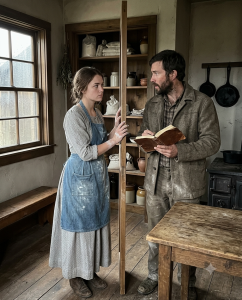
Nobody warned the men at Morgan Ranch that the quiet bride Caleb Morgan brought home would change the entire place before they even realized what she was doing.
At first, they only laughed at her.
When Eliza Heart stepped down from the wagon in her plain dress and sensible shoes, the ranch hands standing near the corral exchanged the kind of grins men use when they think life has just handed them something amusing. Four of them made bets before her boots even touched the ground properly. She looked too soft for the place, too slight, too quiet. Morgan Ranch was all dust, wind, hard labor, and harder tempers. Men broke there. Horses broke there. Even seasons felt sharpened by the land.
Caleb Morgan saw the looks, heard the muttered remarks, and felt the pressure of their judgment settle over him immediately.
He should have been used to it. Men had opinions about everything he did. He ran the ranch with discipline that bordered on severity, and that earned him respect, but not affection. Still, the way they looked at Eliza irritated him in a new way. He had brought her here because something about her steadiness had reached him in a part of himself he rarely examined. He had not expected warmth from the men, but he had not expected open mockery quite so quickly either.
“Your wife?” Hank Turner, the foreman, asked with a raised brow.
“My wife,” Caleb replied.
The younger hand by the fence laughed. “Thought you’d bring home a real ranch woman, boss. Not somebody who looks like she belongs in church.”
Eliza heard him. Caleb knew she did because her gaze turned toward the speaker for the briefest moment. There was no outrage in her face, no flustered embarrassment. She simply looked, lowered her eyes again, and picked up her cloth bag.
That composure unsettled him more than tears would have.
Inside the main house, nothing improved. Morgan Ranch had food, shelter, stock, and land enough to command envy from smaller operations, but it did not have comfort. The dining room was functional, not welcoming. The kitchen served necessity, not pleasure. The meals, prepared by an aging cook named Silas, filled the stomach but offended nearly everything else. Hard biscuits, dry meat, limp beans, weak coffee. The men complained constantly and still ate every bite because there was work to do and no time for standards.
Eliza noticed everything.
That first night she stood at the far end of the room pouring water while the men made their jokes. One said he would rather pay for a meal in town than choke down another supper like this. Another guessed the new Mrs. Morgan could maybe sew curtains but certainly not cook. Hank, sharpening a knife by the door, made the cruelest remark of all.
“A wife like that doesn’t warm a house. She just makes it sadder.”
Caleb heard it. Eliza heard it too. But she didn’t react. She only watched the room with those calm, attentive eyes, as if the meal itself were telling her a story she intended to memorize.
That became her pattern over the next several days.
She moved quietly through the pantry, the kitchen, the cellar, the storeroom, and even the bunkhouse, never intruding loudly and never asking foolish questions. She checked flour sacks. She examined spice jars. She smelled the lard and frowned at the rankness of it. She tested the oven door. She noticed where tools were kept, where waste collected, where water dripped, where men left plates half-scraped and where the housekeeper had long ago stopped trying to make anything pleasant.
Silas caught her in the kitchen and dismissed her sharply.
“No need for a lady standing around in here.”
“I’m not standing around,” she said quietly. “I’m learning.”
Silas laughed in a way that suggested both insult and exhaustion. “Then learn not to be underfoot.”
Caleb overheard that exchange from the hallway and was hit by an unwelcome surge of shame. He was not a sentimental man, and he certainly wasn’t a man skilled at apology, but something about watching her absorb every barb without retaliating made him feel the coarseness of his own household more keenly than before.
At night, Eliza kept a little notebook.
The first time he saw it, she closed it too quickly for him to glimpse the contents.
“What are you writing?” he asked.
“Things I don’t want to forget.”
“About the ranch?”
She glanced toward the kitchen before answering. “About what it’s missing.”
That answer lingered in him longer than he wanted it to.
The truth was, Morgan Ranch was missing more than decent meals. It was missing softness, ease, gratitude, humor—things Caleb had never believed essential. His father had run the place like a campaign. Work first. Emotion nowhere. Caleb had inherited not only the ranch but the habits stamped into its walls. Meals were meant to fuel labor. Rules were meant to prevent chaos. Men were meant to do their jobs and keep their weaknesses to themselves.
Eliza walked into that world like she saw every invisible crack at once.
Then Silas got sick.
The second week brought a bitter morning cold. When the cook did not appear before dawn, one of the stable boys went to fetch him and returned pale-faced. Silas was sweating through his blankets, feverish and barely coherent. The news spread fast. The men began cursing before daylight had properly broken. Without breakfast, the entire rhythm of the ranch would slip. Horses had to be saddled. Gates checked. Stock moved.
“Perfect,” Hank said, slamming his palm onto the table. “Now we won’t even get bad food.”
Caleb was already halfway into the bunkhouse, prepared to assign someone to boil coffee and fry whatever they could salvage, when Eliza appeared in the kitchen doorway.
She wore a plain apron tied neatly around her waist. Her hair was pinned back. Her face, usually soft with quiet reserve, held a new kind of certainty.
“I’ll make breakfast,” she said.
The room turned still.
Hank leaned back in mock amusement. “Mrs. Morgan, with respect, we don’t need tea for dolls.”
Caleb started to cut him off, but Eliza lifted one hand.
“Let him talk.”
Then she entered the kitchen and closed the door.
At first, the men listened with smirks. Then the smells began.
Real butter. Onions hitting hot iron. Meat waking under heat instead of drying to leather. The rich scent of coffee strong enough to announce itself from across the room. Then biscuits—fresh biscuits—rising in the oven with a smell so warm and impossible it silenced complaint more effectively than any shouted order Caleb had ever given.
When Eliza finally opened the door, even Caleb stared.
She carried out breakfast as if she had always belonged there. Skillet potatoes browned perfectly at the edges. Soft eggs folded with cream. Pepper gravy built from proper drippings. Tall golden biscuits. Fried apples scented with cinnamon she had discovered buried in the pantry. The coffee was dark and strong. The whole room smelled transformed.
The men approached cautiously, almost suspiciously, and took their first bites with expressions that changed so quickly it was nearly comical.
One hand closed his eyes after tasting the gravy. Another muttered an actual prayer. Hank bit into a biscuit and said nothing for almost a full minute, which for him was close to a miracle. No one left early. No one pushed away a plate. They ate everything and looked half-offended when there wasn’t more.
Eliza did not bask in their reaction. She simply poured coffee and told them the food would get cold if they kept staring.
That breakfast changed more than the menu.
By the end of the week, no one rode into town for meals. By the week after that, men adjusted their work so they would not miss supper. The table, once a place of grim necessity, began holding people longer. Men lingered. They talked. They laughed. They asked for second helpings and, eventually, for recipes as if it had become perfectly natural to ask the boss’s wife how she got biscuits that high or broth that rich.
Even Silas, once he recovered enough to leave his bed, stood in the kitchen doorway and watched her work with grudging awe.
“Where’d you learn that?” he asked one afternoon after tasting her beef stew.
Eliza did not stop stirring. “At a place where food was the only kindness some people got all day.”
The answer stayed with Caleb.
She was not simply skilled. She understood what food did to people when it was made with care. It softened them. Opened them. Made them less guarded, less hurried. Around her table, the men said things they would never have said while standing in a field with reins in hand.
And Eliza listened.
That was the part Caleb noticed too late.
She learned which man missed his mother’s cornbread and grew quiet on Sundays. Which one secretly sent money to a younger sister in Nebraska. Which one watered down whiskey to hide how much he drank. Which one bullied others because fear was easier than shame. Which one walked with a limp he denied because he needed the wages. She learned where supplies went missing and which excuses were lies. She noticed the signs of infection before the injured hand confessed. She knew who had nightmares, who lied badly, who spoke too quickly when nervous, and who looked toward the south pasture whenever Caleb mentioned his father.
Her little notebook filled steadily.
Caleb didn’t know that at first. He only knew the ranch felt different. Warmer. More human. It irritated him at times because he had not approved those changes or controlled them. Yet he could not deny that the men worked better when they were fed properly, or that arguments cooled faster when Eliza stepped in with a calm word and a direct gaze. Even Hank, who had been first to mock her, began showing restraint in her presence.
One evening Caleb returned from the north fence line and found Hank at the kitchen door holding his hat in both hands.
“Mrs. Morgan,” Hank said, “will there be enough roast left for the night riders?”
Caleb stopped in the hallway.
Hank was asking. Not sneering. Not demanding. Asking.
Eliza, sleeves rolled, glanced over from the stove. “If you stop picking at it before supper, there will be.”
A few of the men laughed. Hank muttered something under his breath but did not bite back. He actually looked faintly embarrassed.
That should have pleased Caleb, but instead it put a strange tension under his skin. Eliza was becoming central to the place in a way no one had anticipated. The men trusted her. The house revolved around her. Even the rhythm of the ranch had begun to adapt to her influence.
Then came the rainstorm.
It started in the afternoon, heavy and wind-driven, drumming against the roof hard enough to rattle window frames. Most of the men were under cover. Caleb came inside soaked from checking the lower pasture and went to the pantry to look for dry cloths.
That was where he saw Eliza’s notebook on a shelf.
He picked it up only to move it somewhere safer. At least that was the excuse he gave himself.
It slipped open in his hand.
He expected recipes, inventory notes, perhaps a list of supplies. Instead he found page after page of names.
Every ranch hand. Every worker. Observations written in precise script.
Bennett: chews too fast when lying. Misses his children. Saves sugar packets in his pocket.
Eli: pretends not to feel the cold. Favors his left wrist.
Jonah: sends letters weekly. Receives none back. Watches the road after mail days.
Then Caleb found his own name.
Caleb Morgan: carries hunger like punishment. Eats as if he doesn’t deserve to enjoy it. Sleeps lightly. Watches doors when angry. Hides loneliness behind rules.
He stared at those lines until something inside him shifted uneasily. She had seen him. Not the capable ranch owner. Not the stern man people obeyed. The man underneath.
Then he turned the page and found Hank’s entry.
Hank Turner: says cruel things before anyone can see what he fears. Knows something about the fire ten years ago. Watches the south pasture whenever Caleb mentions his father.
The pantry floor creaked.
Caleb looked up.
Eliza stood in the doorway, flour dusting her fingers, her expression drained of all softness.
For a long second neither of them spoke.
Finally she said, very quietly, “So now you know where I decided to begin.”
Caleb closed the notebook halfway, though not fully. “What does this mean?”
She stepped inside and shut the pantry door behind her. Rain beat harder against the house. The rest of the ranch seemed to fall away.
“It means your father destroyed my family,” she said.
The words hit him harder than anger would have.
He searched her face for some sign that this was exaggeration, grief, misdirected blame—anything simpler than what she had said. He found only pain held under strict control.
“My father is dead,” Caleb said.
“I know.”
“And you married me because of him?”
“I came here for the truth because no one in town would say it plainly, and the men who knew most had spent ten years burying it.”
Her eyes dropped briefly to the notebook in his hands.
“Hank was one of them.”
Caleb felt the room tilt. “The fire.”
She nodded once. “My father worked for yours. There was a fire in the south storage shed. Officially it was an accident. Officially my father caused it. Officially he drank too much, got careless, and cost your father money. That’s the story that survived.”
“And you don’t believe it.”
“No,” she said. “I know it’s false.”
The certainty in her voice made him go still.
She told him then, not all at once, but in measured fragments, how her father had been blamed after the fire and driven out in disgrace. How their family had lost everything. How her mother had died still insisting he had been innocent. How Eliza had grown up with whispers, with pity, with doors closing to them because Morgan money and Morgan reputation carried more weight than the truth. How she had heard names over the years—Hank among them. How she had taken a job in town. How Caleb had appeared at the boardinghouse. How she had recognized the surname instantly and, against all good sense, stepped toward the one path that might finally lead her into the center of the lie.
“You used me,” Caleb said.
Her face tightened. “At first, yes.”
The honesty cut deeper than any soft denial would have.
“At first?” he repeated.
She held his gaze. “Then I met you.”
There was no room in the moment for romance. The words landed raw and unfinished between them.
Before Caleb could decide whether anger or woundedness was stronger, shouting erupted outside.
A ranch hand was yelling for Hank. Another voice shouted from the yard that the old south storage shed had been forced open. Men were running through rain and mud toward the pasture edge. Caleb’s pulse jumped.
That shed had been locked for years on his father’s orders. Caleb had never challenged it. He had accepted the old explanation: damage, instability, no reason to bother with what remained.
Eliza’s face changed the instant she heard the commotion.
She moved toward the door, but Caleb caught her wrist. “What’s in that shed?”
She met his eyes with a look that held fear, grief, and vindication all at once.
“The proof,” she said.
They ran through rain together.
By the time they reached the south pasture, half the ranch was there. The old shed sagged at one side, weather-beaten and half-swallowed by years of neglect. Its doors hung open. Inside, a lantern threw weak gold over warped wood, dust, and the blackened marks of a fire long past.
Hank Turner stood near the entrance, soaked through, looking like a man whose secrets had just stepped into daylight.
On the ground near his boots lay a metal cash box forced open with a pry bar.
Inside were ledgers, folded papers, and a silver watch blackened by heat.
Caleb felt his stomach drop. He knew that watch. It had belonged to his father.
One of the younger hands pointed to the papers. “Found these tucked under the floorboards.”
Hank turned sharply. “That was private.”
“Private?” Eliza’s voice sliced through the storm. “You mean hidden.”
Everyone looked at her.
She stepped forward, rain slipping down her hair and sleeves, no longer the quiet bride they had underestimated, but a woman who had carried a decade of unanswered grief straight into the heart of the ranch.
“Tell him,” she said to Hank.
Hank’s jaw flexed. “This ain’t the place.”
“It became the place the day your silence ruined my father.”
The men shifted uneasily. Caleb bent and picked up one of the ledgers. The handwriting belonged to his father. The entries were not about feed or wages. They were about diverted funds, falsified losses, and shipments hidden from tax assessors and business partners. Several pages had been ripped out, but enough remained to paint an ugly picture. Then Caleb saw the line that froze him.
Compensation withheld. Blame assigned to Hart.
Hart.
Not Heart. Hart. Eliza’s family name before years of shame had made some people alter it, soften it, forget it.
Caleb looked up slowly. “My father blamed her father to cover theft?”
No one answered.
Eliza did. “And when my father threatened to expose him, the shed burned.”
Hank closed his eyes briefly, like a man too tired to keep carrying his own cowardice. When he finally spoke, his voice sounded older than Caleb had ever heard it.
“It wasn’t meant to go that far.”
The storm seemed to hold itself still around those words.
Caleb stepped toward him. “Start again. Tell the truth.”
Hank swallowed. “Your father was skimming money and hiding stock sales. Eliza’s father found out. Said he wouldn’t keep quiet. They fought in that shed. I was there. So was Silas. We both heard it. Your father shoved him. Lantern went over. Fire caught quick. We all got out, but when the books were at risk, your father said if the truth came out, all of us would hang with him.”
Eliza stood absolutely motionless.
Hank continued, voice rough. “By morning, the story had changed. Hart was drunk. Hart was careless. Hart caused the blaze. Your father paid enough men to repeat it until it became fact.”
“And you helped him,” Eliza said.
Hank looked at the mud. “Yeah.”
Caleb felt fury rise so hot it nearly blinded him. Not only at Hank. At his father. At himself for inheriting a story and never probing its seams. At the ease with which a powerful man had protected his name by crushing another.
“What happened to Eliza’s father?” Caleb asked.
Hank’s answer came quietly. “He left town broken. Died two winters later.”
Rain hit the roof of the shed in a hard burst. No one moved.
Silas, leaning heavily on a younger hand, appeared at the edge of the group. Fever had left him weak, but not silent.
“It’s true,” he said hoarsely. “All of it. I should’ve spoken years ago.”
Eliza’s face tightened, but there was no triumph in it. Only the old ache of being right too late.
Caleb looked at the ledger again, then at the gathered men, then at his wife. He understood suddenly that the warmth she had brought into the ranch had never been simple domestic kindness. It had also been method. She had fed the men until they trusted her, listened until she could sort fear from guilt, watched until the weak places in the old lie began to show.
She had come for justice.
And she had found him in the middle of it.
What happened next changed Morgan Ranch more deeply than any good meal ever had.
Caleb brought the papers to the county office himself. He gave a sworn statement. So did Silas. After two days of pressure and drink and sleeplessness, Hank did too. The official record was amended. It did not restore Eliza’s father to life, but it restored his name. The debt owed to the Hart family was acknowledged in writing. Caleb sold part of a profitable herd and used the money to settle what his father had stolen and withheld, adding more than the records required because figures on paper could never account for the years taken from them.
Some men expected Eliza to leave once the truth was exposed.
She did not.
But neither did things return to what they had been.
For a while, Caleb and Eliza lived in a silence more honest than any they had shared before. She had used him. He had unknowingly benefited from the injustice done to her family. Love, if it was growing there, had to crawl through the wreckage of all that truth. There were nights they ate in near-quiet, both exhausted by what could not be undone. There were mornings she avoided his eyes. There were afternoons he stood outside the kitchen door with words he did not know how to shape.
Then one evening he found her alone at the table, notebook open.
“Still writing what the ranch is missing?” he asked.
She looked up. “Less than before.”
He sat across from her. “What does it still need?”
Her answer came after a long pause. “Something better than guilt.”
He nodded slowly. “Then I’ll have to learn.”
That was the beginning.
Not forgiveness handed over neatly. Not romance suddenly purified by confession. Something harder and more real. Caleb stopped running the place like punishment. He repaired the house as well as the fences. He paid closer attention to the men, not only their labor. He listened when Eliza spoke. She, in turn, stopped measuring every room as if preparing for battle. She began leaving the notebook closed more often. Sometimes she laughed. The sound startled everyone the first few times, including her.
Morgan Ranch never became soft, but it became human.
The table stayed full. The food stayed good. Men still worked brutally hard, but they did so under a roof that no longer felt starved of warmth. Hank remained for one season more, long enough to help correct old records and shoulder some of the public shame he had earned, then left on his own. Silas retired properly and, to everyone’s surprise, admitted that Eliza’s biscuits were better than his had ever been.
As for Caleb and Eliza, theirs became the kind of marriage born twice—once from need and deception, and again from truth.
Years later, people in town still told the story of the plain bride who came to Morgan Ranch and made the hands stop eating in town. They laughed when they told it, focusing on the cooking, the biscuits, the gravy, the men wandering around half in love with roast chicken and pie.
But that was never the real story.
The real story was that a woman everyone underestimated walked into the house of the family that had ruined hers, fed its people until they forgot to guard themselves, uncovered a buried lie, and forced a powerful name to answer for what it had done.
And maybe that is the part that lingers longest.
Not whether Eliza was right to marry Caleb with a secret in her heart. Not whether Caleb deserved the grace she eventually gave him. Not even whether justice can ever make up for years stolen by silence.
Maybe the question that remains is simpler and sharper than that.
What should matter more—the kindness a person offers you now, or the damage attached to the name they were born carrying?