She almost didn’t unlock the door.
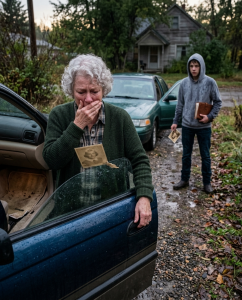
Years later, Dottie Marsh would still think about that exact moment in the Harvest Foods parking lot in Billings and wonder how many lives turn on decisions so small they barely feel like decisions at all. A hand reaching across a seat. A latch clicking open. Twenty minutes of shelter offered to a soaked teenager under a grocery store overhang while rain came down sideways and the whole sky looked determined to flood eastern Montana clean off the map.
At sixty-seven, Dottie’s life had narrowed into routines she trusted. She parked far from the entrance. She shopped with a list written in blue pen on the back of old church bulletins. She drove home to Roundup before dark if she could help it. Since Gerald died eighteen months earlier, routine had become less a habit than a railing.
So when she saw the boy under the cart return, what moved her was not drama. It was the opposite.
He looked like somebody who had already learned not to expect rescue.
Gray hoodie soaked dark. Thin shoulders bowed inward. One hand clutching a plastic grocery bag so tightly the handles were stretched white. He stood in the useless strip of shelter as rain blew past him from all directions, not asking, not signaling, just enduring.
Dottie watched him longer than she liked to admit. Long enough to imagine Gerald’s voice saying, Well, Dot, either let him in or stop staring.
She pushed open the passenger door.
The boy hesitated before climbing in, and even that struck her. Most teenagers would have moved fast. This one studied her face first, as though he needed to know whether kindness had conditions attached.
“Just till it slows down,” she said. “I’m not going anywhere.”
“Thank you,” he said. Then, a beat later, “Really. Thank you.”
He sat with his hands folded around the bag in his lap. He smelled faintly of rain and wet cotton. Fifteen, maybe sixteen. Brown eyes that kept flicking to the windshield, then down, then back again. His name was Daniel.
Dottie introduced herself. He nodded politely. Not chatty. Not rude. Just careful.
The rain drummed on the roof hard enough to swallow conversation. Dottie left it that way. After thirty-four years as head librarian in Roundup, she knew how to share quiet without making it feel like emptiness. Silence could be a gift when offered properly.
After a while she noticed him looking over his shoulder at the canvas bag in her back seat, the one with the old Missoula Public Library patch.
“You read?” she asked.
Something opened in his face and closed again almost immediately.
“My grandfather was,” he said.
Was. Past tense, weighted enough that Dottie didn’t ask another question. She simply said she was sorry, and he answered with a small nod, like grief was too ordinary in his life to require words.
When the storm eased, he got out quickly. Thanked her a third time. Crossed the lot without looking back.
That should have been the end of it.
Then she found the photograph under the passenger seat.
It was soft at the edges, worn by being carried. Face-down. She picked it up and for reasons she could not have explained, she did not turn it over. Not in the car. Not on the drive home. Not while passing the grain elevators, the Methodist church, the water tower, all the landmarks of a life she believed she understood.
At home she left it on the counter while she put away groceries with hands that kept pausing over ordinary objects. Milk. Bread. Tea bags. Nothing sat right inside her. The feeling was old and particular. It reminded her of the morning after Gerald’s funeral when she found his journals in the cedar chest at the foot of their bed.
He had never told her he kept journals.
Thirty years of entries in his tight, slanted handwriting. Some were practical, lists of weather and expenses and names. Others were private weather systems of a different kind: fear when Dottie had her biopsy; joy when their daughter Claire took her first teaching job in Bozeman; the shame he felt after a fight he had ended with silence because silence was the only apology his father had ever modeled.
Dottie had cried through half of them. She had laughed through some. She had loved him more for all the tenderness he had failed to speak and managed, somehow, to write down.
But there had also been gaps.
Several missing volumes from the years before their marriage. Gerald had numbered the journals in Roman numerals on the spine, and between the cracked leather books marked III and VII there had been a clean, impossible absence. Four years gone.
When she asked Claire whether she had seen them while helping sort the house, Claire said no. Dottie assumed they had been lost in one of the moves, or ruined in the basement flood back in ’93, or thrown out by Gerald himself because young men often disliked the evidence of who they had once been.
Still, every now and then she wondered what was inside those missing books.
Now the photograph lay in her palm and that old feeling returned.
She took it back outside to the Subaru, as if the house could not contain whatever truth had attached itself to that little square of paper. The evening was dim and damp. The driveway shone slick. She opened the car door and turned the picture over.
Gerald.
Seventeen years old, solemn in his senior portrait. Dark hair. One eyebrow slightly higher than the other. The same mouth that had smiled at her across decades of breakfasts and funerals and ordinary Tuesdays. She knew that face intimately. And because she knew it so well, the shock struck harder.
This was not merely a copy she had forgotten existed.
On the back, in Gerald’s handwriting, were four words.
For my son, Jacob.
And below them a date from October 1975.
Dottie was already dating Gerald then.
She stood in the driveway not breathing until the crunch of tires on gravel snapped her head up. Daniel’s old sedan had pulled in behind her Subaru. He got out holding a second photograph and a weathered leather journal under his arm.
“Mrs. Marsh?” he said.
She nearly told him to leave. Nearly told him she was too old for secrets and too tired for dead men rearranging her life. But his face stopped her. Not because it looked like Gerald. Not exactly. Because it carried the same expression Gerald used to wear whenever he expected bad news and intended to stand still for it.
“What is this?” she asked, lifting the photograph.
Daniel came closer and held out the other picture.
Young Gerald stood beside a beautiful dark-haired girl Dottie recognized on sight: Elise Varnum, daughter of Evelyn Varnum, who had become one of Dottie’s closest friends in town years later. In the photograph Gerald’s arm brushed Elise’s sleeve. They were too close to be casual.
“My dad was Jacob Varnum,” Daniel said. “Gerald was his father.”
The air seemed to leave the world.
Dottie knew Evelyn’s story as it had always been told: Elise got wild young, left Montana after a fight with her mother, raised a son out of state, died before reconciling with the family. Dottie had accepted that version because it had never seemed to belong to her life.
Now Daniel held out the missing journal.
“My dad found Gerald five years ago,” he said. “He wasn’t trying to hurt anybody. He just wanted answers. Gerald asked him not to tell you until he could explain it himself. Then he got sick. Then my dad got sick. Before he died, he made me promise to bring you this if Gerald never did.”
Inside the front cover was a sealed envelope with Dottie’s name written on it in Gerald’s hand.
She opened it at the kitchen table while Daniel sat across from her dripping quietly onto an old dish towel she had put beneath his chair.
Dot,
If Jacob’s son is standing in front of you, then I have run out of time to tell you what I should have told you myself. You may hate me after this. I hope you will at least hate me for the truth.
The letter trembled in her fingers as she read.
In 1974, before Dottie and Gerald became serious, Gerald had been in love with Elise Varnum. Young, foolish, intense. They had planned to leave for Missoula together after graduation. Then Elise became pregnant.
Gerald wrote that he was ready to marry her. Ready to work two jobs. Ready to disappoint every expectation in town if that was the price. But Evelyn intervened.
Dottie read the next pages twice because the facts felt impossible.
Evelyn had come to Gerald alone one night while Elise was staying with relatives. She told him Elise had changed her mind, that she did not want him, that the baby could not be his because there had been someone else. She made him swear never to embarrass her daughter by asking questions in public. Gerald, nineteen and humiliated, believed her for two miserable months.
Then Elise called him once from Spokane, crying, saying none of it was true. Her mother had forced her out. The baby was his. She begged him to come.
He drove west that same night.
By the time he found the address, Elise and the baby were gone.
Gerald spent a year writing letters that came back unopened. He called until the number changed. Eventually he was drafted into a version of adulthood built on duty and suppression. When he returned, he met Dottie at a church picnic. She was kind and steady and funny in a dry way that made him feel more honest than he had in years. He told himself the chapter with Elise had been sealed by cruelty beyond his control.
So why had he never told Dottie?
The answer in the letter was uglier than betrayal but not cleaner.
Because shame calcified.
Because he had tried once, early in their marriage, and been interrupted by Dottie’s father landing in the hospital and Claire arriving two years later and the thousand practical emergencies by which silence disguises itself as patience. Because every year that passed made the confession harder, and once Evelyn moved back to Roundup and pretended not to know him in any meaningful way, Gerald convinced himself the old wound would die with the people who caused it.
Except it didn’t.
Five years before his death, Jacob found him through a DNA site after Elise died. Jacob was forty-four, a mechanic in Idaho, and furious. He had grown up with Evelyn’s version too, except harsher: that his father had abandoned him before he was born.
They met in a diner outside Butte.
Gerald described the meeting in the missing journal with a pain so raw Dottie had to stop reading twice. Jacob arrived with suspicion sharpened into a weapon. Gerald arrived with thirty years of regret. Neither man got what he wanted. Yet neither could quite leave.
There were more meetings. Awkward lunches. Medical-history conversations disguised as practical necessity. A fishing trip neither of them enjoyed and both cherished afterward. Claire never knew because Gerald kept postponing the conversation with Dottie until it could be complete, careful, worthy.
Then doctors found the mass in his lung.
He had intended, letter after letter insisted, to tell Dottie after surgery. Then after the second round of treatment. Then after Christmas because Christmas had enough sadness in it already. Then after Claire’s school-year ended so she could be there. Then time closed.
Dottie wiped her eyes angrily. “Coward,” she muttered.
Daniel, sitting so still at the table, said, “My dad called him that too. At first.”
At first.
The story came out in pieces over tea Dottie forgot to sweeten.
Jacob had not fully forgiven Gerald, but he had come to believe him. What changed his mind was not a speech. It was evidence hidden in plain sight: dozens of returned letters Gerald had kept, each addressed to Elise at old Spokane addresses, postmarked 1974 and 1975. Evelyn had lied to everyone. To protect reputation. To avoid scandal. To keep her daughter’s pregnancy from becoming town gossip. And when lies require maintenance, they demand more lies. Evelyn told Elise Gerald had rejected her. Told Gerald the child might not be his. Told Jacob his father disappeared by choice.
When Jacob confronted her in her nursing home room three years ago, Evelyn finally admitted it.
“Did you know?” Dottie asked Daniel quietly.
He shook his head. “Not all of it. Dad wanted to tell you in person. Then he got pancreatic cancer. He said if he couldn’t do it, I had to.”
“Why come to Billings first?”
Daniel looked at the grocery bag he had nearly crushed in both hands earlier. “I had the journal and the pictures in there. I drove to your house and sat outside for twenty minutes. Then I panicked and went to town instead. I wasn’t sure you’d want to see me.”
That broke her more than any page.
He was sixteen. His father dead three months. His grandmother gone. His biological great-grandfather buried. And he had still crossed two states in a storm to hand a widow the missing half of her own marriage.
Dottie rose from the table and went to the cedar chest. When she returned, she placed Gerald’s other journals beside the missing one Daniel had carried in.
“For all these years,” she said, not quite to him, “I thought I knew which silence belonged to me and which didn’t.”
She read until midnight.
The missing journals did not reveal a double life. They revealed a damaged young man trying and failing to outrun a loss that had been engineered for him. They revealed the first months of his love for Dottie too, and that part hurt in a different way. He wrote that he did not deserve her steadiness. That he feared he had come to her with a room inside himself boarded shut. That if the past ever returned, he must tell her everything.
He had meant to. He had failed.
By two in the morning, Dottie knew two things at once: Gerald had wronged her, and Gerald had also been wronged. Betrayal could coexist with tragedy. Love could survive inside cowardice and still leave wounds.
Daniel dozed in the armchair under Gerald’s old afghan while she finished the last pages. At dawn she covered him with another blanket and watched his sleeping face in the gray light.
Family resemblance, she decided, was less in the eyes than in the held breath.
The next weeks changed more than she expected.
Dottie called Claire and told her everything. Claire cried, then raged, then asked practical questions in exactly the order Dottie would have. They drove together to Idaho for Jacob’s memorial service, where Dottie met the people Gerald had almost had and almost lost: Jacob’s sister by adoption, who hugged her fiercely; Daniel’s aunt, who had her mother Elise’s mouth; old friends who said Jacob had been stubborn, funny, and impossible to intimidate.
At the service Daniel stood at the lectern and spoke about fathers, the ones who fail you, the ones who try too late, and the terrible mercy of learning that both things can be true.
A month later, Dottie visited Evelyn’s grave alone.
She did not forgive her there. She did not curse her either. She simply stood in the wind and said, “You stole forty years from all of us.” It felt insufficient. It was also accurate.
By autumn, Daniel was calling once a week. First for questions about Gerald’s medical history, then about books, then about whether it was normal to miss people you had only just begun to know. Dottie told him yes. More normal than anyone admitted.
At Christmas, Claire set an extra place at the table and did not make a ceremony of it. Daniel came with a pie from a gas station bakery and apologized for it until Dottie laughed and told him a Marsh family rule was that any pie delivered through snow counted as a miracle.
After dinner she showed him Gerald’s fishing tackle, the Methodist church directory photos, the embarrassing mustache year, the brass library stamp Gerald once tried to borrow and never returned properly. Daniel laughed in the same surprised burst Gerald used to when something caught him off guard.
That laugh nearly undid her.
The full truth never became neat. There was no version in which Gerald turned innocent or Dottie turned unharmed. There was only the version in which human beings failed one another in overlapping circles of fear, pride, shame, and love.
Sometimes, late in the evening, Dottie still reread Gerald’s letter. Not because it made everything better. Because it made things clearer.
He had loved her.
He had also hidden a son.
Both facts sat on the page together, refusing simplification.
In the spring, Daniel visited again. They drove to Billings for groceries and, on the way back, passed the Harvest Foods where it had all begun. Rain stitched the windshield, light and harmless this time.
“That’s the parking lot,” Daniel said quietly.
Dottie smiled without looking at him. “I know.”
He was silent a moment. Then he asked, “Do you ever wish you hadn’t opened the door?”
She thought of the journals. The lies. The grief. The lost decades. The grandson found too late and yet somehow not too late at all.
“No,” she said.
Because some truths wreck the house they enter.
And some truths, arriving wet and shivering and years overdue, turn out to be family.
When she glanced over, Daniel was looking out at the rain with Gerald’s old habit of pressing his lips together before emotion showed. Dottie reached across the seat and patted his hand once, a small ordinary gesture. The kind lives are built on. The kind lives are changed by.
Later, she would wonder what the biggest red flag had been all those years ago. Gerald’s silences. Evelyn’s polished stories. The way small towns protect appearances more fiercely than people. She never settled on one answer.
What she knew was this: love is not made false by what it fails to know, but it is tested by what it chooses to do when the truth finally arrives.
And on a rain-struck afternoon in a grocery store parking lot, the truth had arrived looking like a cold boy asking for nothing.