Jonah Reed had not wanted to go to the church fundraiser.
He had agreed for Lucy.
That was how so many hard things happened now. Not because he wanted to be around people. Not because he believed fresh air and folding tables and casserole smiles could do anything meaningful against grief. But because his daughter was five years old, and five-year-olds still wanted balloons even when death had moved into the house and made every room quieter than it used to be.
Since Claire died the previous winter, Jonah had developed a private dislike for community events. People either avoided him, as if widowhood might be contagious, or they approached him with that same softened expression that always made him feel like he had already become a story told in a lower voice.
Lucy, on the other hand, had started asking why weekends felt empty.
Why nobody sang in the kitchen anymore.
Why Daddy didn’t laugh when pancakes stuck to the pan.
Why the house still smelled like Mommy’s hand cream in one drawer and nowhere else.
So when the church sent home a fundraiser flyer covered in cartoon cupcakes and raffle prizes, Lucy had looked at him and asked whether face painting counted as church work.
He had almost said no.
Then she had smiled in a way so painfully like Claire that his resistance collapsed.
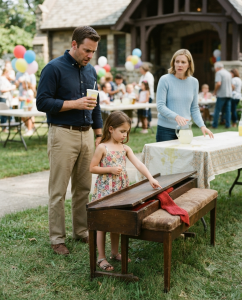
That was how he ended up on the lawn of St. Matthew’s on a bright Saturday afternoon, carrying his daughter on one hip while the whole place buzzed with the careful cheerfulness churches have perfected over generations. Children ran in zigzags between tables. Women arranged lemon bars under plastic wrap. Men stood over grills discussing charcoal with the seriousness of surgeons. Teenagers in volunteer shirts looked embarrassed by everything.
It was the kind of afternoon built to suggest that whatever was broken in a person’s life might soften if enough people around them kept acting normal.
Jonah had never believed that for a second.
Lucy pointed out every booth they passed. The paper angel craft station. The used book table. A dog tied near the bake sale wearing a tiny neckerchief. Jonah nodded at all of it and answered when necessary, trying to look less tired than he felt.
At the lemonade stand, a woman in a pale blue sweater turned toward them with a pitcher in both hands.
She looked around his age, maybe a little younger. Her hair was pinned back carelessly, as if she had done it in a rush and forgotten to check a mirror. Her face was warm but drawn, the kind of face that might once have looked open and easy before life added years in places sleep could not fix.
“One or two cups?” she asked.
“Two,” Jonah said.
But Lucy was staring.
He felt a thread of apprehension pull tight immediately. Children stared for strange reasons, and in the months since Claire’s death, he had become too alert to anything even slightly out of rhythm.
The woman noticed it too. “Hi,” she said gently to Lucy.
Lucy narrowed her eyes with thoughtful seriousness.
Then she asked, “Do you still keep the red scarf in the piano bench?”
The pitcher slipped in the woman’s hands.
Lemonade splashed over the edge of the tablecloth.
She did not drop it. But she froze so completely that Jonah’s body reacted before his mind caught up.
“Lucy,” he said sharply.
His daughter looked offended. “What? She does.”
The woman slowly set the pitcher down. Her knuckles had gone white. “What did you say?”
Lucy pointed toward the church hall. “The scarf. In the piano bench. Mommy said you put it there because you couldn’t throw it away.”
All at once the noise around them lost clarity. The laughter from the raffle table, the thump of feet on grass, the crackle of a microphone—everything thinned into distant static.
“Who is your mother?” the woman asked.
Something defensive flared in Jonah before he could regulate it. “My wife is dead.”
The woman’s gaze snapped to his face.
Not surprise.
Not curiosity.
Pain.
“I know,” she whispered.
Jonah felt the air leave his lungs.
Lucy rested her chin on his shoulder. “Daddy, she’s the one from Mommy’s songs.”
Claire had left voice notes on her phone—lullabies, half-finished melodies, recordings of herself singing nonsense words to Lucy when she was a baby. Recently Lucy had been begging to listen to them at bedtime. Jonah almost always said yes and then paid for it afterward, lying awake while Claire’s voice lived for a few minutes inside a speaker and disappeared again.
The woman’s fingers dug into the table. “Claire Reed?”
Jonah stared at her. “Who are you?”
She looked at Lucy first, and it was such a naked expression of grief that his anger paused in confusion.
Then she said, “My name is Elise.”
The name hit him with the force of an old bruise pressed suddenly hard.
Years earlier—before Lucy, before cancer, before the routine shape of ordinary married life had fully set around them—Jonah had once come home to find Claire crying over a letter in their kitchen. He had asked what was wrong. She had hidden the page too fast. He had asked who it was from.
She had only said, “Someone I hurt because I was trying to survive.”
When he pressed again, she had whispered a name.
Elise.
He had not pushed further. At the time, it felt respectful. Mature. Loving, even. Marriage had made him believe there would always be a safer day for difficult truth.
There hadn’t been.
Now a woman with that name was standing behind a lemonade table shaking so badly she could barely remain upright.
“Please,” Elise said. “Come inside.”
He should have walked away.
Instead he followed her into the church hall.
The room smelled like wood polish, lemon cleaner, and old paper. Sunlight slanted through stained glass and landed in colored fragments across the floor. At the far wall stood an upright piano Jonah vaguely remembered from holiday services. Its bench sat open, and a red scarf hung visibly over the edge.
Lucy wriggled down from his arms and moved toward it.
Elise reached the bench first but didn’t touch the scarf. She looked at it with a rawness that made any lie impossible.
“I haven’t opened this in years,” she said.
“You knew my wife,” Jonah replied.
Elise nodded.
“How?”
She met his eyes. “We were together.”
For a heartbeat, he understood each word individually and none of them collectively.
Then understanding arrived all at once.
His first thought was not outrage. Not even jealousy. It was something colder and sadder: a rearranging of the past.
Claire’s occasional silences.
Her discomfort around certain church conversations.
The old photos she once called “a different life.”
The strange tenderness and regret in some of her songs.
Lucy climbed onto the piano bench and touched the scarf. “Mommy said this was the one you wore when she played the wrong hymn twice.”
Elise laughed through tears, the sound collapsing halfway into a sob. “She remembered that?”
Jonah looked sharply from Lucy to Elise. “How do you know that story?”
Elise wiped her face. “Because it happened.”
And then, with the gentleness of someone handling something both precious and dangerous, she told him.
Years ago, Claire had come to St. Matthew’s temporarily to help with music. Elise taught in the church school then. Their first conversations had been ordinary—sheet music, choir rehearsals, children’s pageants. The ordinary did not stay ordinary. There were longer talks after practice, shared jokes people didn’t notice, private glances that became impossible not to notice to each other. Claire was restless, brilliant, funny in flashes, and carrying some unnamed weight even then. Elise was steadier, rooted, cautious. Somehow that difference became its own kind of gravity.
They fell in love in the sort of environment where falling in love with the wrong person could cost more than either of them knew how to pay.
Claire wanted to leave town. Elise wanted that too, but with less confidence and more realism. Then Claire’s father got ill. Family pressure deepened. Rumors started. Fear moved in. The life they imagined together stopped looking romantic and started looking impossible.
“Claire panicked,” Elise said quietly. “She called it practicality. I called it leaving.”
Jonah stood very still, listening to the life his wife had lived before him take shape in another woman’s mouth.
“Did she love me?” he asked before he could stop himself.
It was a humiliating question, but grief strips dignity first and asks permission later.
Elise did not hesitate. “Yes.”
That hurt more than a denial would have.
Because it meant the truth was not simple. Claire had not divided herself neatly into before and after. She had not necessarily chosen one love and discarded another. She had survived by becoming the person her life would permit, and somewhere in that process she had both loved Jonah and betrayed something essential in herself.
Lucy, unaware of the precise wound but sensitive to tension, slid her hand into Jonah’s.
“Elise,” she said softly, “Mommy said you were the bravest person she knew. But she was the one who left.”
Elise folded inward around the words. Jonah could see how deep they landed.
He should have asked Lucy to stop speaking. Instead he found himself unable to interrupt, because each impossible sentence was revealing something no adult in the room knew how to reach on purpose.
Then Lucy said the thing that changed the day entirely.
“Mommy came back here one last time,” she said.
Jonah looked at her. “What?”
“After she got sick.”
His pulse stuttered.
Claire had made several unexplained trips in the last months of her illness. She said they were appointments, paperwork, errands she preferred to handle alone. He had disliked it but accepted it. Illness shifts the balance of a marriage in strange ways; the healthy spouse becomes desperate to help, and the sick spouse sometimes becomes equally desperate to preserve one private corner of agency.
Elise had gone pale.
“She came here?” Jonah asked.
Elise nodded slowly, as if dragged by memory she had been resisting for too long. “One evening. A Tuesday. The children’s choir had just left. I heard the side door open, and there she was.”
She described Claire thin and exhausted but unmistakable, standing in the dusky hall with one hand gripping the back pew as if she needed the building itself to steady her. At first Elise had thought she was imagining things. Then Claire smiled that small, apologetic smile Elise had once known too well, and reality became harder, not easier.
“She said she didn’t have much time,” Elise whispered.
Jonah stared.
“She said she had been thinking about honesty. About what she had done to us. To you. To herself.” Elise looked at the scarf. “She said she was tired of every important truth in her life being stored in rooms nobody entered.”
Jonah could not speak.
Elise told him Claire had cried at the piano. That she had sat on the bench with the red scarf in her hands and laughed once at the absurdity of finding the same scarf after so many years. That she had said she wanted Lucy to grow up knowing her mother was not only the version people found easiest to understand.
“She said you deserved the truth,” Elise said. “Not because she didn’t love you. Because she did.”
There was a cruelty in that distinction Jonah had no strength to untangle.
“She brought a letter,” Elise continued. “For me. Or maybe for both of us. I don’t know. She said if she found the courage, she would tell you herself and the letter would never matter. She left it in the bench and asked me not to touch it unless…” Elise broke off.
“Unless what?”
“Unless the truth came looking for us anyway.”
Jonah closed his eyes.
Claire had intended to tell him.
Maybe.
Eventually.
When she could bear it.
When she could survive the consequences.
But death had arrived first, and now their daughter—small, solemn, unexplainable—had walked into a fundraiser and kicked open a door everyone else had left shut.
Elise reached into the piano bench and lifted an envelope.
Claire’s handwriting stared back at Jonah from the front. Time had faded the ink, and a water stain blurred the lower corner. He knew that handwriting intimately: grocery lists on the fridge, notes in Lucy’s lunch, messages left beside his coffee mug during the years before illness swallowed routine.
He took the envelope in numb fingers.
Elise said, “There’s something else.”
He looked up.
“The day Claire came back, she wasn’t alone.”
A new kind of dread moved through him. “Who was with her?”
Elise glanced toward Lucy, then lowered her voice. “A man.”
Jonah felt confusion cut cleanly through grief. “What man?”
“I didn’t know him.” Elise swallowed. “He waited outside at first. Then he came in when she started crying.”
Jealousy did not come. Something worse did: the realization that there were still more rooms in Claire’s life he had never entered.
“What did he look like?”
“Older than us. Maybe mid-fifties. Dark coat. Greying beard. He looked… familiar somehow. Not familiar to me personally. Familiar to Claire.”
Jonah searched his memory and found only fragments. Doctors. Hospice personnel. Cousins. Family friends. Men from church he had never noticed long enough to remember.
“What happened?”
Elise took a breath. “He told Claire they were out of time.”
The phrase sent a chill through Jonah.
Elise explained that the man had been gentle but urgent. Protective, almost. Claire had argued with him quietly near the side door. Elise had caught only pieces—“not yet,” “he deserves more,” “I can’t do this in a hallway.” Then Claire had come back to the piano, put the letter in the bench, kissed the red scarf once with a ridiculous sad smile, and said maybe some truths only arrive after you’re gone.
“Who was he?” Jonah asked again.
“I don’t know.”
That answer would not leave him alone.
He took Lucy home early. The fundraiser continued without them. He barely remembered the drive. Lucy fell asleep in the back seat with a streak of face paint she never got to choose because she never made it to that booth.
That evening, after tucking her into bed, Jonah sat at the kitchen table with the envelope in front of him and all the lights off except the one above the stove.
For a long time he did not open it.
He thought of Claire in this same kitchen years earlier with tears on her face and a letter in her hands. He thought of all the times he had chosen patience over intrusion and called that love. He thought of how often love really was patience—and how sometimes it became an alibi for fear.
Finally he slid a finger beneath the seal.
Inside were several pages folded carefully together.
The first line nearly undid him.
If you are reading this, then truth has finally become less cruel than silence.
Claire’s letter was not a confession in the dramatic sense. It was not written to shock. It was written by a woman who had run out of time and was trying, imperfectly, to leave something honest behind.
She wrote that she had loved Elise deeply and failed her badly. She wrote that she had loved Jonah too, and that the two truths had spent years being arranged by other people into shapes that made no moral sense but emotional sense all the same. She wrote that she had not married him as a lie, though she had entered the marriage carrying unfinished grief she never fully named. She wrote that motherhood had made her more honest internally and less brave externally, because the more she loved Lucy, the more terrified she became of any truth that might destabilize the child’s world.
Then came the part about the man.
His name was Samuel Price.
Jonah read it twice before placing him.
Claire’s uncle.
A black sheep branch of the family, half-spoken of and rarely seen. The one relative who had quietly sent money during her treatment without ever making a show of it. Jonah had met him once, maybe twice.
Claire explained that Samuel had known about Elise. Years ago, when everything had begun collapsing, he had been the only family member who told her that fear and goodness were not the same thing. Near the end of her illness, when she decided she wanted to put her life in order, he drove her to St. Matthew’s because she was too weak to go alone and too ashamed to ask Jonah before she was ready to explain.
She had intended to come home that night and tell him everything.
She couldn’t do it.
Not because she changed her mind.
Because she looked at Lucy asleep on the couch, saw Jonah washing dishes with his sleeves rolled up, and lost her nerve in the face of the ordinary life she had once prayed for and later found too late to be uncomplicated.
In the letter she apologized, but not in the vague, polished way people do when they hope apology will function like erasure. She apologized specifically. For underestimating his strength. For letting him build a life beside a sealed door. For asking Elise to keep a silence that belonged to all of them. For teaching Lucy songs full of ghosts and never naming them.
The final page was the hardest.
Claire wrote that if Jonah ever met Elise, he should know this: Elise had not ruined anything. Elise had been the truest version of herself Claire had ever known, and the red flag in their story had not been love but fear—fear of town gossip, fear of family expectations, fear of losing belonging, fear so normalized it started dressing up as wisdom.
Jonah sat with the pages until dawn.
The next morning he called Samuel.
The older man answered on the third ring and knew immediately why Jonah was calling. His voice cracked before Jonah even said Claire’s name. They met that afternoon in a diner off the highway, where Samuel confessed he had begged Claire to tell Jonah everything the night he drove her to the church. She had intended to. She had rehearsed it in the car. Then she panicked.
“She loved you,” Samuel said heavily. “That was the problem. She thought telling you would destroy the home she’d built. She was wrong. But she was dying, son. Dying people still make frightened choices.”
Later that week, Jonah returned to the church.
Not for answers this time. For closure, or whatever damaged approximation of closure real life permits.
Elise was in the hall alone. The red scarf lay folded on the piano.
They spoke for nearly two hours.
No accusation they exchanged stayed simple. Jonah had a right to be angry, and he was. Elise had a right to her own grief, and she carried it without defending herself. They talked about Claire’s laugh, her stubbornness, the way she hummed while looking for things. They talked about her terror near the end, about what illness strips away and what it reveals. Elise admitted she had nearly mailed Jonah the letter after the funeral but could not bear to turn his mourning into public wreckage before he had caught his breath.
He believed her.
Not immediately.
Not generously.
But enough.
When Lucy came with him the following Sunday, she walked straight to Elise as if continuing a conversation interrupted only briefly. Elise knelt and let Lucy drape the red scarf around both their shoulders. Jonah watched from the back pew with a pain so strange it almost felt like peace.
Months passed.
The shape of Claire’s memory changed.
Not easier.
Truer.
Jonah began telling Lucy stories that included more than one version of her mother. Claire the singer. Claire the anxious planner. Claire the woman who once burned soup because she was trying to dance in socks. Claire the person who loved deeply and sometimes made fearful choices. Claire the mother who left behind more honesty than she managed to live.
As Lucy grew, she asked questions in stages, each appropriate to the age she was then. Jonah answered as best he could. When she was older, he showed her the letter. He did not do it to burden her, but to refuse the family tradition of tidying human complexity into lies children are expected to inherit quietly.
He and Elise never became what movies would demand.
They did not fall in love.
They did not become best friends overnight.
They did not solve each other.
But they became something rarer and perhaps more useful: two people willing to hold the same complicated memory without trying to own it.
On certain evenings, Lucy sat at the old piano while Elise showed her chords. Sometimes Jonah listened from the doorway. Sometimes they sang Claire’s songs, not as hauntings now but as inheritance.
The red scarf remained in the bench for another year. Then one winter Lucy asked whether they could finally take it out because “hidden things make too much dust.”
Elise laughed so hard she cried.
Together they shook out the scarf in the church yard. It still smelled faintly of cedar and age and rain-soaked wool. Lucy wrapped it around her own neck, then around Jonah’s, then around Elise’s, turning grief into a shared ridiculous tangle until all three of them were laughing in the cold.
Later, alone, Jonah stood in the empty hall and looked at the piano bench one more time.
For a long time he had thought the worst betrayal in his marriage was the secret itself. But memory had taught him something sharper. The deepest wound was not that Claire had loved before him or differently than he understood. It was that fear—other people’s fear, her fear, the whole town’s silent pressure—had convinced her that truth was something dangerous enough to postpone until there might be no life left in which to survive it.
He still did not know whether he would have handled it well if she had told him sooner. Maybe he would have been angry. Maybe wounded. Maybe both. But that uncertainty had become its own answer. Real love is not protected by ignorance nearly as often as people think.
When he finally left the church that night, he touched the closed piano bench with two fingers in passing.
A hiding place, he thought, can look a lot like a place of safekeeping until enough years go by.
Claire had spent too many of hers confusing the two.
And if there was any aftershock that remained when the anger settled and the tenderness returned, it was this: the biggest red flag in the whole story had never been who Claire loved. It had been how many people around her taught her, in ways subtle and direct, that honesty would cost more than silence.