When Elena Sandoval lifted her hand at the livestock auction in Tepatitlán and offered two pesos for each of the thirty-seven skinniest goats in the corral, the laughter came so quickly it felt rehearsed.
Men turned from the rails to stare at her. One nudged another with his elbow. Someone actually whistled. The auctioneer leaned forward, hand cupped to his ear as if dignity itself required him to double-check what he had heard.
“Two pesos, señora?”
Elena held his gaze. “Two.”
That only made it worse.
July heat in Los Altos de Jalisco had a way of flattening everything—grass, patience, hope. The air above the dirt pens shivered. Sweat ran down the necks of ranchers wearing crisp shirts and expensive hats, men who spoke loudly when money was being lost and even louder when it belonged to someone else.
Mateo Sandoval stood next to his wife with his face tight and colorless. He looked like a man trying not to react in public to something he didn’t understand in private. He had spent three years scraping a living from a stony slope outside San Miguel, and now the whole town was watching Elena spend what little they had left on animals that looked one dry week away from dying.
At the end of the pen, Don Silvestre Corona adjusted his mustache with two fingers and let the corner of his mouth curl.
“Some people don’t know how to lose with dignity,” he said.
Silvestre owned the biggest dairy in the region. He sat on the board of the Caja Rural. He donated to church repairs, sponsored local rodeos, lent tractors at election time, and wore respectability so naturally that most people no longer noticed how carefully he had built it. When he spoke, men laughed because they wanted him to see them laugh.
“First the money runs out,” he added. “Then the shame.”
Elena heard every word. She said nothing.
She had long ago learned that silence unsettled people more than defending herself.
On the ride home, the goats kicked and cried in the back of their battered truck while dust curled behind them in a long pale trail. One had a cloudy eye. Several were infested with worms. Their ribs stood out like fingers under torn hides. Mateo drove with both hands locked on the wheel until he finally said what he had been holding in since the auction yard.
“Explain it to me.”
Elena stared at the hills. Dry brush. Thorn scrub. Patches of cactus. Thin grass. Land cattle hated.
“Our slope doesn’t work for cows,” she said. “It works for goats.”
“That’s all?”
“No.”
He looked at her.
She took a breath. “I’ve been watching Doña Esperanza.”
Mateo knew the name. Everyone in the area did, though rarely with respect. Esperanza was an Oaxacan widow who sold small batches of goat cheese from a roadside stand and grazed her herd where others saw only thorns and dust. The larger ranchers treated her as a curiosity, almost an embarrassment. Yet year after year she kept going while men with bigger properties complained about the weather and the price of feed.
“She showed me how they eat,” Elena said. “How they hold weight where cows don’t. How the milk lasts us longer if we turn it into cheese.”
Mateo said nothing for several seconds.
“And if you’re wrong?”
“Then we’ll be wrong while working,” Elena answered. “We’re already drowning doing nothing.”
It was the kind of sentence that sounded brave until it reached home.
Their parcel was sixteen hectares of rock, scrub, and stubbornness. The small house needed repairs. The kitchen roof leaked when storms came. Their only cow, Lucera, gave less milk every month. The debt with the Caja Rural had become the uninvited guest in every conversation, present even when no one named it.
That night they reinforced old fencing by lantern light. The goats huddled together, nervous and skeletal. Mateo worked without complaint, though the movements of his hands were hard and tired. Then Doña Remedios arrived.
Mateo’s mother never knocked when she believed concern gave her permission to enter like judgment itself.
She stood in the yard, shawl pinned tight, taking in the goats with a look of insulted disbelief.
“So it’s true,” she said. “You bought dying animals.”
Elena drove one more staple into the fence before turning. “I bought what we could afford.”
“You bought shame,” Remedios snapped. “My son works himself to the bone and you turn this place into a circus.”
Mateo straightened. “Mamá.”
But Remedios wasn’t done.
“Your wife dreams like a rich woman and counts like a child. Sell the land while someone still wants it. Before the bank takes it.”
Elena had been hearing versions of that speech for months. What made this time different was that it no longer sounded like fear alone. It sounded like the town had already decided the ending for them.
After Remedios left, Elena went into the cellar beneath the house. It was damp, rough, and smelled of wet earth. Some boards were rotting. Water had stained one wall dark. No sane person would have called it promising.
Elena stood there anyway and imagined shelves lined with aging cheese.
Cheese that could survive heat better than butter. Cheese that could travel farther. Cheese made from animals that didn’t need lush pasture to live.
When she came back up, Mateo was outside with the oil lamp.
Someone had driven a knife into a fence post, pinning a folded note in place.
Goats won’t save a debt. And this land will soon belong to someone else.
Mateo looked down the road into darkness, but whoever had left it was long gone.
The next month stripped away any illusion that Elena had chosen an easy path. The goats were sickly and suspicious. She treated worms, cleaned wounds, learned to mix feed from whatever they could afford, and slept so little that some mornings she found herself standing in the yard unable to remember whether she had already fed the youngest doe. Mateo started helping before dawn and after dusk. Not because he had fully accepted her plan, but because refusing to help would have meant choosing defeat with his eyes open.
Two goats nearly died in the first week. One had to be lifted to drink. Another refused food until Elena sat beside it on the dirt and fed it by hand.
Then little changes began.
A doe that had barely stood now pushed another away from the trough. Coats lost some of their dullness. Milk came in tiny amounts at first, then enough to matter. Elena practiced making cheese from instructions Doña Esperanza had shared in fragments—salt at the right moment, cloth tied tight, pressure not too heavy, patience when everything in her wanted quick results.
The first batch collapsed.
The second cracked.
The third held its shape.
She wrapped a small wheel in cloth and took it to Harlan Mendoza’s grocery and feed store, expecting nothing except maybe another laugh.
Harlan gave her that on schedule.
“Now you’re selling rock cheese too?”
But a woman buying flour asked for a taste. Then another man did the same. By the end of the morning Elena had sold all she brought and taken two requests for more.
The following week she sold out again.
The week after that, a woman from a nearby town asked whether Elena could make a firmer version to travel.
That should have been the beginning of relief.
Instead, trouble started multiplying in ways too deliberate to be called bad luck.
A sack of mineral salt was slit open in the shed and spoiled by moisture. One gate was found unlatched before sunrise, though Mateo swore he had secured it. Three goats got stomach sickness after someone tossed rotten mash near the pen. Then Harlan, suddenly overly friendly, mentioned in an offhand tone that Don Silvestre had been asking about Elena’s goat milk.
“How much do they produce?” Harlan asked, pretending it was mere curiosity. “How many cheeses? Who buys from you?”
Elena smiled without warmth. “Why does he care?”
Harlan shrugged too quickly. “He asks about everything.”
No, Elena thought. Men like Silvestre did not ask about everything. They asked about things that threatened to become important.
A few days later Mateo returned from town carrying a folded paper from the Caja Rural. Sweat had soaked through his shirt. His mouth looked carved from stone.
“They moved up our review.”
Elena stopped washing curd cloths. “Moved it up to when?”
“Next week.”
Her heart thudded once, hard.
“They never move it up.”
Mateo nodded. “Silvestre was there when they told me.”
That night Elena took out the ledger she kept hidden beneath a flour sack. She began adding columns by lamplight. Feed. Salt. Repairs. Milk output. Cheese sold. Repeat customers. Tiny profits, yes, but real. Not enough to erase the debt yet. Enough to prove they were no longer collapsing.
She stared at the numbers until the truth shifted shape in her mind.
If the land was taken now, no one would really be taking a failed hillside.
They would be seizing the beginning of something.
A place already showing proof. A model others could copy. A goat dairy where the big cattle men had seen only worthless scrub.
The next morning Elena wrapped two fresh cheeses, tucked the ledger under her arm, and rode into town.
She intended to ask the Caja Rural why the review had been accelerated.
She did not intend to overhear the answer.
The office door near the rear corridor stood slightly open. Elena was walking past when she heard Mateo’s surname and stopped.
“Push the review before harvest,” Don Silvestre said in the calm tone of a man giving instructions he expected to be obeyed. “They won’t make the payment if the extension is denied.”
Another voice answered, low and uneasy. “But their figures are improving.”
“They have goats, not protection,” Silvestre replied. “Once the parcel goes to auction, I’ll buy it through another name. Cheap. Quiet. Then we convert the slope before anyone starts copying her.”
Elena felt the cheese in her hands bend under the pressure of her fingers.
Copying her.
So that was the real insult hidden beneath all the laughter. Silvestre had seen the same thing she had seen—maybe faster than the others. He knew goat dairying on dry hillside could work. He wanted her to fail publicly, lose the land privately, and watch him profit respectably from the idea afterward.
Then the second man spoke again.
“There’s also the permit issue. If someone reports unsanitary curing conditions, local sales can be suspended.”
Silvestre gave a soft laugh. “Good. Pressure works better from three sides.”
Debt review. Sabotage. Permit complaint.
Nothing about the past few weeks had been random.
Elena stepped back from the door so quickly she nearly struck the wall behind her. When she reached the courtyard, she found Doña Remedios standing near the entrance with a basket on her arm.
The older woman saw her face and immediately understood something had shifted.
“What happened?”
“Not here,” Elena said.
Remedios hesitated only a second. Then, in a lower voice than Elena had ever heard from her, she said, “Tell me on the road. He has relatives in every office.”
They walked in silence until the town sounds faded behind them. Finally Elena repeated everything she had heard.
Remedios stopped cold.
A look crossed her face that Elena had not expected to see there: shame.
“He came to my house,” Remedios said.
Elena turned.
“Silvestre came weeks ago. He said he was worried. Asked whether Mateo was missing signatures, whether your cellar was legal, whether you kept proper sales records, whether the goats were healthy enough for milk.” Her mouth tightened. “I thought he was gathering information because the debt was serious.”
“And you told him?”
“I told him too much.”
Elena almost answered with anger. She almost said the cruelest thing available. But Remedios looked suddenly old in a way she never had before.
“I thought I was protecting my son,” she whispered.
By the time they reached the parcel, the goats were shrieking.
Both women broke into a run.
The cellar door stood open.
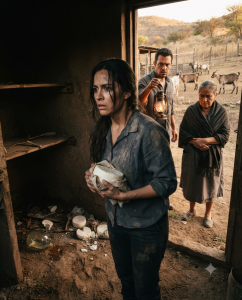
Inside, one shelf had been knocked over. Two fresh rounds of cheese were ruined on the floor, dirty and split. A clay jar of brine lay shattered. On the packed earth near the back wall, Elena found muddy boot prints.
Not theft.
A warning.
Mateo arrived moments later, then stopped dead in the doorway. His face hardened as he took in the damage.
For the first time, Remedios spoke before anyone else could.
“This was done on purpose,” she said. “And I know who started it.”
Something changed in Mateo when he heard that from his mother.
People often imagine turning points as loud, dramatic things. A slap. A confession. A public collapse.
In reality, their turning point began with three exhausted people sitting at a rough kitchen table under a leaking roof, deciding that shame had already cost them too much.
Elena spread out the ledger, sales notes, and dates of every suspicious incident. Mateo listed names. Remedios listed visitors, gossip, and who in town owed Silvestre favors. They worked past midnight.
By dawn they had a plan.
Doña Esperanza, when Elena rode to see her, did not act surprised.
“Men like that never mock what they truly believe is worthless,” she said, handing Elena a packet of rennet wrapped in paper. “They mock it until they can take it.”
Esperanza agreed to testify that she had taught Elena the cheese process months earlier, before Silvestre began asking questions. Harlan, pressed harder than he expected by Mateo in front of two customers, admitted that Silvestre had offered him a discount on feed in exchange for sharing information about Elena’s buyers. A young clerk at the Caja Rural, frightened by how far things had gone, quietly copied the internal note showing that the review date had been changed after a private recommendation from Silvestre.
The permit complaint was harder.
It came from the municipal health office, citing anonymous concern about unsafe curing conditions. Elena did not deny the cellar needed work. Instead, she cleaned it top to bottom, replaced spoiled boards with Mateo, whitewashed the walls with lime, borrowed proper shelving through Esperanza, and invited the inspector back before the office could delay the visit.
When the inspector arrived, he found order, records, sanitation measures, and a woman who answered every question without lowering her eyes.
He passed the site with conditions for improvement rather than closure.
That alone rattled Silvestre.
But Elena still needed something stronger than survival. She needed daylight.
The annual town fair gave it to her.
Every producer in the region brought samples—milk, cheese, preserves, sweets. Silvestre’s dairy occupied the largest stall as it always did, polished and crowded. Elena’s table was much smaller. Remedios stood behind it beside Mateo, not smiling but fully present, which in itself caused whispers.
People came first out of curiosity.
Then they stayed for the taste.
Elena’s goat cheese was firm, bright, and unlike what most expected. Not poor people’s substitute food. Not desperation disguised as dairy. It was good.
Very good.
By midday her samples were nearly gone.
Then Don Silvestre made his mistake.
He approached her table with the smile he used when he wanted witnesses more than conversation.
“You’ve done well for yourself,” he said. “Perhaps we should talk business.”
The crowd nearby quieted.
Elena looked at him steadily. “You mean the business you planned to take after forcing our parcel into auction?”
Silvestre’s expression barely moved. “Careful. That sounds like bitterness.”
Mateo placed the copied Caja Rural note on the table where several people could see the header. The young clerk, pale but determined, stood from the side crowd and said, loud enough for others to hear, “It’s real.”
Murmurs spread.
Remedios took one step forward, chin lifted.
“And he came to my home asking about my son’s land,” she said. “Pretending concern. Fishing for weakness.”
Silvestre tried to laugh it off, but the sound landed badly. Harlan, who had hoped to stay invisible, was now trapped by the eyes turning toward him.
“You asked me too,” he muttered. “About her buyers.”
That was all it took.
Respect is built slowly and cracks fast. Once the first fracture appears, everyone starts seeing the lines that were always there.
Silvestre denied everything, of course. Claimed he had only been helping assess risk. Claimed gossip had twisted his words. Claimed enemies envied him.
But no one missed the fact that he had never denied wanting the land.
The fair committee chair, who had once owed Silvestre a favor and now suddenly wished he didn’t, asked him to leave the producers’ area until matters were clarified. The priest pretended to examine another stall while listening carefully. Two members of the Caja Rural board quietly requested a meeting.
By evening the town had a new story to tell.
Not that Elena was foolish.
That she had seen value where others saw waste.
The review of the Sandovals’ debt did happen, but under scrutiny it could no longer be rushed in the shadows. Elena presented her ledger, sales growth, permit approval, and advance purchase requests from two nearby shops. A small agricultural cooperative, hearing the noise around the fair, offered a modest support loan specifically for small-ruminant production. It was not a miracle. It was enough.
Enough to keep the land.
Enough to finish repairing the cellar properly.
Enough to buy feed without pawning Elena’s wedding earrings, something she had nearly done in silence two weeks before.
Silvestre never faced the kind of public punishment stories usually promise. Men like him rarely do. But he lost something that had served him longer than money: automatic trust. The Caja Rural board distanced itself. The quiet deal for the Sandoval parcel vanished. People became slower to laugh when he spoke and faster to compare his polished words with their own memories.
For Elena, the change was less dramatic and more satisfying.
Orders grew. Then grew again. Customers who once bought out of curiosity returned because the cheese was worth returning for. Mateo stopped saying “your goats” and started saying “our herd.” Remedios, after a long silence one evening, admitted she had been wrong.
She did not cry. Elena did not either. Some apologies arrive dressed in plain work clothes.
Months later, when shelves in the repaired cellar held row after row of aging wheels, Remedios ran her fingers lightly over one and said, almost to herself, “I thought you were filling this land with misery.”
Elena smiled without turning around. “So did everyone else.”
Remedios looked at the rows of cheese, at the goats stronger now than the day they arrived, at her son laughing outside while patching a trough.
“No,” she said quietly. “Not everyone. One man knew exactly what you were building.”
That was the part Elena never forgot.
The insults had hurt. The sabotage had cost them sleep, money, and nearly the land. But the clearest proof that she had been right came from the man who tried hardest to bury her before she could succeed. He had recognized the future in those starving goats before the town did. He just believed she did not deserve to own it.
In the end, that may have been his biggest mistake.
Because poverty had taught Elena to work with little. Humiliation had taught her to keep her mouth shut until facts could speak. And betrayal—especially the kind wrapped in concern and respectability—had taught her to count everything.
Every peso.
Every wheel of cheese.
Every name.
Every lie.
When people later told the story, they liked to begin with the auction and the laughter. It made for a cleaner tale, one foolish woman buying thirty-seven nearly dead goats while a town mocked her.
But the truth was uglier and more revealing.
The goats were never the crazy part.
The crazy part was how close everyone came to letting the most respected man in town steal a poor woman’s idea simply because he wore polished boots and she smelled like hay and brine.
And that question lingered long after the cellar was repaired and the debt finally stopped stalking their table:
If Silvestre had succeeded before anyone noticed, who would the town have called brilliant then?