They told the new seamstress to sit behind the curtain so the wedding guests would not see her.
Maya heard the words clearly, even though Celeste’s mother had spoken them in the soft, polished voice of a woman who believed cruelty did not count if it was whispered.
“She’s just here to fix hems,” Mrs. Vale said. “Keep her away from the photographs. We don’t need shop staff in the background.”
Maya stood behind a tower of white roses with her sewing basket tucked against her hip. For a moment, she pretended the words had landed somewhere else. On the marble floor. On the silver trays. On the staff in black uniforms hurrying past with champagne and folded linen.
Not on her.
But the shame found her anyway.
She lowered her eyes, tightened her fingers around the worn handle of her sewing bag, and followed the wedding planner’s assistant toward the small storage room behind the ballroom curtain.
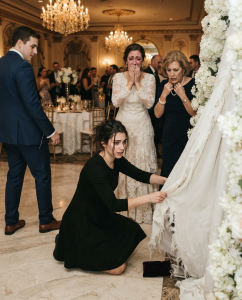
The mansion was enormous, the kind of place where even silence looked expensive. Crystal chandeliers hung like frozen rain. The staircase curved dramatically toward the front hall, where guests in silk and diamonds were already arriving. Everywhere Maya looked, there were flowers, candles, mirrors, champagne, and people who knew exactly where to stand so they looked important.
She did not belong in any of it.
At least, that was what they wanted her to believe.
Six weeks earlier, the dress had arrived at the tiny tailoring shop where Maya worked with her aunt. It came in a white garment bag carried by a driver who looked terrified to breathe near it. Celeste Vale had followed behind him, pale and trembling, her mother walking two steps behind with fury pressed into every line of her face.
The gown had been ruined.
Not stained or wrinkled. Ruined.
The designer’s team had altered the bodice incorrectly. The beadwork had been pulled too tight across the waist. A section of lace on the train had torn when someone tried to force the gown onto a mannequin. The veil loop had snapped. The silk at the inner seam had puckered so badly the dress would not fall right when Celeste walked.
Mrs. Vale had been ready to sue someone.
Celeste had simply cried.
“My wedding is in six weeks,” she whispered. “Can you fix it?”
Maya’s aunt had looked at the gown, then at Maya. They both knew what the question really meant. Could they fix the mistake of a famous designer without the money, staff, or recognition that designer had? Could they save a wedding dress no one wanted to admit had been destroyed?
Maya touched the fabric gently.
“I can try,” she said.
She should have said no.
For six weeks, the dress consumed her life. She worked after hours. She skipped meals. She rebuilt the damaged beadwork one pearl at a time. She reinforced seams so carefully they disappeared beneath the silk. She matched lace patterns by hand under weak yellow light until her eyes burned.
Her aunt told her to charge double.
Maya did not.
Celeste came twice for fittings, and each time she stood in front of the mirror with tears in her eyes.
“It looks better than before,” she said once.
Maya had smiled, tired but proud. “Then it’s doing its job.”
On the final fitting, Celeste hugged her.
Mrs. Vale did not.
She inspected every inch of the gown, then said, “At least it will photograph properly.”
That was the closest she came to thanks.
Now, on the wedding day, Maya sat behind a curtain in a storage room beside crates of extra candles and boxes of napkins, holding the same dress across her lap while Celeste stood on a platform outside, minutes from walking down the aisle.
The last repair was tiny: one loose thread near the hem. Nothing anyone else would notice. But Maya noticed. That was her curse and her gift.
She saw what others overlooked.
Through the curtain, she could hear the wedding breathing around her. Violins warming up. Guests murmuring. The planner speaking too quickly into a headset. Celeste’s bridesmaids whispering about lipstick, shoes, and which side of the aisle looked better for photos.
Maya kept sewing.
Then the wedding planner screamed.
“What do you mean it’s gone?”
The room changed instantly.
Maya froze with the needle halfway through the silk.
Outside the curtain, shoes struck marble in frantic bursts. Someone dropped a glass. A woman gasped. Another voice said, “Check the vanity again.”
Celeste’s voice broke through the confusion.
“It was just here.”
The curtain was pulled aside so sharply that Maya flinched.
The wedding planner, red-faced and sweating beneath perfect makeup, stared at her as if she had forgotten Maya existed until that second.
“Did anyone come through here?”
Maya shook her head. “No. I’ve been here with the dress.”
The planner disappeared again.
Maya carefully set the needle down, rose, and stepped just close enough to see into the bridal area.
Celeste stood in the center of the room wearing the gown Maya had saved. The dress looked breathtaking. The restored bodice gleamed softly under the chandelier. The lace train spread behind her like white water.
But Celeste’s face was crumpled.
“My veil pin,” she whispered. “The diamond one. It’s gone.”
Maya had heard about the pin that morning. Everyone had.
It belonged to the groom’s grandmother, a family heirloom passed down for three generations. The groom’s mother had delivered it personally, along with a warning that it was priceless. Not only because of the diamonds, but because of what it represented.
Now it had vanished.
The groom’s family gathered near the fireplace, their expressions tight. The bride’s family clustered near the vanity. Security guards checked the floor, the tables, the flower arrangements.
Then Celeste’s aunt cried out that her pearl earrings were missing too.
A bracelet was gone from the groom’s mother’s purse.
Two rings had disappeared from a velvet tray.
The panic turned sharp.
This was no misplaced pin.
This was theft.
At first, no one said Maya’s name.
They did not need to.
She felt the attention move toward her like a shadow spreading across the floor.
She was the only person in the room not related to either family. The only one not wearing silk or satin. The only one whose shoes were plain and whose hands showed the tiny scars of work.
Mrs. Vale turned slowly.
Her eyes settled on Maya.
“Check her bag,” she said.
The words were quiet, but every person heard them.
Maya felt heat rise in her throat. “My sewing bag?”
“We have to be thorough,” Mrs. Vale said.
There it was. The language of polite accusation. We have to be careful. We have to be reasonable. We have to protect the family.
A security guard approached her.
Maya wanted to refuse. She wanted to tell them she had saved that dress, that she had worked nights while they slept, that without her the bride would be standing there in a ruined gown. But pride was dangerous when people had already decided you were guilty.
So she picked up her bag and handed it over.
The guard emptied it onto a silver tray.
Spools of thread rolled across the metal. Needles scattered. Small scissors clinked beside a tape measure. Hooks, pins, chalk, scraps of lace, and a folded photograph of Maya’s little sister slid into view.
No jewelry.
No diamonds.
No heirloom pin.
Nothing.
The guard checked the pockets. He shook the lining. He looked inside the small tin where Maya kept spare needles.
Still nothing.
Maya waited for someone to apologize.
No one did.
Mrs. Vale’s mouth tightened, as if innocence had inconvenienced her.
Celeste looked ashamed, but she said nothing. Her tears hung on her lashes. Her hands trembled against the restored bodice.
Maya bent to gather her things from the tray.
That was when she saw Adrian.
The groom’s cousin stood near the floral backdrop behind the display table, half hidden by white lilies. He was young, handsome in the careless way rich men sometimes were, with a navy suit, a loosened smile, and a gold watch he kept touching as though time belonged to him personally.
He was smoothing his cuff again and again.
Maya might not have noticed if she had not spent her whole life watching hands.
Hands confessed before faces did.
Adrian did not look worried about the missing jewelry. He did not look angry that the wedding had been delayed. He looked irritated. Impatient. Like someone waiting for a scene to end so he could leave.
Then his fingers caught on something at his cuff.
A thread.
Maya’s body went still.
Not just any thread.
Deep ivory silk thread from her emergency kit.
She knew it because she had dyed it herself to match Celeste’s veil. She had used it only once that morning to repair the torn inner loop where the veil pin was supposed to sit.
The spool had been in her bag.
Her bag had been beside her chair.
And now that thread clung to Adrian’s cuff.
Maya picked up the spool slowly.
The room was still muttering, still searching, still looking everywhere except where it needed to look.
She stood.
“Why,” she asked, her voice quiet but clear, “is the bride’s cousin wearing thread from my emergency kit on his cuff?”
Every sound stopped.
Adrian’s hand froze at his sleeve.
“What?” he said.
The word came too fast.
Maya lifted the spool. “This thread is mine. I used it this morning on the veil. It was in my bag until someone touched it. Now it’s on your cuff.”
Mrs. Vale stepped forward. “Are you accusing a guest?”
Maya looked at her. “No.”
She turned toward Adrian.
“I’m following a stitch.”
For one second, no one moved.
Then Adrian smiled.
It was a beautiful smile, practiced and empty.
“You’re confused,” he said. “There are a thousand white threads in this room.”
“This one isn’t white,” Maya said. “It’s ivory with a gray undertone. I matched it to the veil lace. And there’s beeswax on it because I wax my thread before hand-stitching.”
Adrian’s smile faded.
Maya walked toward him.
He stepped back.
That single movement changed the air.
The groom noticed it. So did the security guards.
Maya’s eyes dropped to the floral backdrop behind Adrian. It was a towering arrangement of roses and lilies draped over fabric panels. Beautiful from the front. Messy behind. The lower corner had been tucked under too neatly, as if someone had hidden a tear in a hurry.
Maya crouched and lifted the edge.
A small fabric pouch fell onto the marble floor.
The sound was soft.
The silence afterward was not.
One of the guards picked it up and opened it.
The diamond veil pin lay inside, bright as ice.
Beside it were the pearl earrings, the bracelet, and two rings.
Celeste made a broken sound.
Adrian ran.
He shoved past a waiter, knocked into a column of flowers, and sprinted toward the side corridor. The groom shouted his name. Security rushed after him. Guests near the entrance turned as the commotion spilled into the hall.
Maya did not move.
She did not chase him. She did not celebrate. She did not look triumphant.
She simply stood there with a spool of thread in her hand while everyone who had silently accused her now avoided her eyes.
Mrs. Vale’s face had gone strangely still.
Celeste stepped down from the platform.
“Maya,” she whispered. “I’m so sorry.”
Maya looked at the dress. There, at the inner seam near the waist, something caught her eye.
The stitch line was wrong.
Her stitch line was never wrong.
She moved closer, lifted the edge of the bodice lining, and saw that someone had opened the seam after she finished the final repair. It had been sewn shut again with her ivory thread, but poorly. The tension was uneven. The knots were hidden in the wrong direction.
Someone had tried to make it look like Maya’s work.
Her stomach tightened.
Celeste saw her expression. “What is it?”
Maya did not answer immediately. She loosened the seam with the tip of her needle and pulled free a tiny folded scrap trapped beneath the lining.
It was the torn corner of a jeweler’s appraisal receipt.
Celeste stared at it.
Her face changed from confusion to recognition.
“That was in the envelope with the pin,” she said. “My mother said she locked it in her bedroom safe.”
Maya looked across the room.
Mrs. Vale was speaking urgently to the wedding planner. Her pearl clutch was tucked beneath her arm. At the edge of the clasp, almost invisible against the pale satin, clung a loose strand of ivory-gray thread.
Maya’s thread.
Celeste saw it too.
The bride took one step back from her mother.
“Mom,” she said, her voice barely steady, “why is Maya’s thread on your bag?”
Mrs. Vale turned.
For the first time that day, her composure cracked. Not enough for the guests to notice. Enough for Maya.
“My darling,” she said, smiling carefully, “you’re upset. This is not the time.”
“It is exactly the time,” Celeste said.
The groom entered again, breathless, with two security guards behind him. Adrian was between them, his jacket twisted, his face pale with rage and panic.
“He said your mother told him to move the pouch,” the groom said.
The sentence landed like a shattered glass.
Mrs. Vale’s smile vanished.
Adrian jerked his head up. “You said no one would check the backdrop. You said the seamstress would be blamed because she had access to everything.”
Celeste went white.
For a heartbeat, the room forgot to breathe.
Mrs. Vale snapped, “He’s lying.”
Maya held up the scrap of appraisal receipt. “Then why was this sewn into the dress lining after I finished the repair?”
Celeste looked from the receipt to her mother’s clutch.
“Open it,” she said.
Mrs. Vale did not move.
The groom’s mother stepped forward. “Open the bag.”
The command sounded very different coming from someone Mrs. Vale could not dismiss as staff.
Slowly, Mrs. Vale opened the clutch.
Inside was not jewelry.
Inside was worse.
A folded document.
Celeste took it with trembling hands and opened it.
It was a prenuptial agreement amendment. Not the official one Celeste had signed with her fiancé. A different version. One that would have shifted a large portion of Celeste’s inheritance into a family-controlled trust if the marriage was delayed under suspicion of theft or scandal.
Celeste read the first page, then the second.
Her lips parted.
“You were going to stop the wedding,” she whispered.
Mrs. Vale’s face hardened. “I was going to protect you.”
“By framing Maya?”
“By preventing a mistake,” her mother said. “You think love is enough because you’ve never had to preserve a name. His family wanted that heirloom displayed for a reason. They wanted everyone to see what they were bringing into this marriage. I needed leverage.”
The groom stared at her. “So you stole from my family?”
“I moved a few pieces temporarily,” Mrs. Vale said sharply. “Adrian was supposed to return them after the ceremony was postponed. No one was supposed to get hurt.”
Maya almost laughed.
No one like you, she thought.
Celeste’s eyes filled again, but this time the tears did not make her look weak. They made her look awake.
“You were willing to destroy an innocent woman,” Celeste said.
Mrs. Vale looked at Maya as if seeing her for the first time.
“She would have been questioned. The jewelry would have been found later. These things pass.”
Maya felt something inside her go very quiet.
“These things pass for you,” she said. “For people like me, they stay. They become the reason no one hires us. The reason people hide their bags when we enter a room. The reason we work twice as hard and are still treated like thieves.”
No one interrupted her.
Not now.
The bride stood between her mother and the seamstress, wearing a dress built by hands her family had tried to disgrace.
Then Celeste reached behind her neck and removed the veil.
The restored lace slid over her shoulders.
“I’m not postponing the wedding,” she said.
Mrs. Vale stared. “Celeste.”
“I’m not walking down the aisle with you beside me either.”
Her mother recoiled as if slapped.
Celeste turned to Maya. “Will you fix the veil pin?”
The room seemed to tilt.
Maya looked at the diamond pin in the guard’s hand. Then at Celeste’s face.
There was shame there. Real shame. But there was also something else. A choice.
Maya took the pin.
Her hands were steady as she repaired the loop again, reinforcing it with a hidden stitch so precise no one would ever see where the damage had been. She worked in silence while guests whispered outside and the two families stood in the wreckage of what Mrs. Vale had tried to hide.
When she finished, she fastened the pin into Celeste’s veil.
Celeste looked at herself in the mirror.
Then she turned back.
“You saved my dress,” she said. “And now you saved me from walking into my marriage blind.”
Maya did not know what to say.
Celeste faced the planner. “Maya sits in the front row.”
Mrs. Vale made a strangled sound.
Celeste did not look at her.
“And she is in the photographs,” the bride added. “Every one that shows this dress.”
The ceremony began twenty minutes late.
There was no grand explanation to the guests, only a tense silence that followed the bride as she walked down the aisle without her mother on her arm. Her father, shaken and pale, escorted her instead. The groom cried when he saw her. Not because of the gown, though it was beautiful, but because of what they had almost allowed money, pride, and fear to do.
Maya sat in the front row holding her sewing basket in her lap.
People stared at her.
This time, she did not lower her eyes.
After the vows, after the careful applause, after Mrs. Vale was escorted upstairs to wait for family attorneys and Adrian was taken away by security, Celeste found Maya in the quiet hallway near the ballroom.
“I can never undo what happened,” Celeste said.
“No,” Maya replied. “You can’t.”
Celeste nodded, accepting the truth without defending herself.
Then she handed Maya an envelope.
Maya did not open it.
Celeste said, “It’s not hush money. It’s the full amount I should have paid you from the beginning. Plus a written statement about what happened today. Signed by me, my husband, and his mother. No one will be allowed to turn this into your shame.”
Maya looked at the envelope for a long moment.
Then she took it.
Behind them, music began again. Softer now. Less perfect. More human.
Celeste touched the edge of her veil.
“You said you repair what rich people try to hide.”
Maya glanced toward the ballroom, where polished families were learning how ugly a perfect wedding could become when the wrong seam was pulled.
“I repair fabric,” Maya said. “People have to repair themselves.”
She left before the cake was cut.
Weeks later, a framed photograph arrived at the tailoring shop. In it, Celeste stood in her restored gown, the diamond veil pin shining in her hair. Beside her stood Maya, small sewing basket in hand, not behind a curtain, not cropped from the frame, not hidden.
On the back, Celeste had written one sentence.
You found the truth in the thread.
Maya placed the photograph on the shelf behind her worktable, not because she needed proof that she belonged in beautiful rooms, but because she wanted to remember the moment she stopped accepting the corners people pushed her into.
The strangest part was that the dress really had been perfect.
Every pearl, every seam, every hidden stitch had held.
It was the people around it who had come apart.
And long after the scandal settled, Maya still wondered which warning had mattered most: the missing jewelry, the stolen thread, or the fact that everyone had been so ready to believe the poorest woman in the room was guilty.